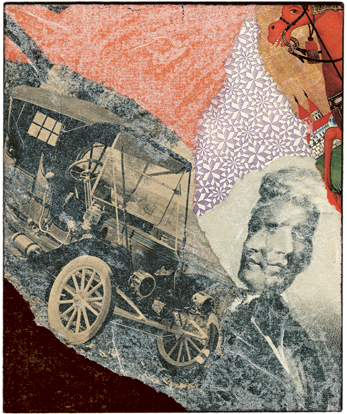
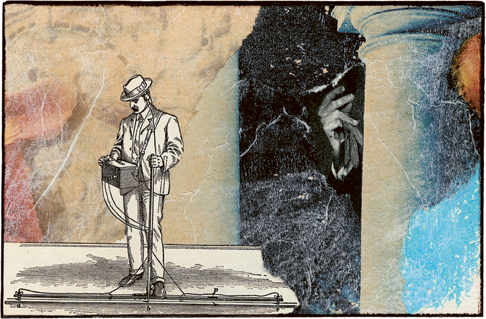
"Untitled [Model A and Horse]"

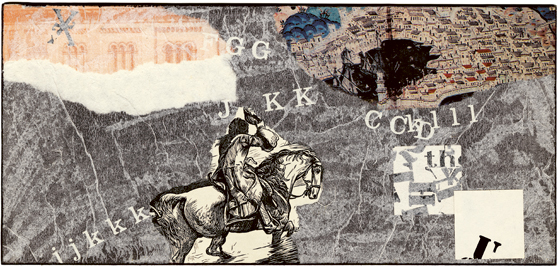
"Collage, at least as I practice it, encourages abstraction," Waldrop writes. "What might ordinarily hold a work together—character, for instance, or chronology—often loses out to foreign bodies appearing from other environments."

"Untitled [Horse and Rider], 1988"

"In my tender years, I fretted because I could neither whistle a tune nor draw a likeness," writes Waldrop. "Though I no longer fret about it, I still can't do either one. I do believe this simple inability (drawing, not the whistle) was a factor in my starting to do collage."

"Untitled ['HD']"

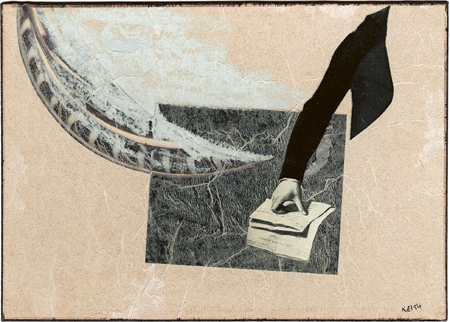
The first public showing of poet Keith Waldrop's collages of cardboard and paper, occasionally cloth or wood, was in Providence in 1979. "Like the poems," Waldrop writes in a preface to Several Gravities, "these were made of materials as disparate as possible, picked because I liked their looks or, really, because they somehow called out to me."

"Untitled [Arm, Book, and Feather]"

"The pictures in general are small, sometimes infinitesimally so, and are rarely larger than the small tabletop at which he works, high up in a cramped studio space under the eaves of his home," writes Robert Seydel in "Imagination's Artifacts: On the Art of Keith Waldrop," an essay included in Several Gravities.

"Untitled [13]"

"I have always written rather little, but endlessly revised," Waldrop writes in Several Gravities. "To the extent that I employ collage, I have the happy possibility of revising what I haven't written."

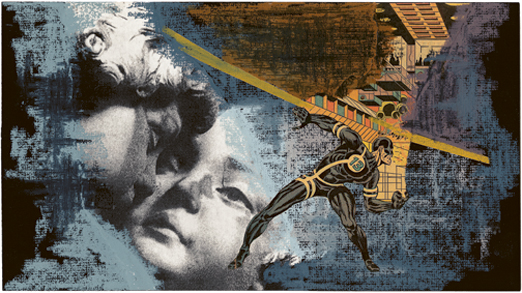
"Untitled [Man and Column], 1989"

"In collage, opacity is the norm, defining a solid architecture through a series of abutments," writes Robert Seydel. "Certainly Waldrop employs this formal structure on occasion, but he more typically enunciates his picture through transparency. Ghostings, hauntings, veilings, falling and ascending figures, drift are central themes for Waldrop, all concerning the in-between, in part the unbeheld."

Clickety-Clack: Deadline for Glimmer Train's Fiction Open Nears

The next deadline for Glimmer Train Press's quarterly Fiction Open is fast approaching: March 31. But a quick look at the Help page on the press's Web site will provide some breathing space for those procrastinating writers out there who have yet to get their submissions ready. "We always have a one-week grace period after the close of a category, so please don't worry if you're trying to make a deadline," coeditors Susan Burmeister-Brown and Linda Swanson-Davies write.

The prize is given for a story in the range of two thousand to twenty thousand words. The winner, who will be announced on May 31, receives two thousand dollars, publication in Glimmer Train Stories and twenty copies of the issue. The second-place winner will receive a thousand dollars and possible publicaiton; the third-place winner, six hundred dollars and a shot at publication. There's a twenty-dollar entry fee.

The winner of the December 2008 Fiction Open, Cary Groner, is a graduate student at the University of Arizona's creative writing program. His winning story, the twenty-five-page "Elaborate Preparations for Departure," forthcoming in an upcoming issue of Glimmer Train Stories, will be his first publication. In an interview on UA's Web site, Groner said the award "came as a pleasant surprise," and responded to the debate over whether writing can be taught. "To me it's a little like wondering whether neurosurgery can be taught," he said. "I came here without much of a clue what I was doing, and although I still have a lot to learn, I'm living proof that if you have attentive teachers and astute colleagues, you can improve."

As further proof that unpublished writers have a shot at winning awards and having their work appear in print, Swanson-Davies and Burmeister-Brown share some hopeful news: "In the recent edition of Best American Short Stories, of the top "100 distinguished short stories," ten appeared in Glimmer Train Stories.... We are pleased to say that, of those ten, three were those authors' first stories accepted for publication."

Disability Groups Respond to Concerns Over Kindle 2 Text-to-Speech Function

by Staff
3.24.09

Responding to assertions by the Authors Guild that Amazon's Kindle 2 device, with its text-to-speech function, violates audiobook rights, and Random House's subsequent deactivation of the function for its e-book titles, nine disability groups last week urged publishers to recognize the benefits of the software, which enables books to be spoken in a computerized voice, to people who are blind or suffer from dislexia or other disabilities, and even those who use English as a second language. 

Emily Perkins Wins Fifth Annual Believer Book Award

In the March/April 2009 issue of the Believer, Emily Perkins was named winner of the fifth annual Believer Book Award for her Novel About My Wife (Bloomsbury, 2008). The finalists, as selected by the magazine's editors—Heidi Julavits, Ed Park, and Vendela Vida—were Samantha Hunt for The Invention of Everything Else (Houghton Mifflin), Mary Ruefle for The Most of It (Wave Books), John Olson for Souls of Wind (Quale Press), Jim Krusoe for Girl Factory (Tin House Books), Tod Wodicka for All Shall Be Well; And All Shall Be Well; and All Manner of Things Shall Be Well (Pantheon), Toby Olson for Tampico (University of Texas Press), and Shannon Burke for Black Flies (Soft Skull).

Previous winners are Tom McCarthy (Remainder, Vintage Books, 2007), Cormac McCarthy (The Road, Knopf, 2006), Sesshu Foster (Atomik Aztex, City Lights, 2005), and Sam Lipsyte (Home Land, Picador, 2005).

The editors had also asked readers to fill out survey cards listing the three strongest works of fiction published in 2008. While these weren't considered for the Believer Book Award—a prize for which there is no submission or application process, beyond writing and publishing a novel that tickles the fancy of the editors—the results are nevertheless interesting, especially for the names of independent publishers that are acknowledged therein. Of the top twenty strongest fiction books, for example, nine were published by indie houses (although two of those titles were published by McSweeney's Books, and their popularity with readers of the Believer is no surprise):

2. Unlucky Lucky Days (BOA Editions) by Daniel Grandbois
6. Vacation (McSweeney's) by Deb Olin Unferth
8. Arkansas (McSweeney's, though a reprint is forthcoming from fellow indie Grove Press in June) by John Brandon
13. Bottomless Belly Button (Fantagraphics Books) by Dash Shaw
14. A Heaven of Others (Starcherone Books) by Joshua Cohen
15. So Brave, Young, and Handsome (Atlantic Monthly Press) by Leif Enger
16. How the Dead Dream (Counteroint) by Lydia Millet
19. The Drop Edge of Yonder (Two Dollar Radio) by Rudolph Wurlitzer
20. Ghosts of Chicago (Jefferson Press) by John McNally


Pages

Subscribe to Poets & Writers RSS