Nicole Counts always had her sights set on becoming an editor. In seventh grade a teacher at her middle school in Windsor, just south of Princeton, New Jersey, introduced her to Hush (G.P. Putnam’s Sons, 2002) by Jacqueline Woodson. She remembers it as the moment she fell in love with reading—and the moment she knew that she wanted to one day work in the world of words. When her teacher said she could become a book editor, her academic path started to take shape—she eventually chose to major in English at Temple University in Philadelphia. Between her freshman and sophomore years, she turned her eyes toward internships. After Googling “Publishers in Philly,” she cold emailed three, and Running Press, a member of Hachette’s Perseus Books Group, with an office in Philadelphia, was the first to reach out to schedule an interview. While it wasn’t an editorial position, she agreed to take it. “I just want to learn what publishing is,” Counts recalls thinking at the time. “So if I have to stand in the corner all day, I’ll do that all day.”

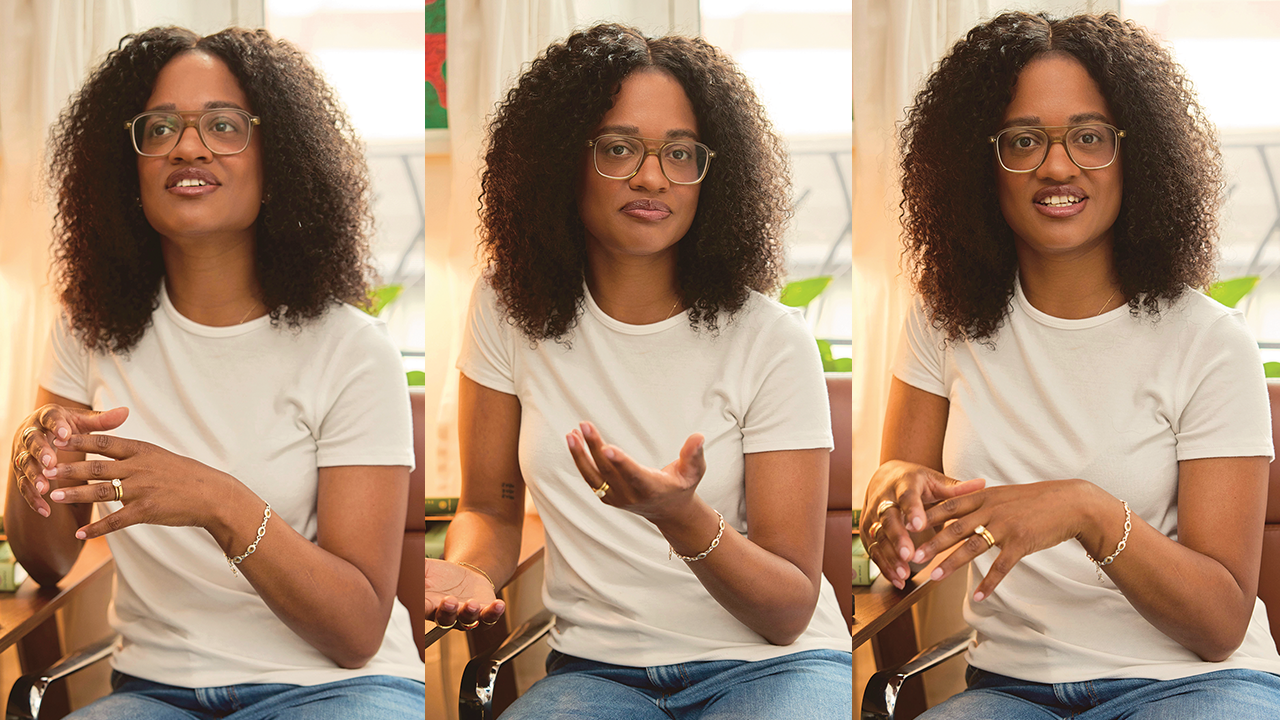
Nicole Counts, editorial director of One World. (Credit: Andres Hernandez)
After graduating from Temple, she worked at Seven Stories Press, then PublicAffairs Books and Nation Books (now Bold Type Books), as a marketing and publicity assistant. A year into the job, brainstorming PR campaigns and trying to get books out into the world, she wanted more control over who was being published. Her teacher’s words had ignited her love of books, but it wasn’t until her mother reminded her of her dream of becoming an editor that she decided to try again. In 2016 an editorial assistant opening at Spiegel & Grau led to her working under editor Chris Jackson, who took Counts with him when he left to reimagine and reopen One World, a once-dormant imprint founded in 1991 with a focus on multicultural fiction and nonfiction. It was then that Counts realized the reason she had taken the leap: “This is why I did this,” she recalls thinking. “This made it all worth it.” She started as an assistant editor, and steadily, over the past decade, moved up to become One World’s editorial director. In those ten years she also published renowned, critically acclaimed works by Kali Fajardo-Anstine, Fatimah Asghar, Maurice Carlos Ruffin, and others.
Over Zoom one recent morning, Counts talked about how both timing and privilege can play a part in entering publishing, how capitalism and trends can dictate creativity—or not—and how even now, what captures her excitement is the opportunity to publish work that feels “like someone’s inner selves are just as important and just as real as gravel on the road or the sun hitting your face.”
I love that your publishing journey started because of a teacher. Can you tell me more about that?
I think we all have to name the privileges or the luck that got us where we are. And I think being from New Jersey, being close to New York, must’ve helped my teacher know.
When I was about to graduate I was looking into publishing jobs, and I applied to so many things that I wasn’t getting, not even rejections. I was messaging random people on LinkedIn asking for informational interviews. And someone said, “You’re not going to get a job in publishing if you don’t have a New York address and/or New York experience.”
I have an uncle—or he’s a fake uncle—who has lived [in New York City] since 1996, and he let me stay in his apartment for free with him and his family. But if I hadn’t had that, I wouldn’t have been able to [get] a New York internship, and I don’t think I would have ever gotten a job in publishing. So I feel like those are the two privileges that allowed me to be here.
And that internship was at Seven Stories Press?
Yes. I’ve done a lot of public health things pretty much my whole life, so I Googled at the time: “Publishing + Social Justice.” And one of the first publishers to come up was Seven Stories Press. I had no money. I worked four jobs in college. I didn’t even know if I could take the time off, but I took a dollar Megabus, rode [from New Jersey] to New York, and came right back. And luckily they hired me, but it was an unpaid internship. At the time I felt like I wasn’t the typical publishing person: I had loans, I had family responsibilities, I worked all throughout college. And so I wouldn’t have been able to take that job if my uncle didn’t let me live with him and his family. And in my mind I was like, “All right, I’m going to start applying for jobs after I’ve been at Seven Stories for at least a month, so it looks like I’ve been in New York and have this experience.” And that’s what I did. I ended up staying for two and a half months. Then I applied to over fifty jobs: agenting, publishing, ghostwriting, everything. And I got one callback, one interview, and then that was the job I got, which was with PublicAffairs and Nation Books, now Bold Type Books, as a marketing and publicity assistant.
What was it like to say yes to a job that wasn’t in editorial?
I didn’t realize at the time—and I still feel—that as a person of color it would be so hard to get an editing job. Someone had told me that editorial in general was hard and that you should take whatever you get so you can get through the door. I think my publishing luck started because at PublicAffairs I worked with really amazing people. I really liked marketing and publicity. After a year they told me to pick a course, and I chose marketing over publicity because I thought it activated my creative side a little bit more. Marketing is amazing, and now I think that’s the thing that drives books to readers. But I would look around me, and I felt like I wasn’t reading the books I wanted to read, and I found myself wanting more control over who was actually being published. I still think that’s basically my same publishing kind of credo.
And so I thought at that time—I was so dramatic, I was twenty-five—“What’s my life going to be?” I thought about leaving and getting my master’s in public health or going to work elsewhere. At the time I was pretty connected to a reservation in South Dakota, and it was—and still is—really important to me. So I thought maybe about working out there. And then my mom was like, “You always wanted to be an editor; just try.”
I had looked at BookJobs.com, where I spent so many months and hours. I applied to three jobs, including Spiegel & Grau. I knew they published Bryan Stevenson, and they had just published [Ta-Nehisi Coates’s] Between the World and Me. I applied, and I found out it was under Chris Jackson. And I was like, “Oh, that would be amazing.”
[I want to add that] my third publishing kind of privilege—because I really do think it’s important to own up to all of them—is that Alessandra Bastagli, who was the head of Nation Books at the time, was the only person I told that I was considering moving to editorial. She emailed [Chris] because I had not heard back from HR. And he was in the process of interviewing, so he wrote to me, and was like, “HR says they don’t have your application, but I’d be happy to meet.” And so that’s how I got my interview with Chris, and I ended up getting a job as his and one other editor’s assistant.
Your relationship with Chris Jackson is one that feels so rare and special, especially once you all launched One World. Can you talk about that?
Three months into working with [Chris], he told me he was starting One World, and I, again, was young and blunt—and I’m still blunt. I was like, “If you don’t take me with you, I’m quitting.” And luckily he laughed, and one day later we started One World.
It was so quick, we just moved to the other side of the floor. And that was one of the first times I felt this full-circle moment because starting an imprint is so much marketing. I was the oldest editorial assistant at the Random House Group at the time. Everyone else was fresh out of college. I had loans. I had to take a pay cut to go with Chris to start over as an assistant. So having started with marketing-publicity and taking this leap just those three months later, I was like, “Oh, this is why I did this. This made it all worth it.”
And now, oddly, it has been ten years since I started working with Chris.
I cannot believe it has already been a decade.
I know! That’s how I feel. One World has been a really interesting place to be because the first hire was Victory Matsui. Chris, Victory, and I had this kind of in-sync drive. And it wasn’t just that we were excited that this new imprint was going to exist, and we were eager to start building out our list: Victory had just come back to publishing; I was still a baby editor wanting to get books; and Chris had this new thing to prove he could make re-successful because he had the choice of doing Chris Jackson Books but decided to bring back One World for all of its original intentions.
And so we all had these things that in some ways we wanted to prove, but I think more than that we just wanted so badly for every author to have the chance to tell their stories in the freest way possible.
What do you mean by freedom?
For me it’s always been about getting us closer and closer to freedom: bodily freedom, political freedom, and emotional freedom. And it was incredible being able to create a mission statement from scratch, even the logo. We used to do this thing where every time we acquired a book, we would have a little dance party just to dance it out. And now it has obviously changed, and it’s very different, but it has been such an honor to be able to witness that and to really feel like you’re doing work that matters.
Can you tell me a bit more about acquiring for One World, especially in the beginning?
When I got the editorial job, I wrote on a Post-it note the books I wanted to see in the world. And at the time they were very kind of identity-based, because that was the world we lived in. I remember I wanted to see a Native American woman have a lot of success. At the time we just didn’t really have that. I was like, “I want more Black American contemporary writing that’s not only set in the South.” I wrote that I wanted a climate justice book written by a person of color. And then I wrote, and I remember in parentheses, “preferably a novel, but I’ll take a nonfiction.” I think my last one was that I wanted a surprising novel that centered on disability.
I cringe only because it still makes me angry that we entered into an industry that made it necessary almost to reduce our desires and reduce the way that we spoke about books and reduce missions into these very obvious things that should have already been happening.
And it has taken me a long time to be able to speak about the things that you want in books, the way that you want to feel after you read a book, the kind of work that you would love for someone to write that isn’t in this dominant white-gaze rhetoric. In so many ways I didn’t realize I had to still constantly be decolonizing my brain. I had to constantly be questioning why I was saying the things I was saying. And it’s so interesting to work in this industry of words and to feel frustrated when you can’t articulate something that feels so obvious. You just want good work, and you don’t want identity to be a reason someone can’t have success. You also want to read things that feel new and fresh and—I hate the word representative, but I guess—representative. There are whole places and beings that I would love to uncover.
Many years ago Penguin had a Penguin African Writer series, and I always thought it would be cool to have a book from every country on the continent. I mean, that’s still a hope of mine. But then, as you get into publishing, you start realizing that it’s even more kind of messed up and granular than that. You start realizing that, “Oh wait, all the Korean translations that we end up being allowed to acquire and celebrate are thrillers—and all gory and psychological.” And I’m sure there’s a lot of great Korean poetry or women’s fiction, but things become trendy.
I think that part of my mission has always stayed…it’s not as simple as not following trends but [rather] not allowing for the dominant machine to define what is allowed and what is not allowed from certain groups or certain peoples.
How do you know a book is for you?
It’s not that the book has to be perfect. It’s not even that the character must have fully arrived at some sort of destination. I love, love, love a book where you can feel the author trying: trying to dig deeper into some question or some sort of understanding or into what it means to grieve. Trying so hard to find new language and new ways of being, like getting us one inch closer to freedom.
It’s an interesting question that I feel like a lot of editors actually have a hard time describing: What are you looking for within those first few pages? I was just reading one of my author’s new novels, like the first time I’m reading their new work, and I suddenly was on page 10 and realized that immediately I believed the character was real. The character felt like a real person I could see, and I believed they were real, so then I immediately was intrigued by what they were going to do. And within the first few pages, I like there to be some sort of mini conflict, of course, because you need tension to make it worth knowing this person. I knew her characters and worlds, so it all felt like I could actually imagine it happening. So that’s the first thing I’m looking for: Is it developed enough and thought through enough that it’s essentially worth your time as a reader?
My Achilles’ heel thing is bad dialogue. As soon as there’s bad dialogue, I’m like, “This isn’t for me then.” I’d rather there be no dialogue than bad dialogue, honestly.
What matters to you in the agent’s query?
Every agent will hate this response, but I never look at the author bio. It never actually sways me, and I truly mean that. It doesn’t sway me if they got their MFA or not. If anything, if they haven’t, I’m normally more like, “Oh, that’s interesting.” But the bio doesn’t really matter. That only starts to matter when you need to convince other people, like your publisher and sales team, to allow you to acquire it. I’m like this with every book that I read.
Even when I read for fun, I don’t read the description. I never read descriptive copy. I just start reading the actual book, and I do the same with almost every single submission I get. I open it up, and right away, while I’m still on my laptop, I’ll read maybe the first three pages. If it is intriguing, normally I’ll either print it or flag it to keep reading later, partially because I don’t think it’s fair to the writer to judge their book based off descriptive copy that the agent or someone else might have written.
Do you feel that pressure, too, to see every book’s commerciality?
Nonfiction is given a little bit more rope because the media around nonfiction is a little bit more of a standard kind of procedure.
Literary fiction is the hardest thing to publish, but it’s also the thing that a hundred years later people still return to. In some ways it’s one of the most important genres because it allows for freedom in a way that no other genre does. It allows you to imagine things. It allows you to dream up new ways of being. It allows you to state the thing that’s happening without maybe the threat of violence or the threat of response. There are things we can say in fiction that you can’t say any other way, but the market is so saturated. There’s so much literary fiction, so writers feel a lot of pressure and urgency to publish as soon as they write their first draft, or even their fourth draft. I don’t think that’s how art works, but of course we live under capitalism. And the main part of capitalism that I struggle with every day is that it means that money makes you worthy. If you’ve created art and you can’t sell it, then the question is, Are you worthy?
And I think, unfortunately, that drives so many people, and it’s then hard to create art that is unshackled. You can’t really create under those conditions. It’s hard then to parse through what we do see. And then when we do get things as editors, either from agents or unagented submissions, the promise when you get something, and you go to your editorial board, and you’re like, “This is going to be the one that breaks through all the noise,” it’s really hard to make that promise because we don’t actually know how any of that is done anymore. No one knows the secret code, and for every book we’re fighting to figure that out.
The difference is my publisher deeply believes in good writing and in taking chances. So I know I probably still have it easier than other editors.
You acquire and edit across genres, including poetry. Is there a difference for you when you are looking at all these different genres?
I am always interested, first and foremost, in the question the author is asking themselves before writing. And then I’m someone who believes that the story finds its form, not the other way around. So if the question dictates that they need to do this kind of experimental path to get to the answer, I will willingly follow that.
But there’s a tendency also to use experimental devices or various literary devices to actually run from the truth because the truth is so hard. So whenever I’m evaluating things, that’s kind of the main question: Are they following this thread because it’s helping them get closer to something, or are they following this thread because they just got to that point where something is about to open up and it’s terrifying?
And both are totally reasonable things. That’s why, for me, it’s always worth talking to the writer about it before making a decision to pass, or even to move forward with the project, because it’s really about their willingness. How willing are they to keep doing the work? Their work is maybe not perfect when it comes to me at all, but if they’re willing and all they want is to keep burrowing and burrowing and burrowing…I love working with these types of people.
We saw a lot of focus on diversifying, especially in publishers hiring staff and in the acquisitions after 2020. What do you hope to see publishing change in the coming years?
I feel like I would be remiss to not name one of the things, which is after the murder of George Floyd and the somewhat revolution that our country went through, when some people accepted that Black people and a whole bunch of other marginalized folks have been mistreated. I mean, that’s the bare minimum: mistreatment. They’ve been murdered for this cause. And so, after that, we saw all these DEI things, and we saw more people coming into publishing, but even more than that, we saw more authors being offered very high advances.
And it’s worth noting that obviously, it’s six years later, and many, many people of color have been fired, especially within the last year. Those advances have gone back down. Although I am someone who believes the advance should just be based off the work and its potential. And that also means that we shouldn’t overpay for things because it limits creativity and what we can actually do for that author’s career.
And none of this is surprising, but I think a question that I’ve been asking myself is: What does our future look like, and what is my role and responsibility? I think, for me, it’s really important to be steadfast, and to keep doing the work that I’ve always been doing or have been trying to do, and not following trends, not getting too depressed when you see all these firings and you see books not working, and just [keep] going back to the core belief—the submission—and surrounding myself with people who believe the same. And be around art that does that. And for me that’s often looking outside of publishing and looking into painters that I love, going to the movies more often, writing a lot of love letters to people. I don’t get a lot of responses, but I love writing love letters.
I am a prolific letter writer. I write a letter every day.
I love that. So I start to look at other mediums. And when you’re not privileged enough to just quit, how do you make it through the burnout? And the grief of the creative bond between an editor and a writer has been taken over by capitalism. Everything is like, “Will it sell? Who’s going to actually read this?” This kind of sacred creative brain trust…that is harder and harder to find now. And again, I think that’s capitalism.
What books are you working on that you’re excited to publish?
Mat Johnson, who is a prolific novelist, is writing a memoir that I’ve been lucky enough to work on. It’s a memoir of his mother, who had MS, and about their relationship as she declined, and he was her primary caretaker, but it’s also a memoir of craft. So he’s kind of well known in the insular, small, literary community as being an amazing professor. He uses the craft of writing to detail his mom’s story. So he’ll take “What does it mean to build out a character?” and then he’ll show you that through his mom’s stories. It is so brilliant, hilarious, moving, and tender. And it has also taught me so much about how to live. I think about his book all the time.
Then I will just say that Nate Marshall, who wrote Finna, has his third poetry collection coming out, called Something Blue. It takes the tradition of wedding poems and funeral poems, and it’s kind of his take on it. After the second draft, I not only cried so hard, but I ended up calling him. I never just call the author. Normally I write a nice letter. And I just called him, and he answered, and I just couldn’t talk. He asked, “What is happening?” And I said, “I’m just so moved. I’m so moved, and I’m so whole, and I’m so grateful for these words.” So I’m so excited for other people to finally get a chance to read it.
Looking forward, what do you hope readers will want, or what do you want to publish in the next few years?
I understand all the books that have been published up until this moment, and I’ve loved many of them, but I think we as a society have been traumatized in grief, paralyzed. For me it has taken a long time to get out of that kind of COVID mentality and the Trump mentality. We’re still living under Trump, obviously. But it’s watching all these facades just come down, and you’re left with the meat and the flesh of the thing.
There feels like a lack of restraint—a few too many beats, an obvious or familiar sentiment added for popular enjoyment/familiarity to get on the right book club, an airy observation, battling metaphors. It feels like there is a lack of patience, of true discovery. What needs to be said, what is the best way to say it. And I don’t think it’s always the writer’s fault. You know that classic Toni Morrison quote, “Good editors are really the third eye. Cool. Dispassionate. They don’t love you or your work,” more of us should be like this. I’m guilty of this too. Writing, the game of writing, the game of publishing, has made editors and publishers not only more compliant, too soft with the literary knife, but too impatient, too quick to get it to market. I’m really frustrated by this lack of restraint and patience, but surface—or, one layer under—observations. Yes, we are all busy and bored easily and we want things quicker, which is all the reasons we say people like short books, but I think when done right—Claire Keegan—what people actually like about those short books is restraint. It’s not really about the length, it’s about the discipline and care the writer is displaying; it’s about the work, not the author. I really, wholly believe the book comes through you, and too many writers now don’t have the patience to allow that.
And because I’m at the beginning of this, I would love if other people who are more advanced in their beings and inside themselves just start to wonder what we could be. The first step of that is always sci-fi/fantasy. I think that’s always the easiest way to imagine some sort of future.
I’d really love books where the body is not secondary, but the body is primary. The way that every interaction, every event impacts the body. And it’s because our bodies are the things that are most disposable, and that mentality is the way that supremacy then wins because we allow for the destruction of our bodies in those ways. So I’m always looking for work, either nonfiction or fiction, where the body isn’t secondary.
I was talking to a colleague about how much I love Ted Lasso and Shrinking, and one of the writers of both is Brett Goldstein. I was trying to express what exactly I loved about these shows. And for me it’s the generosity of the human spirit and how at the end of the day we all just want to experience deep love that’s not necessarily romantic. And bad things happen to us, but also the good. I just hope we keep seeing more stories like that, where at the end of it, you’re left feeling fuller than you are depleted. I would love more books like that.
Vivian Lee is a writer and a senior editor at Little, Brown.