Before the Internet
Caption:
“At nine years old, I transform into things I’ve never been before...” Phil Kaye, author of the collection Date & Time, forthcoming from Button Poetry in September, reads his poem “Before the Internet.”
Genre:
Jump to navigation Skip to content
“At nine years old, I transform into things I’ve never been before...” Phil Kaye, author of the collection Date & Time, forthcoming from Button Poetry in September, reads his poem “Before the Internet.”
Peter Longofono and Katie Longofono are siblings and poets living and working in Brooklyn. Together and separately, they have curated, produced, and hosted a number of salons, magazines, festivals, and reading series, including Coldfront magazine, Washington Square Review, the AmpLit Fest, the SLC Poetry Festival, the Dead Rabbits reading series, the Graduate Poets Series at Cornelia Street Café, and WEIRDD, their latest and greatest endeavor to date.
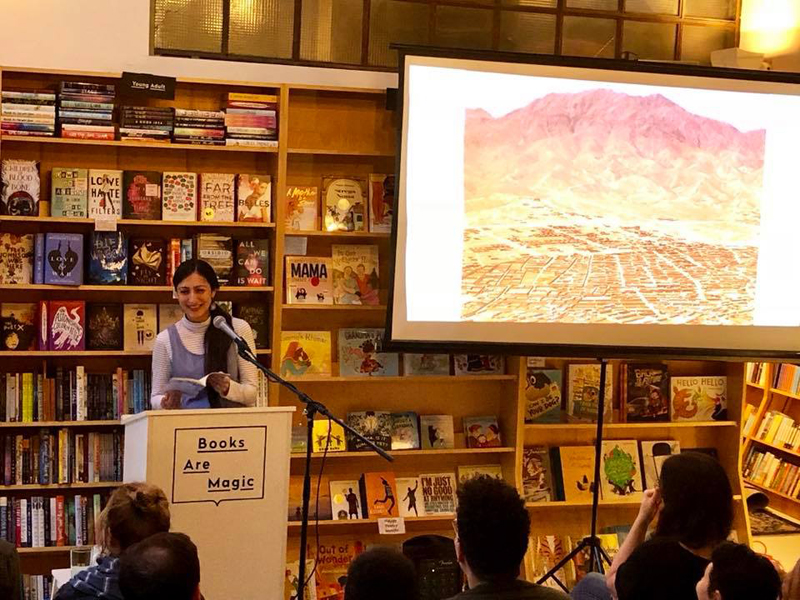
 When we set out to build WEIRDD, our monthly poetry reading series held at Books Are Magic in Brooklyn, we had a few apophatic rules of thumb. No flimsy introductions. No parched mouths. No inhospitable (and inexplicable) non-hosting. No regurgitated blurbs. We knew exactly what we wanted to avoid, having been through that wringer, and though our first season hasn’t been without its bumps, on the whole we feel the series has found its early footing in a well-ordered sensibility.
Perhaps most critically, we are against the poet’s empty pocket. From the beginning, we’ve committed to remuneration, modest as it might be, from our own pockets if necessary—as was the case with our first readers. And given the state of poetry literacy, we’d have been wrong to charge for admission (and turned away from most venues, at that). So we sought with humility for sponsorship, and we’re grateful in turn to acknowledge Poets & Writers for stepping in to do the right thing. Poems are work—great and necessary work—and to support the art (without purchasing it!), pay is a necessary gesture.
What sort of poetry are we supporting, then? Who do we read closely, and who are we able to invite? Again, we can invoke negation to learn the field:
 With these guidelines holding space, we’ve learned so much from so many: Jenny Xie’s gnomic scrying, Ricardo Maldonado’s elfin sonatas, Marwa Helal’s recognitive cataracts, Yanyi Luo’s arch scrutiny, Rio Cortez’s yawning infinity, Jayson P. Smith’s quenching jewels, Paul C. Stone’s mastery of the leap, Jen Hyde’s affinity for apertures, Sahar Muradi’s sense of strata, Valerie Hsuing’s sentient microphones, Chase Berggrun’s climbable wordscapes, Wren Hanks’s unflinching apparatus, Amy Meng’s history of rue, Julia Guez’s kaleidoscopic array, Jen Levitt’s droll orbitals, Jerome Murphy’s painterly ambulation, and Joey De Jesus’s omnivolent manticore.
We’ve understood these contrapuntally with brief lectures on everything from the socio-emotional matrix of Final Fantasy VI (Hubert Vigilla) to the life and times of nineteenth-century black politicians (Jordan C. Vaughn) to a working sketch on neuroplasticity and bioprecarity (Lynne DeSilva-Johnson). And that’s just thus far.
WEIRDD celebrates our devastatingly talented writers and underrepresented voices with real, rigorous, resourced attention. We surprise them with exacting, sonically attuned presentations of their work, simultaneously equipping the audience with an articulate inroad to the work and explicitly disavowing the glazed eye, smirking head-pat, or greasy backslap. This, at last, we can define with a YES: to real community, loving reverence, and untamable empathy.
Support for the Readings & Workshops Program in New York City is provided, in part, by public funds from the New York State Council on the Arts, and the New York City Department of Cultural Affairs, with additional support from the Frances Abbey Endowment, the Cowles Charitable Trust, and the Friends of Poets & Writers.
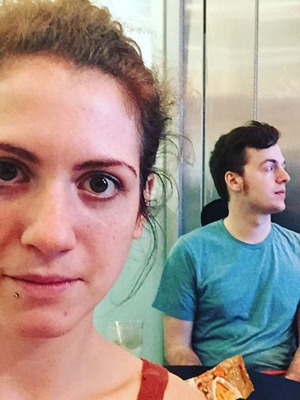
Photos: (top) Katie Longofono and Peter Longofono (Credit: Katie Longofono). (bottom) Sahar Muradi reading at Books Are Magic (Credit: Katie Longofono).How Afghan poetry helped the U.S. military; Winnie-the-Pooh illustration sells for £430,000 at auction; Kamala Harris to publish memoir in January 2019; and other news.
“At the etymological root of both healing and health is the idea of ‘wholeness.’ To heal, then, is to take what has been broken, separated, fragmented, injured, exiled and restore it to wholeness,” writes Jane Hirshfield in her essay “Poetry, Permeability, and Healing” in the Spring-Summer 2018 issue of American Poets. Think of something in your life that has been either physically or figuratively broken, fragmented, or made distant, and write a poem that attempts to restore its wholeness. How might you use the ideas of rejoining parts, searching for new openings, or creating connections for empathy, to write a poem that begins to make what is broken whole?
Margaret Atwood to offer online master classes on creative writing; how children’s books should deal with the Holocaust; booksellers on running their own shops; and other news.
Authors fundraise to reunite immigrant families separated at the border; how to create a perfect storm in a novel; Florence Welch’s poetry; and other news.

Brian Turner is best known for his award-winning poetry collections and memoir about the Iraq War, but with his new project he has pushed into an entirely new dimension of creative expression.
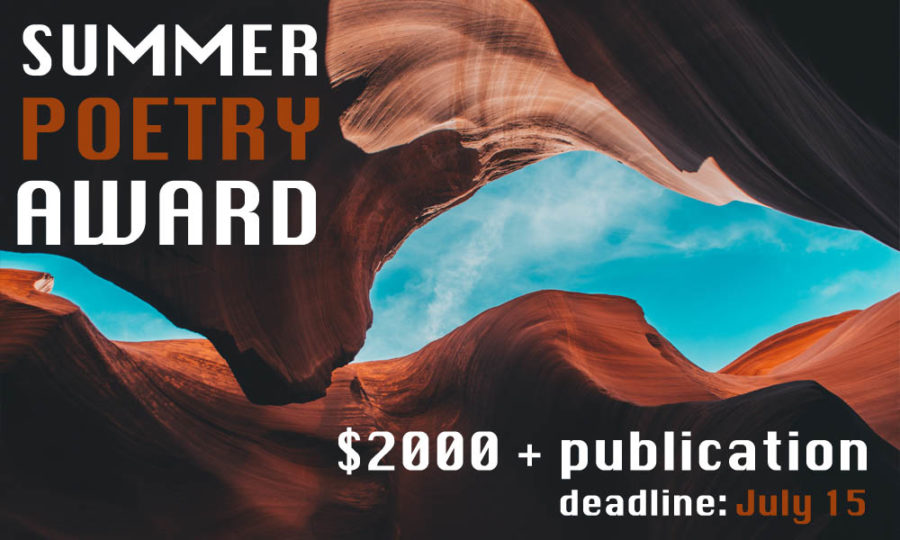
Submissions are currently open for Frontier Poetry’s Summer Poetry Award. A prize of $2,000 and publication on the Frontier Poetry website is given annually for a poem by an emerging poet. The editorial staff will judge.
The editors request work “that is blister, that is color, that strikes hot the urge to live and be. We strongly invite poets from all communities.” Using the online submission system, submit up to three poems totaling no more than five pages with a $20 entry fee by July 15.
Frontier Poetry is a weekly online publication championing emerging poets; “A place where voices—of all colors, ages, orientations, identities—are made equal by a shared belief in the power of language to confront the dark, the vast, the unexplored.” Frontier sponsors several literary awards throughout the year, including the Frontier Award for New Poets, the Frontier Open, and the Chapbook Contest. Visit the website for more information.
Michiko Kakutani’s reading habits; Ottessa Moshfegh’s ten favorite books; Heather Christle’s revision process; and other news.
“Words carry weight, lots of weight. Words can drown us, and words can save us.” Jaki Shelton Green, who was recently named North Carolina’s tenth poet laureate, reads from her poem “From Whence I Enter” at Christ School in Asheville, North Carolina. Green is the state’s first African American poet laureate.