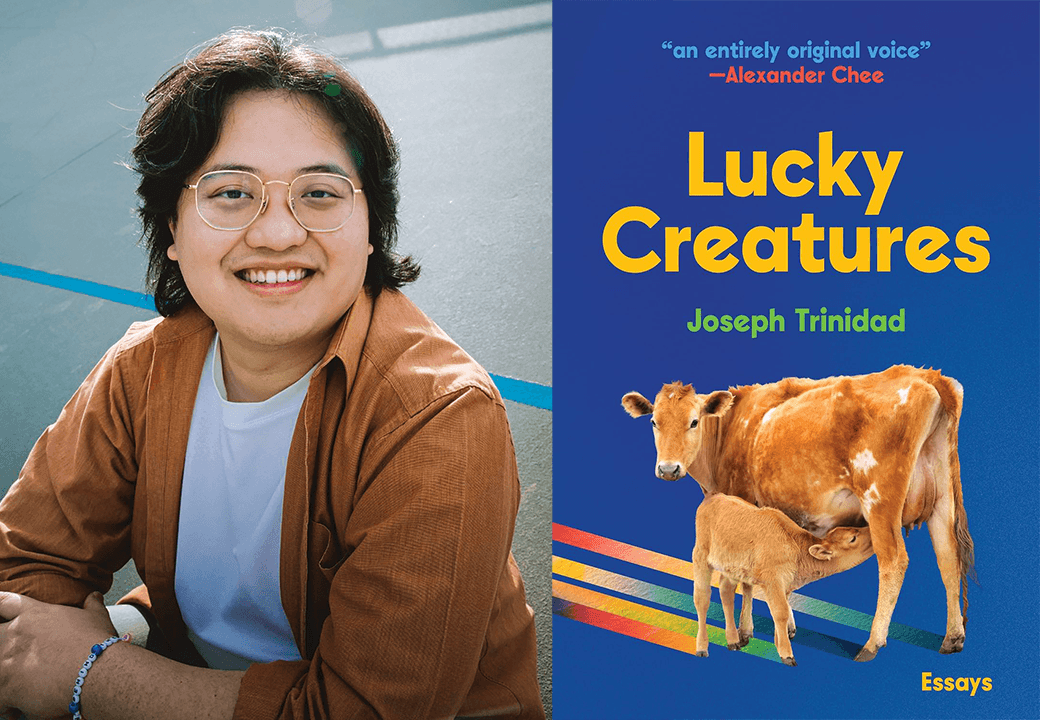
Lucky Creatures (Sarabande Books, June) by Joseph Trinidad, a bold collection of personal essays that traverses the lived experience of a Filipino Kiwi by way of reflecting—in English and Tagalog, with both humor and longing—on growing pains, family, migration, sexuality, and death. Agent: None. Editor: Katherine Webb-Hehn. First Lines: “There’s a little ramp up to the coops, giant green birdhouses made out of plywood, covered in whispers of chicken feathers and marbled speckles of poo. A pebbled path connects the coops to a pond encircled by smooth white stones, a surplus from Mami’s rose garden—a landscaping project from decades before.” (Author photo: Ebony Lamb)

I am a late bloomer. I started writing in Tagalog, then migrated to English when I was thirteen. I first saw myself as a poet and a playwright, mostly because of my many abandoned stanzas and scenes. For some reason it’s the essays I know how to finish.
I have memories I’m not ready to abandon to the vault. My preferred literary techniques don’t accept the truth without suspicion, and in turn I notice what my memories obstruct. With essays, if you notice nothing you are already compromised and dead. I always return to Vivian Gornick, a nonfiction hero of mine, who wrote, “What happened to the writer is not what matters; what matters is the large sense that the writer is able to make of what happened.” The price of expression is craft, and the craft of essay writing requires insight.
It wasn’t until I was twenty-six that I began pursuing publication. As my first American podcast interviewer pointed out, none of the platforms I’ve published with are familiar to your ears: Migrant Zine Collective, North & South, Landfall (now called Landfall Tauraka), the Spinoff. Aotearoa New Zealand has limited spaces for creative nonfiction, and those literary spaces are only becoming smaller for the same reasons they’re shrinking in the United States: lack of funding, declining readership, burnout.
Lucky Creatures started as a rescue mission. My grandmother kept going out during the COVID lockdown, so I called her incessantly, making sure she wasn’t at some reunion taking group pictures. An early draft of “How to Gut a Magnolia,” the book’s opening essay, emerged from those conversations. The book developed over the three years that followed.
The first year was spent in the International Institute of Modern Letters’ master of arts program. At the IIML, I relied on the kindness of my readers. Pro tip: If you want to take your writing seriously, you need at least one poet in your writers group. Luck struck three times that year: (1) I was happy with the shape of the manuscript I wrote during my creative writing program, and (2) I won the Adam Foundation Prize, which meant my first big “paycheck” and the attention of local publishers, eventually leading to (3) a contract with Te Herenga Waka University Press (THWUP).
The second year was the long winter of restructuring and rewriting. Luck struck again when a mate told me my work was strong enough to submit overseas. She recommended the then inaugural Sarabande Prize in the Essay. Sarabande is the reason you’re reading me now; shout-out to Alexander Chee, who picked my collection from what I’m sure was an exceptionally talented pile.
The final year was all about the red pen. I had two sets of editors: Sarabande’s editing team and THWUP’s team of one, a gaggle of Americans and a Kiwi. Many lessons were learned. The best ones were outsourced, often arriving as aphorisms and bon mots: “Know that you can always say no,” “Arsehole lands better than asshole,” and “Even geniuses take inspiration from others.”
The best writing days were the ones when I came to my desk with a clear head. The worst were when I had to contend with intellectual constipation, though I did find that a really good thesaurus reliably lubricates the mind. On those days, and all the days in between, I put my head down and worked. I told myself, “Nothing is as important as what’s in front of me.”
I’ve always said this book is about my pet themes: sex, death, and money, by way of my favorite people: Filipinos, farmers, and fags. Over the years the book remained steadfast and fearless. I refused to treat the reader as a tourist only interested in sights of beauty. Lucky Creatures was done when heaven didn’t feel so far away all the time. No more body bags came out of my past. All my favorite creatures are nearby, their engines running. We are blasting Celine Dion and Regine Velasquez, about to do doughnuts on your driveway.
An excerpt from Lucky Creatures
The Cousin Returns
Kuya Gian from Wellington, New Zealand, 2023
If you’re coming from overseas, people will expect pasalubong, especially if, like me, you’ve been gone for almost fifteen years. It has no direct English translation. Although some people use them, “souvenir” sounds too cheap, “gift” too shallow and transactional. In a sense, whatever you bring back is more of a remembrance than a souvenir, not a gift, as much as “I miss you” is not a greeting. It’s also a test of retention and growth: How well do you remember me and my tastes, how big is your wallet after all those years abroad? I think of it this way: Your partner waits for decades, raises your children alone, fends off suitors by weaving and unweaving their loom, then you return emptyhanded, not even a box of Dunkin’ doughnuts from the airport, let alone a Louis Vuitton card holder. Don’t be like that; bring something back, something that tells the story of your journey. You don’t want to lie, but you also don’t want to undersell your hard work. Refrain from blowing up your image or larding up the contents of your bank account. Stop yourself from buying everyone an iPhone. There are complicating facts, casualties to your migration that even a lot of money cannot obstruct or forgive. Above all, a pasalubong is an apology for your absence, something for those who waited and prayed for your return.
If you’re flying in from New Zealand like I am, and since there are five of you arriving at NAIA, you have at least 150 kilograms of Qantas checked luggage. Your family is going to expect every kilo to be used and spoken for. My father has three brothers; my mother has eight siblings; I, as a result, have a lot of cousins.
Titos are easy: comfortable running shoes they’ll never run in, preferably Nike, size 7 or 8. Tito Wawen has a special request: a red-and-yellow tower of Palm corned beef, which according to him is “the best corned beef in the world.” While we’re at it, we reserve some for tito King, too.
Titas, although not impossible, are harder to shop for, but I figure out what to buy once I find a thread of memory and start pulling. Tita Sunshine likes girly, kikay things, so she’ll get vials of foundation, colorful blouses, all the things she can show off. Tita Jane doesn’t like sweets, but she loves to collect kachuchus for her apartment. There is a sparkly Sydney Opera House ornamental figurine and a set of six coasters from Fiji wrapped in newspaper rattling inside my backpack with her name on them.
The kids, my little cousins, want toys. Yuan, a preteen chinito, has been promised the new Spider-Man game and V-Bucks for new Fortnite skins. Riley, my little chinita princess, who deserves the world, because she’s so cute and funny, will get a monstrous Peppa Pig that’s half her height. She sings when I squeeze her left ear.
No one is as challenging to buy for as Mami, though. What pasalubong do you buy for someone who’s most comfortable in house slippers, keeps her most expensive designer clothes gifted by my uncles abroad in the deepest part of her closet, only to be found years later nibbled by house mice? My mother says, “You’re enough; she hasn’t seen you for years,” an annoying nonanswer. My father suggests earrings, to which I reply: “How about you buy your mother expensive jewelery, Dad?” My sister says, “Perahin mo na lang!” Cash for Mami’s bills is so impersonal and dull, like she’s an afterthought. Max suggests her favorite perfume, YSL Black Opium, which I gifted her from my first real paycheck, finally a good idea, something I know she already likes and might run out of soon.
Then, there are the staples, the conventionally expected, the New Zealand no-brainers. Manuka honey tops the list: lip balm, hand cream, shampoo, moisturizer, lozenges, sugar scrubs, marshmallows, and, of course, in its raw form, in those little UV-protected jars for their tea and lemon, honey, and ginger needs. Also, souvenir shirts and fridge magnets from the dollar store; a supermarket haul of snacks—Pringles, Oreos, Pineapple Lumps, Ferrero Rochers, and stacked and taped Whittaker’s chocolate blocks resembling gold bricks.
•
Familiarity has reduced the plane into a puny can. I’m sardined among other dead-eyed passengers. Every time I board a plane, I believe that I am mere moments away from meeting God, that a soft, sinking death awaits me at each rattle. I do not sleep on flights. An extraordinary tiredness envelops my bones, rendering my senses into mush. I feel formless when I am in the air.
The twang of the pilot’s Australian accent blows through the cabin. He summarizes Manila in numbers: 7:30 pm, thirty-one degrees Celcius, Terminal 3.
Excerpted from Lucky Creatures by Joseph Trinidad (Sarabande Books). Used with permission from the publisher.