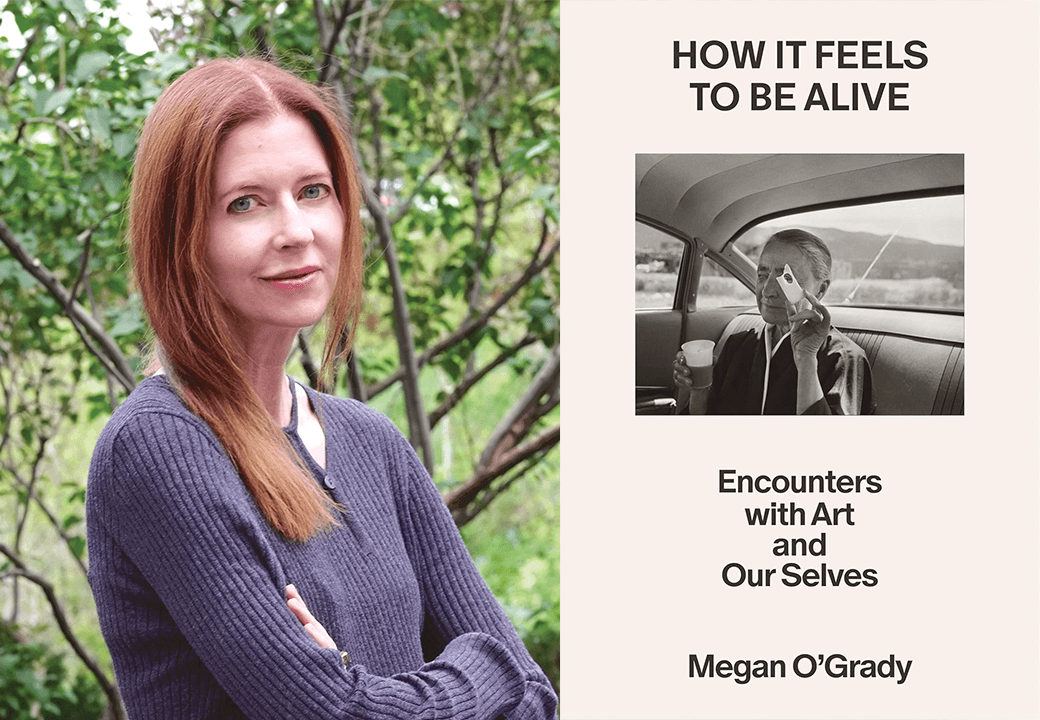
How It Feels to Be Alive: Encounters With Art and Our Selves (Farrar, Straus and Giroux, April) by Megan O’Grady, a capacious portrait of a teenager turned searching young woman turned mother that interweaves the genres of art criticism and memoir to deftly think through how art guides us, transforms our ways of seeing ourselves and others, and aids us in making meaning of the world around us. Agent: Sarah Burnes of the Gernert Company. Editor: Jenna Johnson. First Lines: “Inside, we greet the light. One hue dissolves into the next: lapis to ube, poppy to umber, intense goldenrod leavening into buff, followed by Colorado dawn.” (Author photo: Thorsten Trimpop)

Among my earliest memories of art is sitting with my second-grade classmates on a shaggy reading rug, looking at a grubby laminated Cézanne or van Gogh print that the “picture lady”—a classmate’s mother—brought to school. Shorn of context beyond the title, date, and artist’s (masculine, European) name, these artworks were unfathomable to me. Why this sliver of the world reconstituted this way? Still, something of those fractured perspectives and exuberant colors imprinted themselves on me with what I’d now describe as a sense of contingency—of something ventured, put out into the world to be seen and felt a century later.
Decades later, as a critic for the New York Times, I understood how art can function as a proxy for larger cultural conversations, the objects we see in galleries and museums replete with insights about what was deemed worthy of attention at a particular moment. Our own moment had come to feel increasingly chaotic and cruel, from environmental degradation and a fascist turn in politics to a pandemic that further polarized and broke people.
Things were also heating up in my own life. I gave birth to a daughter, lost my home and everything I owned in a fire, and then moved to a part of the country where wildfire was endemic. A mass shooting at my local supermarket left ten people dead. Part of me wondered why art mattered at all; the other part was certain that it did, that it had fundamentally informed who I was, but it was a subject too vast and ambiguous for journalism. I began to envision a more intuitive and open-ended inquiry, one that encircled art and life, looking within before angling outward.
A set of themes began to surface: What does it really mean to have a body in a hierarchy, or to become a parent in a bottom-line society? How do we see ourselves clearly when we’re so busy being seen? Is there a way “home” that doesn’t feel regressive? How do I understand my existence on earth, given my species’ fatal case of main-character syndrome?
My mentor in graduate school, the novelist E. L. Doctorow—the person who encouraged me to write criticism in the first place—often used the image of a car driving through fog at night as a metaphor for the writing process. You can see only as far as the headlights, but you can make the whole trip that way. This tracks for me. There was no map for what lay ahead; what had set me on this uncertain journey in the first place, after all, was a desire to approach art from other directions. But I had fellow travelers. In a conversation with my agent, Sarah Burnes, I quoted Barbara Kruger’s explanation of why we make art: “to show and tell, through a kind of eloquent shorthand, how it feels to be alive.” That, Sarah said, would make a great title. A few months later, How It Feels to Be Alive sold on proposal to my dream editor, Jenna Johnson of Farrar, Straus and Giroux. By the time I had completed a first chapter—I sent each one to Jenna as I wrote them, the next coming into view with startling clarity—I sensed the rhythm of the book, its patterning of critical, personal, and biographical modes.
I also had artists, whose stories are so illuminating of the exigencies of creative labor and the difference between seeing and envisioning. In 1957, at the invitation of the gallerist Betty Parsons, Agnes Martin traveled from Taos, New Mexico, to New York City, an entire ham in her lap for sustenance. Once there, with the support of a small community of artists whose studios occupied the same derelict building, she began to make the metaphysical forays in paint she is known for. I relate to Martin’s need for external affirmation (and protein-based snacks) as well as to her desire to pursue something urgent and unknowable, to be shared with others across time and all manner of difference.
An excerpt from How It Feels to Be Alive: Encounters With Art and Our Selves
I don’t think I’m unusual in that when I was little, the people in movies and books often felt more real to me than those I knew in my own life. I grew up in Kansas, in a suburban tract home much like those surrounding it, in a part of town with few features apart from a strip mall and a corporate park. Tornado drills were routine, and I sometimes wished that a cyclone really would whirl me off with all that anonymous greige stucco and land me in some glittering Oz.
An overintense, underconfident child and then teen, I depended on the escapes provided by novels, magazines, and field trips to the Nelson-Atkins Museum of Art, with its bronze Henry Moore sheep lyrically grazing on the lawn beside Claes Oldenburg and Coosje van Bruggen’s colossal shuttlecocks, the latter work making it appear as though the gods had been interrupted at a game of badminton. Inside, hanging out on permanent exhibition, were a pensive Buddha, Donald Judd’s amber plexiglass and steel stack, and a small, hard-shadowed de Chirico dreamscape featuring a sausage-like tower. Over time they became as familiar as the faces of good friends: never surprising, never boring.
Once a month or so, the “picture lady”—a classmate’s mother—would bring a Cézanne or Van Gogh or Hopper to school and gather us in a circle on the shaggy reading rug for a close looking exercise. Other than the name of the artist and the year and title of the work, we weren’t given much information; it was almost as though the art had simply materialized, untouched by human hands or experience. Still, there was something about those grubby laminated prints: the lurching floor in Van Gogh’s Arles bedroom, the diverging perspectives of rock and light contained in Cézanne’s alpine view, the communal solitude of Hopper’s nighttime diner. I didn’t know why these choices had been made or why they made me feel as they did, but I remember the impression of possibility I discerned in them, down to the stroke of the brush and the selection of paint and subject: evidence of things begun in uncertainty and then resolved. I would not have been able to articulate any of that, but I knew how it felt to sit with a box of crayons and a blank sheet of paper, the sense of occasion that didn’t end at the edge of the page.
There was not a lot of art on the walls of my childhood home. I most fondly remember an oil painting of a Mediterranean scene (a patch of sea, a tile roof) matted in blue satin, and a gilt-framed cross-stich made by my mother that read GOD BLESS OUR PAD, the words garlanded with flowers: the Costa Brava and the divine, equally notional concepts to my small untraveled self.
Decades later, as empty-nesters preparing for a move, my parents did a major clearing out, and my brother, then in his forties, plucked the cross-stitch from a to-be-donated pile. Over time, what had become dated to my lefty Catholic parents, no longer jibing with their more agnostic, upwardly mobile interiors (they replaced it with a vibrant copy of Picasso’s Harlequin and His Companion, or “the Fauxcasso,” as my brother and I refer to it), had grown redolent with private irony: our mother’s homespun needlework clashed exquisitely with the term pad and its unmistakable whiff of 1970s, pot-smoking hippiedom. Yet neither my brother nor I could bring ourselves to hang it in our own respective pads, to be glimpsed by visiting acquaintances, knowing that only we knew or cared enough to supply the necessary subtext: that this heartfelt blessing had witnessed the upbringing of two faithless adults.
The cross-stitch sat in a closet in my brother’s West Hollywood apartment for months before he had it shipped to me in Colorado at some expense; it arrived professionally wrapped and crated as though it were a Picasso, a real one. Priceless are the semiotics of youth: it transported me back to the wood-paneled certitudes of our Bush/Clinton-era childhoods, when I still believed—if not in god, then in other fixed ideas about the form and content of life.
One of my earliest art memories—I was about seven, probably—is of standing in front of Andy Warhol’s soup can at the Nelson-Atkins with my classmates, craving a toasted cheese sandwich. (Warhol claimed he ate Campbell’s soup every day for lunch for twenty years.) Three and a half decades later I stood with my own students in the University of Colorado Art Museum’s study center, looking at Cannibull’s Soup, a 2003 set of cans by the Mexican American painter and printmaker Enrique Chagoya, their screen-printed labels mocking art industry types—“Cream of Dealer” soup, “Museum Director’s Tripe.” Chagoya had appropriated Warhol’s commentary on consumerist America to make his own statement about consumerism, the kind that turned artists of color into tokenized commodities. A few months after that, I watched a viral video on Instagram of young climate activists throwing canned cream of tomato soup onto Van Gogh’s Sunflowers. “What is worth more, art or life?” the protesters shouted. The messaging was a little strained—what did Van Gogh ever do to the planet?—but using Warhol’s iconic soup to defile sanctified canonical works of Western culture seemed to complete a certain circle: for the blip of a news cycle, the activists drew our attention to how attention itself had been commodified, distracting us from things we should be protecting.
Maybe it also completed a certain circle for me about how art operated. If our cultural problems were recursive, the tools we’d built to grasp them could be as well.
At the outset of the pandemic in the winter of 2020, I found myself at the home of a collector. Over coffee, I asked her what drew her to the specific works she had acquired, but instead of answering my question, she told me which of them had been especially good investments and lamented ones that had gotten away. I recalled a scene in Alfonso Cuarón’s dystopian 2006 film, Children of Men (adapted from P. D. James’s novel), in which Clive Owen’s character visits a cultural minister who hoards priceless works of art as European civilization crumbles. Michelangelo’s David, missing its lower leg, stands in the entryway; Picasso’s Guernica hangs over the dining table like wallpaper. Stripped of context, personal or cultural, art becomes merely an asset or a curio to possess, a status marker. When we foreclose on emotion, when art is treated merely like stuff to monetize or hoard—or to classify and rank—what value really remains? It’s like the old thought experiment about the tree falling in the forest. If a painting sits unseen in tax-free storage in Delaware (where a not-insignificant quantity of the world’s great art is held captive), does it still make meaning?
Excerpted from How It Feels to Be Alive: Encounters With Art and Our Selves by Megan O’Grady. Reprinted with permission of the publisher, Farrar, Straus and Giroux. Copyright © 2026 by Megan O’Grady.