This week’s installment of Ten Questions features Tomas Moniz, whose novel, The King of Aloe Vera, is out today from Algonquin Books. Seventy-five-year-old Reyes Calderón, or Rey, has started each morning the same way for years, stepping outside to grab the San Francisco Chronicle from the front steps of his apartment building in the Mission. But his neighborhood is changing and his days of routine are coming to an end. At the outset of The King of Aloe Vera, Rey has just one month until he must leave his home behind for the San Leandro Rolling Estates Retirement Community and Park. He anticipates spending these days as he has many days before: volunteering at the library, reading the paper, and thinking often of Juliet, his late wife. “Every day, at some point, the wave would hit him and he was thankful to still feel his loss so acutely,” we learn in the opening pages of the novel. “This year marks the end of his eighth year without her. She even had the foresight to pass on rather quickly instead of some long, drawn-out sickness, costing so much time and effort and tears. That was just like her. Efficient. No-nonsense.” But then, just as Rey is getting ready to leave, a new friendship with a young woman in his neighborhood upends his patterns and brings newness to his once-quiet days. “The characters are so authentically rendered that even when something feels far-fetched, readers will root for them,” Kirkus Reviews writes. And Publishers Weekly adds that “Moniz succeeds in getting the reader to root for his flawed but lovable characters. It’s a gem.” Tomas Moniz is a Latinx writer living in Oakland, California. He is the author of Big Familia (Acre Books, 2020), a finalist for the PEN/Hemingway and Lambda Literary awards, and All Friends Are Necessary (Algonquin Books, 2024), which won the California Golden Poppy Award. He also edited the Rad Dad (PM Press, 2011) and Rad Families (PM Press, 2016) anthologies. He teaches at Berkeley City College and in the MFA program at Antioch University.
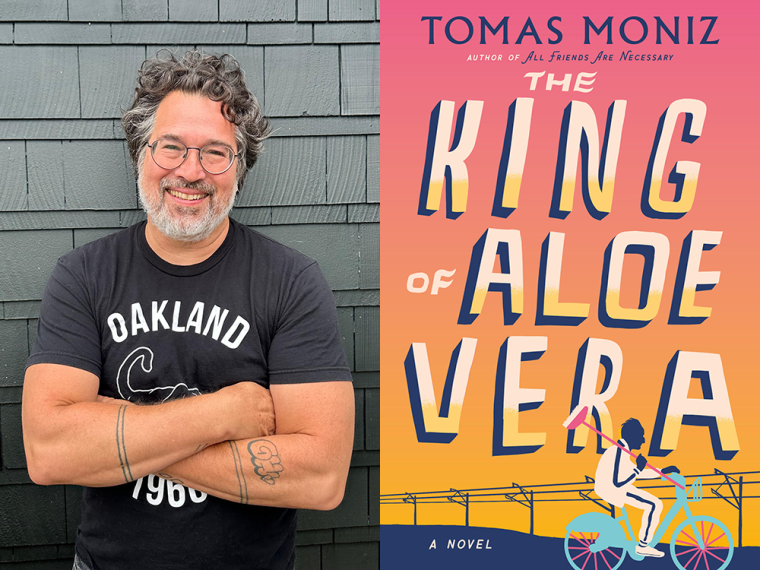
Tomas Moniz, author of The King of Aloe Vera. (Credit: Ella Moniz)
1. How long did it take you to write The King of Aloe Vera?
I had been considering the voice of an elder for a while and it wasn’t until I got a bit too comfortable with writing first-person narratives that felt too similar to my own thoughts and ideas that I decided to do it. I wanted to capture Rey’s voice, a man in his seventies. It was hard but worth the work.
2. What was the most challenging thing about writing the book?
For me, so often the most challenging part is the structure and plot of a story; normally I just write and see what happens. But with The King of Aloe Vera, I came up with the idea of thirty chapters reflecting the days of one month and it really helped me see the way to complete the project. So the hard part was just writing that first draft.
3. Where, when, and how often do you write?
I like to say that I’m a binge-and-purge writer. Sometimes I’m all up in it and sometimes I’m asking myself if I’ll ever write a good word again. But I’ve come to trust the process. Sometimes I know I just need to write through boredom. Sometimes I know I need to just observe and live life and let the writing come later.
4. What are you reading right now?
Dangerous, Dirty, Violent, and Young: My Fugitive Family in the Revolutionary Underground (Norton, 2026) by Zayd Ayers Dohrn. I love stories of radical resistance, especially ones situated in the United States. There are lessons there for our cultural moment right now.
5. What is one thing that surprised you during the writing of The King of Aloe Vera?
What surprised me is how much pleasure [you feel] when you discover, about two-thirds of the way through, that you can see the end. There’s this confidence and pride that you’re going to succeed. Of course, once you get to the end, you realize you have to redo the whole thing, but that glorious moment just before you reach the end continually delights me. Maybe that’s the rush that keeps us working at this craft.
6. What is the biggest impediment to your writing life?
My fucking phone.
7. What is one thing that your agent or editor told you during the process of publishing this book that stuck with you?
My agent told me years ago, “You write such beautiful endings, but you have to make sure you get your readers there.” I think about that all the time: How am I getting my readers to the end?
8. If you could go back in time and talk to the earlier you, before you started The King of Aloe Vera, what would you say?
My editor, Jovanna Brinck, casually asked me at our first meeting: Have you considered setting the book during the month of October? It was like the most obvious yet essential editorial suggestion to realize all the themes and the character development. I’d tell myself to start there from the beginning.
9. Outside of writing, what other forms of work were essential to the creation of The King of Aloe Vera?
One of the things that really helped me with this book was the community I developed in my teaching practice, just hearing other writers and artists talking about their processes, talking about how they struggle and restart. I also love talking process with students. Teaching helps me be a better writer. It holds me accountable. It inspires me and challenges me.
10. What’s the best piece of writing advice you’ve ever heard?
Write what thrills you, not what you think will sell! And don’t forget that. As you revise your project, work hard to keep that thrilling energy, however it manifests, in your book.