This week’s installment of Ten Questions features Kiki Petrosino, whose poetry collection Perfect Italian is out today from Sarabande Books. “Slowly I seep, a stain, taking the shape / of a long-lost lexical gloss. Remade / in my ‘colored’ mouth, conjugated in / wine, my vocab pours back into my glass,” Petrosino reflects in one of the collection’s opening verses. The descendant of Black Americans and of Italians from the hillside town of Padula, Petrosino has had to move between different places and lineages and identities for most of her life. Perfect Italian follows her across linguistic, geographic, and temporal borders as she contemplates her relationships to family and language, and her place in the world. “Petrosino is a poet of deep insight, of taproots, bloodlines, and soil; of legacies blown across continents like hot sirocco; and of the songs that call us home,” Alexis Orgera said in praise of Perfect Italian, while Gregory Orr added that “Petrosino’s extended meditation is rich with eloquence in every line.” Kiki Petrosino is the author of several poetry collections, including White Blood: A Lyric of Virginia (2020), Witch Wife (2017), Hymn for the Black Terrific (2013), and Fort Red Border (2009), as well as the lyric memoir Bright (2022), all of which were published by Sarabande Books. She is a professor of poetry at the University of Virginia and teaches in its MFA and undergraduate creative writing programs. She has received numerous honors, including a DeWitt Wallace/Readers Digest fellowship from MacDowell, a Pushcart Prize, and a creative writing fellowship from the National Endowment for the Arts.
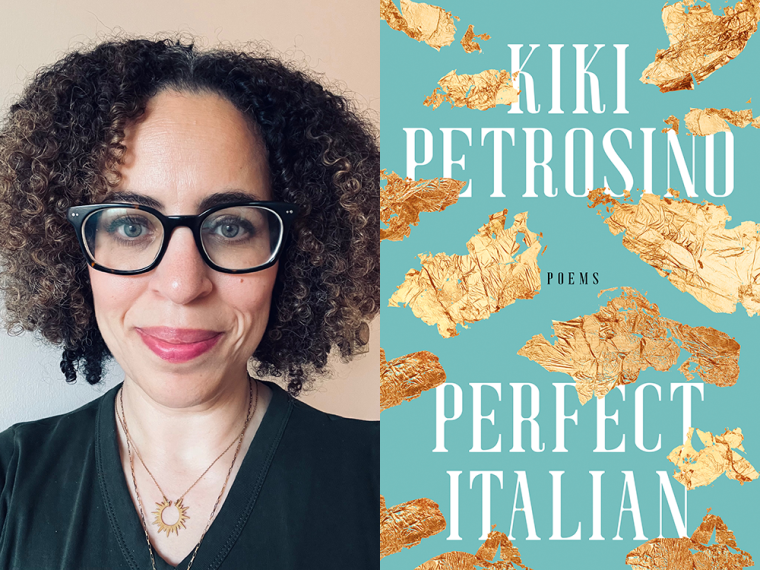
Kiki Petrosino, author of Perfect Italian.
1. How long did it take you to write Perfect Italian?
I need two clocks to answer this question. If I tell the story one way, the writing process took just a few months. I started in early January 2025 and I wrote the final poem in June of that year. But when I turn around to face the other clock, I see how this book has been thirty years in the making. The inspiration for Perfect Italian dates back to 1997, the year I started studying Italian, and the poems trace the contours of my many visits to Italy as a student and artist. I believe certain poems, and certain books, ripen into possibility, and that certainly is what happened with Perfect Italian.
2. What was the most challenging thing about writing the book?
Perfect Italian is the final installment in what I see as a three-book arc, a loose trilogy of writing around issues of heritage, personal identity, and belonging. The first two installments—my 2020 poetry collection, White Blood: A Lyric of Virginia, and Bright, my 2022 lyric memoir—map the complexities of my life as a Black American of interracial ancestry. Each book experiments with the language of self, deliberately bending and refracting received narratives of Americanness. In Perfect Italian, I wanted to focus on Italian as one of my “heritage” languages, but because I’m not a mother-tongue speaker, the whole enterprise of “playing with language” felt different. Learning a new language, especially as an adult, is exhilarating, but it’s also baffling, mystifying, exhausting. You can be lonely inside a language, even after years of studying and speaking. In Perfect Italian, I chose a constrained syllabic structure for each poem to emphasize the granular way a poem (and a self) creates meaning: bit by bit, sound by sound.
3. Where, when, and how often do you write?
I write in feverish bursts, with lots of fallow time between projects. Museums are some of my favorite places to compose. I sit with a notebook, preferably pocket-sized, and write with a strong, inky blue or black pen. Or else: I stand, holding the notebook and scribbling like a reporter. I love to be alone at the museum, taking all the time I want to read over the exhibition notes. Even better if those notes are in multiple languages. Even better if there’s an audio guide I can listen to [through] my headphones. The real world melts away and new thoughts begin to sculpt themselves on the page.
4. What are you reading right now?
I’ve been reading, along with my students, Simon Armitage’s 2016 translation of the fourteenth-century Middle English poem Pearl (Liveright). I’ve always been curious about the medieval world and struck by the beauty of Middle English. Sonically and visually, it seems to hover between temporalities, sounding both strange and oddly familiar to the contemporary ear. Pearl tells the story of a dream, or a vision, experienced by a grieving father whose two-year-old daughter has died before the poem begins. The speaker continually refers to this child as a precious “pearl,” and in the vision, he encounters a resplendent, grown-up version of her. Armitage’s marvelous alliterative translation holds space for beauty and grief. The motif of the pearl, falling into the dark grass, is so exquisitely sad every time it recurs. I’m in awe of how forcefully emotion can translate across languages and centuries.
5. Which author, in your opinion, deserves wider recognition?
I recommend everyone read my friend and fellow poet Dan Rosenberg for his closely observed investigations of consciousness and connection. His latest book of poetry, Bassinet (Carnegie Mellon University Press, 2022), is a moving and graceful contemplation of parenthood. Dan is also an accomplished translator, and his cotranslation of Slovenian poet Miklavž Komelj’s Night Is More Abstract is forthcoming from Zephyr Press later this year.
6. What is the biggest impediment to your writing life?
At any given moment, multiple ideas for future creative projects arrive in my imagination. There’s no time to do them all. Choosing, from those possibilities, which is most urgent, pressing, and possible—that’s my continuing challenge.
7. What is one thing that your agent or editor told you during the process of publishing this book that stuck with you?
Working with Kristen Miller at Sarabande was a particular delight. More than any specific piece of advice, it was her precise and attentive editorial reading of Perfect Italian that gave me the confidence to believe that, yes, this strange book of syllabic poems is real, and someone else can hear the music I’m trying to make! Kristen gave me the time and latitude I needed to develop the project from beginning to end. As a poet and translator, she was my ideal reader for this book, which is all about moving across languages and emotional geographies.
8. If you could go back in time and talk to the earlier you, before you started Perfect Italian, what would you say?
When I began writing Perfect Italian, I didn’t know that my father, Vincent Petrosino, would pass away before I could show it to him. Since this book touches on his lineage, I was looking forward to knowing what he thought of it, and, I guess, what he thought of me in it. In retrospect, I see how the book spirals around notions of loss. Many of the poems now read, to me, like elegies for my father, even though I wrote them months before his death. Can a poem, in reaching for something beyond the moment of composition, pick up some vibration from the future? If I could go back in time, I’d ask myself (gently) to pay closer attention to the character of that reaching. I’d try, I’d try to finish the book earlier, so my father could read it.
9. Outside of writing, what other forms of work were essential to the creation of Perfect Italian?
Literacy—in one’s mother tongue or in another language—is labor of a beautiful kind. Over the past three decades, I’ve tried to maintain some proficiency in Italian and to travel to Italy whenever I can. My studies have been formal and informal, enriched by reading, by family visits, and by conversations with strangers. My knowledge is imperfect, like a poem, but willful and insistent, like a poem.
10. What’s the best piece of writing advice you’ve ever heard?
It wasn’t a piece of advice. It was what I saw in another artist. Many years ago now I received a residency at the Hermitage Artist Retreat in Florida. Sandi Hammonds, a painter, set up her daily practice in such a dedicated way. She would watch the sunrise each morning, then spend all day working in her studio. As evening fell, she would take a drink—just one—of expensive tequila before leaving her workspace. That was it: those two things, every day. And those rituals, I came to understand, sealed her practice and made space for it at the same time. She got so much work done! In writing Perfect Italian, I didn’t rise to Sandi’s level of discipline, but the practice of writing those poems, syllable by syllable, was both supportive and somehow freeing. Writing in syllabics became my ritual. It allowed for the space of the page to hold me.