At the end of our conversation, Deesha Philyaw asks me about Sheila. “Just out of curiosity,” she says. “What did you think of that character?”
I can tell by the sharp eyes behind her wide-rimmed raspberry-colored glasses that this isn’t an off-the-cuff query. Sheila Battle is the head deaconess of the fictional Hope in Christ megachurch in Philyaw’s second book of fiction, the novel The True Confessions of First Lady Freeman, forthcoming in September from Mariner Books. After Scharisse “Schar” Freeman, wife of the pastor, is caught on camera at a clandestine riverside meeting with another married pastor, Sheila oversees contrition sessions meant to bring Schar back into the fold of the congregation and her marriage. As their meetings progress and Sheila’s personal life and history become clear, a human being emerges from behind her chilly, holier-than-thou armor, one both wounded and of the earth, with desires and fantasies (funny, kinky ones that involve take-out Caribbean food, her devoted husband, and George Jefferson actor Sherman Hemsley), a fondness for day-drinking hard lemonade, and a mouth that would make a heathen blush. “Initially, I was like, ‘ugh,’” I tell her, “but then I realized there’s more to Sheila than I thought there was, and I began to feel for her.”
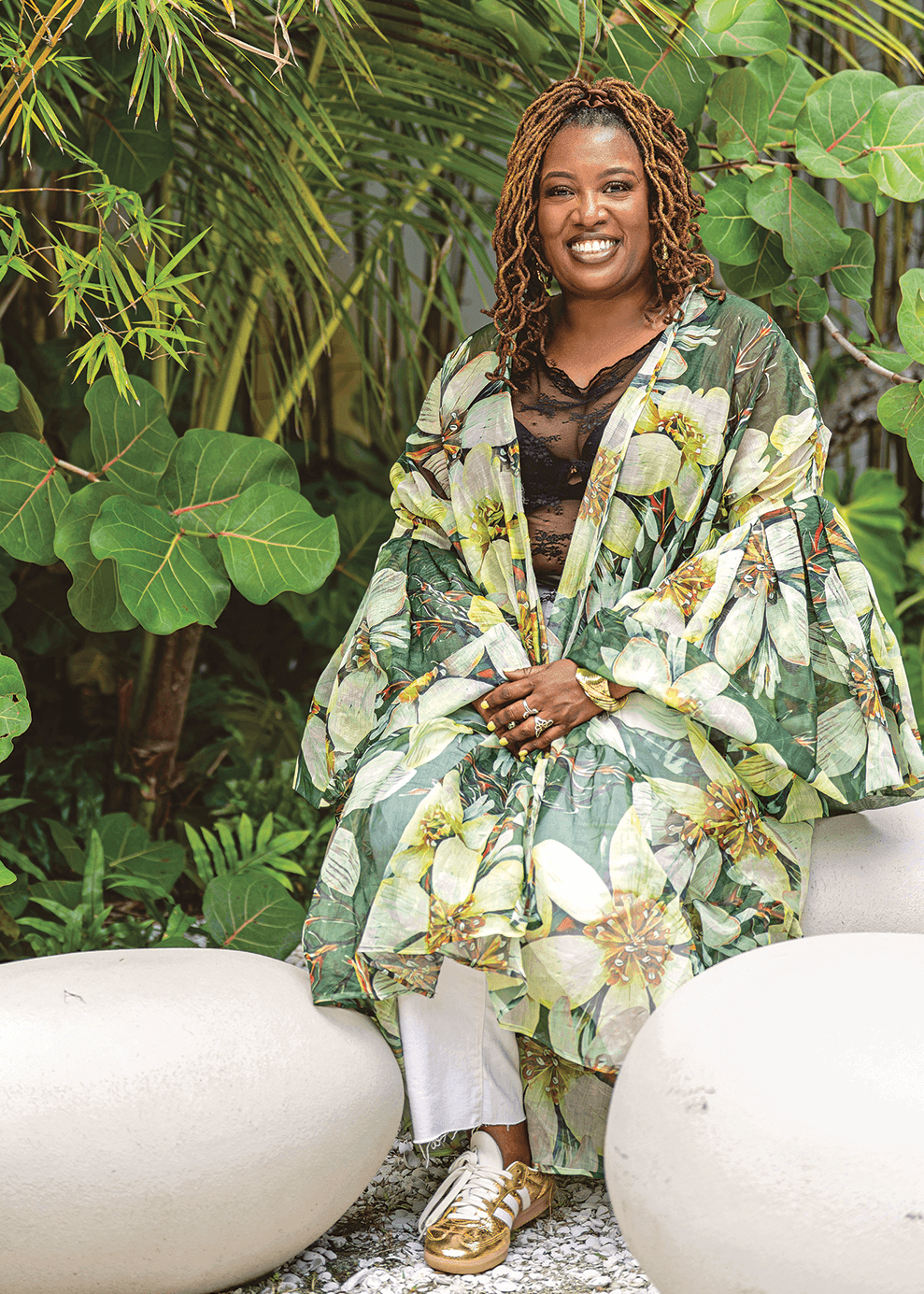
Deesha Philyaw, author of The True Confessions of First Lady Freeman. (Credit: NIBA Photography)
“That’s what I hoped,” Philyaw replies. She’s speaking to me from her home in Miami, with a gorgeous white orchid and well-stocked bar cart behind her. “I didn’t want any of the characters to come across as a cartoon villain.” She sees Sheila as a litmus test for how well she’s done in this regard. If the reader doesn’t out-and-out hate Sheila, then she knows she’s conveyed humanity to even one of her hardest-to-love characters. For all the intrigue and drama among the Southern Black megachurch upper echelon, the incredible fashions and astounding wealth that the Freemans display without an ounce of humility, and the humor that comes of Philyaw mocking the hypocrisy, pettiness, and astounding small-mindedness of supposedly godly people, she writes with such compassion that these characters—equal parts ridiculous and aggravating though they may be—never devolve into gross caricatures.
It’s a brilliant performance on the page, one well suited to the zeitgeist. In the novel, powerful men in the church community have committed moral abuses and demand the silent obedience of the women around them in order to maintain business as usual. Scharisse Freeman’s confessions are in part a mea culpa for her failings, but they’re also a revelation of truth, a plea for understanding, and an announcement of emancipation from this conservative, patriarchal religious world. Who in today’s America, no matter their faith or lack thereof, is not in some sad way beholden to false idols of money, fame, celebrity, sex, and youth? What if, Philyaw’s novel asks, we decide to drop all that hollow foolishness and follow our hearts?

In the context of the Black church, First Lady is the term given to the pastor’s wife, a role model for the women of the congregation. Philyaw’s novel opens at the 2011 First Lady USA pageant, an invented televised competition in which twelve First Ladies vie for the title of most devout, beautiful, ideal model of wifely Christian excellence. Scharisse Freeman had long wanted to be invited to compete, and finally, at the age of forty-one, she stands in the talent portion of the evening to deliver a humorous monologue spoofing the “Proverbs 31 Woman,” one whose entire personality and life is in service to her husband and family (defined in Proverbs 31, all thirty-one verses of which Philyaw includes in the book for those not in the know). Except, when all eyes are on her, Schar doesn’t crack jokes. Instead, she removes her dress and, wearing only fig leaves for modesty, addresses the various controversies that have followed her since her early twenties, when she went from being on the wrong side of the tracks to First Lady of one of the largest megachurches in America by marrying a man fifteen years her senior. The book then rewinds to Schar’s fortieth birthday as she narrates how she arrived at a place where she felt she had nothing to lose except her dignity, if she kept quiet.
While it’s impossible to sketch out the numerous, connected scandals Schar has been asked by her husband, the church leadership, and even some of her pageant rivals to suppress without spoiling the story, suffice to say that, having been born to a young, unwed, impoverished mother, Schar uncovers an entire conspiracy surrounding her origin. When I reveal to Philyaw that I, too, grew up in a religious environment in which I had to pretend to be the son of a man who was not my biological father, Philyaw knows I get it. “So then you’re familiar with secrets, with shame, with [people wanting] you to be something you’re not, or some version of you that’s palatable to them but which, at a certain point, becomes unpalatable to you,” she says. “That’s what happens with Scharisse. She was fine with the performance until she realized, ‘These people don’t give a damn about me.’”
Philyaw started writing over twenty-five years ago as a stay-at-home mom in Pittsburgh. “I wrote for only a few minutes a day,” she tells me. “I wanted to do something with my brain that was just for me.” Growing up in Jacksonville, Florida, she had always loved to read, but as a first-generation college student at Yale, pursuing writing didn’t feel like a practical option. After graduating she married and took jobs in management consulting and elementary school teaching before setting her career aside for full-time parenting. In her youth she’d been exposed to various church environments, from African Methodist Episcopal to Missionary Baptist to Southern tent revivals. She had accomplished what most of those denominations asked of a woman—to marry, to mother, to support her spouse—yet she didn’t experience joy or gratitude. That dissatisfaction transformed into guilt.
At first she channeled this emotion into fictional characters. Eventually, in the early aughts, she divorced, and it was the necessity of needing to make a living that brought her to freelance writing—for some years, in addition to article and essay writing, she blogged about parenting and co-ran a website with her former husband about raising healthy children of divorce. That led to her first book, written with her ex, Co-Parenting 101: Helping Your Kids Thrive in Two Households After Divorce (New Harbinger Publications, 2013), which is how she found her agent, Danielle Chiotti of Upstart Crow Literary Agency. “It was a twist of small-town fate,” Chiotti says. “I had just transitioned from working as an acquisitions editor to a literary agent, and I had a sense of what could work in the nonfiction market. Deesha’s take on co-parenting stood out. Beyond that it was the energy of her writing and the voice she brought to her work which drew me to her. It was immediately clear that she’s a writer who puts her whole self into whatever project she’s working on.”
“Danielle’s always been relational, not transactional,” Philyaw says. “She wasn’t just about that deal; she was always asking, ‘What else are you working on? What do you want to do? What are you dreaming of, big picture?’” For Philyaw that was a novel. In 2006 she wrote the beginning and ending of what would eventually become her first novel but found herself stuck in the middle. When money needs arose, she’d put the project aside. As the years went on she avoided the novel altogether in favor of writing short fiction. It was Chiotti who told her that she really liked these “church-lady stories” she’d been sharing with her, a through line in the pieces Philyaw hadn’t noticed. Chiotti suggested that Philyaw write more stories intentionally themed around Black women, sex, and the Black church. When she had six complete stories, only three of which had been published, Chiotti took the partial manuscript on submission. With a laugh, Philyaw says, “I didn’t know we were breaking the two cardinal rules of publishing: You cannot debut with a short story collection, and you cannot go out on submission with a partial. But Danielle was like, ‘We’re gonna do both of those things.’”
“We took a chance,” Chiotti admits. “But it felt right. A writer’s work is an organic, living thing, and when something feels like it’s coming together in a real way, why wait?”
Corporate publishers passed on the nascent collection, but West Virginia University Press said yes. Philyaw was forty-nine in 2020 when The Secret Lives of Church Ladies came out. The collection was a finalist for the National Book Award for Fiction and received the Story Prize, the Art Seidenbaum Award for First Fiction, and the PEN/Faulkner Award for Fiction. It remains the best-selling title in the history of the University of West Virginia Press. “Something clicked after that,” Philyaw says. “I was better at storytelling, and I felt more confident that I could finish something because I actually had just finished something. Success begets success.”
And yet completing her first novel wasn’t as simple as filling in the blank space between beginning and end. She could now see that her earlier drafts featured a protagonist who was bored and miserable with her life, not all that different from how Philyaw once felt. This woe-is-me vibe sapped the story of energy. During the pandemic, Philyaw took an online class on writing satire with Rion Amilcar Scott, author of the collection The World Doesn’t Require You (Liveright, 2019). One of the class’s big ideas, adapted from George Saunders, was that “if you are mocking something through satire, you really have to understand it first,” Scott says. “If you don’t know the nuances and intricacies of a subject, even one you may disdain, then you are just being condescending.”
This connected to something Chiotti told Philyaw: that the stakes of the novel felt too low. By speaking truth to power, Scharisse is jeopardizing not only her marriage, but her position within the church community, which brought her wealth and privilege. Chiotti asked, “What if, instead of despising her life as First Lady, she loved it?” Finally it clicked. “I had a visceral reaction to that,” Philyaw says. “I would hate being the First Lady of a megachurch. But that’s why she couldn’t just be a version of me on the page. Schar has to be Schar. She can love this thing even though I don’t relate to it, right?”
Instead of minimizing Schar’s lifestyle, she outsized it, approaching the project as a humorous send-up of what has become all too common: the pastor with a trophy wife, a Bentley, and other excesses of the rich and famous. She figured that “if First Ladies are all about surface presentation and pageantry, well, let’s put them in an actual pageant.” A self-described nerd, she threw herself into researching fashion and luxury items as Scharisse and the other contestants took shape for her through their style. “For Schar it’s not just the clothes, of course,” she says. “It’s what the clothes represent: her reinvention of herself from being a girl who doesn’t belong in the church to being a First Lady fashionista. Out-dressing everyone is her security blanket.”
Scott says the other idea he focused on in his class was that “the first subject of satire must be the self, because every single adult is implicated in every piece of stupidity or evil that humans perpetuate.” So while many things changed for Scharisse, at heart Philyaw kept what she loved about the character from the first draft—her snark; her emotional connections to her queer best friend, her beloved aunt, and her teenage daughter; her morality and self-awareness, which grow over the course of the narrative. “There’s a scene in the church where she reflects on the fact that she has this Prada lifestyle which is paid by a congregation full of people who can barely pay their own rent, all in service to a god she’s not sure she even believes in,” Philyaw says. “That moment was always in there, from the beginning.”
Philyaw’s editor at Mariner, Rakia Clark, knew she wanted to work with Philyaw on her novel before she even saw the manuscript. Though she primarily works in nonfiction, Clark grew up in the Black church in Georgia and identified with Philyaw’s story collection. She acquired The True Confessions of First Lady Freeman as a partial manuscript. When she received the complete book she recognized that there were elements of the story from earlier drafts that, though important to Philyaw, no longer fit. “Deesha knew what she wanted this book to say,” Clark says. “But we needed to work through what plots and characters best served that message.”
The challenge was one of scope: Philyaw’s novel has a large cast with a lot of story. Clark and Chiotti both thought it easier to visit Philyaw in Miami and work in person rather than through editorial letters. Over the course of a couple of days at Philyaw’s kitchen table, the three of them storyboarded every chapter. Characters were cut; the various plotlines prioritized. Some required expansion, others reduction. Afterward the drafts became shorter, then longer, then shorter again. Philyaw lamented but ultimately listened to Chiotti, who told her to trust the process and Clark’s notes. Sure enough, draft by draft, the novel turned into the propulsive book that it is today, guided throughout by Philyaw’s determination that the story illustrate how a woman might need to destroy her life in order to find her real, true self.
In some ways this mirrors Philyaw’s own story of becoming a writer. When she began writing, she felt entrenched in the mindset—forged by the church—that sex was taboo, so writing stories in which her women characters had sexual desires and fantasies seemed, as she puts it, “naughty.” She continues: “We don’t talk enough about how evangelical Christianity infantilizes people, particularly women. All this shame and guilt, and the fear of punishment, it shapes and pressures women into being smaller, safer, quieter versions of themselves.”
As a survivor of Catholic school, I ask if she encountered the adage, as I did, that you must guard your thoughts and rein in your imagination, since fantasy is a hotbed of sin. Even daydreaming and, of course, writing fiction are to be avoided unless they’re in service of Christ. She agrees and remembers when, as a young Christian mother, she heard a radio sermon that advised parents against exposing their children to Maurice Sendak’s classic Where the Wild Things Are (Harper & Row, 1963). In that book, the little boy, Max, disobeys his mom and is punished by being sent to his bedroom. While there, he uses his imagination to transform his room into another world populated by monsters, where he has feral fun. So, the preacher said, the book teaches kids how to turn punishments into a kind of reward. Philyaw couldn’t believe the insidiousness. “To kill creativity, artistry, and imagination is a way of seeding self-hatred,” she says. “I wish I could say it was at that moment I knew that this was not the religion for me, but it took a few more years.”
During that time being a writer was like having a second, hidden life, and for a while she kept her short stories from most people, including her husband. Though there was no direct correlation, not long after she began her public life as a writer, they divorced. A year later she left the church. Along with those two relationships, she left behind the belief that anything she writes needs to be approved by someone else. “I’m gonna write what delights me, surprises me, challenges me, interests me,” she says. “Anything that happens after that is gravy. I mean, I hope people like it and it has an audience, but my first audience is me.”
Like many of the characters in The Secret Lives of Church Ladies, Schar is lusty and enjoys sex. It’s possible to track the emotional shifts in her marriage to David through the kind of sex they have or don’t have. Philyaw thinks writers do a disservice to their characters when sex enters a story just for the sake of sex, without thinking what it contributes to the plot. That’s not to say it needs emotional depth—sometimes characters, like people, want to be wild—but when she writes sex she wants it to move the story forward in some way. She credits Clark with pushing her, every time sex came onto the page, to ask why and to consider what purpose the act was serving. “Just like it’s boring if the characters have the same conversation or argument again and again, they also can’t have the same sex,” Philyaw says. “The dynamic has to change the way their relationship is changing and the way the characters are changing.”
Sometimes, though, the erotic scenes are simply juicy, good fun. Philyaw’s favorite is when Schar masturbates to a fantasy out of Jane Eyre, something she wrote because she thought it funny to play on the word ejaculate, which is used in Victorian English as a synonym for shout. In another, when David’s hot cousin Marcus shows Schar how to descale and gut a fish, Philyaw researched the process so that she could inject the action with a teenage, immature sexual rush—something that mimics the flirtatious energy between the characters. She has Schar run an entire monologue full of double entendres through her head as she ogles Marcus’s fingers probing around inside the slit fish. “Is there sex?” Philyaw says. “No. But it is sexy and playful.”
“Deesha Philyaw is the most radically entertaining writer on Earth,” Kiese Laymon, author of the memoir Heavy (Scribner, 2018), tells me. “She makes culture with her art, and that art walks patriarchy down in absolutely gutting ways.”
Laymon and Philyaw met about ten years ago, when she interviewed him along with other contributors to Jesmyn Ward’s anthology The Fire This Time: A New Generation Speaks About Race (Scribner, 2016). “He’s the blueprint,” she tells me. “In terms of modeling how to be a good literary citizen, how to support writers in the way that you can but also how to prioritize your own work, [and] how to sometimes say no.” This balance is tough—every writer is on the hustle—and she recognizes how important it is to reach back and lend someone a hand because she’s had writers do that for her. Still, you need to make sure you’re not saying no to your own work all the time, otherwise it’ll never get done. “Kiese has always encouraged me to advocate for myself,” she says. “And to take risks, to not play small.”
She goes on: “Talking about community through the lens of care shouldn’t be radical, but it is. The default is to think of your peers as competition, but when we do that the industry benefits at our expense. Instead we need to ask, ‘How can we help one another?’ Especially in an industry where there is so much bias. We should be rooting for and celebrating everybody, not just ourselves.”
Echoing this sentiment, Laymon says, “Deesha refuses to hoard. She’s so kind, and [she’s] also a rugged listener. Watch Deesha listen. That’s part of her superpower as a writer.”

Over the course of two decades, Philyaw learned to listen to her heart, to her collaborative creative community, but most of all to her characters, whose voices she channels with pitch-perfect precision onto the page. All the while she never lost sight of her narrative north star, which is that every character in this book wants only freedom. Some have found it, or think they’ve found it, through the roles they play within the church hierarchy, but that path, though paved with gold and co-branded business opportunities, has led the aptly named Scharisse Freeman to an emotional dead end, cut off from the people in her life who care about her but are not approved of by the religious powers that be, namely her husband. This includes Schar’s down-and-out aunt with addiction issues as well as the queer, progressive best friend she’s lost touch with, and even her own daughter, who she got accustomed to treating like an accessory. Returning to that community of women means dropping the fashionista mean-girl routine and returning to herself; doing what she wants to do, not what she’s been asked or forced to do by her husband, the church, or a centuries-old sexist proverb.
Scharisse’s journey is as powerful and inspiring to witness as it is hilarious, a feat that could be accomplished only by a writer who has walked a similar walk and today looks back on it with a strong, gracious heart and a brilliant smile. How fortunate are we, her readers, that she shares this infectious optimism with us.
An excerpt from The True Confessions of First Lady Freeman
A Proverbs 31 woman is the Beyoncé of evangelicals. She rocks T-shirts and drinks from coffee mugs that declare, I’M A PROVERBS 31 WOMAN. Her babies wear bibs with MY MOMMY IS A PROVERBS 31 WOMAN printed on them. Her husband drives a car with a KEEP CALM AND MARRY A PROVERBS 31 WOMAN woman bumper sticker. In an unlikely twist of fate in the early 1990s, I became a Proverbs 31 woman. But not just any Proverbs 31 woman. I became the ultimate Proverbs 31 woman, by marrying Rev. David Freeman, pastor of one of the largest Black megachurches in America. I wasn’t yet twenty-three and my prefrontal cortex hadn’t fully developed—so of course I thought I’d won the lottery.
Fast forward eighteen years, and here I am backstage at the First Lady USA pageant, poised to take home the crown. I’ve spent most of these eighteen years unabashedly coveting the title. Both the New and Old Testaments list covetousness as a sin; I’m guilty as charged. But the saints would say I’m washed in the blood, so it all balances out. Now, finally, I get my chance to compete in the by-invitation-only pageant, which features twelve contestants, like Jesus’s twelve disciples. All of us are pastors’ wives, aka First Ladies.
The way I pictured it, becoming First Lady USA would be my life’s pièce de résistance, the great equalizer between me and the other women, who, as the daughters and granddaughters and great-granddaughters of pastors, deacons, assistant deacons, Sunday school teachers, and other proper churchfolk, were born with respectable-but-not-quite-silver spoons in their mouths. I have no such lineage. The pageant had snubbed me for my first five years of eligibility, in part because I couldn’t trace my family’s church membership back to the signing of the Emancipation Proclamation, and in part because the space on my birth certificate marked “father’s name” is blank.
Yet you best believe I’ve got the audacity—the pure, unmitigated gall—to parade around in this life and on this stage tonight like I belong here. Like I fucking own it.
From The True Confessions of First Lady Freeman by Deesha Philyaw. Copyright © 2026 by Deesha Philyaw. Reprinted with permission of Mariner Books, an imprint of HarperCollins Publishers. All rights reserved.
Brian Gresko is the author of the book You Must Go On: 30 Inspirations on Writing & Creativity (2025) and the director of Writing Co-Lab, an online teaching cooperative.
Correction: An earlier version of this profile inaccurately stated that an adaptation of The Secret Lives of Church Ladies for HBO Max is in production with actor Tessa Thompson’s production company; the adaptation is currently in development.