Min Jin Lee has chosen to meet at Naro, a restaurant in New York City’s Rockefeller Center that serves modern Korean dishes, a tribute to the country where she was born and lived until the age of seven. She arrives early. “I’m not going to be late,” she says as we wait for our table. “I think it’s a sign of respect for the other person but also a sign for yourself. I wish we could be more thoughtful about this. I think things would get better if we realize that respecting the other person is a sign of self-respect.”

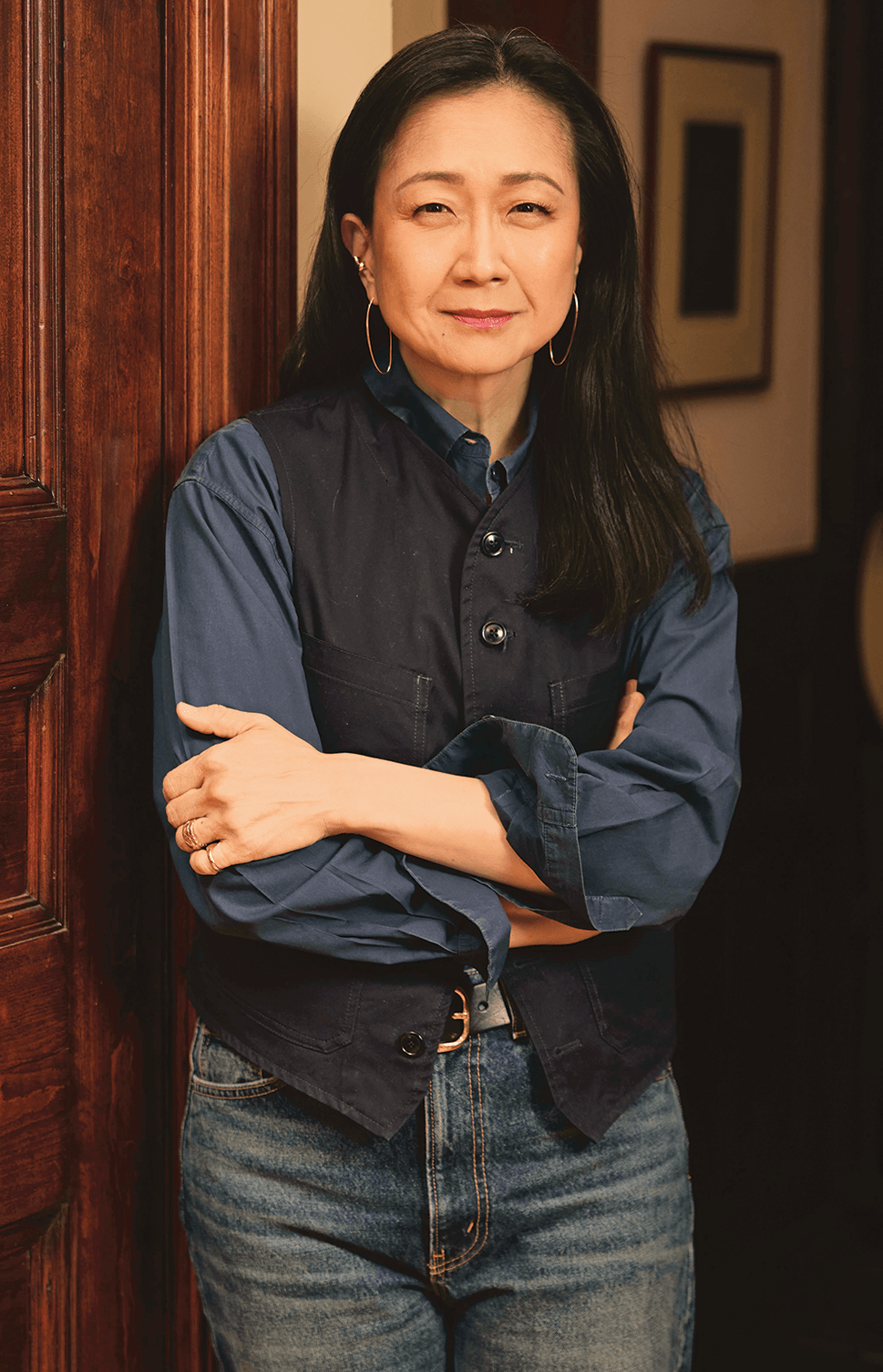
Min Jin Lee, author of American Hagwon. (Credit: Andres Hernandez. Photo assistant: Leo Alejandro.)
After being seated, Lee asks the server for a bottle of sparkling water and begins to scan the menu, not for her own favorites, but with an eye to what might be pleasing to her companion. “Do you like beef?” “Do you eat raw fish?” “I’ve never had anything bad here,” she says in a rapid-fire, cheerful delivery. “Once we deal with the food, I can concentrate on questions.”
Hunger, appetite, and satisfaction matter to Lee, on many levels. A committed feminist, she believes that women should be allowed to eat what they want, when they want, without societal judgment. A first-generation American whose family knew economic struggles in their early years after leaving Seoul, she went on to earn degrees from Yale University and Georgetown University Law Center and worked for two years in corporate law before a health crisis forced her to switch careers. That second career has paid dividends: Both of her novels, Free Food for Millionaires (Grand Central Publishing, 2007) and Pachinko (Grand Central Publishing, 2017), have been published to enormous popular and critical acclaim. Her third, American Hagwon, is forthcoming in September from Cardinal Publishing, a new imprint of Hachette.
Even in conversation her devotion to crafting exquisite prose is evident, as is her passion for reading. Before we’ve received one of the several appetizers she has chosen, Lee begins talking about books and authors, including nonfiction greats like Annie Dillard and Matthew Desmond and novelists such as George Eliot and Edith Wharton. When a reference to William Makepeace Thackeray’s 1848 satirical novel, Vanity Fair, arises, she agrees wholeheartedly that Becky Sharp—its cunning, ruthless protagonist—inspires her and in fact inspired Danbi, one of her new novel’s characters, a young woman whose upwardly mobile striving and conniving upends an entire family.
Lee herself knows what it’s like to be a striver. “Even after I became a National Book Awards finalist in 2017,” she says, referring to the National Book Foundation’s honor for Pachinko, “I still couldn’t get a teaching job in New York because I didn’t have the correct terminal degree. I managed to get an interview through a friend, and the interviewer said, ‘How did you get to my desk?’ It was over in minutes. I walked out and I was crying, sobbing on the sidewalk, thinking I did my life entirely wrong. My husband didn’t have a job, I was forty-nine, and our kid was a first-year in college. I thought, ‘I do everything wrong. I’m inefficient.’”
One might say that feeling of inefficiency is what threatens to trap the Koh family in American Hagwon. When comfortably middle-class paterfamilias John Koh loses his job and decides with his wife, Helen, to move to the United States, he accepts a low-paying, high-stress job at a seafood restaurant in Los Angeles in order to provide a base income for the entire family. While readers will understand early on the factors that motivate him, it is nevertheless painful to follow his endless striving as he leaves behind his own version of the American Dream in order to ensure one for his children—Bo, DH, and Mido—whose separate yet interconnected paths to success and self-actualization run through Sydney, Seoul, Los Angeles, and beyond. John’s and Helen’s decisions emphasize the greater social crux of the novel, where material success and personal ethics commingle and sometimes collide.
American Hagwon is the third novel in Lee’s planned tetralogy, which began with Free Food for Millionaires in 2007, continued with Pachinko in 2017, and will end with The Marshall Plan at an unspecified date. “It took me ten years to write Pachinko,” says Lee. “I hope this one will go a little bit faster. I have to be mindful of keeping my overhead low, because I don’t know how long I’m going to have to take.” Each book revolves around a different Korean family and community during a different era—or, in the case of Pachinko, eras. If the first book was about excess—set in Manhattan during the 1990s, it follows a daughter of Korean immigrants addicted to a glamorous lifestyle—and the second, which focuses mostly on Koreans in Japan during the post–World War II era, was about deprivation, American Hagwon is about education. One of its epigraphs is from James Baldwin: “The paradox of education is this—that as one begins to become conscious one begins to examine the society in which one is being educated.”
Lee says the new novel’s title refers not only to the Koh family’s particular educational training, but also to the entirety of their American experience. “A hagwon is any kind of lesson outside of formal education,” she says. “Many of them, like those started by characters in my book, focus on academic tutoring and exams, but if you take piano lessons or ice-skating lessons, those places are hagwons too.” In South Korea hagwons are often for-profit private educational institutions, but for the characters in her new novel, lessons learned extend far beyond the boundaries of a traditional education. As the Kohs move from Seoul to Sydney and on to southern California in search of their best life, both parents and children learn crucial lessons about different cultures—but they also wind up taking a master class in how the human heart can bring people closer together as well as tear them apart.

By now the four-top table (“We need the acreage,” she says) is littered with plates of delicious food, including cucumber salad, fresh oysters, and king crab dressed with pine nuts. The author waves her chopsticks at the feast. “I wanted to critique what it means to have all this excess and the inequity of capitalism and its codes.” She’s discussing the experience of attending two of this country’s most elite colleges and universities, as she did in the eighties and nineties, without understanding those codes. “There was all this pretense. I remember going to pizza parties my first year in college and bringing my five dollars because I thought I had to pay my fare to be at the table, even if I only had sixty dollars that month for everything. Then I’d see someone dive in for a slice or three and not contribute a penny.” During her undergrad years studying history, she worked at the Ann Taylor store in downtown New Haven, Connecticut, near the Yale campus, and sold clothes she couldn’t afford to her classmates. “For four years everyone pretends like they’re all equal,” she says. “But when you exit that door after commencement and there’s no generational wealth behind you, you can be lost.”
In Korea, Lee’s father was a marketing executive at a cosmetics company, and her mother was a piano teacher. When they moved to Elmhurst, New York, in 1976, when Lee was seven, for the first year they ran a newsstand in an office building: “Candy bars, mints, newspapers. His big improvement was adding an ice-cream [freezer]. We lived in Queens, but the newsstand was on 33rd and Broadway.” After a year her father became a business partner with someone who sold costume jewelry wholesale, at 1235 Broadway. “It [was] called Sunny Variety,” Lee says. “I worked there all the time, on weekends, when I was on breaks. I really felt like I was part of the family initiative.”
Lee’s own family initiative—by which she means the communal support of her husband of thirty-plus years; their son, now twenty-eight; and her parents—is strong, as she and her now-retired husband care for her aging parents, after the family cared for his own in their later years. “I’ve been married for a long time, and it’s such an incredible blessing to see my parents be so fond of him, and vice versa. For example, this past winter [my husband] found these rubber mats with wiring in them that melt the snow on your walkway. I feel like he should have favorite son-in-law status forever,” she laughs. “One of the things I think about a lot is how people always focus on the growth of their children, but parents grow—you have stages in parenting, too.”
So, too, do writers. For Lee the early stages of writing coincided with illness. When she was in high school, Lee was diagnosed with hepatitis B after a routine blood donation. “Basically, I got a letter saying, Please don’t ever come back to donate again,” she says. No one is entirely sure how she got the disease, but doctors determined it had been with her since birth. After years of uncertainty and pain, finally in her mid-thirties she received a blood transfusion that put her into remission, and she has been physically healthy ever since. But it was in the middle of that health crisis that Lee turned to writing full-time. In 1995, too ill to continue working as a lawyer, following a miscarriage and a difficult pregnancy, she became a mother. That same year, she writes in a letter included in the 2017 tenth-anniversary edition of Free Food for Millionaires, “We learned that beloved family members, who could no longer support themselves, were awash in catastrophic debt, and suddenly, we were responsible for another household.” Money was tight, and time was even tighter. By then she had been writing for six years, with two failed novels to show for it. But she stuck with it, taking inexpensive or free classes at the 92nd Street Y and other New York City venues whenever she could and reading voraciously. “There was so much to learn and practice, but I began to see the prose in verse and the verse in prose.” Shortly after she finished a first draft of her debut novel, which she would go on to sell to Grand Central Publishing in 2006, when she was thirty-seven years old, she learned from her doctor that a course of treatment with interferon had finally cured her liver disease. “One in a million, he marveled. I went home that afternoon, and I lay down on my bed with my good news. This life was unexpected. I told myself that I could not be so afraid of judgment that I would hold back. And so I did not.”
Readers around the world have benefited from that decision. Free Food for Millionaires was a national best-seller, Pachinko has sold over a million copies in the United States alone, and Cardinal has announced a massive million-copy first printing for American Hagwon.
At the heart of all three of Lee’s novels are tight-knit families, and in American Hagwon, the Kohs—despite being upended first by betrayal and then Asia’s IMF crisis, widely known as the Asian financial crisis—survive their various moves intact, each driven to succeed in their own way and to honor their family. The charming son DH, after graduating from Yale, moves to California, where his parents have resettled, and, seizing an opportunity within the large Korean population there, opens a hagwon with his dear friend Lion. DH chooses to employ his sister, Mido, and other friends because he recognizes their skills will prove useful to the endeavor.
But that’s not the only reason he hires friends and family. At one point Lion gives an impassioned speech to all the parents of the students at the hagwon. “As you know, I am very fond of your children. I’m grateful for them,” he says. “However, it’s clear to me that they are under too much pressure, and I thought that if all of us could change our mindset, perhaps examine where this pressure is coming from, then perhaps the children could have better lives. I feel certain that they would flourish as well. I’m interested in improving their childhoods, so they can become strong and well-adjusted young adults.” It is a pivotal scene in the novel, which builds on the immense strain and stress of South Korean students who are driven to acquire elite university degrees equated with socioeconomic success. Lion pushes for an adjustment of thinking, understanding that immigration involves change, on all sides.
“My books are a diasporic quartet; I’m writing about what happens when people leave a nation and change the nation they leave and also change the nation where they are,” says Lee. “Not to mention those people are changing as well.” One of the most powerful themes running through American Hagwon is about how families in a diaspora not only survive hardships, but also endure through times of celebration and happiness. The survival Lee writes about depends less on financial necessity than on the deep respect and love of family, which comes across in many scenes in the novel, including one in which a dying parent places keepsakes in separate bags for each of her children.
“I cried so much writing that scene,” says Lee. “The scene is really moving to me, because Helen’s trinkets aren’t necessarily all that valuable, but she wants her sons and daughter to know that they were of value to her.” She adds: “I cried so much over various scenes with John, too, because he’s so stalwart. He’s the moral center of the book.” In the Koh family, morals are often equated with money—not because the family loves money but because money earned and shared allows everyone to enjoy a better life. The frank discussions between parents and children about rent and mortgage amounts, car payments, and student loans give all of them the information they need to help one another.
Korean American author Angie Kim, whose second novel, Happiness Falls, was published by Hogarth in 2024, believes that Lee’s work both accurately reflects the first-generation experience and moves further into other aspects of Korean and Korean American lives. “When you don’t see people like you or stories like yours, it can start to feel like there’s only one kind of story to be told,” she says. “For example, in Pachinko [Lee] dared to portray Korean experiences in other parts of the world. It helped me to see that other Korean American writers don’t have to stick to the ‘bullied immigrant’ plot.”
Kim, who belongs to a writers group of Korean American authors called Fourth Kingdom, including Alexander Chee, Jimin Han, and Marie Myung-Ok Lee, believes that writing beyond the theme of assimilation distinguishes Lee’s work. “She didn’t just mine the well-known conflicts. She went to a different place and showed everyone that there are people who feel different in Asia, too. There are nuances of discrimination and bias that go beyond the way people look and speak. She examines history, lineage, ancestral grief, and trauma, all in ways that I find revelatory.”
Lee’s creative process includes interviewing people, examining real lives for background information that she weaves into the narrative. “What I noticed when I interviewed certain people for this book was that there might be a lot of different immigration statuses within one family,” she says. While this kind of material is invaluable, she still worries: “I feel really terrified of getting things wrong,” she says. “I’m writing fiction, so I shouldn’t stress too much, but I want to be as accurate as possible, especially when I’m writing about the legal process and things like that.”
She continues: “One young woman was born here, but her mother was undocumented and had been deported, so the woman was taking care of her two siblings. Things might come down to: The youngest one can afford to pay for the phone, the middle child can pay for car insurance, and so on. The woman had the whole thing broken down carefully.” While Lee knows that not everybody is in this situation, she believes it’s important for her readers to understand how a Korean family in the diaspora might handle financial insecurity. “It’s not going to be this politeness,” she says. “It’s a real privilege not to have to discuss your bank account with anyone else because there’s always enough in it.”
The Koh family is affected by emigration as well as another character’s actions but also by the 1997 IMF crisis, a period of economic decline that caused high unemployment and widespread bankruptcies in South Korea, from which it rebounded several years later. Even so, Lee says, the repercussions can still be felt. “The thing that I really worry about with Korea is despite all its growth, you have so many people living in so little space. The country has the highest rate of suicide and the highest rate of poverty among the elderly of industrial nations,” she says. “At the same time, we have a wave of Korean culture around the world, like KPop Demon Hunters, Parasite, Squid Game. It doesn’t really relate to the lived experiences of ordinary people. It’s bone-crushingly scary when you see how poor the aged can be, living in shacks, collecting paper, economic victims of the IMF crisis.”
She acknowledges that poverty also exists in the United States, and it’s one of the things that has led her to activism, on behalf of Koreans and other Asian Americans, and as a Democrat who supports New York Mayor Zohran Mamdani and Massachusetts congressional candidate Dan Koh, among others. Her strong belief in social justice plays a role in each of her published books, reflected in the hegemonic privilege of financiers in Free Food, the oppression of Korean service workers in postwar Japan in Pachinko, and the obsession some immigrant Koreans have with brand names and status symbols in American Hagwon.
Yet it may be her final book in this quartet, The Marshall Plan, that most clearly articulates Lee’s views on how humans should treat one another. “I think the Marshall Plan is the greatest thing the United States did in the twentieth century,” she says, referring to the U.S. foreign aid initiative, enacted in 1948, that provided $13.3 billion over four years to help European nations rebuild their war-torn economies, modernize industry, and prevent the spread of communism. “And I just think it’s such a beautiful idea that you can be generous, and it’s good for everybody. It’s not like the idea of ‘you give to me and then you lose.’ It’s ‘you give to me and we all win.’”
For The Marshall Plan, Lee is choosing to focus on South Korean miners and nurses who left their country in the 1960s and went to work in Germany. “They sent their money back home to Korea, so the book is about remissions. But it’s also about Koreans who went to Europe and learned about that continent’s art and culture and music and brought it back to Korea,” she says. As she makes clear, these were men and women doing hard jobs, “not high-level nursing, more like scut work,” and living frugally so that they could support families back home, much like Filipino caregivers do today in the United States.
Each novel Lee writes begins with a great deal of research. “I start with a question, and then I start to think about my own views on the topic. Then I do the fieldwork. I interview, I research, I visit places, I do the secondary research. I do a lot of academic research as well,” she says. “I read so much nonfiction, because I have to learn. There are all these interdisciplinary aspects: anthropology, law, economics, politics, it all gets in there,” she says. For American Hagwon, she had to learn about the education systems in South Korea, Australia, the United States, and England. “They’re all different. They have different timelines and different assessment methods. I thought I was going to lose my mind! For example, I didn’t know that becoming a lawyer in Australia is so different from becoming a lawyer in the United States. Even before I can get to the story, my head is full of details.”
In her upstairs office at her home in Harlem, she has a library wall with a special section for whichever novel she’s working on. “These aren’t books I’d necessarily read from cover to cover,” says Lee. “For American Hagwon my reference shelf holds over a hundred books.” For Lee that bookshelf is a reminder that storytelling is all about craft. “You can tell me ten really interesting things, but if there’s no execution involved, if it doesn’t hold up, I don’t really care,” Lee says. “A novel seems like a big, baggy thing that can hold a lot of weight, but you have to be very careful about the way it’s constructed. You have to know where all the drawers are. What’s the material? Is it built for the outdoors? Is it meant to be attached to a wall? All of that. So I really respect fellow craftspeople. I really care about the bowl of a spoon, the handle, its weight.”
As Lee speaks she is holding up one of the delicate spoons we’ve been given with the several desserts that have replaced our main courses. She laughs. “I’m a little OCD. I mean, I do have OCD. I do. I mean, I literally have diagnosed OCD, anxiety, and depression. I have all three. Trifecta!” Her longtime psychiatrist has told her that when you do the work of therapy, it can be a huge help with these conditions. “I can get depressed, I can get anxious, I can get overwhelmed. And I’ve become very good at allowing myself to feel like shit for a certain period of time, just taking a couple of hours to kind of sit there and sulk. I think that’s okay.”
She puts down the spoon and continues. “But then you have to promise yourself that you’ll get up and start again. But I also know that I’m never going to be a fast writer, or someone who writes funny books. I have friends whose work I admire who write beautiful books every three years. It must be so nice to be that efficient and that talented.”
One of the things Lee has begun to incorporate into her process is reading the Judeo-Christian scriptures in full each year. “I read that Willa Cather did this, and I decided to give it a try,” she says. “I am a practicing Christian. My grandfather was a minister who ran an orphanage. I’m steeped in that tradition and in this idea that we’re all connected, that I’m responsible for you, that I’m responsible for strangers. I’m responsible, to the extent that’s reasonable—and sometimes unreasonable. I believe that unless we practice sacrifice, something’s going to have to give.” And while she appreciates beauty, she says, “If you don’t care about people who lack housing or food or education, if you don’t care about the elderly and the very young, I don’t care about your beautiful ideas. That’s what it comes down to. Sell it somewhere else because I really need to see the work and the action.”

When Reagan Arthur came to Grand Central Publishing in September 2024 after a four-year stint as publisher of Knopf, American Hagwon was already under contract, so it wasn’t a certainty that she’d become Lee’s editor, but it did work out that way. “I take zero credit for that,” says Arthur, laughing over the phone. “One of the things I loved about the manuscript from the get-go was all of the women characters, each of whom is in a different situation, but all of these situations require some kind of sacrifice.”
Arthur feels strongly that Lee’s underlying ideas about her Christian faith inform the interactions between many of these characters. “Of course some of the characters in the book go to church, participate in faith-based activities, but what interested me was hearing Min herself talk about the principles of Christianity that gird, say, Helen’s devotion to her family. There’s a subtlety to how she handles this, where she makes a reader think that what these people are doing in community, as a family, is about a life lived according to faith.”
By the time Lee and I have finished our desserts and receive hot drinks—a decaf Americano for Lee, a mint tea for me—we’re back to talking about words. Or are we? “I think words are so powerful,” she says, and nods at my teapot. “We know the power of the verb ‘to steep.’ I remember one of my writing teachers in college sharing that you can always tell a writer by the verbs she chooses. And it’s true. If you look at a piece of writing, it’s not the adverbs. It’s always the verbs. It’s not the big words. It’s the choice of verb.” She then talks about her decision to be a writer, using the same verb four times: want. “Even when I’m really sad, I never want to go back. I’ve never wanted to say, ‘I hate this. I don’t want to do it anymore.’ I never once said, ‘I want to be a lawyer again.’”
Our meal concludes after nearly three hours, and although Lee needs to get back home, she insists on walking me from the restaurant to the McNally Jackson bookstore nearby, knowing that I haven’t visited that location previously. We take a turn through the first floor together, each of us pointing out books for the other, and for a few minutes we are not author and interviewer, just a contented pair of lifelong readers in our element. Before she leaves, Lee hugs me and says, “I can’t imagine a more perfect afternoon.”
An excerpt from American Hagwon
Throughout her childhood, Mido’s teachers had asked Helen to come in to discuss her daughter’s excessively quiet manner. At her preschool in Paramus, and in the first years of school in Seoul, Mido barely spoke with the other children and was left out of friendships. At her primary school in Sydney, the teachers had hinted at learning issues, despite her high marks. They’d encouraged her to talk more in class, advocate for herself, and work better in groups.
Helen saw herself as a modern, educated parent, and she wanted to help her youngest child. She took time off from work and visited a learning specialist, a speech therapist, and an occupational therapist. The doctors in Sydney pronounced Mido normal, more or less. A reputable pediatrician said there was nothing medically wrong with the girl’s hearing or vocal cords. The child psychologist believed that Mido’s shyness was cultural, and all the moving around might have confused her. Asian children, the school counselor had observed, were often less talkative.
Mido’s father, a high-functioning introvert who managed the natural resources department at a multinational trading company, dismissed such simplistic nonsense. Not all Koreans were quiet. His own family had been filled with loud people. At the slightest provocation or encouragement, his mother, father, and elder brother would shout and argue their well-articulated opinions. To be left alone, John had retreated into his studies, excelling at math and foreign languages. As an adult, he did not ask for much in life. He enjoyed listening to music and being in the presence of his wife and three children.
John wanted to comfort his dear Helen, who was clearly troubled that their daughter did not have friends. Throughout her own childhood, Helen, like her elder sister, was a natural leader—engaging, kind, and deliberate in her goals and methods, articulate in both Korean and English. In college, she had served as vice president of an English poetry society and secretary of a music appreciation group. Helen took her daughter’s difficulties personally.
John felt less anxious about his daughter’s prospects. Mido was a seventh grader who read at a college level. The other children did not appreciate her, he reasoned. When ready, she would speak up, make friends, and find the work she was meant to do. She would grow out of this social reticence. Helen, a devout woman, prayed he was right. Maybe Mido would be more outgoing if her self-assured brothers didn’t crowd her with their larger personalities, or if the Koh family hadn’t moved across the world every few years.
From American Hagwon by Min Jin Lee. Copyright © 2026 by Min Jin Lee. Reprinted with permission of Cardinal, an imprint of Grand Central Publishing, a division of Hachette Book Group, Inc.
Bethanne Patrick’s work has appeared in VQR, Elle.com, the Rumpus, the Grace & Gravity series, and elsewhere; her literary journalism has been published in the Los Angeles Times, Poets & Writers Magazine, and other publications. She is the author of Life B: Overcoming Double Depression (Counterpoint, 2023).