I don’t think of it as a memoir,” insists Edwidge Danticat when she describes We’re Alone (Graywolf Press, 2024), a collection of essays about writers she reads and loves, as well as the past and present of Haiti, where she was born. She prefers rasanblaj, a term that Haitian American artist and anthropologist Gina Athena Ulysse uses to describe an “assembly, compilation, enlisting, regrouping (of people, spirits, things, ideas).” Some of these essays are new, others are reframed or blended versions of previously published ones. Through the paradoxical title itself, Danticat celebrates the “singular intimacy” that writers have with readers, each alone yet together as they meet under the “canopy of language.”
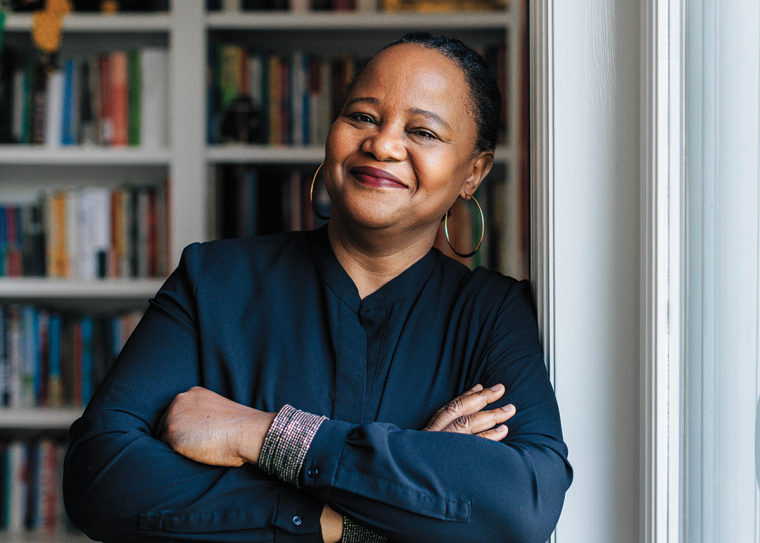
Edwidge Danticat, author of We’re Alone. (Credit: Marc J. Franklin)
Best known for her fiction, Danticat burst onto the literary scene in her mid-twenties with the publication of Breath, Eyes, Memory (Soho Press, 1994). That debut novel garnered national attention when Oprah Winfrey chose it for her book club—and brought in a Haitian chef to serve a dinner for the televised discussion. Over the next fifteen years Danticat produced five more books of fiction: A collection of short stories, Krik? Krak! (Soho Press, 1995), which was named a National Book Award finalist; a second novel, The Farming of Bones (Soho Press, 1998), winner of an American Book Award; two interconnected story collections that are considered novels, The Dew Breaker (Knopf, 2004) and Claire of the Sea Light (Knopf, 2013); and her most recent collection, Everything Inside (Knopf, 2019), winner of the OCM Bocas Prize for Fiction. Her numerous awards include a MacArthur Fellowship, the Neustadt International Prize for Literature, the Vilcek Foundation Prize, and several honorary degrees, including one from Smith College and another from Yale University.
All along this steady path of publication and honors, Danticat has written award-winning journalistic reporting, personal narratives, and social criticism. Brother, I’m Dying (Knopf, 2007), about the death of her father and uncle, was a finalist for a National Book Award and winner of a National Book Critics Circle Award. In 2010 she published Create Dangerously: The Immigrant Artist at Work (Princeton University Press, 2010), inspired by Albert Camus’s 1957 lecture “Create Dangerously.” The book began as a lecture delivered in 2008 at Princeton University as part of the Toni Morrison Lecture Series and received the OCM Bocas Prize for Nonfiction. A play of the same title, adapted from the book, was written and directed by Lileana Blain-Cruz and performed in Miami in 2023. In another collection of essays, The Art of Death: Writing the Final Story (Graywolf Press, 2017), Danticat recounts the months spent with her mother after she was diagnosed with ovarian cancer and explores how other writers have tried to come to terms with mortality. Michiko Kakutani described it in the New York Times as “a kind of prayer…an act of mourning and remembrance, a purposeful act of grieving.” We’re Alone follows this pattern in essays circling and entwining one another and addresses similar themes with a keener sense of urgency—of time passing and the constancy of change—through the artist’s awareness of the delicate precarity of life.
We’re Alone is divided into two sections “married,” says Danticat, by a preface, with topics ranging from tributes to “the literary loves of my life” (James Baldwin, Toni Morrison, Paule Marshall, Gabriel García Márquez, and others) to the colonial history of Haiti and the gangs that currently threaten the country, along with such global issues as environmental degradation and political violence against immigrants. At age fifty-five, Danticat is looking back over thirty years of publishing, the death of her parents and other family members, two daughters reaching toward adulthood, and a move back to New York City after living in Miami for over twenty years.
“I thought it might be a good time for a change,” Danticat muses as she talks about the most tangible shift in her circumstances when, in the fall of 2023, she became a full-time university teacher. She carries the title of the Wun Tsun Tam Mellon Professor of the Humanities in the Department of African American and African Diaspora Studies at Columbia University, the second person to hold this position, after Elizabeth Alexander, who is now president of the Andrew W. Mellon Foundation. Farah Jasmine Griffin, the William B. Ransford Professor of English and Comparative Literature and African American and African Diaspora Studies at Columbia, was one of the leaders building that newly established department. “I wanted to make sure that the arts were included, not just something you study, but something you take seriously as a way of thinking. For me that meant having an artist as full-time faculty,” Griffin says. “Our search committee considered all different kinds of artists, but Edwidge was always my ideal because I wanted our students exposed to her energy, her thinking, and her writing. She and I both loved Toni Morrison and spent time with her, so I had this idea of Toni at Princeton—so why not Edwidge at Columbia?”
Since Danticat attended Barnard College as an undergraduate, the Columbia University campus is somewhat familiar. “I know the physical landscape, and some of the professors I had are still here,” she says. “Having that memory of being in those classrooms and now being in front of students in some of the same classrooms makes it easier to imagine a future for my students, to project what they might be doing based on what I’m reading, what they’re sharing, and their interactions in class.” She laughs. “These eighteen-year-olds feel so much smarter than eighteen-year-old me!”
Each of the three classes she developed and taught during the 2023–2024 academic year evolved from her own interests as a writer and researcher. Writing in the Presence of the Ancestors, a graduate course, was anchored in Toni Morrison’s essay “Rootedness: The Ancestor as Foundation,” which had been collected in the anthology Black Women Writers (1950–1980): A Critical Evaluation (Doubleday, 1988). Seminal works were paired with contemporary readings written in response: Lorraine Hansberry’s play A Raisin in the Sun with Imani Perry’s Looking for Lorraine, James Baldwin’s essays with Eddie S. Glaude Jr.’s Begin Again, and Salamishah Tillet’s book In Search of The Color Purple with Alice Walker’s classic novel. Danticat also taught an undergraduate course, Sing a Black Girl’s Song: The Nonfiction of Nzotake Shange, that met in the author’s archive at Columbia. Danticat says she chose to focus on Shange’s nonfiction and go beyond the poetry and plays that have been the subject of critical and scholarly analysis. She marveled at seeing the students interacting with Shange’s objects: “Each student chose an item or set of items to study, so we had presentations on her jewelry, her magazine collections—things actually in the archive.”
Another graduate seminar, Harlem and Haiti, centered on writers from the Harlem Renaissance who spent time in Haiti and wrote about it, including Zora Neale Hurston, Langston Hughes, and Arna Bontemps. In all these courses she “brings the creative writing practice of thinking we’re in a process together into the classroom, so we’re learning together,” she says. “There’s a collaborativeness to it, and I’m delighted at how much I’m learning. Since I try to gear the classes toward things I’m also researching, the community element has been wonderful.”

In the preface to We’re Alone, Danticat explains the origin of the title—from a poem by the Haitian writer Roland Chassagne, “whose words read like secrets.” During the brutal François Duvalier dictatorship in 1963 Haiti, Chassagne was arrested for sharing “contraband literature,” imprisoned at Fort Dimanche, and never heard from again. The words “we’re alone” then could mean, Danticat writes, no one is coming to save us. Yet those same words can “be a promise writers make to their readers,” a feeling she recalls from her own experience as a young girl growing up in Haiti. “Of course the history of Haiti, the Haitian Revolution, is about standing alone, so you could say that we’ve been alone a lot in this global political way,” she says. “But I really wanted to go back to when I was little. I listened to people performing stories, singing, so flashy, and I thought that it was beautiful, but I couldn’t see myself engaging an audience in this performative way. When my uncle gave me the Madeleine book [by Ludwig Bemelmans], I remember sitting with it and thinking that I was alone with this person, whoever that is, we are alone together. I thought that’s what I can do. Sometimes the more you start writing about something, the more it provokes another layer of memory. I remember that feeling of being alone with the writer as very intimate. To this day when I read something personal that someone has written, I think they’re confiding in me, they trust me. So if I flip that into being the writer, it’s that I really trust the person on the other side—and We’re Alone suggests that intimacy.”
In the first section of essays, Danticat trusts her readers with stories of her interactions with authors who profoundly influenced her, whether in the flesh or spirit, pledging that “every word I put down on paper is an act of both witness and love.” She recalls discussions with her high school friend Norma about A Raisin in the Sun and the too-short life of Hansberry as well as how when she was in Grenada to receive an honorary degree from the University of the West Indies Open Campus, she felt the presence of Audre Lorde. She writes about Baldwin not as a literary critic, but as if the two of them are in conversation, especially through his 1953 novel, Go Tell It on the Mountain. When she writes, “This is what the best novels do, unbury the dead, or at least break down the doors and let the skeletons out,” it’s unclear whether she is thinking of his novels or her own—or both.
But it is when she shares glimpses into her relationship with Paule Marshall and Morrison that the intimacy feels palpable. For many years Danticat has been paying tribute to Marshall’s “kitchen poets”—women who “slip phrases into their stew and wrap meaning around their pork before frying it. They make narrative dumplings,” as she wrote in Krik? Krak!—but in We’re Alone she writes about having tea in Marshall’s apartment overlooking Washington Square Park in Greenwich Village when she encouraged a young Danticat to take a position as an adjunct at New York University. (She did.) The story of Danticat’s meeting Morrison in 2006 at the Louvre is the stuff of movies and magic. Morrison’s assistant called to invite Danticat to join Morrison and a group of other writers, dancers, and filmmakers at an event to be held at the Louvre several months later. Recently diagnosed with pneumonia and still nursing her newborn daughter Mira, Danticat declined. Morrison herself called to ask what she could do to change her mind. “I made what I believed was an unreasonable request,” Danticat writes. She would need her husband, mother, and mother-in-law to travel with her to help with the baby. Without hesitation, Morrison said, “Done,” and arranged a Paris apartment for the whole family.
Farah Jasmine Griffin says that the mention of Danticat’s name would cause Morrison’s face to light up: “She recognized Edwidge’s gift—that she was supremely talented—but also I think she recognized a kind of genuineness; there was nothing transactional. Edwidge wasn’t seeking anything from her, and Toni absolutely adored her.” Reading and hearing about Danticat’s connection with these writers, it is not difficult to understand why she cites—or confides—the line from Morrison’s novel Sula to capture the feeling she had in the presence of both Marshall and Morrison, the “sheer good fortune to miss somebody long before they leave.”

In the second part of We’re Alone the writing becomes more overtly political, the tone more assertive. Danticat has said that writing is for her a way of processing loss, and the four essays in this section are centered in contemporary Haiti and the Haitian diaspora, with graphic details of kidnapping, police violence, and the impact of living “in transit,” she says. “We don’t have the illusion anymore that we’re alone in anything because at this moment in the world right now, we can see these connections between our own personal struggles and a much larger struggle.”
She says she wrestled with whether readers, many largely unfamiliar with Haiti’s history and politics, might not understand. One way she addressed this concern was by focusing on individuals whose stories are not being told, such as Patrice Michel Dérénoncourt, an attorney, criminologist, engineer, and academic who was kidnapped the same day, October 16, 2021, as the seventeen Mennonite and Anabaptists from the Ohio-based Christian Aid Ministries. Dérénoncourt was killed because his family lacked the ransom money the kidnappers were demanding—almost a million dollars—and his death was neither noted nor reported outside of Haiti. “I knew a little about him,” Danticat says, “but then I went down the rabbit hole and started reading about him, I went to his Facebook page, where he had this correspondence, and I thought that this one person who meant so much to us was hardly mentioned except locally. I thought his story should also be told, like that of the others. That’s what I want the reader to come away with: that there are these individuals who are also suffering but who also have joy, they do art….” Poet, novelist, and photographer Rachel Eliza Griffiths describes Danticat’s ability to bring Haiti to her readers regardless of their experience or backgrounds. “Haiti knows and remembers Danticat’s bones, and her pages tend the bones of her beloveds,” she says. “Haiti speaks because these voices, which Danticat reminds us are also our own, are called to testify.”
Water—the beauty of the sea, the lure of the shore, the Middle Passage, the destruction of hurricanes, even toxic waste that pollutes beaches—is a leitmotif throughout We’re Alone, but it becomes a metaphor for the essay itself. In 2020, Danticat’s daughter Mira took an online precollege course, Writing the Self, with this inviting description written by the teacher, Erica Cardwell, a writer and critic affiliated with the University of Toronto in Scarborough:
Imagine: “The Essay” is a body of water—far-flung and teeming into the distance. And you, the writer, are alone on shore. Will you enter the water? And if so, how will you swim? Or will you stand on shore as the water splashes against your ankles?
Cardwell says that she uses the metaphor as a teaching tool to broaden her students’ conception of what an essay is: “To be really open, I’m not a good swimmer, so when I think of the essay as a body of water, it’s an ongoing attempt, a persistent process, to conquer something. It’s a metaphor that works for me as a writer.” Danticat was so taken by the course description that she asked permission to use it in an essay she was writing that eventually became the final chapter of We’re Alone. Cardwell says she has read and admired Danticat’s work, but “for her to feel connected to my teaching is one of the biggest compliments in my career as a teacher.”
A striking feature of We’re Alone is the presence of Danticat’s daughters, Mira and Leila, who enter and exit, quite naturally, in various essays. That might not be surprising given the mother-daughter relationships that are at the center of much of her fiction. But this is closer. Danticat writes, “In my own life, I wrestle with mortality by keeping a pocket-size notebook with a list of instructions and counsel for my daughters.” She questions the neatness of the clinical stages of grief, a kind of linear model, because, she says, after her parents’ death, she thought there should be another stage—pure terror. “What I felt most when my parents died and I had younger children was terror that I could die and leave them,” she says. Thus the notebook, an instructional manual that ranges from, as she writes, “what they might call cringe (‘Do not ever underestimate how awesome you are’) to the spiritual (‘Keep some element of faith in your life. You saw how your grandmother’s faith brought her such solace and comfort as she was dying.’).”
In the passages about her daughters, the process of reframing rather than repeating earlier work is clear. The heartrending description, for instance, of four-year-old Edwidge clinging desperately to her mother in the aiport as she walked toward her flight to join her husband in New York City—leaving Edwidge and her brother with their uncle and his family for eight years—has appeared in a number of Danticat’s writings, yet this time has a separate layer. “Of course, we’re working with the same life,” she says, “it’s the same experience but within a different prism—being older, having lost my parents, having my own children who are nearly adult. I’m seeing how this material, this experience, looks now in the present.”
In one of the most powerful chapters, “By the Time You Read This,” Danticat quotes Frantz Fanon’s assertion that living in a Black body means living with “certain uncertainty” and reflects on Baldwin’s letter to his nephew, titled “My Dungeon Shook,” warning him of what it means to live in a society that cruelly and summarily devalues him. When asked whether We’re Alone might fall into the tradition of Baldwin’s letter and more recently Ta-Nehisi Coates’s book-length letter to his son, Between the World and Me (Spiegel & Grau, 2015), Danticat wonders: “I hadn’t thought about it that way, but there’s so much of writing that is unconscious. This little book is a part of my heart and falls exactly into what you’re saying.” And with Mira in college and Leila in high school, it’s far from finished; as Danticat writes, “I am still drafting a ‘My Dungeon Shook’ letter to my daughters.”
Yet she seems to be circling around that letter or a similar one that is less a warning to be ever vigilant and more an exhortation to remember. Danticat points out that even in her early fifties, she became one of the oldest members of her father’s family and thus was viewed as an elder. She writes about mourning individuals, place, and possibility. In the past she wrote of immigrants who had come, like her parents, to the United States seeking a better life for the next generation but always looking forward to returning, even in retirement, to Haiti. With that possibility increasingly dim today, the loss of “homeland” exacts a heavy toll on connection of every sort.
Although Danticat and her husband frequently visited Haiti and took their girls to stay with their paternal grandmother at her home in the rural town of Gros Marin, that home was damaged, rebuilt, and nearly destroyed by hurricanes and earthquakes, and rebuilding is untenable with gangs controlling much of the country. She is now in New York City, missing the neighbors, community, and rituals that would support her as she ages. Mira and Leila, who last visited Haiti in 2008, speak Kreyòl, though Danticat points out that “like most immigrants’ children, they answer their parents in English.” Under such circumstances, to remember is life blood, as Danticat writes: “Families…expand like ripples in a pond. Migration forces you to remake your family, as well as yourself. Family is not only made up of your living relatives. It is elders long buried and generations yet unborn, with stories as bridges and potential portals. Family is whoever is left when everyone else is gone.” That may be the message, maybe even the “My Dungeon Shook” letter, that Danticat is writing to her daughters in We’re Alone.
Danticat is enjoying being back in New York. One of her brothers and his family live in Brooklyn, another brother is in Mount Vernon, and a third nearby in New Jersey. As a doting aunt to eight nieces and nephews, she appreciates “the whole different dynamic” of no longer being a visitor and being able to meet for lunch, stop at a bookstore, and just hang out. “It makes me sentimental to see these babies having lives away from their parents,” she says with affection. The pace of her work, however, continues. Watch Out for Falling Iguanas, a children’s book with illustrations by Rachel Moss, is scheduled to come out in 2025. She is revising a manuscript for another novel, which she says is “in process,” and writes regularly for the New Yorker and a host of other publications. She is planning a new course for the fall semester at Columbia University on photographs from the African American and African diaspora, again following her own research interests, in this case visual art. After “Look at Me: Photographs From Africa Past and Present,” a lengthy piece she wrote for Harper’s magazine in 2013, she has published essays on artists including Betye Saar and Widline Cadet, whose photograph is on the cover of We’re Alone.
And Danticat refuses to give up hope. As she wrote in a recent New Yorker article, “The Haiti That Still Dreams,” Haiti needs a new narrative to replace the single story of catastrophe. She says that she does not underestimate “the purposeful deconstructing of physical structures and institutional structures by these armed groups, more a paramilitary than a gang,” but she knows “so many wonderful people inside Haiti who are working hard day by day, on both the micro and institutional levels, against what is happening, and you have to hope that one day they will win.” Her most recent visit to Haiti was in 2019, yet she continues to tell inspiring stories of her homeland and its people. As she promises in the final lines of We’re Alone, “I too have been lost, but eventually, words, stories, images find me. Once again, I have entered this body of water, and suddenly I am no longer on the shore. Vwayaj la a p kontinye. The journey continues.”
An excerpt from We’re Alone
They Are Waiting in the Hills
When I was asked to speak at Ms. Morrison’s memorial service at the Cathedral of St. John the Divine in New York City on November 21, 2019, a service that also included the writers Jesmyn Ward, Ta-Nehisi Coates, Michael Ondaatje, and Oprah Winfrey, I began to see her and aspects of her work everywhere.
I saw her in bleak and sunny skies. I saw her in daisy trees. I saw her on benches by the road. I heard her voice in church hymns, spirituals, and jazz tunes, because she was, as she wrote of Jadine in Tar Baby, “not only a woman but a sound…a world and a way of being in it.”
I kept seeing her, too, in shiny, beautiful hairpins woven through gray locks. Each time she’d given me one of those hairpins, I felt as though she was sharing pieces of her infinite crown with me. I felt her presence in her sister writer friends, Sonia Sanchez and Nikki Giovanni, and Black women writers closer to my age and younger, like Jesmyn Ward and Tayari Jones. Though she carried a particular strand of genius in every single cell of her body, she had constantly reminded us that it is indeed not scarce and that we, too, could skillfully, beautifully, and politically tell our stories. (“If there is a book that you want to read, but it hasn’t been written yet, then you must write it.”) This had made it so much easier to tremble less in her physical presence. Because “quiet as it’s kept,” she half giggled when she laughed and had a twinkle in her eye when she was in the presence of someone whose company she enjoyed. She drank vodka on a cold day—the really good stuff—and smoked cigarettes. At the Louvre, she was the literary giant that is Toni Morrison, but she was also Chloe Wofford, and she allowed me, in brief, privileged moments, to see them both, for which I will always be grateful. Her work was, of course, sublime. We do not just read it, we experience it. She gave us both lullabies and battle cries. She turned pain into flesh and brought spirits to life. She urged us to be dangerously free. She gave this foreigner a home. Her work has carried me through adolescence and marriage, parenthood, and orphanhood. I have recited and paraphrased her sentences to myself while cradling the tiny bodies of my newborn daughters (“They get bigger, older, but grown? What’s that supposed to mean?”) and the skeletal faces of my dying parents (“Soft as cream”). I hoped that, like Baby Suggs, they too would die soft as cream. And I came to think of her, as she wrote in The Bluest Eye, not only as a friend of my mind but as someone who “does not want me to die.”
“Death is as natural as life,” she wrote. “And you sure did live in this world!” I said in the church that day. Some called her Sister, Soror. Others called her Teacher, Editor, Beloved, and Mentor. “We still call you by those names,” I said, “but now we also call you Timeless. We now call you Ancestor.”
From “They Are Waiting in the Hills” from We’re Alone. Copyright © 2024 by Edwidge Danticat. Reproduced with permission of Graywolf Press, Minneapolis, Minnesota, graywolfpress.org.
Renée H. Shea, formerly an English professor at Bowie State University in Maryland, has written extensively for Poets & Writers Magazine, most recently a profile of Julia Phillips. She writes an interview series on poets laureate for American Book Review and leads an author team for the English Language Arts High School Series for Bedford, Freeman & Worth.