With a graceful flick of the wrist, Garth Greenwell produces a small pink fan, unfolds it, and flutters it in front of his face, an elegant move executed with such deft sleight of hand I don’t notice whether he pulled the fan from his bag or back pocket. I’m impressed and envious—sweat stipples my forehead as well. We’re at a café in New York City’s Greenwich Village. Outside, the overcast day cannot decide whether it wants to be muggy or chilly. Either way it’s uncomfortable, and as we order iced coffee we reminisce about the last time we met in person, in November 2019, in the same neighborhood, when the weather was inhospitable in another extreme, windy and frigid. Since then, the COVID-19 pandemic changed everyone’s lives, but for me and Greenwell something else changed, too.
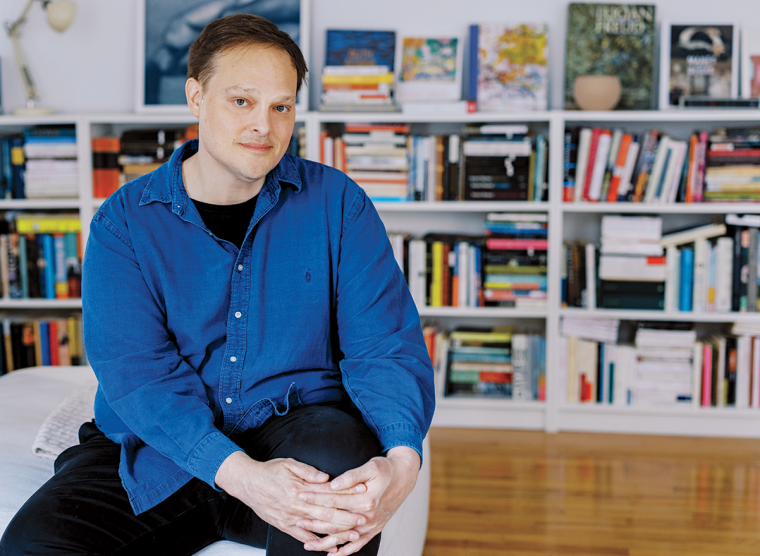
Garth Greenwell, author of Small Rain. (Credit: Rebecca Ou)
In July 2020, in Brooklyn, I was hospitalized for a sharp pain in my gut that several hours of scrutiny and tests determined to be caused by an intestinal blockage. Surgery cleared it, though no one could figure out why a forty-something like me, healthy and without a history of digestive issues, would experience a life-threatening problem like this, more common in much older people. Around the same period, in Iowa City, where he lives with his partner, Greenwell was also hospitalized. In his case, the issue was with his heart. His latest book of fiction, his third, the novel Small Rain, out in September from Farrar, Straus and Giroux, begins with just this situation: An unnamed narrator enters the hospital during the height of the pandemic for a torn aorta, a painful and potentially fatal condition not often experienced in middle age. To treat the problem requires knowing what caused it, and that mystery catalyzes the narrative.
In a bright corner by the front window of the café, the fan now folded on the table next to his coffee, Greenwell explains how the novel grew out of his own medical emergency. “In some sense, writing Small Rain was my trying to deal with mortality. At the heart of this book is the question, ‘Okay, if this is it, then what has my life meant? How does one measure the value of a life, and how would I measure the value of mine?’”
A powerful existential question to ponder, and yet Greenwell’s experience in the hospital felt anything but dramatic in the conventional sense. In its wake he wondered, “Can I make a book about a guy lying in a bed for ten days? Can that be a novel? And if that’s the narrative shape of the book, then what else can fill it?”
He saw in this aesthetic problem the contradictory sensations that being hospitalized evoked: As a patient, one must literally be patient—passive, disempowered, waiting for health care providers to do something for you or to you in order to solve your body’s puzzles. This is a profoundly boring experience, and yet surviving a mortal predicament is the antithesis of boring. In Small Rain, the narrator finds the most mundane activities of his treatment—the thrice-daily heparin shots to decrease the risk of blood clots, navigating the bathroom while encumbered by IV lines, the little machine that chirps as his vitals change, among many other daily routines—fascinating, part of an adventure he may not make it out of alive, though there’s nothing he can do to affect his situation other than bear it. In terms of story and structure, this fascinated Greenwell. “The whole idea of a protagonist is predicated on action, change, agency. How can you have a protagonist from whom all those things have been taken?” And yet, Small Rain is the opposite of lethargic or dull. It pulses with vitality.
That’s in part because, stylistically, Greenwell builds upon the techniques of his previous books, What Belongs to You (FSG, 2016) and Cleanness (FSG, 2020). In both, Greenwell writes from the body in a way that illuminates how the often-inane language and repetitive actions of sex become profound when lit from within by desire. His prose follows his narrator’s thoughts so intimately that it dips and dives between the physical and abstract, the present and the past, the earthy and the elevated, much as everyone’s thoughts do, in the middle of a meeting, or during a romantic kiss, or even when reading an article like this one. In Small Rain, the same happens, only the body on the page is one in a crisis not of sex but of life and death. “My literary project is basically phenomenological,” Greenwell says. “The experience of this body in this moment in this condition doing this daily, mundane, but also bizarre thing—that is literature.”
Greenwell—who fell in love with art at the age of fourteen when a choir teacher recognized his vocal talents (when he’s speaking his voice has a warm, rich tone, gentle yet commanding when excited) and who remains passionate about a wide range of music that centers on the human voice, from the twentieth-century English composer Benjamin Britten to the pop experimentalist Björk—says Small Rain has a recitative/aria structure. In opera, recitative refers to the dialogue meant to move the story along, while an aria is a display piece for a soloist. The recitative moments in Small Rain occur during visitations between the narrator and his partner, a poet identified only as L, or the narrator and his caregivers, like Alivia, his nurse. These moments introduce new topics or themes and expand on the mystery of his ailment. Most of the time, though, the narrator is alone in his hospital bed, during which he soliloquizes on a variety of subjects, including grand topics like love and the making of a home, the English contralto Kathleen Ferrier, dogs, and a passage about the potato chip that Greenwell included in part because he found it delightful. It is these arias, more than the medical mystery, that are the throbbing lifeblood of the narrative, as the narrator essentially considers whether the life he has lived, one devoted to art, beauty, and pleasure, has been worth it.
“What really interests me as a writer,” Greenwell says, “is the question of meaning-making. Human beings are meaning-making animals; that is what is distinctive about us. Sex, romantic love, God, art—which are all things that I’m interested in—are ways of thinking about making meaning in life.”

In the flat, white light of the plate glass window, Greenwell appears attentive but relaxed, munching on ice cubes whenever I ask a question. The baristas have on a mix of classic rock, but Greenwell’s full voice carries over the music. While Carole King belts out “I Hear the Earth Move,” he shares about how he came to prose almost by accident. After his early education in singing and music, he dedicated himself to poetry. Then, in 2010, while living in Bulgaria and teaching English at the American College of Sofia, he found himself inspired by his experiences abroad to try prose, something he had done only when composing critical pieces about art. He considered the work, drafted longhand in the early hours before school, just a project, not a book. What emerged were short fiction pieces about an unnamed narrator, a gay man from Kentucky, a poet, teaching English in Sofia.
Greenwell’s first book, the highly acclaimed What Belongs to You, is a triptych composed of three of these pieces: The first and last sections tell of the narrator’s relationship with a hustler, Mitko, whom he meets while cruising public men’s rooms, a dangerous activity since prostitution is an arrestable offense and homosexuals in Bulgaria are the targets of discrimination and sometimes violence. The incongruous middle section addresses the narrator’s youth and sexual awakening in Kentucky. Greenwell’s follow-up, Cleanness, is built of short fictions that fit in and around the Bulgaria sections in What Belongs to You. The pieces in this book, which Greenwell compares to a song cycle, explore the narrator’s love of teaching, his sex life, his search for romantic love, and his passion for poetry and art.
The narrator of Small Rain is the same as in the previous books, and some years have passed since the events of Cleanness. In that interim, the narrator met and fell in love with L, and together they bought a house in Iowa City, where they both teach. Greenwell hopes that readers do not see this domestic phase of the narrator’s life as a repudiation of his promiscuity in the previous books; there is not meant to be an implied hierarchy. However, this is a less sexually explicit story than Greenwell’s first two books. (He says a friend joked, “Thank you for writing a book I can buy for my mom.”) The narrator’s torn aorta takes sex off the table and turns his thoughts to love, partnership, and the comforts as well as the challenges of nesting. “The first two books are invested in a certain kind of erotic adventuring that’s very recognizable as adventure,” Greenwell says. “The challenge of this book is to see that domesticity is itself an adventure. The process of knowing someone, even over many years, is never exhausted; it is never finished.” While the relationship between L and the narrator in Small Rain looks very different from that between Mitko and the narrator in What Belongs to You, in their marrow they are the same—a search to know someone else more intimately, to love that person more fully, and, in the process, to know and love the self.
While much of the narrator’s biography hews close to Greenwell’s own, none of this is autofiction. In fact, Greenwell loathes that term. “Life comes without shape,” he tells me. “In that sense, narrative is always utterly fictional and artificial.” The raw data of his life is processed, sometimes elaborately, in the process of narrativizing it, and in plenty of places Greenwell makes stuff up entirely. For instance, in Small Rain, the nurse Alivia is pure invention. No ICU nurse would ever work such long hours so many days in a row, nor is the character directly based on any of the caregivers Greenwell encountered while in the hospital himself. But for the sake of aesthetics, and the narrative through-line of the book, Alivia is present from start to finish, and her relationship with the narrator allows for intimate discussions to unfold between them. In ways both big and small, Greenwell makes these kinds of imaginative choices in service to the art of the book and the logical, thematic demands of the narrative, without regard for whether they fit in any factual way with his own biography.
In the past, writing in a shorter form felt like a way of tricking himself into writing a book, but with Small Rain he committed to a novel-length narrative from the outset. Even three books in, Greenwell admits that felt “daunting.” This is also his first book set entirely in America. He hadn’t anticipated writing about Iowa—he was preparing to write a novel set in Kentucky (where he was born, in Louisville, in 1978), but the pandemic made traveling for research impossible. Nor did he ever imagine living in Iowa, for that matter, or being in a stable, long-term relationship. “I associated literature with a bohemian existence,” he tells me, and had “an obvious resistance to a certain kind of bourgeois life.” For a long time he also dismissed the virtue of neighborliness, and yet he saw it firsthand in Iowa City, this “little blue dot in a very red state.” He continues, “This book asks the question: How do we live with each other? The narrator wonders that about himself and his partner, and about himself and his neighbors. That leads to an explicit political thinking that is different from my first two books.”
As Stevie Nicks croons “Landslide” through the sound system of the café, Greenwell describes how, despite these differences in content, much of his process has remained the same as when he began composing fiction. He still works privately and does not share his work with early readers. He writes by hand in large notebooks, which he organizes almost like a screen, with marginal spaces for him to deposit notes and ephemera, fragments of thought. Slowly, generatively, the drafts grow, are refined, and eventually typed. By the time his agent or editor sees a word, the project is complete. And he remains guided by two principles: Be patient and be indulgent. He aims to drill deep into every moment, every sentence, every scene, and he resists thinking of narrative as a means to an ending. In other words, he doesn’t compose a scene considering the information it needs to convey to a reader in order to move the story forward toward conclusion; he allows himself to follow his thought organically where it goes, open to the surprises he might find as he works without a goal.
“Art encourages a relationship to time that is radically unproductive, radically un-instrumental,” he says, his voice thick with ardor. “It is always a gamble.”
An artist can never know if their work is going to come together, whether that be a novel, a painting, a song, anything. And that, he says, is the real question, the one that matters. Of course, false questions often get in the way of creative work too—questions about the value of the art as a product, a form of commerce. Questions like: Will this book land me an agent, or get published, or sell enough copies to pay my mortgage? Those are entirely unhelpful questions to consider from a process point of view. For Greenwell, writing requires putting all of that aside in favor of immersion, discovery, and bewilderment.
“If I believe anything about art, I believe that art is a way of looking. It’s not a subject matter; it’s an orientation toward existence,” he says. “I think the whole reason we have art is because we are fundamentally bewildered in the face of existence. We have to shut down that bewilderment almost all the time just to function as human beings in the everyday world, but art is a space where we can be vulnerable to that bewilderment. But you only get there through patience and indulgence.”
While Marvin Gaye and Tammi Terrell trade lines on “Ain’t No Mountain High Enough,” I ask Greenwell about what I see as a blurring between his critical work and creative writing. We live in an age crowded with newsletters—some mornings the majority of messages in my inbox are Substacks. Navigating this digital republic of letters can be overwhelming and requires prioritizing. Greenwell’s newsletter, To a Green Thought, lands at the top of my list. It’s delivered several times a month, and in it Greenwell writes expansively, often effusively, about the art he has recently encountered—theater, opera, museum exhibits, film, and, of course, literature. His artistic acumen astounds me, as does the breadth of these pieces, which zoom close for line readings or scene analysis, then pull back to situate the particular work of art within the artist’s career, life, and influences. Several of the arias in Small Rain remind me of this work, especially one—and Greenwell knows exactly which one. “The thing in this book I’m happiest and proudest of is that the fourth section opens with a fifteen-page essay on a poem which really is just an essay on a poem—and it goes hard as an essay on a poem,” he says. “But the narrator thinking about a poem in a way that is adequate to that poem is part of the same endeavor as when the narrator tries to think about L in a way that is adequate to their relationship.”
He continues: “Engaging with art is like engaging with a person, and in both cases what it means to engage fully is what it means to engage with one’s whole life.” Here, I think, is what makes Greenwell’s writing in his Substack so special on the level of art criticism—it is rooted in a profound love for art and aesthetics, and from that place of devotion, it elucidates the art for the reader in a way that is just as surprising, delightful, and beautifully composed as the art itself. At their best, Greenwell’s missives feel like a brilliant friend has just finished a coffee and is expounding to you with passion and erudition on a subject they’re fully steeped in—and now that I write it, I realize it is very much like the experience of sitting and talking with Greenwell himself.
Unlike his fiction and published essays, Greenwell’s Substacks are composed on the computer, relatively quickly. What subscribers receive are almost first drafts, and he admits that because of his commitment to publishing at least two a month there are times that he gives himself permission to return to the familiar and, say, document a close reading of a favorite paragraph or poem. Typically, though, his letters capture the experience of being surprised or moved by a work of art that is new to him—and this is what keeps him engaged in writing them. Take, as a recent example, Greenwell’s missive about Italian filmmaker Alice Rohrwacher’s latest, La Chimera. He tells me that he wandered into a cinema and saw the movie with no expectations and felt, while watching, a sense of wonder. That led him to see the film several more times, then to seek out Rohrwacher’s other films, and also to rewatch the Fellini, Pasolini, and Rossellini films that inspired her. “That experience of just diving into an artist’s world,” he says, “that’s what I live for.”
These are like mini classes he designs for himself, short periods in which he indulges his obsession for a particular artist. (While I worked on this profile, Greenwell sent a follow-up essay extolling Rohrwacher’s first feature film.) “An aesthetic education only happens through intense engagement with great artists,” he says. “For me that engagement means as holistic an engagement as possible. Reading everything, not just the greatest hits.” He makes clear that this education, like his approach to writing fiction, is not goal-driven. There’s no “payoff” in terms of what this experience will mean for his own art. He even hates putting it that way. Rather, full engagement is an occasion for pleasure, which brings Greenwell back to the page feeling inspired and sometimes excited to try something new. His favorite experiences with his Substack have been accidental like this—seeing a movie like Jonathan Glazer’s The Zone of Interest, or a Darrel Ellis exhibit at the Bronx Museum, and having the experience of walking into someone’s consciousness and wanting to find out more about them.
Real-world commitments—his teaching position at New York University, for one—prevent him from having as much time and space as he’d like for this kind of engagement, and that’s also what he loves about the Substack. “There’s not a magazine willing to pay me to take a week of my life in order to learn everything I can about Alice Rohrwacher,” he says. “So it’s hard to justify doing that. And, unfortunately, I do often have to think of my critical art writing in financial terms as a way of protecting my fiction.”
Cleanness was the first time Greenwell brought a flavor of his critical writing into his fiction, in a piece where the narrator looks at paintings, but in Small Rain this happens more explicitly. “I love the fact that the novel can be capacious enough to make space for critical art writing in this way,” he tells me. “I like the idea that my fiction writing could become porous to that essayistic attention and also that my critical art writing can become porous to the affective, whole-life holistic writing that happens in my fiction.” Seen in this light, Greenwell’s Substack is another aspect of his phenomenological project of documenting a life oriented toward art, a life lived fully, open to the bewildering beauty of our own humanity.
In Small Rain, on his sickbed, facing death, Greenwell’s narrator returns again and again to the question of what makes us human. “Humanness is an endeavor,” Greenwell says. “Stepping into one’s humanness is not about the biological fact of participation in the species. It is an orientation to the world that involves effort and a certain kind of aesthetic thinking, and moral thinking, and engagement with others.”
He continues: “My music, poetry, fiction, all of it is the same quest to understand, outside of a theological context, where does meaning come from? I think it comes from love and also art.”
As a fellow writer who passed through the dark days of dealing with a mysterious, life-threatening complication, I find his philosophic words stirring something within my chest. To live fully is to give all of yourself to the things you care about—the ecstasies of the body, the excitement that comes when mind touches mind through art, the journey of knowing someone else intimately, of loving them, and yourself, over time. In book after book, this is the life Greenwell documents his unnamed narrator living, and in essay after essay, he writes about living that life himself. Much can and should be made of Greenwell’s exquisite sentences—line by line, he is a true poet—but to me this is the exalting importance of his work, which is truly iconoclastic in its unabashed exuberance about being a body here on this earth, often confused and troubled but also experiencing joy in everything from operas and blow jobs to salty potato chips and a single, deep breath.
An Excerpt From Small Rain
I still couldn’t read. But I could stare at a poem, a short poem, letting my eyes focus and relax, my attention come and go; and there was one poem in particular I stared at hour after hour, in the book I had asked L to bring to the hospital. It wasn’t a special poem, or not to anyone I knew of but me. I had thought of it because it was about a sparrow, it had come to mind every time I saw the sparrow outside my window, or the several sparrows; there was never more than one, but it couldn’t have been the same bird every day. The poem was by George Oppen, a poet I had come to love in graduate school, though I found him hard, even when I wasn’t in a hospital bed, drugged and groggy; I seldom felt I understood him, not in a way that I could package or paraphrase, reduce to propositions. They were hard poems to teach, though I kept trying to teach them; they were gnomic, almost impenetrable sometimes, abstract. He liked to play with the little function words of English, participles and prepositions; words were like gravel for him, little stones he sifted through his fingers. I liked that about him, I liked that his poems were less psychological than the poems I was usually drawn to, less shifting moods than blocks of light or sound, tonalities; I liked how different they were from the poems I wrote. And I loved how, among the abstraction, his images became luminous, shards of the real, non-abstract world, occasions for wonder. He had a poem about deer that was one of my favorite things; I had read and taught it so often it felt internal to me, like a bit of my consciousness that had somehow stumbled into the world, a prosthetic consciousness—which is something poems can be, they can create new spaces in our interiors sometimes, not just giving language to something that was mute before but generating something new. Poetry is the accoutrement of the self, one of my professors liked to say. That they are there! the poem exclaims, the one about deer, a line that came to me every time L wore his pijama de ciervos; when he came to bed and I put my arms around him it was just the expression I wanted of wonder, making no claims, demanding nothing, postulating no predicate, a wonder at sheer being.
From Small Rain by Garth Greenwell. Published by Farrar, Straus and Giroux, September 2024. Copyright © 2024 by Garth Greenwell. All rights reserved.
Brian Gresko is a writer and illustrator based in Brooklyn, New York, who co-runs Pete’s Reading Series. Gresko is a founding member of Writing Co-Lab, a teaching cooperative.