




Making a Nobel Case for Philip Roth
After odds were released earlier this week citing Syrian poet Adonis as top contender for this year's Nobel Prize for literature, the Millions released an open letter calling for Philip Roth to receive the honor—one of the only major awards missing from the Connecticut writer's resumé.
As of Monday's forecast by British gambling company Ladbroke's, Roth has twenty-five-to-one odds of taking the Nobel, given to an author who has produced "the most outstanding work in an ideal direction."
"Can we please stop the nonsense and give Philip Roth a Nobel Prize for literature before he dies?" begins the letter, written by Michael Bourne, who recognizes Roth for his brilliance at tackling the subject of "the essential unknowableness of the human heart."
"The case for Roth's candidacy for a Nobel Prize isn't that he's a nice guy; it is that he's a genius, and in Roth's case, his genius lies in his audacity," Bourne says. "Audacity without intelligence begets mindless spectacle, but Philip Roth is the smartest living writer in America, and his work, good and bad, brilliant and puerile, is among the best this country has ever produced."
According to Ladbroke's, among the authors heading up the list of Roth's competition are Tomas Tranströmer (with projected odds of nine to two), Thomas Pynchon (ten to one), and Haruki Murakami (sixteen to one). Fellow American luminaries Don DeLillo, Cormac McCarthy, and Joyce Carol Oates join Roth in the twenty-five-to-one camp.
The winner of the ten-million-kronor prize (approximately $1,463,830) will be announced on a yet-undisclosed Thursday in October.
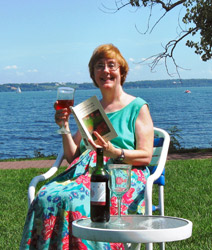 We plunge into our topic: "Telling the Stories of our Lives: Writing the Personal Memoir." After some discussion, we start an exercise. Following the guided visualization, everyone is asked to write from a childhood memory. As we’re beginning, a woman and her twelve-year-old daughter join us, apologizing for their lateness. I initiate introductions, settle the latecomers into chairs, bring them briefly up to speed, then encourage them both to start writing. The mother goes ahead, but the girl just sits, looking scared and confused. We’d advertised the workshop to all ages, but she's the only youngster. Her mother said she loves to write, but right now I know exactly how she’s feeling, afraid of embarrassing herself, of doing it "wrong."
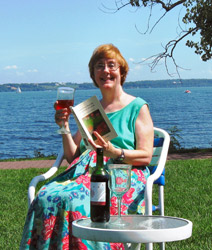 It's a poet’s world. Making connections with other poets and writers, though, isn't easy. Without the kinds of venues more urban areas can sustain, this loose collection of hamlets, villages, townships, and two small cities, Auburn and Geneva, has had no central clearinghouse for writers.