Ursula K. Le Guin on the Imagination, Richard Adams’s Library, and More
A defense of Mary Oliver; David France wins 2017 Baillie Gifford Prize; Zinzi Clemmons speaks out against Lenny Letter and Lena Dunham; and other news.
Jump to navigation Skip to content
A defense of Mary Oliver; David France wins 2017 Baillie Gifford Prize; Zinzi Clemmons speaks out against Lenny Letter and Lena Dunham; and other news.
Jess Rizkallah reads her poem “tbh i’ve got more things to say about hair than i have hair” at an event for the Asian American Writers’ Workshop in New York City. Rizkallah’s debut collection, the magic my body becomes (University of Arkansas Press, 2017), is the inaugural winner of the Etel Adnan Poetry Prize.
Submissions are currently open for the inaugural Frontier Poetry Award, a new prize of $5,000 and publication in Frontier Poetry given annually for a single poem. Ten finalists will each receive $100 and publication. The editors will judge.
Using the online submission system, submit up to four poems of any length with a $20 entry fee by Thursday, November 30. Multiple submissions are allowed. The winners will be announced in February 2018.
Established as an arm of the Masters Review, Frontier Poetry is now its own online publication that aims to provide a quality platform for emerging poets. Tyehimba Jess, winner of the 2017 Pulitzer Prize in poetry, recently judged Frontier's inaugural Award for New Poets. Visit the website for more information, including recent publications and what the editors look for in submissions.
Visit our Grants & Awards database and Submission Calendar for more upcoming contests in poetry, fiction, and creative nonfiction.
Washington Post’s best books of 2017; a profile of Chinese novelist Xue Yiwei; writing with a disability; and other news.
In this 2002 video, poet and essayist Mary Ruefle reads a selection of poems and prose pieces for the Lunch Poems reading series at UC Berkeley. Ruefle is the author of On Imagination (Sarabande Books, 2017), a chapbook-length essay exploring the act of writing.
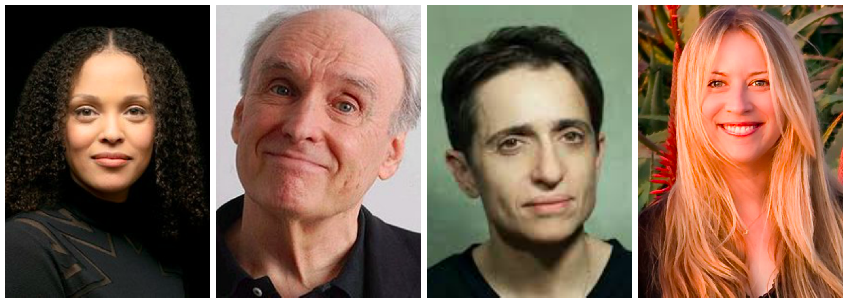
The winners of the 2017 National Book Awards were announced this evening in New York City. Jesmyn Ward took home the award in fiction for her novel Sing, Unburied, Sing (Scribner), and Frank Bidart won the award in poetry for Half-light: Collected Poems 1965–2016 (Farrar, Straus and Giroux). Masha Gessen won in nonfiction for The Future Is History: How Totalitarianism Reclaimed Russia (Riverhead Books), and Robin Benway won in young people’s literature for her novel Far From the Tree (HarperCollins). Each of the winners will receive $10,000.
Actress Cynthia Nixon emceed the ceremony and opened the evening by emphasizing the importance of books. “Books are among the most powerful weapons we have against what has lately felt like a hostile world,” she said. “For some of us books provide a welcome escape or a valuable resource for arming us with indispensable knowledge of history. But it also offers something we so desperately need: broadened perspective…. They cultivate empathy, they inspire action, they make us feel less alone, and they expose us to an experience we couldn’t imagine on our own.”
The winners of the 2017 awards echoed this sentiment. “Writing the poems was how I survived,” said Bidart upon winning the poetry prize. “I hope that the journeys these poems go on will help others survive as well.” In her acceptance speech, Ward addressed the crowd and said, “You looked at me and the people I love and the people I write about…. and you saw your grief, your love, your losses, your regret, your joy, your hope. I am deeply grateful, and I hope to continue this conversation with all of you for all of our days.”
Earlier in the evening, Bill Clinton presented the Literarian Award for Outstanding Service to the American Literary Community to Richard Robinson, the chairman, president, and CEO of Scholastic. “All over this country there are people who are forming new neural networks at the speed of light, stimulated by books that wouldn’t be here if not for [Robinson’s] day job at Scholastic and his commitment to this kind of philanthropic work,” said Clinton.
The foundation also honored Annie Proulx with the 2017 Medal for Distinguished Contribution to American Letters. Actress Anne Hathaway, who starred in the 2005 film adaptation of Proulx’s story “Brokeback Mountain,” presented the award to the writer, who is the author of several story collections and novels, most recently Barkskins (Scribner, 2016). The annual $10,000 award is given for lifetime achievement, which Proulx wryly noted in her acceptance speech. “Although this is award is given for lifetime achievement,” she said, “I didn’t start writing until I was fifty-eight.”
Established in 1950, the National Book Awards are among the literary world’s most prestigious prizes. The 2016 winners included poet Daniel Borzutzky, fiction writer Colson Whitehead, and nonfiction writer Ibram X. Kendi.
“Poems ask you to...really think empathetically, compassionately, and deeply about things.” Aaron Coleman, whose chapbook, St. Trigger (Button Poetry, 2016), won the 2015 Button Poetry Prize, talks about his writing interests and the power of poetry as a tool that can shift everyday language and change perspectives.
Essayist Megan Stielstra on finding community; a profile of Roxane Gay; why Leonardo da Vinci wrote backwards; and other news.
In a series of poems titled “American Sonnet for My Past and Future Assassin,” Terrance Hayes seemingly addresses an abstraction: How can one have both a past and future assassin? Would this assassin be a person, or would it be a system, a history, a feeling? Hayes embraces the ambiguity, and writes his poems as if he were speaking to an individual: “I lock you in an American sonnet that is part prison, / Part panic closet, a little room in a house set aflame.” Is there a force in your own life that is asking to be addressed? Try writing your own sonnet that confronts this force—however abstract—and speaks to it as if it were a person.