Find details about every creative writing competition—including poetry contests, short story competitions, essay contests, awards for novels, grants for translators, and more—that we’ve published in the Grants & Awards section of Poets & Writers Magazine during the past year. We carefully review the practices and policies of each contest before including it in the Writing Contests database, the most trusted resource for legitimate writing contests available anywhere.
Find a home for your poems, stories, essays, and reviews by researching the publications vetted by our editorial staff. In the Literary Magazines database you’ll find editorial policies, submission guidelines, contact information—everything you need to know before submitting your work to the publications that share your vision for your work.
Whether you’re pursuing the publication of your first book or your fifth, use the Small Presses database to research potential publishers, including submission guidelines, tips from the editors, contact information, and more.
Research more than one hundred agents who represent poets, fiction writers, and creative nonfiction writers, plus details about the kinds of books they’re interested in representing, their clients, and the best way to contact them.
Find publishers ready to read your work now with our Open Reading Periods page, a continually updated resource listing all the literary magazines and small presses currently open for submissions.
Since our founding in 1970, Poets & Writers has served as an information clearinghouse of all matters related to writing. While the range of inquiries has been broad, common themes have emerged over time. Our Top Topics for Writers addresses the most popular and pressing issues, including literary agents, copyright, MFA programs, and self-publishing.
Our series of subject-based handbooks (PDF format; $4.99 each) provide information and advice from authors, literary agents, editors, and publishers. Now available: The Poets & Writers Guide to Publicity and Promotion, The Poets & Writers Guide to the Book Deal, The Poets & Writers Guide to Literary Agents, The Poets & Writers Guide to MFA Programs, and The Poets & Writers Guide to Writing Contests.
Poets & Writers lists readings and other literary events held online and in person. Whether you are an author on a book tour or the curator of a reading series, the Literary Events Calendar can help you find your audience.
Research newspapers, magazines, websites, and other publications that consistently publish book reviews using the Review Outlets database, which includes information about publishing schedules, submission guidelines, fees, and more.
Well over ten thousand poets and writers maintain listings in this essential resource for writers interested in connecting with their peers, as well as editors, agents, and reading series coordinators looking for authors. Apply today to join the growing community of writers who stay in touch and informed using the Poets & Writers Directory.
Since our founding in 1970, Poets & Writers has served as an information clearinghouse of all matters related to writing. While the range of inquiries has been broad, common themes have emerged over time. Our Top Topics for Writers addresses the most popular and pressing issues, including literary agents, copyright, MFA programs, and self-publishing.
Find a writers group to join or create your own with Poets & Writers Groups. Everything you need to connect, communicate, and collaborate with other poets and writers—all in one place.
Well over ten thousand poets and writers maintain listings in this essential resource for writers interested in connecting with their peers, as well as editors, agents, and reading series coordinators looking for authors. Apply today to join the growing community of writers who stay in touch and informed using the Poets & Writers Directory.
Find information about more than two hundred full- and low-residency programs in creative writing in our MFA Programs database, which includes details about deadlines, funding, class size, core faculty, and more. Also included is information about more than fifty MA and PhD programs.
Whether you are looking to meet up with fellow writers, agents, and editors, or trying to find the perfect environment to fuel your writing practice, the Conferences & Residencies is the essential resource for information about well over three hundred writing conferences, writers residencies, and literary festivals around the world.
Poets & Writers lists readings and other literary events held online and in person. Whether you are an author on a book tour or the curator of a reading series, the Literary Events Calendar can help you find your audience.
Discover historical sites, independent bookstores, literary archives, writing centers, and writers spaces in cities across the country using the Literary Places database—the best starting point for any literary journey, whether it’s for research or inspiration.
Establish new connections and enjoy the company of your peers using our searchable databases of MFA programs and writers retreats, apply to be included in our directory of writers, and more.
Each year the Readings & Workshops program provides support to hundreds of writers participating in literary readings and conducting writing workshops. Learn more about this program, our special events, projects, and supporters, and how to contact us.
The Maureen Egen Writers Exchange Award introduces emerging writers to the New York City literary community, providing them with a network for professional advancement.
Find information about how Poets & Writers provides support to hundreds of writers participating in literary readings and conducting writing workshops.
Bring the literary world to your door—at half the newsstand price. Available in print and digital editions, Poets & Writers Magazine is a must-have for writers who are serious about their craft.
View the covers and contents of every issue of Poets & Writers Magazine, from the current edition all the way back to the first black-and-white issue in 1987.
Find details about every creative writing competition—including poetry contests, short story competitions, essay contests, awards for novels, grants for translators, and more—that we’ve published in the Grants & Awards section of Poets & Writers Magazine during the past year. We carefully review the practices and policies of each contest before including it in the Writing Contests database, the most trusted resource for legitimate writing contests available anywhere.
Every day the editors of Poets & Writers Magazine scan the headlines—publishing reports, literary dispatches, academic announcements, and more—for all the news that creative writers need to know.
In our weekly series of craft essays, some of the best and brightest minds in contemporary literature explore their craft in compact form, articulating their thoughts about creative obsessions and curiosities in a working notebook of lessons about the art of writing.
The Time Is Now offers weekly writing prompts in poetry, fiction, and creative nonfiction to help you stay committed to your writing practice throughout the year. Sign up to get The Time Is Now, as well as a weekly book recommendation for guidance and inspiration, delivered to your inbox.
Ads in Poets & Writers Magazine and on pw.org are the best ways to reach a readership of serious poets and literary prose writers. Our audience trusts our editorial content and looks to it, and to relevant advertising, for information and guidance.
Start, renew, or give a subscription to Poets & Writers Magazine; change your address; check your account; pay your bill;
report a missed issue; contact us.
Poets & Writers is pleased to provide free subscriptions to Poets & Writers Magazine to award-winning young writers and to high school creative writing teachers for use in their classrooms.
Read select articles from the award-winning magazine and consult the most comprehensive listing of literary grants and awards, deadlines, and prizewinners available in print.
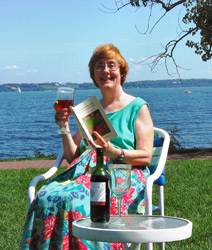
For the month of September, longtime P&W-suported writer Patricia Roth Schwartz blogs about her experience in Seneca County, New York.
October in the Finger Lakes flares out in a profusion of color: scarlet maples, golden beech, burgundy sumac. Deer leap across country roads. I drive to the tiny village of Ovid where history has left its imprint, especially in the form of a charming set of Greek Revival county courthouse buildings (now a museum) in descending sizes known as The Three Bears.
I eat my picnic lunch at a table outside the adorable structures (Baby Bear is as big as a child’s playhouse) savoring sunshine and drifting leaves. Spotting a tiny thrift shop across the street, I'm there in a flash. It’s full of almost all new clothes, each item a dollar! Soon, clutching five items, I approach a sweet-faced lady in her 80s who serves as volunteer cashier. Suddenly I realize I've left home with no cash! The thrift shop does not accept credit cards or checks. The cashier tells me I can come back later to pay. "We close at one.” I say, "But I'm doing a poetry reading at the Edith B. Ford Memorial Library." I point to the flyer in the store window.
Behind me another shopper speaks up. "Here—" she pushes a five dollar bill toward me. "I'll send you a check," I say and thank her profusely. She says, "No need." "I'll come over to the library," offers the cashier, Anna, who'd been telling me earlier about growing up nearby on a farm. "You said a friend of yours was coming." "Yes, I can borrow five dollars from her," I say. So it's settled; I go next door to a small supermarket. I need a Reese's Peanut Butter Cup. (It's been that kind of day.) I have a little change; I'm sure it’s enough. But at the cash register I’m counting out pennies. Behind me, another Ovid angel appears. A young man plunks down coins, insists on paying for me. I walk across the street to the library in a pleasant daze, convinced I‘ve entered another plane of existence, one that is utterly charmed.
A small group gathers for my reading. I sit in a comfy rocker in the children's reading nook, encouraging everyone to sit in a semicircle around me. Halfway through the reading, Anna, the thrift shop cashier, enters. She's brought her lunch, a large submarine sandwich. Sitting discreetly at the back table, she eats it, crumples up the wrapper, then moves up to the semicircle. I read poems about my family, my childhood in West Virginia—memories, stories. Afterward we talk. "When I was married," the widowed Anna says, "I had a notebook I used to write in. My husband thought I was pretty good." I don't think Anna has ever been to a poetry reading before. We encouraged her to get another notebook and start up again.
Literary agent Jason Allen Ashlock argues his profession should not also act as publishers; GalleyCat says this is the worst week to pitch a publishing professional; England's poet laureate claims texting is good practice for writing of poetry, and other news.
Back in February we posted the prologue of an original Web series about an insurance broker who reads poetry on the streets of Vancouver's financial district. Here is the second episode of the mockumentary, written and directed by Michael Grand.
From July 13 to 16, 2011, P&W-supported poets Mayda Del Valle, Oveous Maximus, and Shihan participated in inkSlam, Los Angeles’ largest spoken-word festival, held at the Greenway Court Theatre.
The four-day event featured daily writing and performance workshops and nightly showcases celebrating the creative landscape of artists on the slam poetry scene.
Over one hundred poets, including burgeoning rhymesters and veteran Tony Award winners, graced the stage of the Greenway Court Theatre, as a sold-out audience cheered them on night after night.
“InkSlam allowed L.A. residents to see poetry in a light different from the one they were used to,” said inkSlam director Shihan Van Clief, who performs as Shihan. He is also a founding member of Da’ Poetry Lounge, the nation’s largest ongoing open mic series, which takes place Tuesdays at Greenway Court. “Most people have a junior high or high school reference point for poetry, which was, for a lack of a better term, ‘old’… We offered poetry from a young perspective.”
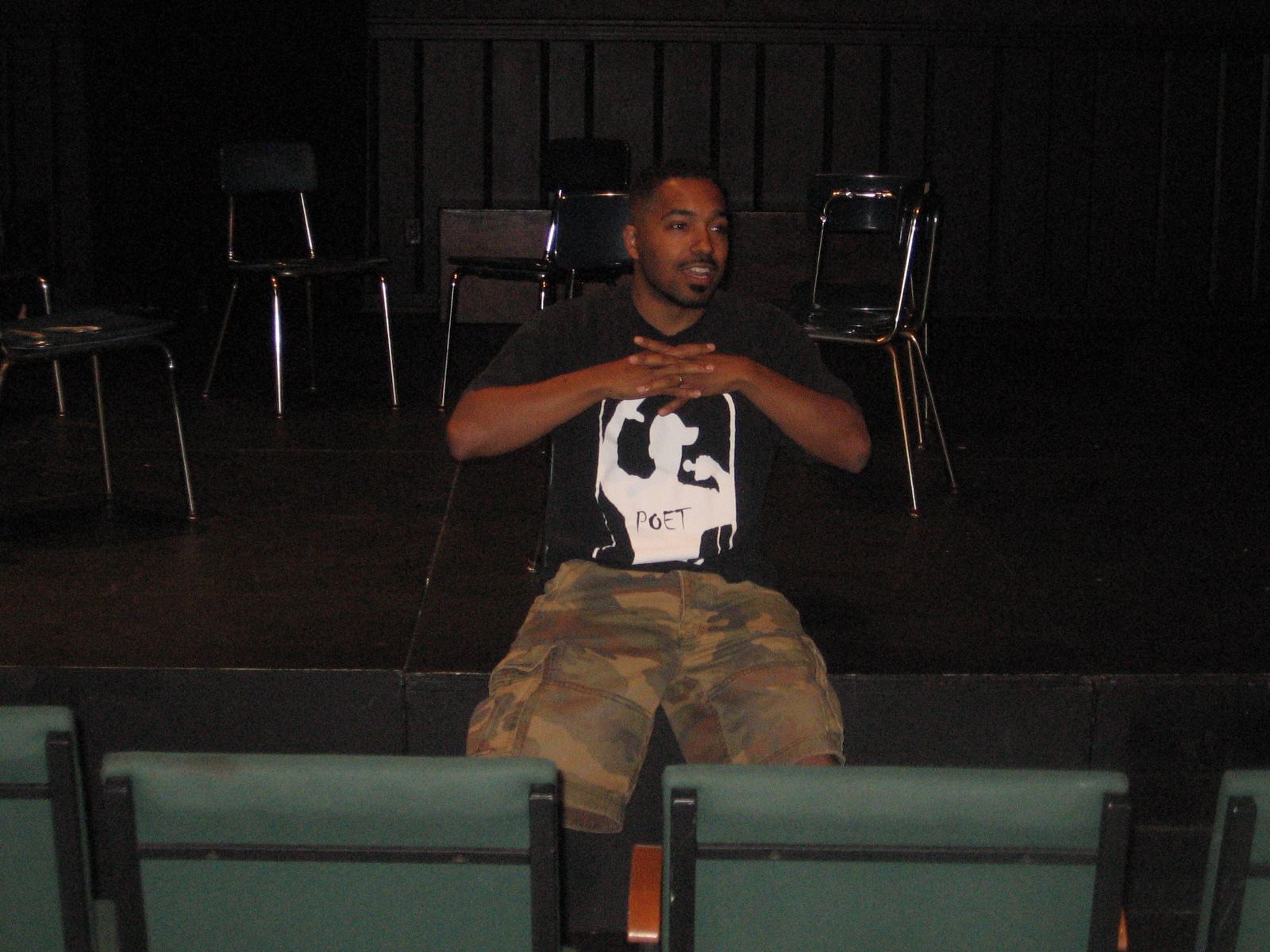
The festival aims to re-brand poetry as something anyone and everyone can enjoy, according to Van Clief. There were craft workshops geared towards the youth as well as business workshops to better inform poets on how to make art their livelihood in today’s multifaceted market.
InkSlam evolved from the partnership between the nonprofit organization Greenway Arts Alliance and Da’ Poetry Lounge. As Van Clief recalls, the idea for inkSlam came in 2009.
“[The poetry scene] had been defunct for years,” said Van Clief. “There was and is still a definite need for more art-based programs in L.A., and we figured this would be a good starting point; we wanted to create the best poetry festival Los Angeles has ever seen.”
Now inkSlam is making that dream a reality. A spoken-word competition was added to the festival’s agenda, making inkSlam a true poetry slam. In good fun, eight teams competed for the title of inkSlam champion over the course of the last two days of the festival.
Da’ Poetry Lounge, the seasoned home team, came in first, with a team from Santa Cruz finishing an incredibly close second.
“Santa Cruz Slam team snuck in under the radar and surprised a lot of folks,” said Van Clief. “Their group work was just very well thought out and executed to a tee; they made me rethink some of the group material our team had.”
To ensure that the festival would end on the most engaging, and humorous, of notes, the second place team received their $750 cash prize in quarters, leaving third and fourth place winners to receive theirs in dimes and pennies respectively.
Photo: Shihan at a workshop about the business of spoken word. Credit: Cheryl Klein.
Poet Rusty Morrison, also cofounder of ten-year-old press Omnidawn Publishing, has seen both sides of literary competition. Her first book, Whethering,won the Colorado Prize for Poetry (Center for Literary Publishing, 2004), and was followed a few years later by the true keeps calm biding its story, published in 2008 as part of the Sawtooth Poetry Prize from Ahsahta Press. The book went on to win the James Laughlin Award from the Academy of American Poets. Morrison has also received the Poetry Society of America's Alice Fay Di Castagnola Award, Cecil H. Hemley Award, and Robert H. Winner Award. Her most recent collection, Book of the Given, was selected for publication by Noemi Press in 2010 a few years after she'd submitted a shorter version of the book to (but didn't win) the press's chapbook contest.
On the flip side, Morrison's press, which she runs with her husband, Ken Keegan, administers its own series of competitions, with two poetry book prizes (a new contest launched this summer) and one chapbook award. We caught up with her recently to discuss what it's like to have a foot in two realms, and to get her insider's take on using contests to find a place for one's work in the world.
What do you look for in a contest? What has inspired you to submit your work for particular awards? I enter contests for full books and for series of poems. Both kinds of contests excite my interest. Probably the most important criteria for me in choosing to enter a contest are my respect for—and feeling of kinship with—the publication or the press that is offering the contest. New presses and journals are as valid and worthy of my respect as older ones. But I want to feel that I admire the choices made by the press or the journal, and I want to see that their aesthetic is aligned with mine, regarding both the work chosen and the way it is presented.
How did you know your manuscripts were ready to go out? I am an avid believer in revision, so most all of my work has undergone distinct stages in the revising process. I believe that it's in the process of revision that I can bring the most excitement into my writing. Of course, I'm not talking about the fine-tuning that happens at the very end of the process. I'm talking about a wilder, riskier kind of revision, in which I attempt to open opportunities in the work that I can't see during the initial writing process.
I try to take most works through a few stages of revision, and then let the work sit for a few days, or a week, or more. When I return to it, I look again and attend to it with my most open-spirited perceptions, to see if something more might want to arrive in the work. And I let myself add and change quite radically, as I follow my intuitions. After I've done this a few times, I usually have the sense that a work has given me all the possible inspirational opportunities it has, or that I can glean from it. That's when I'm ready to hone it, and I let myself become more overtly conscious/critical, and I do the fine-tuning that I think helps finish a piece. Usually, I let it sit a day or two, and see how the 'honing' looks. I never send out a piece that I've just changed in any way. If I make a change, then I let the poem sit another day.
I've just described the way that I work with a poem series, but this is similar to the way that I perceive a full manuscript. I see a manuscript as a constellation of smaller units of difference. As I work on a manuscript as a whole, I want to bring my attention to those differences, as well as to the larger arc of alignments that will give the manuscript a sense of wholeness. So when I bring a number of these series together in the manuscript, they often change in ways I can't predict. When I am in this manuscript-creating process, I am often surprised by what emerges in a smaller series, once it comes into the manuscript. In this process, I am often revising again. I'm not after uniformity, but actually, I'm again seeking surprises. I want to let difference and surprise emerge in ways that provoke and challenge me, and, I hope, might excite a reader too. I suppose I begin to trust that a manuscript is ready to be sent out if I see that it has taken me through a process of evolution, and that it has constellated into a force that reflects that evolution.
Have you also submitted your manuscript to publishers outside of a competition? I have, but I haven't had any publications come from that process. Recently, Noemi Press published a new work of mine. But that occurred because I'd sent to their contest. My work didn't win, but the press was interested in publishing it.
Has being a contest administrator changed the way you look at writing prizes or modified your practice of submitting work in any way? I have more appreciation for how much work goes into running a contest. I'm actually one of the manuscript readers, or screeners, so I do not manage the database or the contacts. This protects me from seeing anyone's names. But I know how vigilant Ken Keegan, my press partner, is in tracking work and contacting writers if there's anything amiss in their submission process. And, I can see how much time this takes him. So when I submit I try to get everything ready, and then let it sit a day. Then, the next day, I look over the work one more time and I check over everything that is required. I understand all too well that when I am nervous about my poems, and focused on the writing, I may be neglectful of the other details: getting my cover page right, getting my payment made correctly, etcetera. Getting these little things right will make a contest administrator's life much easier, and I want to be sure I'm sending in a submission that is easy to accept.
What has been the most rewarding aspect of receiving an award? Is there a prize that has been of particular value to you? It is such a shock and honor and pleasure to win an award. Every award has given me a sense of recognition that is deeply and powerfully moving. After each award, I've found myself in a haze of amazement for days. I suppose that winning a prize is both marvelous and a little frightening. Generally, in my creative life, I work very hard to trust within myself that the most important thing is to keep writing and to keep growing as a writer. I try to focus on that, and not upon how well the poems succeed in finding an audience. But then, if and when I win a prize, I feel such a thrill, such a rush of surprise to imagine that there is actual acknowledgement in the reading public for my work. It is a little scary because it broadens my trust in the work's ability to make contact and to give something to readers that they value. And it increases my hope that my future poems will have relevance for readers. It is such a different feeling from the one I can cultivate for myself, internally, as I do the work and acknowledge the risk and gratification of the work itself. So winning a contest opens me to more expectations, more awareness, and this is a good thing, as long as I keep it in perspective.
As both a writer and a publisher, what piece of advice do you have for writers looking to contests as a way to get their work into the world? I think that my best advice is to keep sending out the work. I know this seems obvious, but so many writers slow down, or give up on the submission process. I send my work to many, many, many contests each season. I try to do it without worry, without thinking about winning. I just do it as a step in my own internal process of poem development. I consider the moment of "sending something out" as an accomplishment. It marks the poem or the series or the manuscript as having come-of-age.
When the work returns to me, if it isn't accepted—which is so often the case—I just reconsider it, and often find myself entering into some bit of revision. The work continues to stay fresh to me that way. So submitting—to contests as well as other forms of submission—is a way to get some distance on the work, and then meet it again, when it returns. In that meeting, it might want to grow and might ask me to grow too, in some form of rethinking or revision. But it might also simply still feel "finished" and then I send it out again. And sometimes, the work is accepted somewhere or it wins a contest, and that is incredibly sweet!
In the video below, Morrison reads from her series "Necessities and Inventions" at a San Francisco salon last summer.
Correction: An earlier version of this post inaccurately stated that Morrison's Book of the Given had been a finalist for Noemi Press's poetry book award. The book was not a finalist for that award, but rather had been entered into Noemi Press's chapbook contest in a shorter form, and, though it did not win, the book was later published by the press in an expanded version.
How a Twitter trend is born; top authors pitch story ideas for crowdfunded publication; bridging the L.A. divide with books; this fall's must-reads; and other news.
With work on their minds this Labor Day weekend (when many of us are taking three days off), the fine folks at Open Road Media take a look at how several writers, including Andres Dubus and Don Winslow, paid the bills while they were struggling to make it in the literary world.
Joining the ranks of Herman Hesse and Sigmund Freud, Syrian-born poet Adonis is the first Arabic-speaking writer to win the triennial Goethe Prize for literature. The eighty-one-year-old poet, whose Selected Poems in a translation by Khaled Mattawa (Yale University Press, 2010) recently won the 2011 PEN Award for Poetry in Translation, received fifty thousand euros at a ceremony last Sunday, Goethe's birthday. (The prize is worth approximately $71,365.)
Goethe himself introduced aspects of Arabic literature to European readers—inspired by the Persian poet Hafiz, Goethe published the poetry collection West-östlicher Divan (West-Eastern Divan) in 1819. In a reversal, according to the prize judges, "Adonis has carried the accomplishments of European modernity into Arabic cultural circles, with great effect."
"I wanted to draw on Arab tradition and mythology without being tied to it," said Adonis of his process in an interview with the New York Times (via the Guardian). "I wanted to break the linearity of poetic text—to mess with it, if you will. The poem is meant to be a network rather than a single rope of thought."
Adonis, who adopted his pen name at the age of nineteen (he was born Ali Ahmad Said Esber), is the author of more than twenty books of poetry including Mihyar of Damascus (BOA Editions, 2008), A Time Between Ashes and Roses (Syracuse University Press, 2004), and If Only the Sea Could Sleep (Green Integer, 2002).
Patti Smith honored for the poetry of her music; Russia's most famous inmate pens prison stories; Seattle faces a week without libraries; Pride and Prejudice and Zombies has Austen at its heart; and other stories.





 I eat my picnic lunch at a table outside the adorable structures (Baby Bear is as big as a child’s playhouse) savoring sunshine and drifting leaves. Spotting a tiny thrift shop across the street, I'm there in a flash. It’s full of almost all new clothes, each item a dollar! Soon, clutching five items, I approach a sweet-faced lady in her 80s who serves as volunteer cashier. Suddenly I realize I've left home with no cash! The thrift shop does not accept credit cards or checks. The cashier tells me I can come back later to pay. "We close at one.” I say, "But I'm doing a poetry reading at the Edith B. Ford Memorial Library." I point to the flyer in the store window.
 The festival aims to re-brand poetry as something anyone and everyone can enjoy, according to Van Clief. There were craft workshops geared towards the youth as well as business workshops to better inform poets on how to make art their livelihood in today’s multifaceted market.