




National Novel Writing Month, Pauline Kael's Didion Rivalry, and More
Today marks the beginning of National Novel Writing Month; New Hampshire's RiverRun Bookstore is in danger of closing; Pauline Kael's rivalry with Joan Didion; and other news.
Jump to navigation Skip to content
Today marks the beginning of National Novel Writing Month; New Hampshire's RiverRun Bookstore is in danger of closing; Pauline Kael's rivalry with Joan Didion; and other news.
In Nothing: A Portrait of Insomnia, published last month by Harper Perennial, Blake Butler uses scientific data, historical anecdote, Internet obsession, and figures as diverse as Andy Warhol, John Cage, Jorge Luis Borges, and Stephen King to explore the tension between sleeping and conscious life. This bizarre trailer, directed by Drew Mobley, evokes Butler's own 129-hour bout of insomnia described in the book.
While other social networking sites are useful for playful community-building, LinkedIn provides a place for professional writers to focus on sincerity when creating connections.
While U.S. publishers continue their cautious march into the digitization of American titles, the rest of the world is looking to take advantage of other burgeoning markets in Europe, Japan, and beyond.
Despite the average wired American’s tendency to downsize their character counts, the page counts of newly published books of translated fiction show that the rest of the global literary community may be beefing up.
Longtime P&W-supported sponsor and writer M. L. Liebler, author of fourteen books of poetry including The Moon A Box, which received the 2005 Patterson Poetry Award of Excellence, blogs about curating and hosting Wayne State University's Thursdays in the D in Detroit, Michigan.
On September 22, over one hundred folks packed the Scarab Arts Club in downtown Detroit’s cultural center to hear a wild, fun, and moving reading/performance by a wide variety of literary artists. Thanks to Wayne State University’s Office of Student Affairs and its great staff, I was honored to curate and host Thursdays in the D with Detroit singer/songwriter Audra Kubat, poet Brian Gilmore from D.C., deaf hip-hop star Sean Forbes from Detroit, former slam star Jeffrey McDaniel from New York City, and the insanely talented Jessica Care Moore from Detroit.
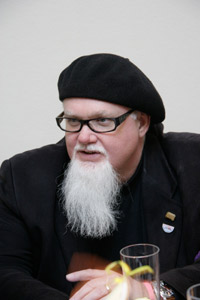 I would say 75 percent of the audience had never attended a poetry reading. The audience was made up of urban and suburban students and teachers, senior citizens, blue collar workers, labor activists, college deans, and others, all of whom came together to listen, enjoy, and join in the fun of poetry. It’s a beautiful thing to see the arts thrive in a city that has been hit very, very hard by the recession. Our community is clearly nourished by the arts, and this program was ample proof.
The program began with Detroit’s young singer/songwriter, in the Joni Mitchell tradition, Audra Kubat. Audra’s lyrics are basically poems set to music. Brain Gilmore of the D.C. poetry scene and DC Writer's Corps followed and delivered a great set of poems, with Frank F. Koscielski on piano, as a wonderful homage to Duke Ellington from his book Jungle Nights & Soda Fountain Rags. Next up was Detroit’s Sean Forbes, a deaf young hip-hop artist working with Eminem, who stunned the audience with his cool hip-hop beats and poems as he signed and spoke his work. Jeffrey McDaniel, Pitt Poetry Series author of The Endarkenment, delivered from his old school slam days a fabulous set combining high quality poetry with precision timing and showmanship. To conclude Jessica Care Moore, star of HBO Def Poetry Jam, delivered politically charged poems in the spirit of the late Gil Scott-Heron, Black Star, and Public Enemy’s Chuck D. To put the cherry on the sundae, nationally known Shakespeare impersonator Chuck Wilcox came up to the podium in costume and performed a Shakespeare sonnet!
Folks, I don’t care where you live in this great country (or world, for that matter), it just doesn’t get any better than this. Ah, Thursdays in the D makes me glad to be alive in this wonderful city.
Photo: M. L. Liebler.
Support for Readings/Workshops events in Detroit, is provided by an endowment established with generous contributions from the Poets & Writers Board of Directors and others. Additional support comes from the Friends of Poets & Writers.
The inspired world of Steve Jobs, through the eyes of his novelist sister; Ireland elects a poet president; Barnes and Noble expands e-book real estate; T. S. Eliot and Groucho Marx, penpals; and other news.
Happy Halloween! In honor of this ghoulish holiday, the Poetry Foundation has put together a sampler of Halloween poems. Read and listen to them, then write one of your own.
To get us all in the mood for this evening's festivities, here's a reading of "Darkness," a poem written by Lord Byron in 1816, also known as the Year Without a Summer because Mount Tambora in the Dutch East Indies had erupted the previous year, throwing ash into the atmosphere that blocked the sun and caused abnormal weather patterns across northeast America and northern Europe. Happy Halloween!
