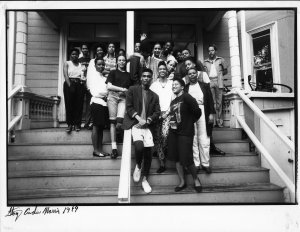
Adrienne Rich
Pioneering feminist poet Adrienne Rich, who passed away on Tuesday at the age of eighty-two, reads her poem "What Kind of Times Are These?" at the Geraldine R. Dodge Poetry Festival.
Jump to navigation Skip to content
Pioneering feminist poet Adrienne Rich, who passed away on Tuesday at the age of eighty-two, reads her poem "What Kind of Times Are These?" at the Geraldine R. Dodge Poetry Festival.
Last night in Abu Dhabi, Lebanese author Rabee Jaber was awarded the International Prize for Arabic Fiction, given for the past five years for novels originally written in Arabic.
The forty-two-year-old author took the award, also known as the Arabic Booker (it is sponsored by major literary prize underwriter Man Booker), for his historical novel The Druze of Belgrade.
Still unpublished in English, a state that is likely to change shortly if the fate of past honorees' work serves as any indication, Jaber is a well-known author in his native Lebanon. He has published seventeen novels and, in 1992, won the country's Critics Choice Award for his debut, Master of Darkness.
Jaber received fifty thousand U.S. dollars, and each finalist received ten thousand dollars. The shortlisted authors were Jabbour al-Douaihy of Lebanon for The Vagrant, Ezzedine Choukri Fishere of Egypt for Embrace on Brooklyn Bridge, Nasser Iraq of Egypt for The Unemployed, Bachir Mefti of Algeria for Toy of Fire, and Habib Selmi of Tunisia for The Women of al-Basatin.
The award was presented at the launch of the Abu Dhabi International Book Fair. The winner and shortlisted authors will appear in conversation tomorrow evening at the festival to discuss risk-taking in Arabic fiction.
Past winners of the Arabic Booker include Saudi novelist Raja Alem (The Doves' Necklace) and Moroccan author Mohammed Achaari (The Arch and the Butterfly), who split the award last year, as well as Egypt's Bahaa Taher (Sunset Oasis) and Youssef Ziedan (Azazel), and Abdo Khal of Saudi Arabia (Spewing Sparks as Big as Castles).
Novelist Ann Patchett weighs in on the debate over women's reproductive rights; Flavorwire features twelve great small press books, including Melissa Broder's Meat Heart; Eric Weinstein offers advice for the new crop of MFA graduates; and other news.
Like fiction, good nonfiction narratives are often driven by description of place. Think of a place that you know well—your kitchen, your office, or a spot you often visit—and, from memory, write a passage that describes that place. Focus on the physical characteristics of the space, leaving out any emotion that may be connected to it, and be as descriptive and detailed as possible. The next time you’re there, read your description and see how accurately your memory served you. Take note of the details you may have missed.
The author of The Long Walk: A Story of War and the Life That Follows, forthcoming in July, talks about the work of remembering what he's already written in his head and getting it down on paper in the lastest episode of Knopf Doubleday Writers on Writing.
Look through your desk or visit a thrift store or drugstore to find a selection of postcards. Write short missives to yourself in the voice of an imagined character, sending a dozen or so cards to your home address. Allow your reaction to receiving the postcards and the messages themselves, inspire the beginnings of a story.
Novelist David Goodwillie investigates the hazardous job of nuclear diving; Commentary ranks American writers using the MLA International Bibliography as a guide; John Green, the best-selling author of The Fault in Our Stars, explains why checking a book out of a library is preferable to online piracy; and other news.
This short video, which was shot, directed, and edited by Glen Milner for the Daily Telegraph, shows Suzanne St. Albans's novel Mango and Mimosa being printed by Smith-Settle Printers in Leeds, England.
Open a dictionary, an encyclopedia, or a book from your bookshelves to any page; choose a word, and write it down. Repeat this nine times. Write a poem with ten couplets (they need not rhyme) using one of the words from your list in each couplet, without using the first person.