




Toni Morrison
Torrene Boone talks with the Nobel Prize winner whose latest novel, Home, was published last year by Knopf (the paperback was published by Vintage International in January), at the New York City offices of Google.
Jump to navigation Skip to content
Torrene Boone talks with the Nobel Prize winner whose latest novel, Home, was published last year by Knopf (the paperback was published by Vintage International in January), at the New York City offices of Google.
Recently, Poets & Writers awarded one poet and one fiction writer with a trip to New York to meet with editors, agents, and other literary professionals as part of the California Writers Exchange contest. The winning fiction writer, Laura Joyce Davis of Oakland, blogs about her experience.
 I am so grateful to Poets & Writers for the once-in-a-lifetime experience of the California Writers Exchange! I heard people say this week that there’s no mystery in publishing, but for those of us not in New York, it can feel mystifying. In an attempt to pull back the curtain and share what I’ve learned, I give you my Top Ten Things Every Writer Should Know:
1. Revise like it’s your full-time job.
Agents and editors alike emphasized revising, putting your book away for a couple of months, revising again, getting feedback—and then repeating until you reach perfection (or something like it).
2. Read, read, read!
The only way writers will survive is if people buy their books. But reading also helps you discern where to send your work. This is true of literary journals (where you’re looking for a natural home for your writing) as well as books (if you find a book like yours, the agent and editor for that book might also like your book).
3. Get connected.
Pick up one of the “best of” collections, look at which magazines nominated the authors there, and then submit to those magazines (referencing the story you enjoyed in the collection). This helps on two levels: It shows that you did your research, but also that you have a sense of the kinds of stories they publish and love.
If you have a connection to an editor (even a small one, like a personalized rejection), mention it. Writers who get a personalized rejection are sometimes flagged so that future submissions will be read by more senior editors rather than by interns or whoever looks at the slush pile.
4. Be a man (or be like one).
VIDA showed us that men are published in greater numbers than women. I learned this week that men also submit in greater numbers, are more likely to submit again after being rejected, or write letters to the editor pitching story ideas. Women, let’s put ourselves out there more.
5. Develop a thick skin.
I met an author who submitted to 150 agents over the course of four years, finally found an agent, and then sold his book in two weeks. Another writer sold her book to a major publisher, but was tormented by a few negative reviews on GoodReads (even though most people love her book). No matter how successful you are, you will still face rejection, and there will always be someone who doesn’t like your book.
6. Persevere.
It has never been so easy to be a writer, but so difficult to be a professional one. The good news is that for the persistent, things seem to work out eventually. Maybe (okay, probably) you won’t get a six-figure advance or be in Oprah’s book club, but with a lot of diligence, your book will be edited and published by someone who loves it just as much as you do.
7. Get involved in your local literary community.
Volunteer with your local literary magazine. Go to readings. Help out other writers. The people you help may end up buying your book, and the journals you assist may take a closer look at your story. Plugging into our literary communities means we are part of the conversation of what is happening in publishing and in life.
8. Look for creative opportunities to publish and build a platform.
Blog. Write interviews and essays. Speak at events. Tweet. These things are good promotion, but will also connect you with the people who are going to care about your book once it comes out.
9. Remember that we’re all just people.
Many of the agents and editors I met said that they wished authors understood that they are human. They have a full client list, dozens of manuscripts to read, and hundreds of new queries every week. Remember that people in the publishing industry have lives (and kids and hard days and relationships) just like you do.
10. Keep writing!
Remember that agents and editors are not disdainful of new writers or eager to reject; they are waiting for the next story that makes them miss their subway stop. There will always be room in the world for great writing. May that challenge us all to produce it!
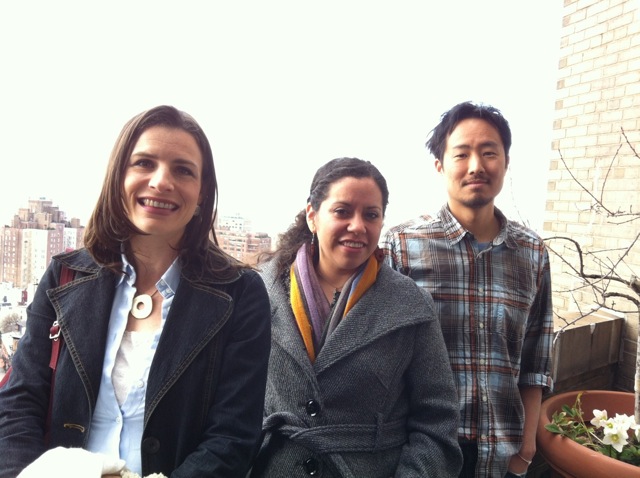
Photo: From left: Laura Joyce Davis, Xochitl-Julisa Bermejo, and Jeffrey Yang of New Directions. Credit: Jamie FitzGerald.
The California Writers Exchange contest is made possible by a generous grant from the James Irvine Foundation. For more information on the contest, visit here.
Amazon Publishing announced it intends to dramatically speed up royalty payments to its authors; Tampa Bay Times revisits the last interview with Jack Kerouac; the Rose Reading Room inside the New York Public Library’s main branch may attain landmark protection; and other news.
What are you looking to see in a writing sample, specifically in the first five pages?
I want to see that it works: characters, narrative voice, the opening strokes of plot—all grooving in unison like the opening to a great song, no matter what genre (though admittedly, heavy metal is not for me). Or, to put it another way, I’m looking for pretty much the same thing you’re looking for when you browse the bookstore, randomly picking up books and glancing over the first page. Do you keep going or do you put it down? Whereas you’re thinking, “Do I want to buy this?” I’m thinking, “Can I sell this?”
Collect phrases and words that you see throughout the day today. Arrange them on the page, using line breaks where they seem to naturally fall. Next, above the lines you’ve recorded, write words and phrases that are somehow related to those on the page, such as synomyms, antonyms, or words that sound or look similar. Rewrite what you’ve recorded replacing the new words with the old. Use this as the first draft of a poem and continue revising it into a finished draft.
Award-winning novelist, essayist, lyricist, and screenwriter Nick Hornby visits Columbia University's Heyman Center to talk with poet and Barnard professor Saskia Hamilton.
Recently, Poets & Writers awarded one poet and one fiction writer with a trip to New York to meet with editors, agents, and other literary professionals as part of the California Writers Exchange contest. The winning poet, Xochitl-Julisa Bermejo of Los Angeles, blogs about her experience from NYC. (Stay tuned for another post from winning fiction writer Laura Joyce Davis as well!)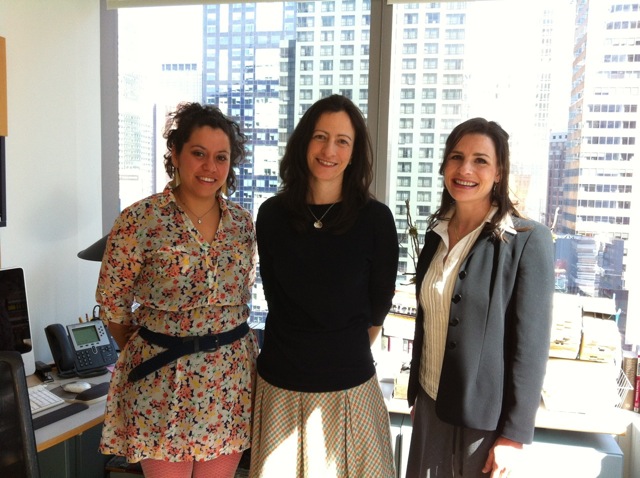 The invaluable gift this trip has given me is confidence to know that I am moving in the right direction, and that as long as I keep working on my writing, I will reach my goals. Being able to walk into the offices of The New Yorker has been a crazy experience, but it has also shown me that everyone is in this “business” because they love books, and everyone works extremely hard to put out their best work because of that love. Often this work will be thankless, but as New Yorker fiction editor Deborah Treisman told me, “Don’t be afraid to be rejected.”
Opportunities like this trip will be far and few between, but hopefully, I can remember the glow of this moment when I am back at my desk agonizing over a poem that refuses to go my way. In that moment I can remember how Alice Quinn, the Poetry Society of America’s executive director, recited poetry to me, sounds dancing on her tongue, with a giant smile, and know that there are people out there hungry and excited for poetry. The next time I cry over my computer, I can think of New Directions editor Jeffrey Yang, who told me when he wrote the last poem of his collection Aquarium, he wept as he wrote the lines, and know that I am not alone. Or when I’m struggling to have my book published, I can remember that there are Johnny Temples in the world who started Akashic Books because he liked cool books, and is always looking for something exciting.
The New Yorker is looking, Akashic is looking, A Public Space is looking, Poetry Society of America is looking. All I have to do is be fearless in putting my work out there because eventually it will link up with someone who is looking for just what I am sending. When I look at it that way, it doesn’t feel so ominous. There is a publisher, there is a magazine that is looking for me, I just have to find them. And that goes for all of us.
You may remember that in my previous blog post, I asked each guest two questions. Here are some more fun answers:
Q: As a reader, what is the first book you remember getting swept up in?
Jeffery Yang (editor, New Directions): A Tree Within by Octavio Paz.
Brigid Hughes (founding editor, A Public Space): Little House on the Prairie by Laura Ingalls Wilder; The Bell Jar by Sylvia Plath; The Old Man and the Sea by Ernest Hemingway.
Brett Fletcher Lauer (poetry editor, A Public Space): Are You There God? It’s Me, Margaret by Judy Blume.
Alice Quinn (executive director, Poetry Society of America): The Children’s Hour #9 edited by Marjorie Barrows. It was devoted to poetry. I remember reading “The Barefoot Boy” and Robert Browning.
Aurora Anaya-Cerda (independent bookseller, La Casa Azul Bookstore): It has to be Where the Red Fern Grows by Wilson Rawls. That was THE book.
Deborah Treisman (fiction editor, The New Yorker): When I was young, Oxford Book of Poetry for Children. I called it “the purple book.” In high school, it was Lolita by Vladimir Nabokov.
Johnny Temple (independent publisher, Akashic Books): Honestly, it was probably something like a Nancy Drew book. My mom would know.
Q: Besides reading and writing, what is an activity that is important to your writing/creative work?
Jeffery Yang: My mental health [is important]. I run a lot.
Brigid Hughes: Walking.
Brett Fletcher Lauer: Watching the Kardashians.
Alice Quinn: I try to memorize a poem almost everyday while I walk the dog in the morning.
Aurora Anaya-Cerda: Performing arts, going to museums, going to the theatre. It feeds my soul.
Deborah Treisman: Staying up on current events. Knowing what’s going on.
Johnny Temple: Can I say my music? The Caribbean. Traveling to book festivals in the Caribbean. The Calabash in Jamaica (and other festivals) is my favorite thing in the world of books that isn’t writing.
Photo: From left: Xochitl-Julisa Bermejo, Deborah Treisman, Laura Joyce Davis. Credit: Jamie FitzGerald.
The California Writers Exchange contest is made possible by a generous grant from the James Irvine Foundation. For more information on the contest, visit here.
The Christian Science Monitor reports independent bookstores are increasing sales; Author Patrick Wensink candidly reveals how much money he made after breaking into the Amazon top ten; Susan Orlean shares her memories of working for the Boston Phoenix; and other news.
The n+1 coeditor talks about Dave Eggers, McSweeney's, and the problem with literature as "a pretty object." Does n+1 have a beef with Eggers? No, but McSweeny's has proved to be a useful literary foil, says Gessen.
Recently, Poets & Writers awarded one poet and one fiction writer with a trip to New York to meet with editors, agents, and other literary professionals as part of the California Writers Exchange contest. The winning fiction writer, Laura Joyce Davis of Oakland, blogs about her experience from NYC. (Stay tuned for another post from poet Xochitl-Julisa Bermejo as well!)
 I am living a writer’s dream.
We’ve only been in New York for a few days, but we’ve packed in weeks of writerly wisdom, months of ideas to contemplate. The agents, editors, and writers Xochitl and I have met have been generous, thoughtful, and helpful. Writers, there is hope as long as these good people are here!
On Monday we met with Deborah Garrison, an editor at both Pantheon and Knopf. She told us about her fifteen years at the New Yorker, where she personally read through the “slush pile” of submissions and always hoped to find a voice unlike any other. It’s the same perspective she brings to her work now, whether reading poetry, fiction, or non-fiction. She said that the most important thing for a writer is to be true to oneself, to write what you must—not the story you think will be marketable. She said that the best writers appreciate editing that makes them better, and that they know how to recognize good advice without getting defensive. This is the reason I’m not interested in self-publishing: I want to learn from someone like Garrison, to become a better writer because of the perspective she can show me. Julia Glass calls Garrison an “incredible editor,” and now I understand why.
When I met Tea Obreht (author of The Tiger’s Wife) last week at the AWP writer’s conference, she told me that her agent Seth Fishman was amazing—not just a great agent who works hard, but also a really nice guy. She was right. I met Fishman on Monday, and he immediately put me at ease, but also gave great advice. Keep publishing in literary journals, he said, because the people reading those journals are the same people who are going to buy your book. He also emphasized that authors should do everything they can to get the entire publishing staff excited about their books; editors sometimes move to other jobs, but your book will be okay if you have a team of people rooting for it. Fishman is a relatively young agent, but he’s made an impressive start to his career in a short time.
On Tuesday I met with Gail Hochman (agent for Michael Cunningham and Julia Glass). “I’ve been doing this for a hundred years,” she said. Looking at the towers of papers in her office and hearing about clients who have called her while she was in the airport or the maternity ward, I don’t doubt that she’s packed a hundred years of work into the thirty-plus years she’s been doing this. She talked about the challenges of selling books, about how a story and its characters have to grab the reader in the first few pages or it won’t sell. When I asked her what she wished every young writer knew, she said to remember that everyone reading your book (even your agent) is a real person; they have a full life beyond their work with you, so cut them some slack.
It’s been a true gift to meet with people like Garrison, Fishman, and Hochman. I hope I get to the opportunity to work with some of them. But even if I don’t, they’ve given me a little more faith in the world of writing, and on any day, that’s worth a lot.
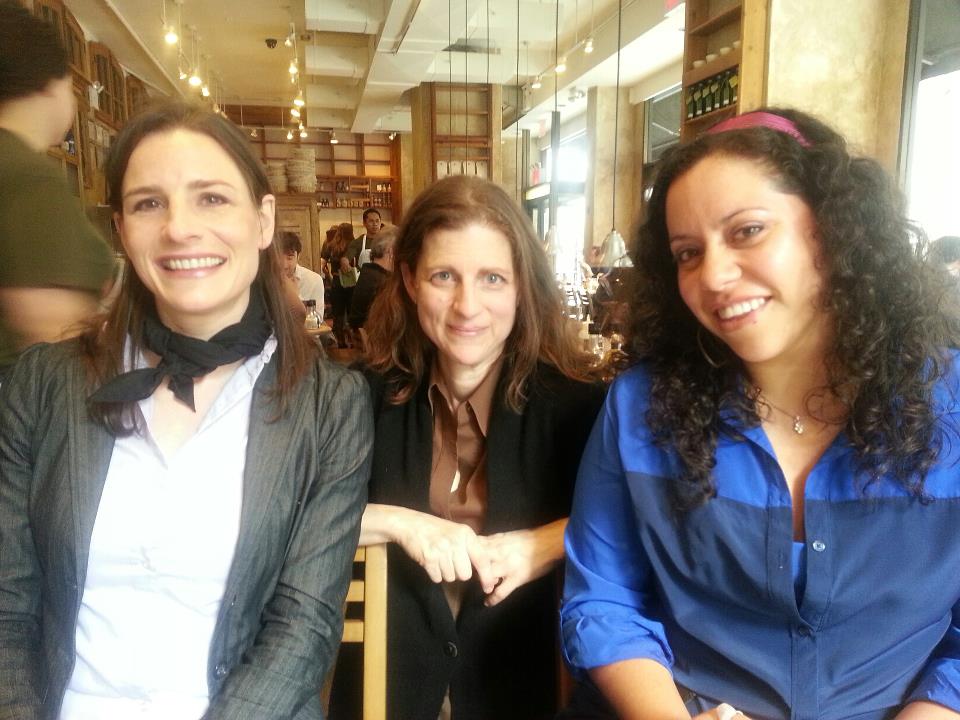
Photo: (left to right) Laura Joyce Davis, Deborah Garrison, and Xochitl-Julisa Bermejo.
The California Writers Exchange contest is made possible by a generous grant from the James Irvine Foundation.
