Voice of Dissent

1.31.24

In his essay published in the Evergreen Review, Younis B. Azeem writes from his viewpoint as a young student newly arrived in New York from Pakistan about the culture of smoking cigarettes. “Among the few indisputable facts of the world, right below gravity and above the moon landing, is that cigarettes will kill you,” he writes. “In America that belief translates into a two-part statement, the second one unsaid, where it’s declared that cigarettes will kill you before anything else does. This right here, this inherent first-world privilege is something that all the best efforts of Big Tobacco cannot undo.” Azeem asserts that in other places in the world, there are hazardous living conditions much more likely to be the cause of death than smoking. Write a short story in which a newcomer posits an unexpected, iconoclastic, or unusual opinion. How does this create a disruption to your other characters’ everyday lives?

A Conversation With N. Scott Momaday

Caption: 

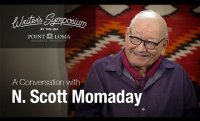
“Words are the intricate bonds of language. Words make a family, a tribe, and a civilization. Language is the context of our experience.” Poet, novelist, and Native American scholar N. Scott Momaday speaks about the power of storytelling and his extensive writing career in a conversation with Dean Nelson from his home in New Mexico for the 2023 Writer’s Symposium by the Sea at Point Loma Nazarene University. Momaday died at the age of eighty-nine on January 24, 2024.

Language as Home

1.30.24

“Like a snail with a shell of sticks //  — she loads them on her back — //   Like a camel with a hump of sticks //  — on her back, on her back — // Like a horse with a knight of sticks and a stick for a sword,” writes Valzhyna Mort in her poem “In the Woods of Language, She Collects Beautiful Sticks” published in the Academy of American Poets’ Poem-a-Day series. In her description of this poem, Mort explains how an inability to write another poem she was working on made her “feel homeless in language and in poetry” and that writing this poem became “a bit of homemaking” for her. Write a poem that reflects your own process when your mind wanders away from writing and you must find a way back into the home of language. Does it involve the vocabulary of domesticity, construction, or helpful creatures?

Performing the Future: Debut Poets Virtual Reading

Caption: 

Poets & Writers Magazine features editor India Lena González hosts this virtual event celebrating the ten debut poets featured in “Performing the Future: Our Nineteenth Annual Look at Debut Poets” from our January/February 2024 issue. The event includes readings by the poets as well as a conversation about their debut books, their influences and inspirations, and their individual paths to publication.

Genre: 

Emily Luan and Brandon Shimoda

Caption: 

In this 2023 virtual event hosted by City Lights Bookstore, Emily Luan, author of 回 / Return (Nightboat Books, 2023), and Brandon Shimoda, author of Hydra Medusa (Nightboat Books, 2023), read from their poetry collections and discuss themes of memory, mourning, and migration in their writing.

Genre: 

The Best Month

1.25.24

In a recent New York Times article titled “January’s Secret: It’s the Best Month,” journalist Steven Kurutz makes a case for the first month of the year. Not usually a fan favorite with its short days and cold weather, Kurutz points out the month’s many unsung advantages: post-holiday relaxation, less crowded streets, the reassuring feeling of getting back into routine, and how the blissfully uneventful stretch of weeks can offer a calming break from social obligations. This week write an essay about your favorite month of the year. Even if it’s one that revolves around a holiday or exciting seasonal offerings, take some time to reflect on the unsung pleasures of the month.

C Pam Zhang With Padma Lakshmi

Caption: 

“I was really curious about how this fear of impending loss affects people.” In this 2023 LIVE From NYPL event, C Pam Zhang reads from her second novel, Land of Milk and Honey (Riverhead Books, 2023), and discusses grief, natural disasters, and apocalypse in a conversation with author and television host Padma Lakshmi.

Genre: 

The Penguin Book of the Modern American Short Story

by
Author: 
John Freeman, editor
Published in 2021
by Penguin Press

In this anthology, a half century of American short stories from all genres, including science fiction, horror, and fantasy, are presented and selected by editor and critic John Freeman. Spanning from 1970 to 2020, a variety of voices, forms, and styles are highlighted, as well as often overlooked stories from renowned authors such as Dorothy Allison, Percival Everett, and Charles Johnson. There are short tales by Tobias Wolff, George Saunders, and Lydia Davis, next to near novellas by Susan Sontag and Andrew Holleran. The wide-ranging collection also includes stories by Chimamanda Ngozi Adichie, Raymond Carver, Denis Johnson, Stephen King, Ursula K. Le Guin, Ken Liu, and Claire Vaye Watkins. “This anthology, though it tracks the high points of the short story, is enabled by spaces these writers opened up,” writes Freeman in the introduction, noting the significant mark these authors have made for the future of the short story. 

Epiphany

1.24.24

Epiphany is a religious day of celebration commemorating the visit by the Three Wise Men to the baby Jesus with their gifts, observed in January. Originating from the Greek word meaning “manifestation,” in a work of literature, an epiphany generally consists of a different sort of appearance—a moment that seems to suddenly illuminate the truth, one that oftentimes changes the course of a character’s life. Write a scene in a new or ongoing short story in which your main character experiences such a dawning realization. What is the catalyst for this discovery? How does this newfound insight transform their subsequent actions or interactions with another character or a future decision?

Pages

Subscribe to Poets & Writers RSS