Chad Harbach is convinced that he needs to come up with two books to write one. “I don’t know why, but I have to feel as though I have two whole books I’m forcing to coexist in the same space,” he says to me over lunch in Portola Valley, a town south of San Francisco, on the eastern slopes of the Santa Cruz Mountains, on a sunny Saturday this past summer. Only then, with twice the material, twice the characters, twice the plot and the existential questions, does he believe he has “enough” for one book.

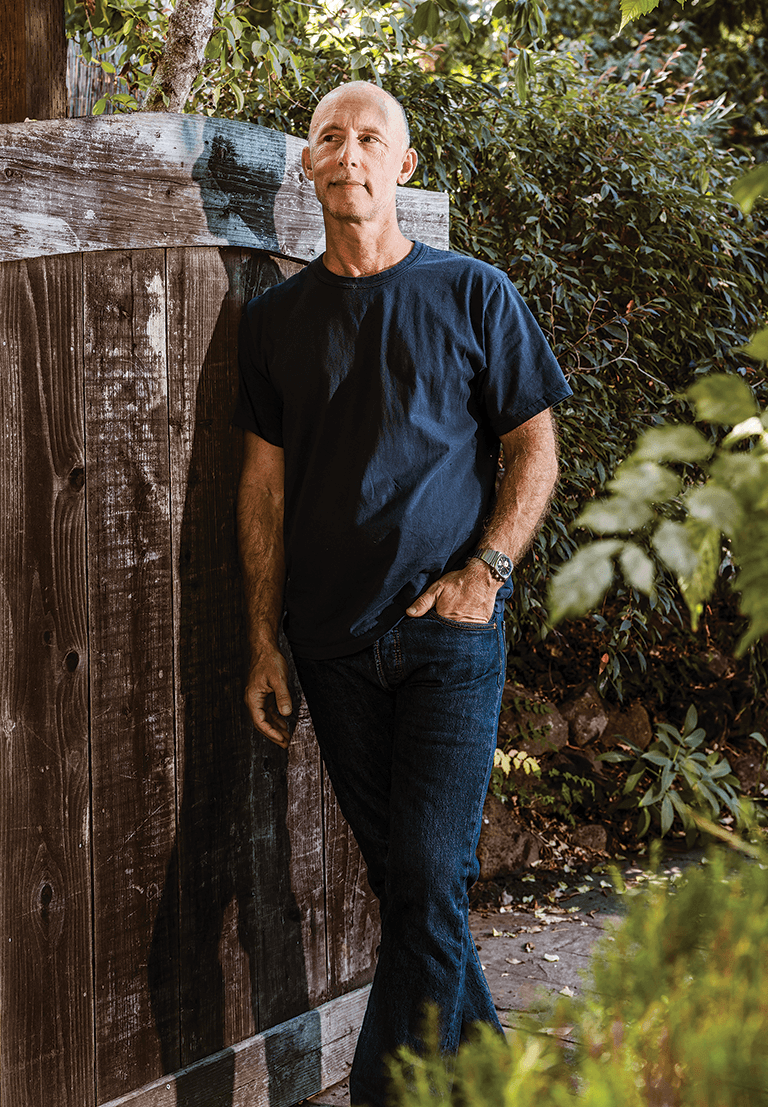
Chad Harbach, author of The Brightness. (Credit: Carolyn Fong)
Harbach illustrates this notion by bringing his fists together and grinding his knuckles over his bowl of salmon and grilled vegetables, but he stops short of noting that perhaps he actually did this merging not once or twice but three times with The Brightness, his sophomore novel, which arrived from Little, Brown in October, fifteen years after his acclaimed debut, The Art of Fielding. I don’t correct him, because he is right that there are two books’ worth of story lines in this doorstop of a novel; it clocks in at 657 pages, or nearly two hundred thousand words. One is the story of Pella Affenlicht, a millennial in the throes of a quarter-life crisis, participating in the wedding of her best friend and the “Buddha” of The Art of Fielding (Little, Brown, 2011), literary upstart Owen Dunne. Harbach tells me he had wanted to include this story line from the earliest days of drafting the new novel, soon after he got home from his first book’s extended international tour. But the destination wedding, which has Owen marrying a young scion of Block Island before three hundred fifty people, most of them from the New York City publishing world, is entwined with a second book’s worth of story, about an on-again, off-again Westish College coed named Dahlia Breughel and the political “project” she deploys (or maybe it’s a “prank,” as Harbach more often called it during our conversations) during the opening weekend of the Westish 2015–2016 academic school year. This story, according to Harbach, came to him much later, but when it did, suddenly the two plotlines were playing off each other in galvanic ways. Pella is in bridesmaid mode out on Block Island, while her fiancé and Westish football coach, Mike Schwartz—another familiar face from The Art of Fielding—is doing damage control back on campus. There Dahlia and her friends’ rape-culture protest/prank has sent his football players, and the campus, into a tizzy.
The reverberations between the two story lines quickly pile up and just as speedily assemble into formation: The island wedding is an allusion to The Tempest, as we learn Dahlia played Miranda in a freshman-year production of Shakespeare’s final play. “The Brightness” of the title is, among other things, a Jezebel-like website of women’s writing; Dahlia gains notoriety on the site, but the editor is also in the social milieu of the publishing guests at the wedding. Owen is thrilled to appear in the wedding section of the New York Times, while the administrators of Westish are doing everything they can to keep the college’s kerfuffle out of the paper of record. The interplay is always deft in Harbach’s hands; the author clearly enjoys the volley, whether it’s at the level of the wending story lines or at the scale of punny dialogue (there are several moments of “fortuitous homophones” that play for witty banter). In these ways, The Brightness feels Shakespearean too: characters pontificating, misinterpreting others’ pontifications, cracking lewd jokes and saying profound things with the same conviction, compounding their predicaments with unforced errors or by plowing ahead with unexamined strategies.
The result is very readable, occasionally cloyingly clever, and quite complicated in what it’s trying to say, particularly regarding campus rape culture and victimization. (A real-life analog to Dahlia’s project and its impacts might be “Carry That Weight,” the 2014 performance piece in which a Columbia University undergrad, Emma Sulkowicz, carried a fifty-pound mattress around campus as a protest against her accused rapist; the young man claimed he was being bullied by the girl and the university; Columbia ultimately settled with the man.) “Rule number one, when you’re writing a novel, is no theses,” Harbach tells me. That may be true, and it does allow him to touch the live wire of sexual violence and its repercussions with more complication, but he does have something to say about the internet, as embodied by the many ways its title term brightness can be interpreted. The invented website “is certainly a very valuable place for people to get together and think together and explore ideas,” he says. “But it’s also, as we learn, a very corporate space, ultimately.” Harbach is interested in something bigger than one site’s blogroll and its venture-capital investments. “The fundamental thing about internet discourse is its relentless 24/7 nature.” He’s threading a needle here, as his own literary career began with n+1, a “magazine of literature, culture, and politics” that he cofounded with several friends in 2004, and while n+1 is adamantly a print periodical, its reputation indubitably grew online. Its web content—and that content’s reverberations around the internet—cannot be uncoupled from its fast ascendancy and assured coronation within the literary zeitgeist (the New York Times Magazine did a feature on n+1 when the publication was just three issues in). Still, Harbach complains the internet—and by extension contemporary culture—is unavoidably “immersive and shining a bright light on you and in your eyes all the time, [which is] deeply contrary to being actually a diurnal creature who should be hibernating half the time, you know?”

There are at least two more ways that Harbach needed to write two books to arrive at his accomplished sophomore novel. On one hand it is a question of process. He first sold The Brightness to Little, Brown in 2022 and turned in a draft four years ago, just before his son, Ansel, was born. He got a double edit on the two hundred fifty thousand–word manuscript—one from Michael Pietsch, the then-CEO of Hachette who had acquired The Art of Fielding for a famous sum (Keith Gessen’s 2011 Vanity Fair profile made much of the bidding war and robust foreign rights), and more notes from Jean Garnett, then an editor at Little, Brown—and both were “full bore,” according to Harbach. But when he returned to the manuscript and his editors’ notes after a parenthood sabbatical, he saw he had a plot problem. “It just was not building in the latter acts the way I knew it had to in order for me to want to publish it,” he tells me. One week—from the Labor Day campus hijinks to the subsequent weekend’s nuptials—takes up the first two sections and extends for over four hundred pages, but like one of Shakespeare’s five-act plays, the novel’s last acts are shorter and accelerate toward the book’s resolution. The edits didn’t necessarily show him the way to solve for the third, fourth, and fifth acts; instead they were “diagnosing a problem,” and he admits that he took his editors’ notes “much farther, as a mandate, than they intended.” Back at his desk, he wrote “millions of words”—certainly enough to fill their own book—about post-wedding Pella, trying to imagine what would actually happen to her after that consequential weekend.
Throughout, Harbach kept the book’s central concern in mind: “The whole reason for being of the novel, if I had to boil it down, is trying to capture what it feels like to be in the part of your life when you are full of potential,” he says. “All of our futures are very wide open, but [then] it really feels dauntingly wide open.” Harbach sought “to capture the really exhilarating, scary feeling of having a lot of potential and not knowing what to do with it.”
He is hardly the first writer to wrestle with the bildungsroman/künstlerroman. His n+1 cofounders have also broached the topic: Benjamin Kunkel’s Indecision (Random House, 2005) and Gessen’s All the Sad Young Literary Men (Viking, 2008) both explore the ennui of precocious (or at least privileged) youth becoming uncertain adults. But Harbach’s durational project—looking so hard, for so long, at these characters on the cusp of becoming—feels like it borrows more from the nineteenth-century novel than the twenty-first-century one. Harbach admits he read all of Jane Austen early in the project, and the unmarried Lily Bart of Edith Wharton’s House of Mirth (1905) gets name-checked as an example of how women, and athletes for that matter, have to trade on their youth, much more than talent or confidence, thus compressing their small window of becoming. “She missed her chances and didn’t cash in,” Pella opines about Lily, even as her own missed chances are clamoring all around her.
This rewrite took three years of intensive work, and the stretch felt, to Harbach, different. “Knock on wood a thousand times,” Harbach says, “but I really feel like this last year of working a few thousand hours on this book kind of unlocked something for me as a writer…. [It was] as though I was having some kind of breakthrough.” He admits part of this new facility was hitting his stride on a long project, but “part of it also just kind of felt...like something new and maybe durable about my own trust in my own faculties as a writer.” When I note this is the best feeling a writer can hope for, he looks a bit sheepish. “It’s a little late, you know; it’s like pretty belated. I’ve been doing this for twenty-five years.”
Harbach was working toward a hard deadline of December 1, 2025, to send the revision to Little, Brown. He had a late-breaking epiphany in a Palo Alto sauna over Thanksgiving weekend when, after several days at his desk, a dose of the steam room inspired a new idea for the novel’s ending; Harbach hurried to the locker room to scribble it down. The heroic edits continued into the new year, as he revised assertively through copy edits. Lisa Borst, an editor at n+1 who served as an early reader, marvels at his ninth-inning efforts. “I’ve never seen somebody—just the amount of hours and stamina he was putting in at the end there, in these marathon, don’t-sleep-for-fifty-five-hours…late-stage, self-revision sessions.” She compares it to the diligent, rep-filled workout sessions of an athlete. Listening to her talk I think of Henry Skrimshander, the phenomenal but also workhorse shortstop in Harbach’s first book, and I can imagine the similarities between small-framed, athletic Henry and Harbach’s own compact, muscular build, a physique he attributes to his karate and yoga practices. Borst is quick to agree: “I was like, ‘Oh, I see the athlete in you.’”
There is a third way that The Brightness is the product of a pair of books: In many ways it is an extension of The Art of Fielding, and while Harbach doesn’t call it a sequel, it couldn’t exist without its predecessor. Whereas The Art of Fielding was all about the men of Westish College, an imaginary liberal arts campus on the Wisconsin edge of Lake Michigan, The Brightness is squarely about the women of the place. Yes, Pella was in the first book: “Pella is the only external observer in The Art of Fielding, of this kind of world of men. [It’s] about their friendships, rivalries, homosocial, homosexual, all the different forms of male friendship,” Harbach explains, adding that he wanted to do the “inverse” here. “I was interested in the women in this book.”
He was also interested in describing friendship. “I think friendship remains really underrated,” Harbach says. “We tend to channel everything through romantic relationships, marriage, partnership, the family”—and Pella found herself in something of a love polygon in The Art of Fielding. The project of The Brightness is different. For Pella, “who’s lost her mother at an early age, who’s lost her father at a fairly early age, who has no siblings or extended family, it’s the kind of central question: What kind of family am I going to build in this world?”
Pella’s chosen family, or her acts of choosing, drive the novel. And in this quest, it is not bestie Owen or fiancé Mike but her other best friend, and new addition to the Westish universe, Irma Friske, who takes the wheel. Irma, a farm girl from a distant area of Wisconsin, is characterized by her small frame, big hair, and bigger brain. She is a rising senior who straddles the novel’s two stories: She is Pella’s gardening buddy and intellectual sparring partner (the two participate in an independent study under Professor Judy Eglantine), but she is also the one who initially conceived of Dahlia’s project, and with a third friend, the affably punky Pammy Chang, the three women become a veritable coven: the Witches of Westish. Throughout the novel, Irma ping-pongs between Dahlia and Pella, each friendship dyad complicated by no small amount of lopsided desire.
As for Pella and Irma, according to Harbach, “the two of them just always existed in relation to one another. ... It’s like a sibling relationship in one way. It’s like a mother-daughter relationship in another way. It’s a friendship of equals in another way. There are other ways in which Irma is kind of the dominant one. ... Of course, Pella preexisted [Irma], but I always thought of the two of them as a unit. Pella needed a friend...and a foil.” The way Irma relates to Dahlia generates an entirely different dynamic; Irma is often chastened into shyness by her more performative friend, and the dynamic edges toward physical want and maybe even romantic desire. The resulting mix of emotions—affection, admiration, and competition—is as complex as anything readers found in the Harpooner’s dugout in The Art of Fielding. Either story line—Pella and Irma, or Irma and Dahlia—would’ve carried a novel, but together they create something of a multiplier effect.
When asked about accessing these characters, writing women and their friendships after spending so much time in the homosocial world of collegiate baseball, Harbach shrugs. “On the most immediate level of me and my notebook, I really felt like I could do it all the time. I just felt like I know these people.”
Pella he certainly knew: Harbach, who recently turned fifty, has been living with the character of Pella since he was twenty-four, more than half his life. She has seen his hairline recede (now he wears a buzz), his stubble turn gray. Yes, she’s been renamed Affenlicht from the more Anglicized “Affenlight” that appeared in The Art of Fielding (in a nice inside joke, Harbach’s first book is now Owen’s debut novel, a roman à clef that catapults him to the apex of the New York City literary scene), but as Gessen wrote in Vanity Fair in 2011, “Pella, as one of the most interesting characters in the novel, [is] the pivot on which the whole thing turns.” In the new novel Pella acts less as a mode of refraction for other characters and finally goes through her own reckoning.
As for inhabiting a world of women, Harbach admits “trepidation” about being a Gen X man writing a book about millennial and zillennial women; the question “Will I be roundly excoriated for doing this?” did pop up from time to time, he says, though he had several women reading to “check my work” throughout. Borst, who was born in 1995, offered, she jokes, a “zillennial woman sensitivity read.” Her experience of reading the book soon transcended a temperature check: “The experience of being a woman in your twenties, I think he’s amazing at [writing] it…. It’s like reading Norman Rush or something. You’re sort of like, ‘How did a man write this?’ I think it’s just so tremendously impressive, especially after [the male-dominated story line of] The Art of Fielding.” Madeline Cash, whose debut novel, Lost Lambs, was published by Farrar, Straus and Giroux in January, also endorses his portrayal of young women. “[It] captures…what it was like to be a girl in college in 2016, which I was but which I imagine Chad Harbach wasn’t, which makes it all the more impressive.”
Three years ago Harbach moved to the Bay Area’s Portola Valley, and he has been “living in total isolation” since, he says. This is something of a hyperbolic statement, as n+1 cofounder Mark Greif teaches just up the road at Stanford University, and Ansel is at the center of Harbach’s days. He says he misses his New York friends and publishing parties, as well as his yoga and karate practices, which have fallen off since becoming a parent, but it’s clear that dadding and writing so intensely have brought him great pleasure.
However, if by “isolation” he means “from the internet,” Harbach has done a good job of avoiding an online footprint. While he is an efficient and polite email correspondent, the last impressions of him on the public web are largely The Art of Fielding profiles and the launch of his edited essay collection, MFA vs NYC: The Two Cultures of American Fiction (Farrar, Straus and Giroux, 2014). At one point over the weekend, he explains his aversion plainly, saying the last decade has been one of “total smartphone saturation and the true collapse of attention span and critical thinking ability in all parts of our society.” His disgust is pointed enough to cause this reporter to drop her phone back into her purse, but it also casts light on why 2015 was the ideal moment to set his novel. His timeline was first a question of chronology (four years of Pella’s education had passed), but the many upheavals on the near horizon—the Trump administration, the overload of social media and demise of the internet, even #MeToo and its blowback—played in Harbach’s favor, with 2015–16 serving almost as a hinge point from which American culture would tumble.
Portola Valley, just west of Palo Alto, is known for its horse estates and huge properties, but Harbach’s edge of it is filled with a cluster of bungalows, and a trailhead just outside his door means that he and Curtis, the Virginia-born mutt who reminds him of the hunting feists of a Faulkner novel, can hike straight from the driveway.

Harbach’s small house is tidy when I visit, the main room lined with bookshelves. In one corner, an oversize desk is stacked with to-be-signed bookplates; children’s toys crowd the coffee table. Harbach admits there is little order to his many books—he was in such a rush to unpack when he moved in a year ago, amid his intensive rewriting, that he couldn’t organize them properly—but there is some intent: The first thing one sees upon entering are several shelves laden with The Art of Fielding editions from around the globe. Closest to the couch is a shelf of fiction, including Jonathan Franzen and David Foster Wallace, and a set of Chekhov. Advance reader copies of The Brightness are scattered about the room.
Now that the gauntlet of editing is finally through, Harbach is reading for pleasure (Thomas Mann’s 1901 debut novel, Buddenbrooks) and has allowed himself a MLB.TV subscription to watch his beloved Milwaukee Brewers; on the day we meet he is wearing a Sal Frelick T-shirt that commemorates a clutch double-play the Brewers outfielder made in the 2025 NLCS. When asked about his sartorial choices, Harbach insists it is probably the only baseball shirt he owns, but he does have several major-league game balls around the house, gifts from an umpire friend.
Out back, Harbach’s garden is nowhere near as elaborate as Pella’s, who has taken farm-girl Irma’s green-thumb tutorial and run with it; when asked about garden plans, he shrugs at being a renter. Still, he has his share of blooming flowers and a tomato plant, which he supplements with weekly trips to the Menlo Park farmers market. We visit that market the next morning, and he buys a bursting bunch of orange flowers—he has a similarly sized pink bouquet going limp at the bungalow. A passing woman, older and Palo Alto–coifed, assumes the fresh bouquet is for me, and Harbach politely chooses not to correct her. He purchases a flat of nearly perfect strawberries, a bunch of broccoli rabe, a head of lettuce. From another vendor he procures fresh-caught salmon fillets, insisting that while he likes to cook, he is nowhere near the chef that Pella, in this second book, has become. Her pleasure—in growing food and cooking it, in feeding her friends—seems, at times, like her primary project.
The produce looks delicious, but as we walk out of the market, Harbach admits he misses the abundant produce at his old farmers market in Charlottesville, Virginia. For a writer who made his name as part of NYC’s young literati in the 2000s and has spent two novels building the mythology of an imagined Wisconsin campus, small-town Virginia looms surprisingly large; he studied creative writing at the University of Virginia, receiving his MFA in 2004, and lived there on-and-off for two decades before his 2023 move to California. While his MFA years at University of Virginia were not the most productive time of his writing life—he found it difficult to workshop early drafts of The Art of Fielding—he did find a mentor in Deborah Eisenberg; the loving, if temperamental, portrait of her, as seen in Judy Eglantine, is The Brightness’s only “true cognate.” When asked, he struggles to describe the power of Eisenberg’s prose but lands, eventually, on “humorous precision…the affect is so good-natured.” A similar good-natured feeling flows through Harbach’s prose; a prepublication review’s designation of The Brightness as “cozy” feels apt, no matter that Harbach is navigating the chaotic, tricky waters of violence and victimhood. Like Prospero controlling the tempest, readers will feel that, as rocky as things get for these characters, Harbach can deliver them safely ashore. Eisenberg says this command was evident during his MFA days, writing in an email that even as a student Harbach’s voice was fully developed and that he possesses “a profound respect for the subject, for the world—a form of humility that commands respect.”
After the farmers market we walk to an outdoor coffee shop a few blocks away, where Harbach knows all the baristas by name. They each ask about his son, and one worker gets effusive about how charming, how friendly and fun the little boy is. Harbach beams, later joking that he paid her to say that. Every parent feels pride at a well-earned compliment, but Harbach, who had earlier confessed that his intense shyness had impeded his participation in life (“I’ve actually never met anyone who has as profound a public speaking phobia as I do”), clearly appreciates his kid’s charisma and early outgoingness. He also recognizes his own growth from the days when he’d drop a class if he learned there was any public speaking involved. Teaching in grad school, his work at n+1, and the “magical dream experience” of The Art of Fielding’s reception have led to his feeling better suited to meet the moment of publishing a novel, including the public aspect. “I’m much more equipped for it,” he says. “I don’t take it that seriously now, but I’m also just, like, very excited about the book.”
His enthusiasm for sharing The Brightness with readers can only be matched by two things that, improbably enough, he calls up on his cell phone: a photo of his son, grinning for the camera, and another of Curtis the dog, preening atop a rock.
An excerpt from The Brightness
“We’re on the Brightness!” Dahlia crowed as she burst into Irma’s room. It was seven thirty Tuesday morning, the light still low and rosy across the quad, and the Witches’ meeting had broken up only a few hours ago.
“On the what?” Irma asked happily. She’d just stumbled from bed and thrown on shorts.
Dahlia laughed. “What rock do you live under, Irma?”
“The rock of my own interests.”
“The Brightness should interest you,” Dahlia said. “Not everything important happened in 1880. Come on, let’s get breakfast.”
Irma laced her boots and clomped down the stairs behind her friend.
“The Brightness is huge,” Dahlia explained. “It only started last year, but it’s taking over. You know how when we were in grade school, there were these different sites for women, like Termagant and the Napkin?”
“No,” Irma said.
“Well, the Brightness is the modern version of those. Except way more popular.”
“Is it good?” Irma asked.
“For now,” Dahlia said. “It hasn’t had time to get bad.”
As they crossed the quad, morning birds still cheeping, Dahlia read aloud from her phone the Brightness post. Her giddiness made Irma glad. They marched into the dining hall boldly and even, Irma thought, with a touch of grandeur in their strides. They heaped white bowls with granola and strawberry yogurt, filled mugs of coffee from the bilgy urns, and found a sunny spot beneath the mullioned windows.
They each had a nine o’clock class. Afterward they headed back to Irma’s room, where Irma assumed her habitual posture, feet tucked up on her chair, eyes flicking between notebook and screen. She needed to finish the Witches’ statement—the weekly print edition of the school paper was about to go to press.
Dahlia was sitting on the left crook of the W; her laptop open before her. As new comments cropped up on the Brightness—they were coming at a furious rate—she shuddered with pleasure and read them aloud to Irma.
“Don’t you have homework?” Irma asked, pretending to be annoyed.
“It’s the first day of school! This is my homework.”
The worrywart part of Irma felt that, since Dahlia had God knew how many incompletes and dropped classes on her record in addition to two entirely missed semesters, it was never too early for her to start her homework. But that worry was for a more hapless Dahlia, not the one who knocked on your door to escort you to breakfast.
From The Brightness by Chad Harbach. Copyright © 2026 by Chad Harbach. Available from Little, Brown, an imprint of Hachette Book Group, Inc. All rights reserved.
Emily Nemens is the author of the novels Clutch (Tin House, 2026) and The Cactus League (Farrar, Straus and Giroux, 2020). She spent over a decade editing literary quarterlies, including leading the Paris Review and serving as coeditor and prose editor of the Southern Review, and now teaches in the MFA writing program at Bennington College.