National Book Award Finalists, Ocean Vuong’s Story, and More
The sophistication of Frank Bidart; Rupi Kaur’s second poetry collection, The Sun and Her Flowers; The Exorcist author’s house for sale; and other news.
Jump to navigation Skip to content
The sophistication of Frank Bidart; Rupi Kaur’s second poetry collection, The Sun and Her Flowers; The Exorcist author’s house for sale; and other news.
James Browning Kepple is a poet, the founder of Underground Books, and president of the New York Browning Society. Each year he helps judge the New York Browning Society’s New York City High School Poetry Contest, which invites over one hundred and twenty public, parochial, and private schools in the New York City area to participate. A resident of Harlem for ten years, he has been a contributor and performer at the Harlem Arts Festival, the Harlem Book Fair, and the New York City Poetry Festival.
Harlem has a deep history of jazz, poetry, social movements, and revolutions. Witnessing its boundaries and definitions encroached upon by the movement of time and gentrification, I wanted to create a link to its illustrious past, as well as a roadway to the future, through the arts, to help secure Harlem’s history in the hearts of its people. It was this sentiment that brought together the first successful Jackie Robinson Poetry Day at the Jackie Robinson Park’s bandshell in Central Harlem last fall. This year we aimed to recreate that success with the support of Poets & Writers.
Underground Books collaborated with various writers and artists in the community to make the day possible. Poet and social activist Bob McNeil hosted the day’s events with brilliant effect. His thorough and deliberate baritone—made even more powerful by the resounding acoustic echo of the bandshell—could be heard from streets over as he brought together the audience, performers, and passersby. Maksym Kurganskyy donated his time to film and edit the event.
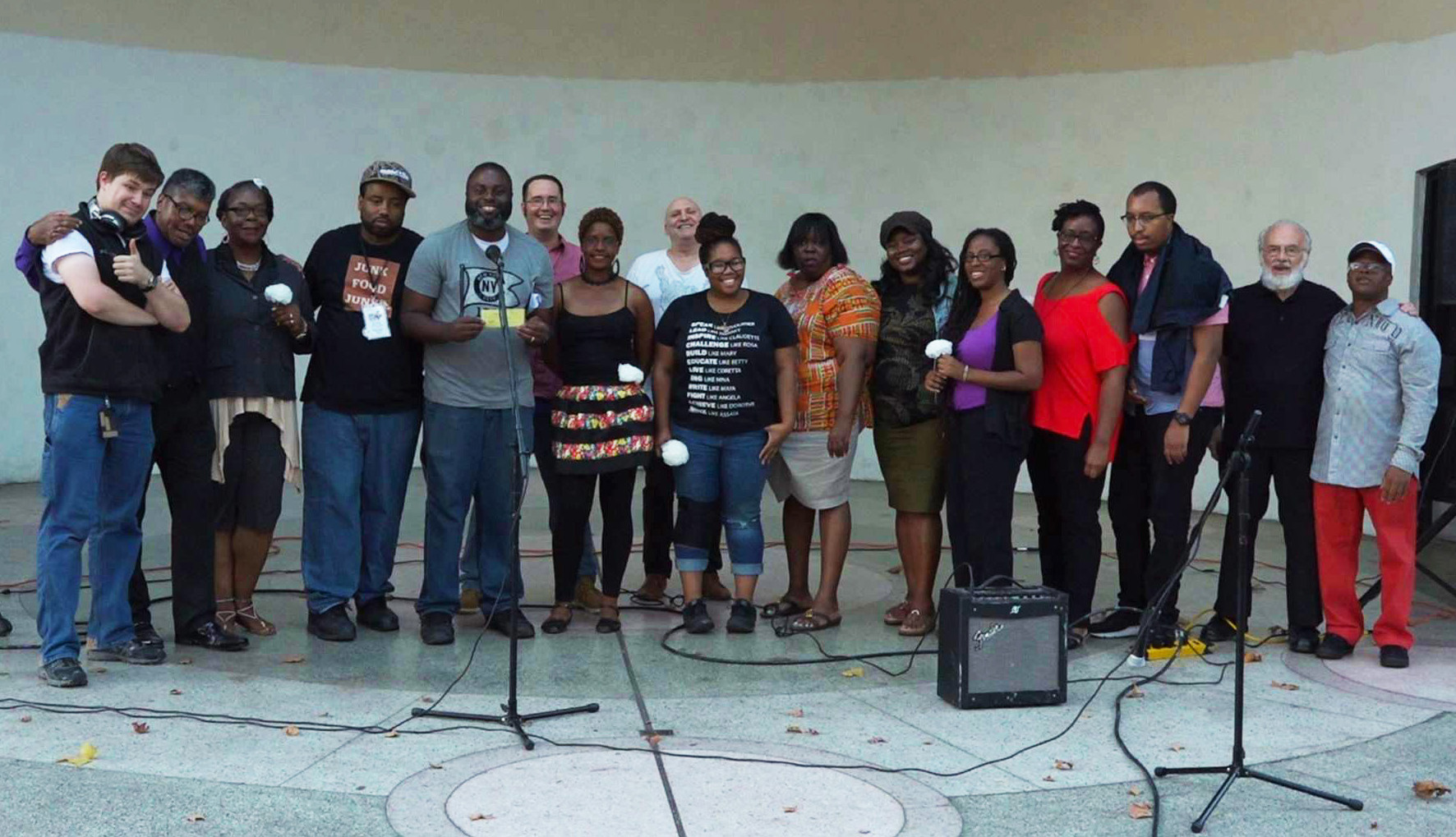
Performances included Jana Astanov, Eartha Watts-Hicks, Marc W. Polite, as well as featured readings by Gregg Dotoli, Olena Jennings, Robert Kramer, and Bob McNeil. Guitarist Edgar Alan provided music throughout, and a Facebook live stream video shared the day’s events with those who could not attend. The winner of this year’s Gregg Dotoli Poetry Prize, local blogger and writer Marc W. Polite, performed a moving rendition of his winning poem, “Poetic Ruminations of Mr. Born Nice.”
Children who attended were invited to participate in the Harlem Renaissance Chapbook creation station, sponsored by Underground Books. They had an opportunity to learn how to make their own poetry chapbooks by selecting works from Langston Hughes, Maya Angelou, Paul Laurence Dunbar, Gwendolyn Brooks, Jean Toomer, Countee Cullen, Federico García Lorca, Alice Dunbar Nelson, and many others. These young members of the community were able to walk home with their own personalized book of Harlem Renaissance Poetry.
As the show drew to a close, Bob McNeil brought each performer up to create an original piece of spoken word poetry by knitting together one line from each person based upon the last letter of the person before them, which created a flowing new poem straight from the minds of the performers on stage.
Underground Books looks forward to continuing to broaden and strengthen the vision of Jackie Robinson Poetry Day—to bring the community and help highlight Harlem’s literary past—and contribute to its bright new future with the support of organizations like Poets & Writers.
Support for the Readings & Workshops Program in New York City is provided, in part, by public funds from the New York State Council on the Arts, and the New York City Department of Cultural Affairs, with additional support from the Frances Abbey Endowment, the Cowles Charitable Trust, and the Friends of Poets & Writers.
Photo: Performers of the second annual Jackie Robinson Poetry Day (Credit: Maksym Kurganskyy).Top contenders for the Nobel Prize in Literature; winners of the Dayton Literary Peace Prizes; writers organize Hurricane Maria relief; and other news.
What can be accomplished without a brain? Three graduate biology students at the California Institute of Technology published a study last month revealing that jellyfish can sleep, the first documented instance of an animal without a brain having the ability to fall asleep. Think of an activity you engage in regularly, and then leap into the realm of the fantastic by imagining how that activity would be different if it didn’t require the use of your brain. Write a poem inspired by this idea, perhaps playing with notions of ancient behaviors, instinctive movements, and primordial processes.
Librarian rejects Dr. Seuss books gifted from White House; 150 writers on the writing process; mystery melody in Proust’s In Search of Lost Time identified; and other news.
“The keeper put me in the cage with the monkeys / Because I asked to be / Put in the cage with the monkeys.” Shane McCrae, whose most recent collection, In the Language of My Captor (Wesleyan University Press, 2017), is longlisted for the 2017 National Book Award in poetry, reads his poem “Panopticon” for the River Styx at the Tavern reading series.
Letters show Proust paid for favorable reviews of Swann’s Way; Durga Chew-Bose advises writers to take it slow; writer Kit Reed has died; and other news.
Washington State poet laureate Tod Marshall speaks out against Trump; the Nation publishes an unseen Kurt Vonnegut story; the letter that inspired Kerouac’s On the Road; and other news.
“This city is full / of stranger things than a man collecting foil.” This short film is an adaptation of a poem of the same title by Matthew Yeager, author of Like That (Forklift Books, 2016) and cocurator of the KGB Monday Night Poetry Series. Directed by Sean Logan, the film features a drum score by tabla player Marcus Wise.
Parul Sehgal shares her approach to book criticism; submitting to thirty journals at once; why U.S. and U.K. book covers are different; and other news.