Sherman Alexie Accusers Come Forward, Gabriel García Márquez’s Birthday, and More
Jay McInerney’s stint as a fortune-cookie writer; Yanyi wins Yale Younger poetry prize; researcher finds manuscript he believes Shakespeare annotated; and other news.
Jump to navigation Skip to content
Jay McInerney’s stint as a fortune-cookie writer; Yanyi wins Yale Younger poetry prize; researcher finds manuscript he believes Shakespeare annotated; and other news.
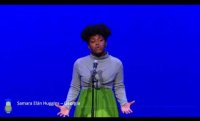
“We aren’t serious when we’re seventeen…” In this video, Samara Elán Huggins, the 2017 Poetry Out Loud National Champion from Georgia, recites “Novel” by Arthur Rimbaud, translated from the French by Wallace Fowlie. Anndee Hochman writes about Poetry Out Loud, a national recitation competition for high school students, in “The Poem Chooses You” in the March/April issue of Poets & Writers Magazine.
“Children under, say, ten, shouldn’t know / that the universe is ever-expanding…” Cennemi Diaz, the 2017 Los Angeles County Poetry Out Loud winner, recites Nick Flynn’s poem “Cartoon Physics, part 1.” Anndee Hochman writes about Poetry Out Loud, a national recitation competition for high school students, in “The Poem Chooses You” in the March/April issue of Poets & Writers Magazine.
While scientists might describe the motion of snakes as rectilinear motion, Emily Dickinson’s poem “A narrow Fellow in the Grass” refers to the snake as “a Whip Lash / Unbraiding in the Sun.” This week, read scientific descriptions, or browse through video clips, of your favorite animal’s movements. Then, write a poem that employs unusual word choice, unexpected imagery, or mimics in some way the physical motion of an animal. Perhaps the manipulation of rhythm, sound, spacing, or repetition will help highlight the movement you capture in your poem.

Dan Beachy-Quick explores the infinite possibilities of poetry and the idea that metaphor can be a philosophy, and poetic craft a means of living a life.
Jon Parrish Peede to head National Endowment for the Humanities; Celeste Ng’s Little Fires Everywhere to be adapted for television; the legacy of Gwendolyn Brooks; and other news.
Tim Fredrick is the author of the short story collection, We Regret to Inform You (Ingram, 2012). His stories have been published in Burningword, Pif Magazine, Wilde Magazine, and Hamilton Stone Review. He is the founding editor and executive director of Newtown Literary, a nonprofit organization dedicated to supporting writers from and living in the Queens borough of New York City.
 How did Newtown Literary begin? What prompted you to launch it?
I began Newtown Literary in 2012 after getting to know several writers in Queens and attending various literary events there. Something was definitely bubbling up at the time, and I was reading and hearing incredible work. Unfortunately, not much of that work was being associated with Queens; authors usually said they were from “New York City” in their bios. I decided that it was time for a written record of the work being produced in Queens and for “So-and-so is from Queens” to be a badge of honor in an author’s bio. The borough has a long history of the literary arts and some of the best literature being produced now is from writers living in Queens or who grew up there.
 The literary events scene in Queens is going strong. What’s next?
One of the great things about the literary scene here in Queens is that it is grassroots. The people who organize reading series, events, literary journals, small presses, and so on are everyday writers who want to contribute to the community. So, in the larger literary scene, it’s hard to know what’s next. For Newtown Literary, we are going to continue with our journal and with our free classes and professional development program. Our focus lately has been on removing barriers to participation. Our free writing classes program—which offers twice-a-month, one-off, free writing classes taught by established Queens writers, such as Scott Cheshire, Jill Eisenstadt, Joseph O. Legaspi, and Min Jin Lee—was born out of a desire to make high-quality creative writing instruction available to everyone, no matter their income. We will continue in this vein.
 In addition to being a literary organizer, you’re also a creative writer. What’s it like wearing two hats, so to speak?
It’s not easy! I often have to choose between my commitment to Newtown Literary—and by proxy, other writers—and my commitment to my own writing. I wish I could say that I chose my own writing more often, but it’s “easier” for me to choose my work at Newtown Literary because it doesn’t challenge me as much as writing does. Running a small nonprofit is so much easier than writing a novel!
Is there any advice you’d offer to creative writers who want to participate in the “behind the scenes” of literary organizing?
Do it. Reach out to people in charge and say, “Hey, I’d like to get involved.” At least at Newtown Literary, it’s that easy.
What has been the most rewarding experience in your work with Newtown Literary?
What I value most about Newtown Literary is our community—it’s not competitive and there are no hard feelings when one person succeeds. While working on the organization takes time away from my own writing, the friends and colleagues I’ve made working here are constantly asking me, “How’s your writing?” and if I respond, “Well...” I know I need to get to work. Some of my closest friends—the ones I go to when I need to talk or vent or celebrate—come from the organization, as well.
Support for the Readings & Workshops Program in New York City is provided, in part, by public funds from the New York State Council on the Arts, and the New York City Department of Cultural Affairs, with additional support from the Frances Abbey Endowment, the Cowles Charitable Trust, and the Friends of Poets & Writers.
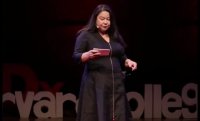
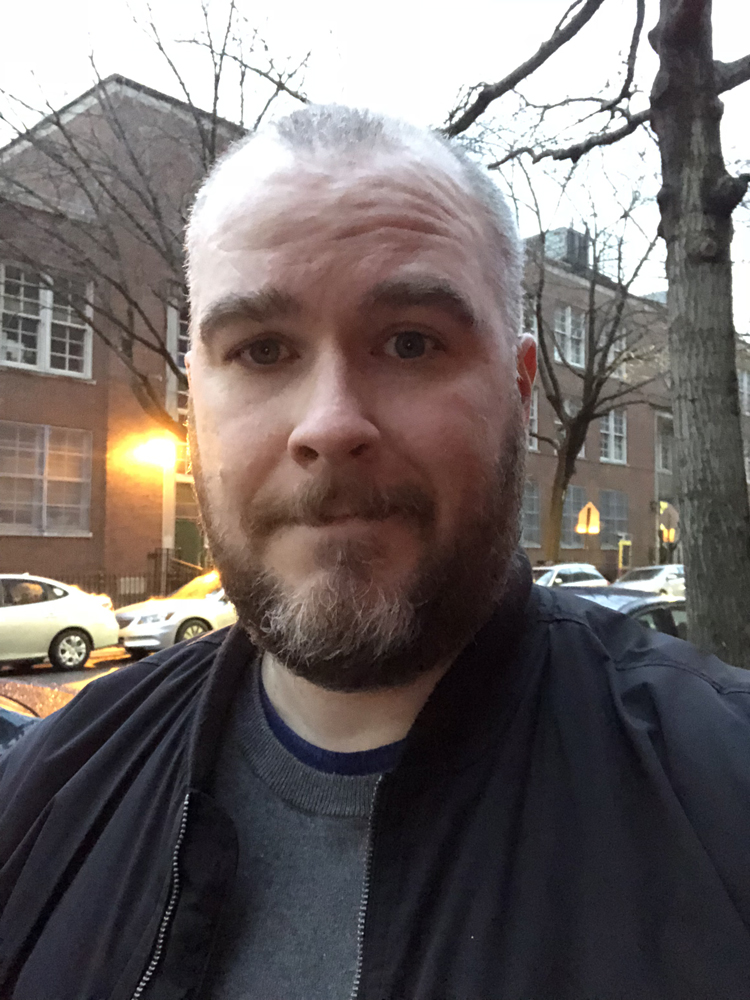
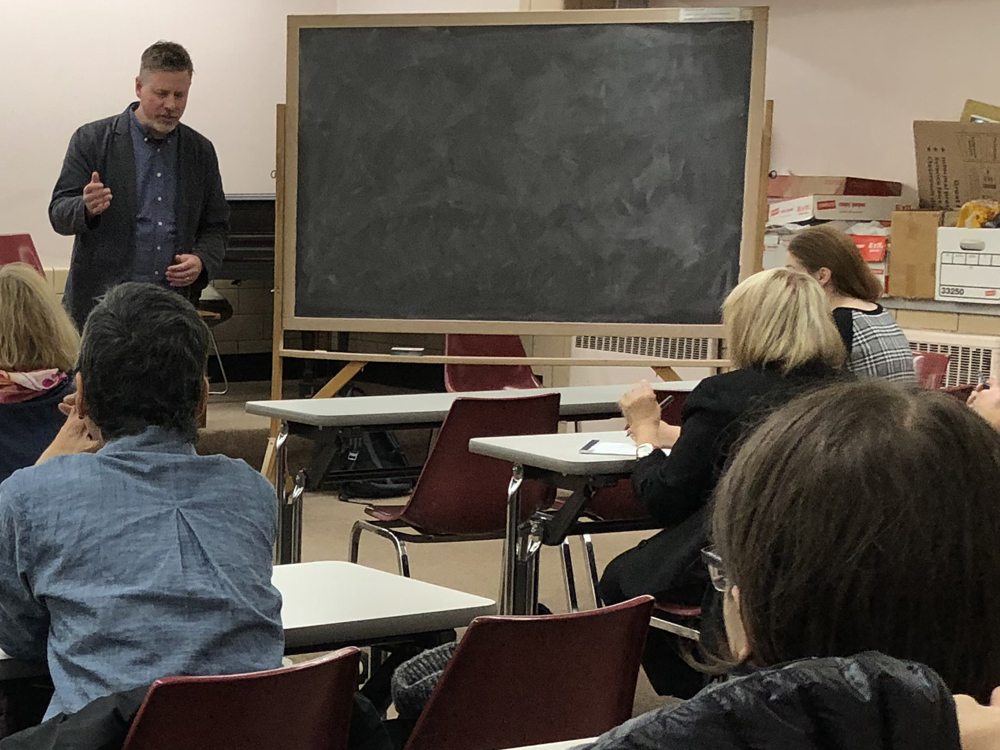
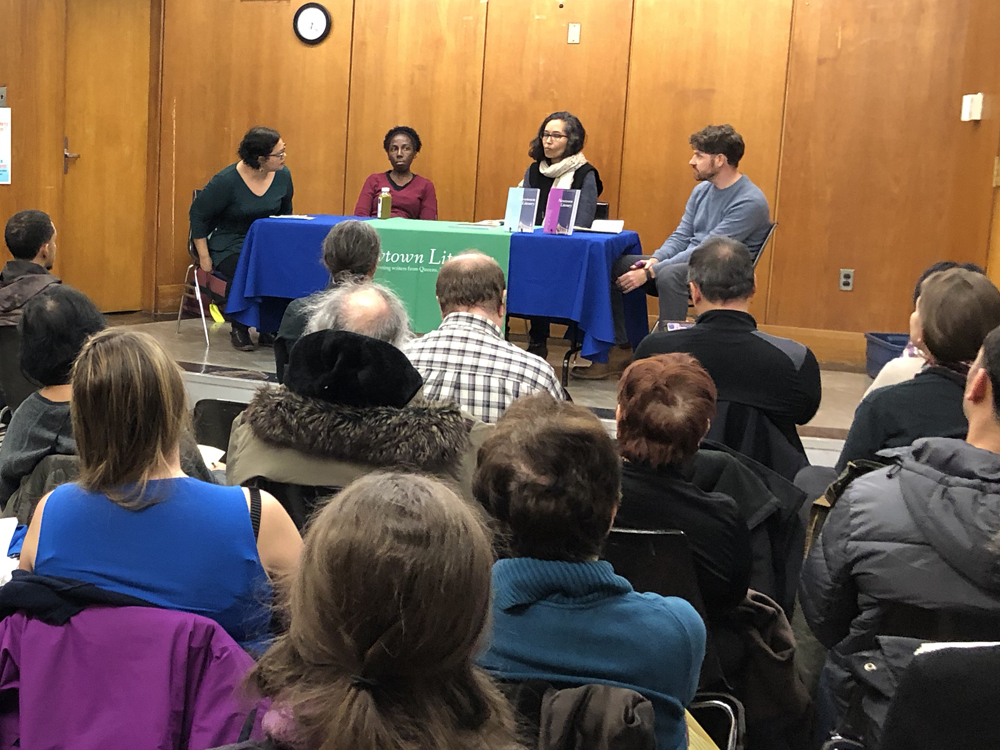
Photos: (top) Tim Fredrick (Credit: Tim Fredrick). (middle) Writer’s Block class led by Scott Cheshire (Credit: Newtown Literary). (bottom) Get Published panel (Credit: Newtown Literary).Brenda Shaughnessy reads her poem “I Have a Time Machine” and discusses the role that poetry can play in recovering from traumatic experiences for a TEDx event at Harvard University. Shaughnessy is the author of Our Andromeda (Copper Canyon Press, 2012) and So Much Synth (Copper Canyon Press, 2016).
Hachette Audio announces vinyl audiobook series; Ta-Nehisi Coates to write Captain America comics; the rare manuscript that was used as a chopping board; and other news.
Submissions are currently open for Verse’s Tomaž Šalamun Prize, given annually for a chapbook of original poetry or poetry in translation. The prize includes $500, publication by Factory Hollow Press, and a monthlong residency at the Tomaž Šalamun Center for Poetry in Ljubljana, Slovenia, valued at approximately $1,500. Anaïs Duplan will judge.
Using the online submission system, submit a poetry manuscript of 20 to 28 pages with a $15 ($10 for current students) by March 15.
The residency will be held from May 20 to June 20, 2019. The resident will be provided with private lodging in an apartment with a full kitchen and bath, but is responsible for her own meals and travel expenses. Visit the Verse website for more information.
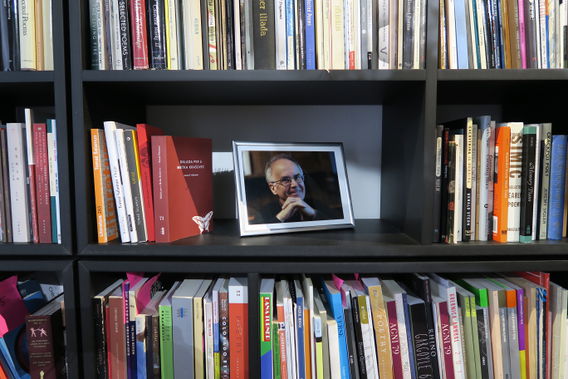
Photo: Bookshelf at the Tomaž Šalamun Center for Poetry featuring a photo of the author