In the second stanza of his famous poem “Self-Portrait in a Convex Mirror,” John Ashbery writes: “I think of the friends / Who came to see me, of what yesterday / Was like.” Friends Who Came to See Me is the name of a new exhibition at the Morgan Library & Museum in New York City. Open through October 25, the exhibition includes twenty-five works on paper from the collection of the poet, who died in 2017, donated to the museum by his husband, David Kermani. Many of the drawings, which date from 1945 to 2007, were gifted to Ashbery by his artist friends, including James Bishop, Joe Brainard, Jane Freilicher, Jean Hélion, Fairfield Porter, and Larry Rivers. In addition to comics, photographs, and illustrated letters, the exhibition contains literary materials such as a first edition of Ashbery’s debut, Some Trees (Yale University Press, 1956), and eight portraits of the poet: a profile in graphite torn from a sketchbook; drawings of Ashbery’s face at different angles in crayon, pastel, and opaque watercolor on dark brown paper (below); the poet staring straight ahead in colored ink and marker. Though we may now be accustomed to Ashbery as the chronicler and observer, this collection allows us to witness the poet, penciled and remade, under the intimate gaze of his companions. We see Ashbery in different modes, moods, and presentations. In R. B. Kitaj’s portrait, the poet looks flushed; in Larry Rivers’s drawing, Ashbery’s legs are crossed and he sports a suit. He is variously forlorn, somber, and amused. He slouches; he poses upright.
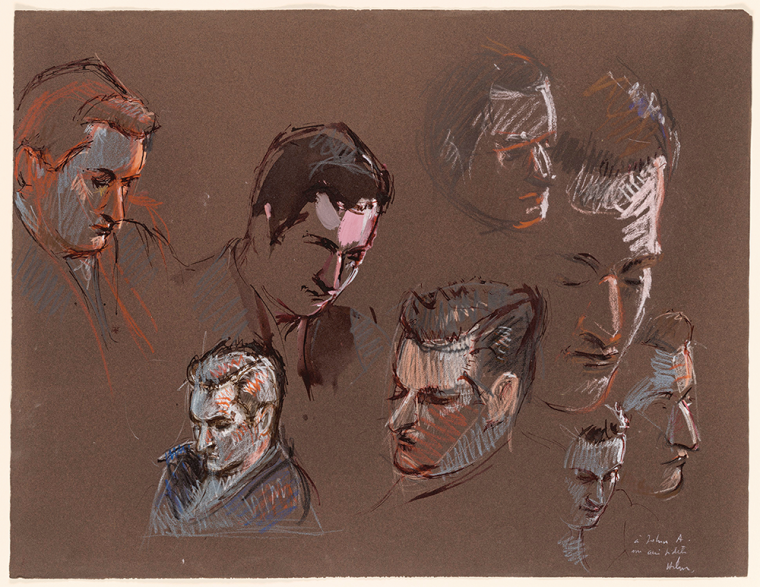
Portraits of John Ashbery by Jean Hélion.
(Credit: Carmen González Fraile via the Morgan Library)Ashbery was born in Rochester, New York, in 1927. His first book was selected by W. H. Auden for the Yale Younger Poets Series. He wrote over twenty collections of poetry in his lifetime, served as the poet laureate of New York State and a chancellor of the Academy of American Poets, received the Ruth Lilly Poetry Prize, the Bollingen Prize, and the Shelley Memorial Award, in addition to fellowships from the MacArthur Foundation, the Guggenheim Foundation, and the National Endowment for the Arts, among numerous other honors. Before all this success, though, Ashbery was working and living in downtown Manhattan in the mid-1950s, socializing with a group of experimental painters and poets, later dubbed the New York School. Ashbery has commented on the advantages of running with the talented crowd of up-and-comers before it was celebrated as a poetic movement.
In his 1983 Art of Poetry interview with the Paris Review, he said, “I sometimes think that the ‘greatness’ my friends and I used to see in each other’s poetry when we were very young had a lot to do with the fact that it was unknown. It could turn out to be anything; the possibilities were limitless, more so than when we were at last discovered and identified and pinned down in our books.” Though writing can sometimes feel like composing into the void, Ashbery articulates the power of a buoying artistic community, its local audience, and the incipient creativity it fosters.
(Used by arrangement with Tibor de Nagy Gallery and Georges Borchardt Inc. Photo credit: Carmen González Fraile via the Morgan Library & Museum)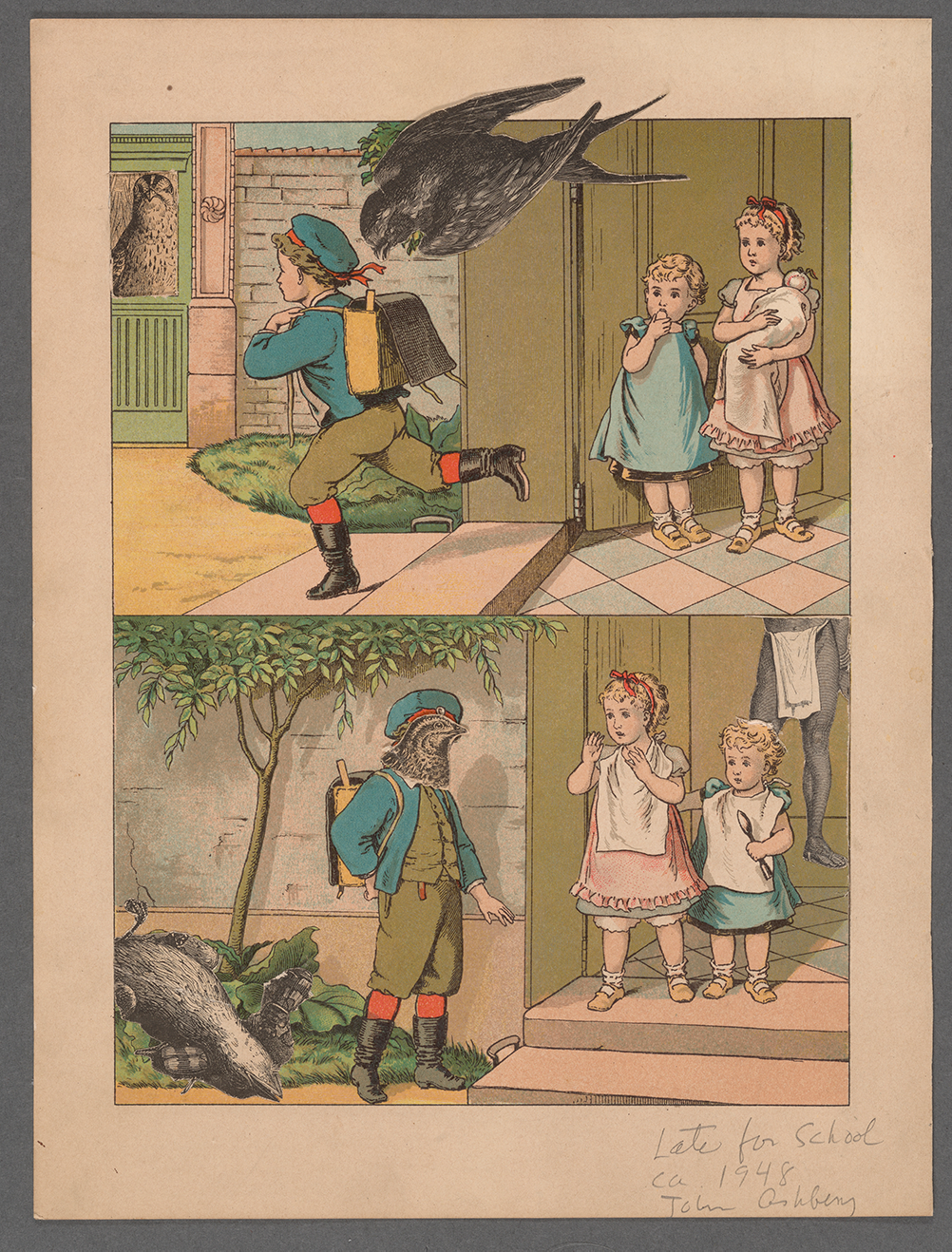
A reminder of his playful, inventive, and elusive aesthetic, the exhibition at the Morgan returns readers and fans of Ashbery to the early stages of the poet’s career, when he was just a college student toying with visual forms, creating palimpsests of boys going to school as children and returning with the heads of birds. Ashbery constructed the collage “Late for School” (above) from cut printed papers in 1948 while he was at Harvard. “Late for School” represents Ashbery’s early interest in surrealism and his childhood desire to become an artist, which he attributed to viewing the reproductions of works by Dalí, de Chirico, and Magritte.
Friends Who Came to See Me “considers Ashbery not only as a poet, critic, or collector but also as someone shaped by the people whom he held dear,” writes Colin B. Bailey, director of the Morgan Library & Museum. Ashbery openly reflected on the blurry boundary between one’s friends and one’s self and the power of personal and artistic inspiration. “Self-Portrait in a Convex Mirror” continues: “How many people came and stayed a certain time, / Uttered light or dark speech that became part of you / Like light behind windblown fog and sand, / Filtered and influenced by it, until no part / Remains that is surely you.”
Serena Alagappan is a senior editor at Poets & Writers Magazine. Find her online at serenaalagappan.com.