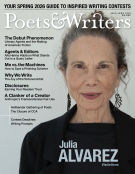
In her latest collection, Visitations, published by Knopf in April, Julia Alvarez has gathered new poems as well as some pieces written as far back as forty years ago to explore what she calls “the landscape of aging.” The prolific and celebrated author has drawn devoted readers to her work since the early 1990s—her first book was the poetry collection Homecoming, published by Grove Press in 1984; seven years later, in 1991, her debut novel, How the García Girls Lost Their Accents, was published by Algonquin Books to wide acclaim—as one of a small cadre of young Latina authors, including Ana Castillo, Sandra Cisneros, Judith Ortiz Cofer, Cristina García, and Esmeralda Santiago, to command their place in the established literary scene. Now 76, Alvarez reflects on being a different kind of model: “Not everybody’s Latin or female, but if they live long enough, they will get old. It’s the great democracy!” Upon the release of her most recent novel, The Cemetery of Untold Stories (Algonquin Books, 2024), she gleefully explained that she had no interest in writing a version of A Portrait of the Artist as a Young Man but rather “A Portrait of the Artist as an Old Woman and a Latina.” With Visitations, she continues that quest.

Julia Alvarez, author of Visitations. (Credit: Joey Ciolko)
The title itself suggests a reflection on the many selves Alvarez has embodied—daughter, sister, writer, mentor, rebel, wife, and teacher. In this autobiographical collection of narrative and lyrical poems, she endows memory with the sacred spirit of a visitation. She recalls her Catholic upbringing and love for ritual and storytelling, explaining that she learned the term visitation as a child in catechism class through the story of the Virgin Mary speaking to her aging cousin Elizabeth, who is also pregnant and suddenly feels her unborn child move in her womb. As Alvarez writes, “This is what poems are meant to do! Quicken the life within us….” Visitations is her first poetry book in well over a decade, yet she has never stopped writing poems, starting every day with a meditational reading of poetry. While some may have thought Alvarez had essentially abandoned poetry for fiction, the genre that brought her the widest acclaim, Sandra Cisneros, best known for her first novel, The House on Mango Street (Arte Público Press, 1983), and the author of four books of poetry, believes otherwise: “Julia and I are essentially poets who make our living with fiction. When you are a poet you see the world the way a poet does. It is our visionary voice, our highest power; not influenced by money, it comes from an intuitive, spiritual place. Julia never abandoned poetry; now it’s taking center stage again.”
But it’s not only a natural process of aging and reflection that has prompted these visitations for Alvarez. In October 2021, during COVID-19 isolation, she suffered a retinal detachment and lost sight in one eye. She describes waking up unable to see out of her right eye, a trauma that felt like “palm branches tumbling down inside the eye.” Her vision went black. Her husband, Bill Eichner, a retired ophthalmologist, recognized what was happening and immediately got her to a specialist. After two excruciatingly long, painful, and ultimately unsuccessful surgeries, she had to adjust to a new reality in which she was unable to drive; she lost depth perception and could no longer push herself to work six or seven hours a day because of the strain on her “good eye.” Yet, while she expected panic and depression, she found herself feeling both relief and release. In an April 2024 essay titled “Falling in Love With Writing Again,” she described experiencing a sense of liberation: “I was back where I had started as a young writer in the play and delight of the writing itself.” Less concerned with recognition and the business side of publishing than her younger self, she quotes the metaphysical poet George Herbert: “And now in age, I bud again.”
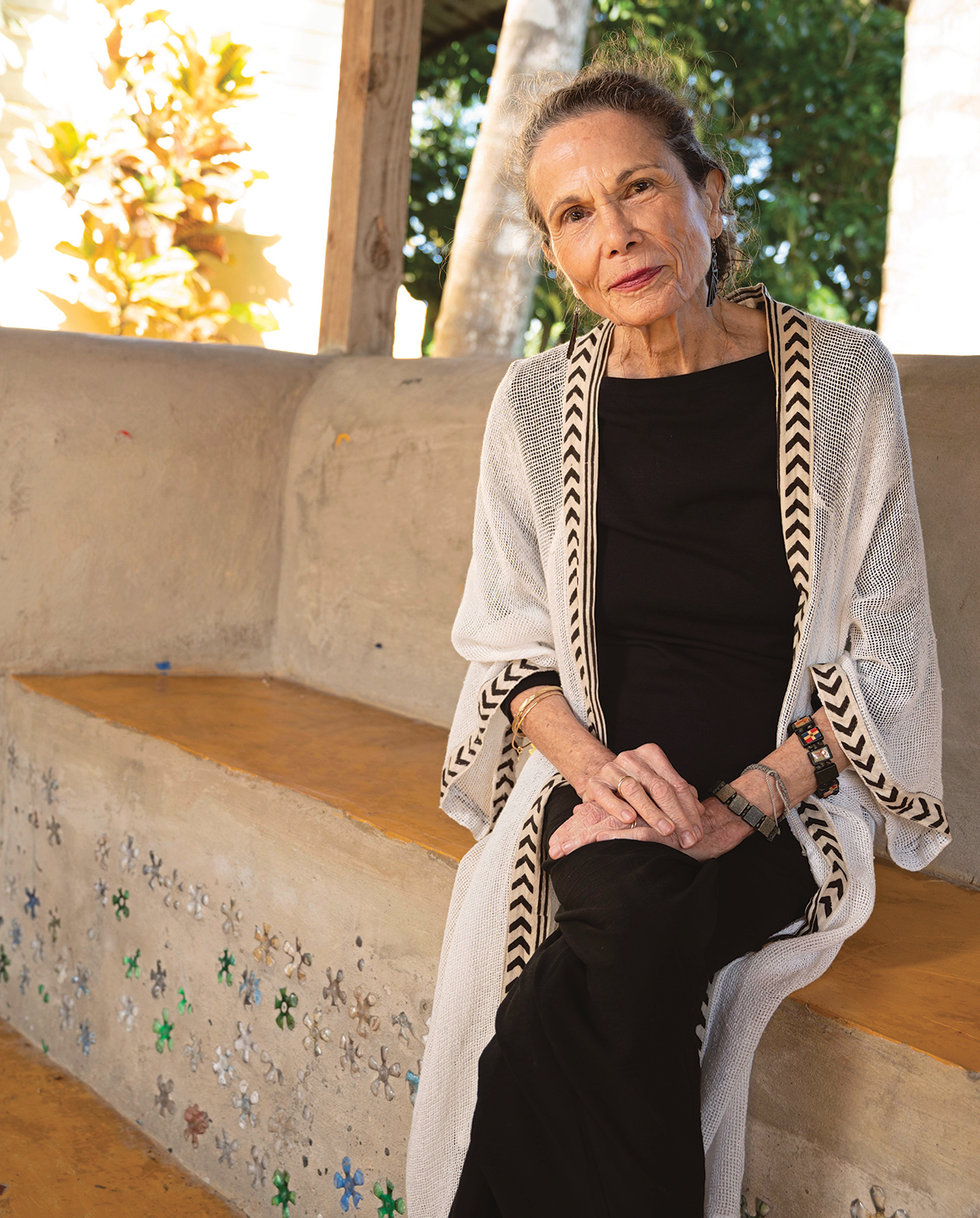
It’s difficult to imagine anyone being in fuller bloom than Alvarez. Whether in poetry or prose she has been telling her stories for decades, starting with her early life in the Dominican Republic under the dictator Rafael Trujillo, who ruled for thirty years before his assassination in 1961. Endangered by being part of the resistance, her family fled the country in 1960 and immigrated to the United States. She chronicled those years growing up largely in Queens, New York, in her semiautobiographical first novel, How the García Girls Lost Their Accents, which became and has remained a staple of the literary canon and school curricula. Seven novels followed, including In the Time of the Butterflies (Algonquin Books, 1994), In the Name of Salomé (Algonquin Books, 2000), and Afterlife (Algonquin Books, 2020). Alvarez is also the author of four poetry collections, three works of nonfiction, and a shelf of young adult novels. She gave up being a tenured professor at Middlebury College to write full-time while remaining a writer-in-residence, a position she holds today as an emerita. Widely honored with prestigious national and international grants, fellowships, and awards, Alvarez was chosen in 2013 by President Barack Obama as a recipient of the National Medal of Arts. Having known commercial success and widespread recognition for decades, she most assuredly is not ready to stop writing. She has said in many interviews that writing is not a job but a way of life, and she’s not about to retire from life.
Alvarez has been on the front lines of changing the complexion, the essence, and the content of the American literary canon since the publication of her debut novel in 1991. Susan Bergholz, her longtime agent and a champion for Latina writers since those early days, recalls what led to the author’s appearance in the September 1994 issue of Vanity Fair magazine and its feature titled “The Four Amigas,” showing Alvarez, Cisneros, Ana Castillo, and Denise Chavez. Contacted earlier by Vogue about a proposed article on women in publishing, Bergholz was asked to send photographs of promising women authors. “They were sent back,” she recalls, “with the message that they don’t quite work for us. No further explanation was given, but I knew: It was because they were all brown-skinned and Latina.” After sending off an angry letter to the editor and receiving no response, Bergholz approached a friend at Vanity Fair, explaining the situation and advocating for her authors. He offered to fly them to Chicago, where they could choose whatever they’d like to wear and participate in a photo shoot.
The article described them as “charter members of a group: Las Girlfriends, dedicated to good writing, unselfish support, and the latest gossip.” All four had new books or reprints coming out that same month. Was this a watershed moment in American letters? Cisneros doubts it. She remembers the momentary excitement of being featured in a fashion magazine but says it “was a kind of mythification of us.” Admiring and respectful colleagues, they were not the close day-to-day best friends that the article implied, nor did it acknowledge the wide diversity of their writing. Bergholz agrees that Vanity Fair was no watershed, but the piece did contribute to getting good editors of major publishing houses to pay attention and “begin to understand what they were missing in American fiction.”

Alvarez calls Visitations a collection of “loose poems…that follow the many incarnations and voices of [her] writing selves over the years” and acknowledges that they have been “revised and in some cases reimagined” with the help of trusted advisers, including John Olivares Espinoza, an early editor of her poetry, and John Freeman, poetry editor at Knopf, along with her “first reader and [current] agent,” Stuart Bernstein. When asked if she was tinkering or overhauling, she questions the distinction itself: “I’m an endless tinkerer. Of course, some poems got major shifts because a poem written twenty years ago was written by a different self. When I read publicly from my own work, I used to get so down on myself, asking why I chose that word, put that comma there. Now I think, So what if my flawed self is out there for the public to see? It’s a good sign that you’ve grown from the writer that wrote that earlier line.” Although she admits some concern about having the energy to sustain another book tour, the trepidation she feels about a book going out in the world is hardly unusual, she says, because “you’ve held the book, worked with it, loved it, and then you have to launch it.” Recalling the way her family and friends, especially the women, found light in reciting poetry at gatherings, even in the darkness of dictatorship, she hopes that even one or two poems in the new book will resonate with a few readers. “That would be enough,” she says, “and that’s a lot.”

Award-winning Haitian American writer Edwidge Danticat sees Visitations as part of a cross-genre trilogy that began with Afterlife and continued in her most recent novel, The Cemetery of Untold Stories. “Julia is teaching us how to say goodbye, not in a somber or sad way but in a freeing way where we leave a little bit of ourselves behind,” Danticat says. “For some it might be painful to go from ingenue to elder, but from the conversations I’ve had with Julia over the years, I think she sees letting go as a gift. It’s beautiful to go back with her into her childhood once again, this time through the lens of an elder and at the same time to see new work emerging.” As Danticat observes, readers familiar with Alvarez’s earlier work, both in fiction and poetry, will find some familiar faces in Visitations. The opening line of the first poem, “Recitation,” announces, “Here I am starting again” as she begins the new book with her young self “in a pink party dress with a flaring crinoline” reciting poetry to entertain her extended family and friends. “I see how ready they are, / their greedy eyes, / their hands folded before them as if in prayer,” a reminder of the rich oral tradition that Alvarez has long celebrated and honored.
In “The Four Girls” she writes of the camaraderie, competition, and shenanigans of her three sisters—Maury, Tita, and Ana—and ends the sequence with “The Long and Short of It,” a heart-wrenching poem in memory of Maury, who took her own life in 2015. On a lighter note, she reflects on birth order, noting that as the middle child, “In a sense, I have always been the artist / for nothing ever came to me whole.” When asked about that definition of the artist, Alvarez says, “When you come as the second child, a piece has already been broken off. And as a middle child, more pieces are going left and right. I think the artist is trying to create a kind of connective integrated space where she’s the one putting the pieces together. I also think, and many of my writer friends agree, that we’ve gone to writing because there is something missing: We say ‘inquietud’ in Spanish, something not quite whole, and we feel the need to address it, not to solve it, but to play with it and see ways in which it can come together.”
In poems both passionate and fanciful, she chronicles her “Falling in Love in Late Fall” with Eichner, whom she married in 1989. In another poem about “youthful middle-aged lovers,” she unabashedly admits, “I dreamed of you touching / the tender skin of a girl / I could no longer be.” Having been married before, she confesses her hesitation, even fear, about “this spring-surprise / of love in our autumn years.” The final poem of the collection ends with the reassuring comfort of her “making my way in the dark / to the spark of my joy / where you lie in our bed, / already sleeping.” A grace note.
One of the most powerful pieces in Visitations is the title poem about Alvarez’s mother, a familiar figure from her novels, poems, and essays. The poem, “Mami at Her Vanity,” published earlier this year in the New Yorker, opens: “I watched as she tried on faces / before an evening out” and meditates on the “many faces surfacing on her face” as the speaker, presumably her namesake daughter, Julia, tries to unravel the mystery of her mother. Born to an affluent and influential Dominican American family, Julia Tavares Espaillat wanted her daughters to be properly behaved, well educated, and suitably married, and the story of this mother-daughter relationship is drama of the first order. Even though Alvarez insisted it was fiction, the autobiographical elements in How the García Girls Lost Their Accents—intimate details of the family’s private life, including the girls’ rebellious behavior and struggles with displacement and cultural assimilation as immigrants—cut too close to the bone for her mother, who threatened to sue her daughter and did not speak to her for several years. In the title poem, “Visitation,” Alvarez describes going to a nursing facility to deliver a talk about her work, complete with a PowerPoint presentation. The self-effacing speaker mocks her own outfit, “a bright huipil,” and her strategy (“if poetry fails, plan B is my ethnic talk”). But all the while she is observing and commenting on the situation, her mother haunts her as the person who always told “the acid-biting truth.” When she sees an elderly woman “looking perplexed / as if trying to place us in her memories,” she imagines it is her mother “in another guise”—clearly a spirit still in her daughter’s heart and mind and still an enigma.
When In the Time of the Butterflies became a success in the nineties, her mother turned from adversary to advocate. Always full of surprises, Alvarez’s mother became an ambassador and representative of the Dominican Republic, and her work at the United Nations led to the establishment of the U.N. Day of Older Persons, celebrated on October 1; she also introduced the resolution that November 25 be declared as the International Day for the Elimination of Violence Against Women. With both regret and respect, Alvarez recognizes that her mother was a woman who would have done very well with a public life, “maybe with one child, if that, hopefully a son, and a career. But she was circumscribed by her circumstances. She had the energy, the intellect, the savvy, and the persistence that should have been in the bigger canvas of the world.” And Alvarez appreciates that her mother taught her how to be an artist. “She taught me the household arts, understanding that they were arts for women of her generation. You clean a house so that it shines, and there isn’t one bit of your fingerprint on it. You work and work, and then you disappear into the work—which is what an artist does.” As her mother predicted, “the mango doth not fall far from the tree.”
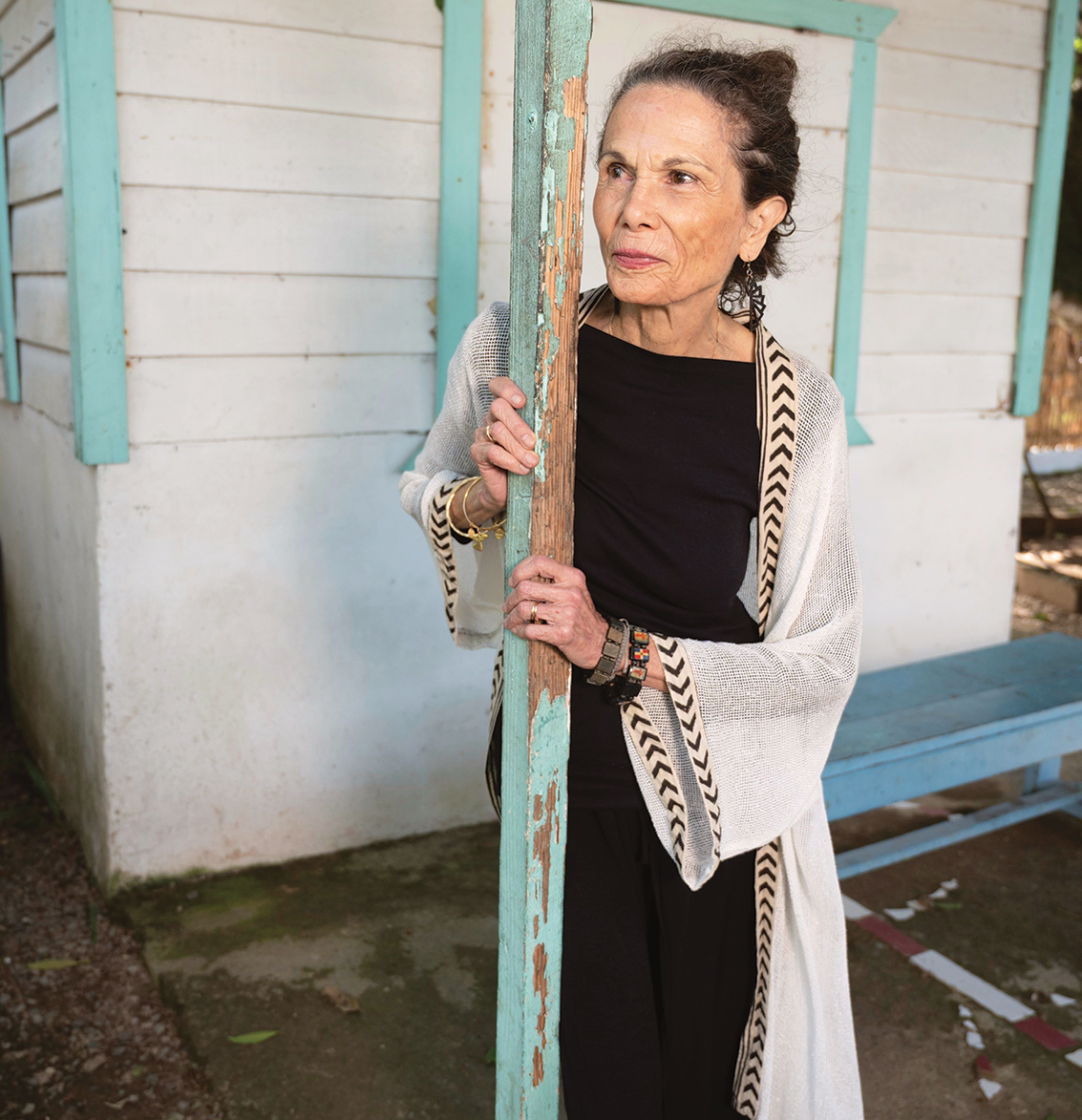
The writer Martín Espada calls Alvarez “a poet of conscience,” an apt description of someone whose work has brought the Trujillo dictatorship into her poetry not through political diatribe but on the most human level. In the lyrical “Balancing Acts,” Alvarez recalls the delight she and her cousins felt when their grandfather was relegated to sitting at the children’s table. For them his company is a gift: “[O]ur grandfather wants to hear from us, / chuckling at our antics in this hell / where he struggles to keep a flicker of hope alive / like the window light that signals a safe haven / for friends on the run from el Jefe’s policia.”
El Jefe, the boss, a reference to Trujillo, is mentioned almost in passing, despite his tyrannical rule. Alvarez marvels: “To think that in a dictatorship with all the bloodletting that was going on, people being disappeared, and families in terror, lights on to signal safe houses—and our grandfather was aware of this—he had access to this world of play and childhood that made us feel safe. What an accomplishment to balance the parts of his life so that he could still have this winged life within him.” Neither polemical, nor didactic, Alvarez’s reminder of this history leaves it to us to wonder if the poem and her grandfather might also hold lessons for our time.
“I Go Through the House Turning Off Lights,” the final poem in Visitations, is set in Weybridge, Vermont, in 2024, after the guests who have gathered to consider what they might do about “the televised war,” a reference to Gaza, though clearly it could be any number of the conflicts in today’s world, depart. Alone, the speaker wonders “what good it does to keep going / over and over things we can do / nothing about”—a wondering that travels through the poems in this collection. Alvarez certainly does not see herself as a political poet, nor a propagandist, but citing the influence of Czesław Miłosz, she says, “A poet should not sink below a certain level of awareness of what is happening during the current time if he is going to write anything useful. People live on the ground, and there has to be a certain level of awareness of being present to the life you’re living, the books you’re reading, or the language you’re crafting. For me that really is where the need to write begins. There’s a pebble in my shoe, and what puts it there is my conscience. It’s something that troubles me, that I can’t shake. It won’t leave me alone until I do something about it—and the way I do something is through writing. But that doesn’t mean being an armchair conscience. I have to show up for things that are foundational to me.”
Case in point: In the Time of the Butterflies, historical fiction based on the true story of the four Mirabel sisters, known as las Mariposas or the Butterflies, is often credited with bringing this tragedy to international attention. Three of the women were assassinated in 1960 for their resistance to the Trujillo regime. With one of those pebbles still stuck in Alvarez’s shoe, she and her husband in 1997 established Alta Gracia, which would become a sustainable organic coffee farm and literacy center in the Dominican Republic. In 2012, the Mariposa DR Foundation opened the Mariposa Center for Girls, a safe space that offers educational opportunities along with job skills and experiential learning. Alvarez has written about owing the upcoming generations “our deepest truest activism, what a friend calls ‘artivism,’—doing the work we love to do.” In so doing she finds purpose and hope: “The mariposas feed me! There’s a reciprocity, a circulation, no hierarchy. Even as our world darkens, there is a spark of joy somewhere, but you have to find it—like the grandfather [in ‘Balancing Acts’].” Similarly, Alvarez and Eichner founded Border of Lights, a grassroots movement to foster awareness and healing through remembrance of the 1937 massacre of Haitians and Dominicans of Haitian descent. Alvarez, who spends at least two months of the year in the Dominican Republic, sees this work as another way to engage in her role as a storyteller. Her efforts are featured in the 2024 PBS documentary film Julia Alvarez: A Life Reimagined.
The young firebrand is hardly tamed by this point in her life. In fact, she speculates, “Maybe I’m going feral in my old age. I find that the older I get, the more baffling it all is, the more the mystery deepens. I want wildness, some tangled-ness. The work of writers late in life often becomes more iconoclastic; they want to break, get beyond where they’ve been. You better make friends with mystery because that’s where you’re headed, lady!” No surprise that this writer who expanded the literary canon and paved the way for so many others continues to inspire. Manuel Muñoz, author of the short story collection The Consequences (Graywolf Press, 2022) and a MacArthur fellow, describes her appeal, one that does not fade with age. “I’ve been in packed rooms with many writers, but with Julia, it is different. The buzzing energy is not only anticipation for what she is about to share, but a sense of gratitude for what she has given. I’m especially moved by seeing young people in thrall just to get a selfie. In her they see how liberating it is to be vulnerable about family or shame or loss or love. There is great pride, too, in seeing that her roots are strong and unshakeable. We all feel it. That’s why we keep reading her, returning to her.”
That sense of wanting to stay in the moment with Alvarez is reflected in the closing piece in Visitations, an essay titled “Sobremesa,” the Spanish word meaning “upon the table” and referring to the tradition of staying for a while after a meal to relax and continue the conversation. Danticat sees it as more than a coda. “It feels integral to the book. Everyone we’ve read about is at the table—Julia’s sisters, friends, her mother, her younger self—you feel they don’t want to part from one another. Rather than close the book, the sobremesa keeps it going.”
In what might be the most powerful poem in Visitations, “Muse Sighting in Matanzas,” Alvarez celebrates poetry’s life force. Writing in the voice of one of the writers brought to Cuba in 1998 to judge candidates for a literary prize, Alvarez mocks “the ambition that drives so many of us / to express ourselves and want to be recognized”—including herself in the “disquisitions” she and her colleagues are ready to deliver. Suddenly, an old woman—“a retired teacher, a spinster…a former maid…a local known to be a loose cannon”—bursts into their midst and begins to recite a poem “swaying with the rhythm of the lines, / her cheeks aflame, the words made flesh in her body.” In this scene Alvarez offers a dramatic enactment of what truly matters about poetry; she recalls attending readings that were clever, smart, “not over my head, but over my heart. A full-bodied poem has the flow of breath in your spirit—and it has to land in my heart.” That poem ends with a celebration of an unlikely muse whose sheer joy in “the mystery caught” in a beloved poem banishes any fear that poetry is “impoverished, embargoed, imperiled,” even in these darkening times. Throughout Visitations, Julia Alvarez generously shares “the play and delight” that has returned to her writing and gently beckons us to linger a while longer at her table.
An excerpt from Visitations
On Sundays
Ciudad Trujillo, 1950s
On Sundays we could choose
whom we belonged to, the choice disguised
as destination: either cathedral mass
with Mami or the beach with Papi—
a simple choice, were it not, we knew,
how on a whim he’d change his mind
en route, as we whined he’d tricked us,
leaving us waiting in the airless Chevy,
just a minute, the backseat burning
in the tropic heat of what would soon
be midday, while he made his rounds
at the hospital, or turned down a wash-
board road that hurt our bottoms to fill
the trunk with river stones that took hours
to pick—just the right size, the right shape—
for the fishpond he was building, which
required a stop at the almacén, just around
the corner, for cement, errands he omitted
mentioning when he promised white sands,
pounding surf, coco water dripping down
our chins and swimsuits—as if to teach us
that no place would ever be the place
we meant to get to, what we hungered for,
the way the sea was hungry, its ragged mouths
opening for boats, toys, kids, spitting them back
as driftwood, shell shards, tiny skeletons;
or coming after us, as we raced up the beach,
never knowing what it wanted from us,
which might be why I chose it every time;
why now in my troubled turnings when I
make no sense or headway, I see how
I trained for this, how each time I knew
from the last time those beaches were
unlikely, knew what I was missing,
how after mass, Mami would drive to Capri’s
with its candy-cane-striped awning, its blast
of winter not yet known firsthand,
the sweating cartons of imported ices,
ice cream under sliding glass lids,
deliberations back and forth, or peppermint,
or plain vanilla, topped with chocolate sauce,
or sprinkled with confetti colors, honing
the skill of choosing predictable outcomes.
Instead I practiced patience in the face
of disappointments, sharp reversals,
for the rare, rewarded hope, when he took
that final curve almost into the sky—
and it lay before us: vast and blue, roaring
in the distance, spired with whitecaps, belled
with buoys, and in the rearview mirror,
his face, like mine, awash with waves
of joy, as I leaned forward,
as if to whisper in his ear, I’m yours,
the way it sometimes happens: we arrive
where we were promised, belong to
what we longed for in ourselves, each other.
“On Sundays” from Visitations by Julia Alvarez, published by Alfred A. Knopf, New York, 2026. First published by Poetry Society of America. Reprinted by permission of Stuart Bernstein Representation for Artists. All rights reserved. Copyright © 2026 by Julia Alvarez.
Writer and educator Renée H. Shea has contributed extensively to Poets & Writers Magazine, including profiles of Edwidge Danticat, Kiran Desai, Rachel Eliza Griffiths, and Julia Phillips. A number of her interviews have appeared in World Literature Today, most recently a conversation with Dinaw Mengestu. She is currently doing a series for the American Book Review on “The Laureates.” She also coauthors English language arts textbooks for Bedford, Freeman & Worth.