






Poets & Writers Magazine welcomes feedback from its readers. Please e-mail [email protected] or write to Editor, Poets & Writers Magazine, 90 Broad Street, Suite 2100, New York, NY 10004. Letters accepted for publication may be edited for clarity and length.
Letters
Feedback from readers
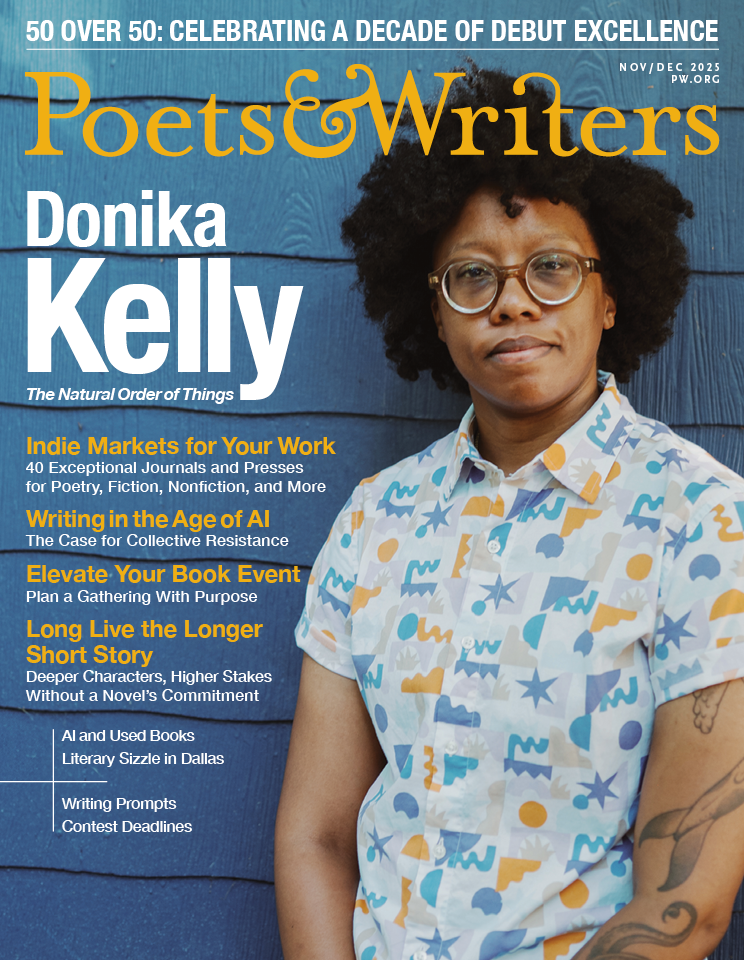
In “Writing in the Age of AI: The Case for Collective Resistance” (November/December 2025), Yiming Ma makes an excellent argument for taking up “our fight as artists to protect storytelling from the advancing encroachment of AI.” I feel that to be effective such resistance must make clear to the public the insurmountable core limitation of AI-generated creative writing, no matter how sophisticated the technology becomes. AI has never actually lived the speakers’ or characters’ experiences it describes, nor felt their (or any) emotions. It can only imitate, mimic, or outright plagiarize emotionally authentic writing. It may eventually do so with great success, but it can never actually be emotionally authentic. Yet AI companies such as Sam Altman’s OpenAI are way ahead of us in grabbing public attention. To start with, we need a snappy counter-acronym to catch on the way AI has, one that makes the above core distinction. I proposed and hashtagged LI, for “live intelligence,” on Twitter (now X) and came upon NI, for “natural intelligence.” But neither is particularly catchy. Reading Ma’s [references to his] conversation with Ai Jiang, I saw the words human and humanity recur. So how about HI, for “human intelligence”? The universal greeting is both engaging and snappy. Famous writers (and other artists) could hashtag it and make it go viral. Then we could all point out that emotionally authentic work has always been and will always remain the exclusive domain of HI.
Sohrab Homi Fracis
Jacksonville, Florida
A double thank-you! I sat in on the Community of Literary Magazines and Presses (CLMP) webinar “How to Pitch: Poets & Writers Magazine” on October 30 and appreciated how clearly Kevin Larimer and India Lena González described the process. Also, thank you for including the Cincinnati Review in the Literary MagNet column featuring Dong Li (November/December 2025). I am a subscriber and have had the issue for two weeks and have even skimmed it a few times. I had not yet sat down to do my read-through but started doing so after the session. When I saw Dong Li’s name, I thought, “Oh, we’ve published him” and then was thrilled to see the Cincinnati Review logo and write-up. Dana Isokawa did a great job presenting what the Cincinnati Review is and what we publish. Thanks for your careful research.
Lisa Ampleman
Managing Editor, the Cincinnati Review
Cincinnati, Ohio
Traffic
Three of the most popular posts from pw.org
1. 5 Over 50: 2025 (November/December 2025)
2. “Ten Outstanding Literary Magazines for Poetry” (November/December 2025) by Dennis James Sweeney
3. “Singing the Sublime: A Profile of Donika Kelly” (November/December 2025) by Brian Gresko
Because of changes to upcoming contests made by the sponsoring organizations after the November/December 2025 issue went to press, the Deadlines section included several inaccuracies. The New Literary Project Jack Hazard Fellowships require up to ten pages of poetry rather than five thousand words as previously stated. Narratively will no longer award two second-place prizes as part of the Memoir Prize, and the winner’s work will be included in a special print collection, not a digital collection as previously stated.