In early 2024, Rebecca Asmo, the executive director of Ohio Humanities, a statewide nonprofit that hosts programs and awards grants, was reading Toni Morrison’s Beloved (Knopf, 1987) during downtime at her son’s basketball game. When a stranger asked about the book, she showed them the cover. “Oh, Toni Morrison,” they said. “I’ve never heard of him.”
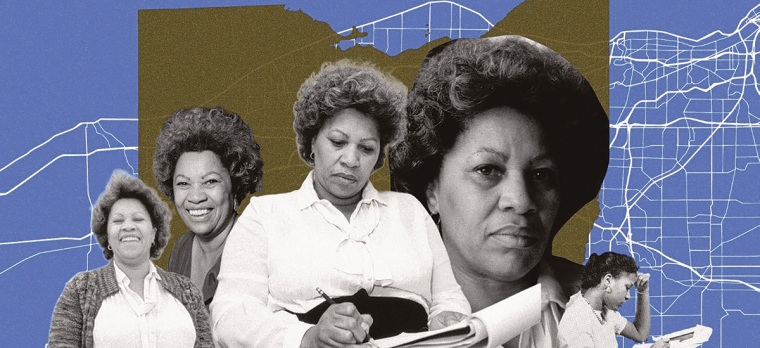
Toni Morrison was born in 1931 in Lorain, Ohio, an industrial town near Lake Erie, which inspired her throughout her career. (Credit: Each + Every via Literary Cleveland and Ohio humanities)
Asmo says the encounter was both informative and fortuitous. That fall she visited Literary Cleveland, a nonprofit with a mission to help writers develop their voices and transform their communities. The organization is also one of Ohio Humanities’ grantees. Since Morrison’s death in 2019, Literary Cleveland has held annual one-day celebrations of the author’s life, but executive director Matt Weinkam and his staff had been wanting to do something bigger. Coincidentally, Ohio Humanities was looking for programming ideas for America 250, a nationwide commemoration of the two-hundred-fiftieth anniversary of the signing of the Declaration of Independence. Weinkam and his staff had already discussed how the time periods of Morrison’s eleven novels cover nearly every major era in American history, from A Mercy (Knopf, 2008), which is set in the late seventeenth century, to God Help the Child (Knopf, 2015), which takes place in the twenty-first. One could arguably study American history through the lens of Morrison’s corpus alone. So when Asmo asked Weinkam if he had any ideas, he jumped at the opportunity.
“I had always dreamed [that] one day it would be great for the north part of the state in Cleveland and Lorain to partner with the south part of the state in Cincinnati,” Weinkam says. “So I [said], ‘You know what we’ve been talking about and dreaming about? This Toni Morrison project that could celebrate her life and work.’”
Thinking back to the stranger from her son’s game, Asmo was immediately on board. Toni Morrison was born and raised in Lorain, Ohio, and some of her most pivotal novels are set in the state, including her debut, The Bluest Eye (Holt, Rinehart and Winston, 1970), which is set in Lorain; Sula (Knopf, 1973), which takes place in a fictional Ohio town; and the epic neo-slave narrative Beloved, which unfolds in Cincinnati. Still, some Ohioans, like the stranger Asmo met, know little about Morrison, if anything at all.
“I had in my mind that there are so many people who don’t know that…arguably the greatest American writer [is] from our state,” says Asmo. So when Weinkam and his team pitched the project, she thought it was perfect.
Beloved: Ohio Celebrates Toni Morrison is a yearlong program series that commemorates the Nobel laureate and her oeuvre. Though there were quite a few bumps in the road, including DOGE cuts that diminished Ohio Humanities’ funding powers in 2025, a host of nonprofits, libraries, individuals, and even the state legislature came together to ensure that February 18, 2026, to February 18, 2027, would be the year of Toni Morrison in Ohio and beyond. During the months between what would have been the author’s ninety-fifth and ninety-sixth birthdays, community partners throughout the state are hosting events with some of the world’s preeminent Morrison scholars as well as film screenings, writing contests, and performances inspired by the author’s work. Though Ohio Humanities and Literary Cleveland are the lead partners in the celebration, both Asmo and Weinkam emphasize that this is for the community, by the community.
“Most of the literary community is writers and readers, individual writing groups, and people who just get together on weekends,” Weinkam says. “When you invite all of those people to propose things, they’ll come up with ideas you never could have thought of.”
The website’s event calendar confirms Weinkam’s statement. There is an abundance of programming, from the academic to the theatrical. In April, Joycelyn Brown and her students at Ohio University held a virtual event featuring student presentations about Black masculinity in Morrison’s fiction. In November, the Steel City Lounge in Lorain will host Morrison After Dark, an interactive event where attendees can sip drinks and swap stories with characters from Tar Baby (Knopf, 1981) and Paradise (Knopf, 1997), embodied by local actors. The Cleveland Review of Books has released a call for essays about Morrison’s work. And although Literary Cleveland is hosting an official book club event where participants will read Morrison’s eleven novels in the order of their time settings, Weinkam encourages writers and readers to organize their own book club events, perhaps with topics that appeal to their specific communities’ interests.
“We’re definitely open to programs from folks outside the state,” says Weinkam. “I hope people feel not just [permitted], but [also] excited to be engaged, no matter where they are.”
Asmo echoes this sentiment. “I would encourage everybody to go to the website and check out the different events,” she says. “They can reach out to Britt [Lovett, project manager for the event series], and if they have thoughts about events they’d like to host, she’s always available to go back and forth and to think through things…. We really encourage organizations to do what they would like to do in their community, and then we [can] amplify and promote that.”
Beloved: Ohio Celebrates Toni Morrison is indeed a collaborative endeavor, one that has the power to unify people through good literature and, at times, a good debate. Namwali Serpell, a novelist, literary critic, and Harvard professor who published a seminal study of Morrison’s work earlier this year titled On Morrison (Hogarth, 2026), helped kick off the celebration with several events.
“The Q&A at the City Club of Cleveland…brought a little fire—in response to a question about Morrison’s reputation for castigating Black masculinity,” Serpell says. “I made a case for Morrison’s men: Milkman Dead, Paul D, Stamp Paid, [and] Frank Money are all, to my mind, incredibly rich portraits of Black men, in all their beautiful, charming, and, yes, flawed humanity. I expect the book clubs across the state that will be reading Morrison’s novels over the course of 2026 will be filled with lively debates of this kind—which is exactly what Morrison herself would have wanted.”
Asmo hopes Beloved: Ohio Celebrates Toni Morrison also serves as a training ground for more grassroots initiatives that can ensure the survival of humanities organizations, which are at the moment under serious threat.
“It’s these small moments that are building a really important advocacy muscle for the humanities and cultural sector that we’re going to need right now and moving forward, because we are in this very serious and critical moment,” says Asmo. “I think state government funding is always an important part of diverse cultural funding. But we’re also thinking about how we improve philanthropic infrastructure, especially in rural areas.”
And, finally, the event series was designed to be a dress rehearsal for the year 2031, which will be the centennial of Morrison’s birth and an opportunity for Ohio-based organizations to celebrate the literary titan in the manner she deserves.
“We’re just five years out from her one hundredth birthday celebration,” says Weinkam. “If we do it now, we can test run it and see what works…so that in 2031, when the whole country will be reflecting on Toni Morrison, we’re ready to take the lead.”
Destiny O. Birdsong is the author of the triptych novel Nobody’s Magic (Grand Central, 2022) and the poetry collection Negotiations (Tin House, 2020). She is a contributing editor of Poets & Writers Magazine.