The first thing you notice when speaking with Alia Hanna Habib, a vice president and literary agent at the Gernert Company, is her deep curiosity and desire to continue learning. You see it when she talks about her hard-won path to becoming an agent to some of the biggest nonfiction thinkers publishing today—Hanif Abdurraqib, Clint Smith, and Nikole Hannah-Jones, among others—and in how she still discovers new writers of memoir, literary fiction, and narrative nonfiction. You can also see it shine through in her free Substack, Delivery & Acceptance, in which she demystifies the publishing process, and her debut, Take It From Me: An Agent’s Guide to Building a Nonfiction Writing Career From Scratch, published by Pantheon in January, a book for emerging and established prose writers looking to start and sustain a writing career.

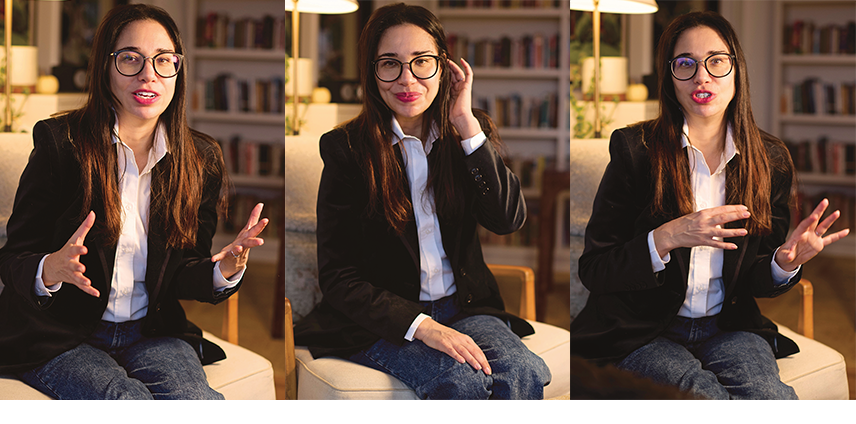
Alia Hanna Habib, a vice president and literary agent at the Gernert Company. (Credit: Andres Hernandez)
Habib graduated from Barnard College in New York City in 2000 and knew right away that she was bookish and wanted a career in publishing. She had no idea what a literary agent did or the difference between publicity, marketing, and editorial. “It was so nebulous to me,” she says, “I didn’t come from the kind of family or the kind of place where one would even know what a literary agent was.” Habib describes her career path as “long and circuitous” because she felt like she didn’t hit her professional stride until her mid-thirties. “And I actually think I’m a better agent for it,” she notes. To her the time to get here meant she was able to think deeply about the kind of career she wanted.
It was in the New York Times Saturday classifieds where Habib found her first publishing job. She recalls circling the ad, going to the local pharmacy to fax in her résumé to the woman who was hiring a publicity assistant at Houghton Mifflin Harcourt, and then being hired to work on cookbooks, a genre Habib wasn’t innately interested in. But her curiosity led her to dive deep and learn. It’s why nonfiction, in general, became so alluring to her. “I genuinely like learning,” she says. “I learned how to cook as a publicity assistant, and then I ended up transitioning to working on other types of books.”
Habib stayed for two years working her way up the publicity ladder, but once again an opportunity to learn beckoned in the form of graduate school. She studied at Rutgers University for five years, getting her MA in English literature with a concentration in the nineteenth-century novel. What followed was a consideration of a life in academia, a stint in Italy, time spent learning a new language, and then a return to New York—home of the Big Five publishing houses—because she still longed to work in the industry. The time away was invaluable, though. “I had to try all these different things to learn that. I never could have learned it without doing those things and eliminating possibilities,” says Habib. By 2010 she began her agenting career at McCormick & Williams (now McCormick Literary), moving at the end of 2017 to the Gernert Company, where she has since moved up the ranks.
Over Zoom, Habib and I spoke about the challenges of switching careers in your thirties, being proactive in pursuit of clients, and what specifics make a query letter stand out beyond merely listing one’s accolades.
You started out in publicity and then became an agent. What led you to make that career jump?
I had no job [when I came back to New York, so I] called up Houghton Mifflin and said, “Hi, I don’t know if you remember me. I was a publicity assistant.” And they said, “We do remember you, and your old boss just quit. Would you like her job?” So I got this huge promotion, and I was a more senior publicity person. Then I really started to think about what I wanted to do with my life. I realized that what I liked about publishing was being a part of figuring out which books are published, and I also wanted editorial involvement. At that point I was in my early thirties, and nobody was looking to take a senior publicist and make her into an editor. It wasn’t happening, and I didn’t have a lot of options to transition.
This industry makes it so hard to change careers at that stage.
It’s sad, and I think that’s actually a failing of our industry that by thirty it felt like, This is your path. I realize now that thirty is young professionally. You think it’s not young when you’re thirty, but it’s young. And this is your path.
[I was asked,] “Do you want to be an associate director of publicity?” I knew I would feel like I wasn’t living to my full potential doing work that was [not] as meaningful to me as I would like it to be. I worked with Julie Barer [agent and cofounder of the Book Group] on one of her books, and she took me out for coffee and I told her my woes. She said, “You should look into being an agent.” I did a bunch of informational interviews, knowing nothing about agenting, and eventually someone gave me a desk at McCormick Literary and I started as an agent there, commission only.
I will say, it’s hard to overstate how broke I was the first five years that I was an agent. I was so broke. And I’m very honest about it because I want people to know what it’s like if you want to do this. But it was very obvious to me within six months that I loved it. When I knew, I thought, I’m going to figure out how to do this really well and I’m going to do it for the rest of my life, or at least for the rest of my working life.
Does your publicity background make you a better agent?
I don’t want to say “better,” but having worked in-house I have a good sense of the timelines, a good sense of what is possible, and I know what good publicity looks like. I try not to micromanage, but I do think good publicity works hand in glove with the author and the agent and is also very editorial.
There’s this idea that good publicity [happens] because the publicist is well connected, just like good agenting is because the agent is a power agent. Of course it helps to have a great reputation. Of course it helps to have a great contact list. But when I was a publicist, people weren’t answering my e-mails because it was Alia Hanna Habib sending them. They were answering my e-mails and accepting my pitches because my pitches were really well written and thoughtful and smart and bespoke. I try to bring that to how I advise my clients about publicity. And—when I’m allowed—how I work with publicists is to get very granular about who we’re pitching, how we’re pitching.
The agent isn’t always brought in for those conversations, and [our point of view] isn’t always welcome, but when it is, it can work really well—the author too, because the author is always going to know the book better than anyone. I think it can be really powerful, and the earlier you start having those conversations, the better.
You joined the Gernert Company in 2017. What was the aha moment that made you feel like agenting was it?
Pretty early in my agenting career I was selling—and I was lucky—for decent amounts of money. But the way agenting math works, it takes forever to make a real salary. So it took me five years for my salary as an agent [to be the same as] the salary I left as a publicist. I would love to be frank about what that number was. This was quite a while ago. When I was a publicity manager, I made $55,000 a year. By that point I had sold multiple books for not only mid- to high-six figures, but even seven figures. I was also, for those first five years, working part-time as a freelance publicist; that’s how I was able to live in New York City. It makes me emotional.
I was at McCormick, and they were so lovely to me there, and I did feel supported, but it was very small, and I knew to grow as an agent I needed to have more people around me, more colleagues to learn from. Gernert reached out, and that’s how I ended up moving there. I think one of the reasons I’ve grown as an agent there is that I have colleagues like Chris Parris-Lamb and Sarah Burnes, and a mentor like David [Gernert]. Seeing that there are lots of different ways to be an agent is actually quite liberating. We all agent differently, but we learn from each other. Even the e-mail style, I can immediately tell if Seth [Fishman] wrote an e-mail versus Meredith [Kaffel Simonoff]. I see they’re both excellent agents, and they have different ways of handling problems, and you steal from that. And that’s been great.
Has there been a change from how you found clients then to how you’re finding clients now?
It’s so funny because in order to build my list, I had to be really aggressive about outreach. This is where being a publicist helped. I’m a voracious consumer of media. So I was just reaching out, reaching out, reaching out, and that’s how I built my list. Literally, yesterday I sent out an e-mail to a young writer, and I will always be doing that. Also, I enjoy it. I don’t want to be passive about what comes in to me. If I operate only on referrals or queries, I wouldn’t be shaping my list in a way that I think makes it strong. A lot of my list is referrals, but a lot of my list is [also] just me reading something and liking it.
I don’t even need to have a book idea. I know talent when I see it; I know when I like a voice. So Clint [Smith], it’s because I read something, I reached out. Merve [Emre], I read something and reached out. Nikole Hannah-Jones, I heard her on the radio and reached out. And in all of those cases, it was just an intuitive sense that the person was talented [and] had something unique to say that I was interested in personally.
What do those conversations look like? What piques your interest?
I’m interested because I see the person is a good writer and I’m interested in the way [they approach subjects], and that surprises or excites me. I don’t want the first conversation to be high pressure. What are your ideas? What are your ideas? No. What do you like to write about? I think a really productive question—and one that writers shouldn’t have to answer on the spot—is: If you had eighty thousand words, what would you [write]? If you had two years to write something, and money, what would you do with that? And come back to me. A book is an opportunity to write in a very different way than you do when you write short pieces. So if you had the time, what would you write about? I also talk about what they like to read. What have you read and loved? What books blessed you? What books have stayed with you? Which writers do you admire? Which writers’ careers do you admire?
Part of it is just getting to know what they’re like, [having] them know what I’m like. It’s always different, and it’s not dissimilar to dating. If you go into a date and you’re thinking, These are my ten questions I’m going to ask to find a partner, you’re going to have a really bad date and you’re not going to be fun. But if you go in and say, I’m curious about getting to know this person and seeing if I like them and seeing if they like me, you will learn what you want to learn from the date.
What stands out to you in a query?
I love when a query shows knowledge of my list. No one wants to feel like they’re being chosen at random. Again, I think dating is a really good analogy, and people often talk about being on the apps and getting a “What’s up?” message. Do not send the query equivalent of “What’s up? Like your profile.” No one responds to that. But if someone writes, “I love the photo of you and your Irish wolfhound. I went to Ireland to play with Irish wolfhounds,” you’re going to respond to that differently. So if someone is being quite thoughtful and targeted, that’s really helpful.
And then the query itself should be well written. Sometimes queries emphasize platform a little too much. They’re a little too much about marketing instead of thinking about the actual writing of the query. At least with my list—and again, it’s different if you’re a different type of agent—I’m not someone who is primarily thinking about platform, platform, platform. I’m thinking about great writers and great thinkers, so I want to see that in the letter.
But is platform important?
I think there are these really reductive clichés of how we talk about platform, and they are [based on] how many social media followers you have essentially. That is not how I think about platform. I think the question of platform is—if you’re writing nonfiction—if you are an expert, what the nature of your expertise is and being really clear about that. Why are you the person we should go to [to] have something explained to us? Is it because you’re a researcher? Is it because of your personal experience? Is it because of your background? And then how are you going to reach an audience? The publisher has to help you reach the audience too, but how are you going to help the publisher reach that audience? Is it because you are a teacher and therefore a great public speaker? Is it your social media? Is it an institution you’re involved with? That, I believe, is a more productive way to think about platform.
In a query, how important is the bio?
I credit my colleague Seth Fishman for this rhyme for what should be in a query letter: The book, which is your explanation of the manuscript. The hook, which is why the book matters. And the cook, which is, why you? So I think the bio says why you. And sometimes it can be a quirky detail. Especially if you have the feeling that only this person can write this book, it’s really exciting.
Do you feel like “the book, the hook, and the cook” is more important than someone’s accolades?
Absolutely. Clint, for example, with How the Word Is Passed—this is in the book—explained that he grew up in New Orleans in a place where the streets were named after fallen Confederate soldiers and war heroes. So that’s where his interest in how slavery is remembered and misremembered came from. Growing up Black in New Orleans was so central to his understanding and noticing this. Being a person who [wonders], What does it mean to drive down a road named after Jefferson Davis? is so much more interesting to me than, I am Clint. I am at Harvard. It doesn’t tell me anything.
What guides you in what you want your list to say?
I always try to come back to allowing myself to be surprised. I don’t go out and think, I want my list to argue a point. I’m going to steal this from [One World executive vice president, publisher, and editor in chief] Chris Jackson. The question that always motivates me is: Why does the world look the way it does? And why am I the way I am? There are so many different disciplines and ways of thinking that seek to answer those questions, be it psychology, history, literature. I don’t believe the world is the way it is because it could only be that way. I think it’s created by people, and I believe that we are motivated by drives and forces and inside and outside influences. Those are the big-picture questions that are why I seek knowledge and self-knowledge. So I’m always looking for things that help me further my study of those questions. And it changes from year to year. I become interested in things.
These past two years I’ve been working on several books by psychotherapists and psychoanalysts, and it’s become an interest of mine. Five years from now it could be another discipline or another set of questions, but it comes from a place of genuine openness. I also think, as someone who dropped out of graduate school, you go to graduate school in the first place because you like research. But I have a very dilettantish brain, so I’m always hopping around. It’s not programmatic. I try to remember what it’s like to be a lay reader, not a professional reader like I am. It’s why it’s so important for me to read on the weekends for pleasure, because most readers aren’t thinking, What do I want the list of books that I read to look like? They’re thinking, Oh, I’m at a bookstore, this cover looks cool, or, Oh, that’s something I want to learn about. I try not to lose that way of thinking about books because that’s how people who actually buy books in a bookstore think.
Does that philosophy also extend to the fiction you represent?
Yes. I don’t do a lot of fiction. I’d love to do more fiction. When I was in graduate school I was studying the nineteenth-century British novel, so I’m deeply interested in the history of the novel. I like fiction [that] is aware of this rich history. I like autofiction. I read a lot in translation, and I read novels that have influences other than the American novel.
Although I would say I’m not necessarily a fiction reader who needs to learn [while reading], I think a lot of fiction readers are. They like to go to a different world, and they are thinking, I’m going to read a novel that’s set in Ukraine to learn about Ukraine. Because I read so much nonfiction, I don’t necessarily seek that. This is very particular to me. A lot of what I look for in fiction, just for pleasure, is style and people who are thinking about style. But I’m also thinking about: What is someone doing with the form that is the novel?
As a published author yourself, your voice is so generous in how you convey information on the page. What made you decide to write Take It From Me?
I love that you used the word “generous” because that word was the guiding principle of how I thought about the book. I have a Henry James epigraph that begins the book, but there was actually another one [from him] that I was thinking about as I was writing. It’s from The Portrait of a Lady in which the heroine, Isabel, suffers a lot. I’m going to paraphrase here. She’s comforted by someone saying, “No one should suffer too long for a generous mistake.” And whenever I was thinking about whether to include something, I hoped I would never regret something that I did out of generosity. Even with my Substack, which I give away for free. Whenever I thought, Should I include it? Am I giving away too much? if the “mistake” was coming from a place of generosity then whatever. I believe that we, in publishing, think we need to hoard information because it is very hard to get, and we think it’s a finite resource that needs to be guarded the way my dog guards his bowl—it’s not. It does not diminish my work as an agent to share what I know. It doesn’t make me less authoritative. It doesn’t cost me money. It doesn’t hurt my clients. It helps other writers. And I can’t represent hundreds of writers; I don’t have the capacity, but I want to help hundreds—thousands of writers. So why not give them what I know? That’s why it’s called Take It From Me. Just take it.
One wonderful thing about staying in the publishing industry is having good mentors along the way, but you are also a mentor for a lot of folks now. What would you say is the biggest advice that has stuck with you?
This gets back to the theme of my book: You can arrive in this rarefied space where people are very smart and often very well-read, and many of them feel like insiders to you while you feel like an outsider. What I discovered through reporting for the book is that so many of the people I thought of as the ultimate insiders said, “I was so freaked out when I got my first publishing job and everybody seemed to understand how everything worked, and everybody knew everybody, and I knew nobody.” So you are probably surrounded by people who feel the same way, and that allows you to actually show vulnerability. You’re allowed to ask for help. You’re allowed to say, “I don’t understand something.”
Also think about building your lateral relationships—your relationships with your cohort. So many of my closest friends in publishing today are people who came up at the same time I did, and now twenty, twenty-five years later, we’re in more senior positions. Of course you want your boss to like you, but get to know the people your age and befriend them. Don’t see them as rivals but as people you’re in the trenches with and can learn from. You can build amazing, amazing solidarity.
Building that community must have been important for you when you were looking for an agent to represent your book.
I feel like my situation is so anomalous. My agent is my colleague Meredith, who’s amazing. As soon as I felt like I actually wanted to write the book, I immediately asked Meredith if she wanted to rep me. I felt viscerally for the first time what it’s like to have someone believe in your book idea and how meaningful that is. It changed everything. Because of my job, I have to be confident, but I needed someone else’s confidence to write my book.
It goes back to building that community of people you trust.
Totally. I work at an agency that’s very collegial, and I don’t feel rivalrous with my colleagues. And I think this is important too: How do I know Meredith? It’s not because she randomly became my colleague. Meredith represented a short story collection called Friday Black [by Nana Kwame Adjei-Brenyah] that I read and loved. I wrote the editor to say, I loved this book. She forwarded it to Meredith. Meredith and I didn’t know each other then, as she was at a different agency. And then Meredith and I ran into each other at a party and she said, “Thank you for that gracious note.” We decided to have coffee together and that led to Meredith coming to Gernert and that’s how we became friends.
Let’s make a habit of hyping everyone up when you love something.
It’s so important. And you don’t have to be someone who works in publishing to do it. Two of the blurbers for my book were blurbers because years ago, before I even thought I would write a book, I reached out to their editors to say, I love this book, and then we somehow got in touch. So many of the friends I’ve made in publishing is because I’m a voracious reader outside of my own list; if I like something I drop someone a line, and I do it all the time. I’ve met so many amazing writers that way.
Writers—even those who are not in the industry yet or can’t go to events—can drop somebody a line, e-mail their agent or their editor. You can do that. And because I’m the contact on a lot of my authors’ websites, people e-mail me corrections to their articles. People e-mail me their arguments. Because I represent so many writers of color, people e-mail me their racist thoughts. And you know how nice it is when we get an e-mail from someone who writes, Dear Clint, we read your book in our class and we loved it, and here are some of the things our students have to say... Or, Dear Merve, your writing about Ulysses made me want to read the book.
What do you hope is the biggest takeaway that writers get from this conversation?
I believe publishing is full of unspoken codes, things you can and cannot break, but all [in] different ways, which I’ve learned about through years of working in the industry and with writers. I do not believe you have to follow all of them to be successful. What I want to show is that there’s all this information and a lot of practices we [agents] don’t even agree on. You can [choose] what to follow, choose what to use, choose what you want to do to shape the career that you want to have. And know the cost of maybe ignoring certain information, which you can do.
You can make compromises. This is about the intersection of art and commerce. And sometimes you’re going to go on the commerce side, and sometimes you’re going to go on the art side, but you can know and then say, “Hey, I don’t want to follow this rule.” That’s okay. Just know what the rule is before you break it.
Vivian Lee is a writer and a senior editor at Little, Brown.