Make a Collage

3.26.13

Make a collage inspired by a working draft of one of your poems, using images from books, photographs, magazines, newspapers, and drawings. You may incorporate words as well. Let the transformation of your poem into another medium inform a revision of the poem on the page.

Short Fiction Contest Deadline Approaches

The Northern Colorado Writers (NCW) short fiction contest, which offers a grand prize of one thousand dollars and publication in the NCW anthology, is given annually for a short story. The deadline is March 31. 

Fiction writers may submit a story of up to five thousand words, along with a twenty-dollar entry fee, via e-mail. Writers need not be NCW members or Colorado residents to enter. 

Novelist and short story writer Alyson Hagy, whose most recent novel, Boleto, was published by Graywolf last year, will judge. A second-place prize of two hundred and fifty dollars and a third-place prize of one hundred dollars are also given. Winners, honorable mentions, and editor’s picks will be published in Pooled Ink, NCW’s annual anthology, which this year will be released in December. 

Established in 2006 by freelance writer Kerrie Flanagan, the Fort Collins–based Northern Colorado Writers was founded in order to “encourage and support writers of all levels and genres.” The organization hosts an annual writers conference—including workshops in poetry, fiction, and creative nonfiction, as well as round-tables with editors and agents—which will be held on April 26 and 27 at the Fort Collins Hilton. NCW also sponsors a creative nonfiction contest (which accepts submissions from April 1 through June 30) and a poetry contest (which accepts submissions from July 1 through September 30). 

Visit the NCW website for complete contest guidelines

Regie Cabico’s Literary Odyssey and It’s Not Even April’s National Poetry Month

P&W-funded Regie Cabico blogs about a whirlwind week of readings and workshops. He is the coeditor, with poet and novelist Brittany Fonte, of the recently published anthology of queer poetry and spoken word, Flicker and Spark (Lowbrow Press). His own work has appeared in over thirty anthologies, including Aloud: Voices from the Nuyorican Poets Café, Spoken Word Revolution, and Chorus & The Outlaw Bible of American Poetry. He received the 2006 Writers for Writers Award from Poets & Writers for his work teaching at-risk youth at Bellevue Hospital in New York. He is a former Artist in Residence at NYU's Asian Pacific American Studies Program and has served as faculty at Banff's Spoken Word Program. He resides in Washington, D.C.

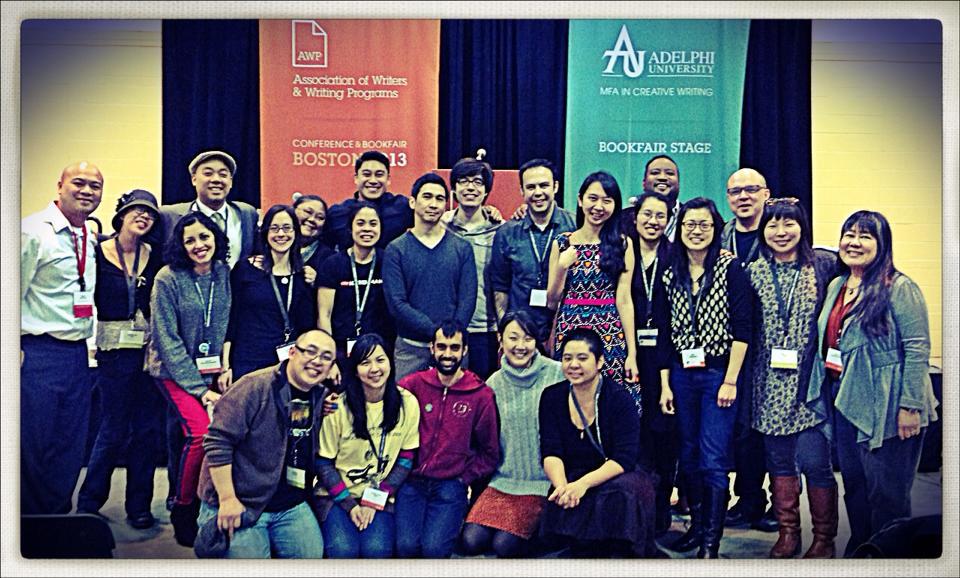
P&W-funded Kundiman, an organization that supports Asian American poets, has been an important resource for me as a teaching mentor, and the co-founders Sarah Gambito and Joseph Legaspi have been long-time supporters of my performance work. If I don’t make it to the 2013 AWP Conference in Boston to attend their ten-year anniversary panel and party, it’ll be like missing a wedding.

On the plane from D.C. to Boston, as we are about to take off, the pilot tells us that all flights in and out of Boston's Logan airport have been suspended. An hour later, they have to clean the ice on the wings. After watching JetBlue’s History Channel entire program on vikings, we finally lift off.

My first reading starts at 7:30 PM. I arrive in Boston at 8 PM. My coeditor Brittany Fonte texts me, HURRY! and I finally get to the reading at 8:30 PM. I read two poems: Baruch Porras Hernandez’ “Pursuit of Taconess” and J Mase the III’s “Neighbor”—both hysterical pieces with serious messages about immigration and transphobia. It’s a hit. Afterward, Nathaniel Siegel takes me out to a gay bar, where I sing “I Am What I Am” really badly.

On Thursday at 1:30 PM is the Flicker & Spark book signing. I spend thirty dollars on beverages and snacks at Trader Joe’s. Three poets show up: Nathaniel Siegel, Dorothea Smartt from London, and Lenelle Moise. Brittany Fonte and I were hoping to find the other poets in the book and thank them.

On Thursday night, Kundiman had a very emotional intimate celebration at the Pucker Gallery. The room exploded with Prosecco, sushi, impromptu massages, and poetry whispered in our ears. Afterward, I take it easy and watch Project Runway with Kim Roberts, a poet and my housemate.

On Friday, I pray that my fRegie Cabicolight to Madison will be on time. I am scheduled to perform at the Midwest Filipino Students Association. I am to give a workshop and a performance in the evening. I bring my bags to Friday morning's Kundiman panel. Myung Mi Kim, Paisley Rekdal, and I read poems and talk about pedagogy.

I leave Boston and its icy wind velocities. At the airport, I see Michael Cirelli, executive director of P&W-funded Urban Word. He confirms my hosting the slam finals on April 20 at The Apollo with rapper MC Lyte.

I can only think about getting to Madison. I get in at midnight. The next morning, my workshop has twenty students and my performance in the evening is a huge hit.

On Sunday, I am eating brunch with the students and comedian Rex Navarette. I insist that we all have a wholesome Wisconsin brunch with organic eggs and cheese. I get to my house at midnight. I will have a Poetry Out Loud workshop to do the next day along with an open mic feature for the Northern Virginia Gay Health Center at Busboys & Poets, and then I will host my weekly spoken word and cabaret show La-Ti-Do.

Once at home, I reflect back on my week. I have too many business cards that need to be sorted. I am totally drained, and it is not even National Poetry Month yet. But I am happy I saw Bonnie Rose Marcus, the director of Poets & Writers' Readings/Workshops (East), who reminded me to apply for D.C. funds while there was some money left. Through Poets & Writers' Readings/Workshops program, I've been paid for doing my community work.

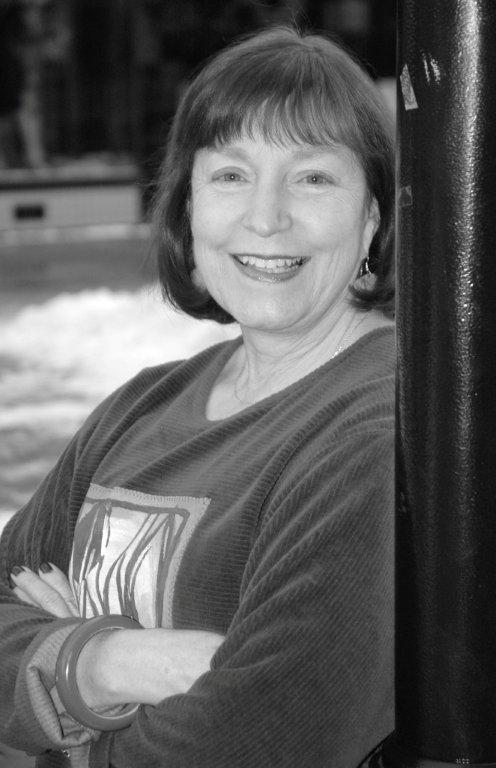
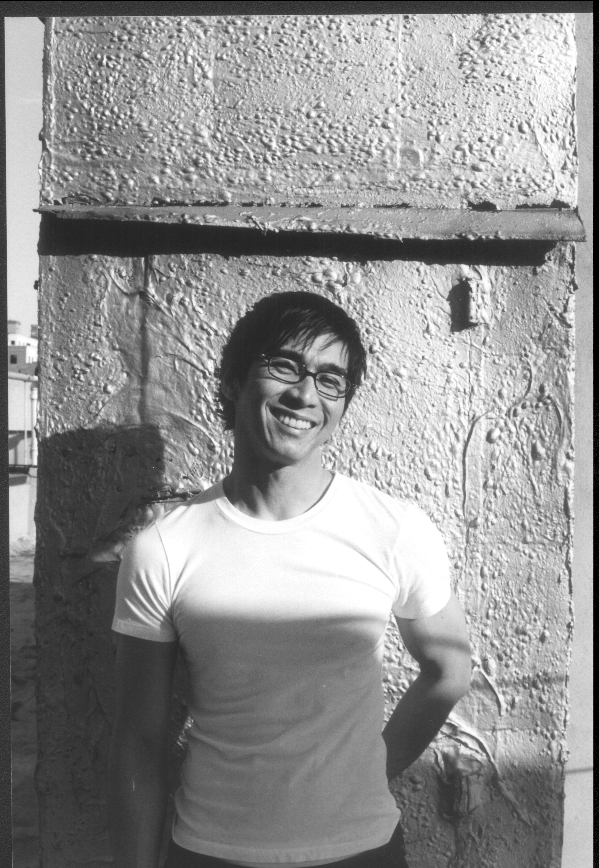
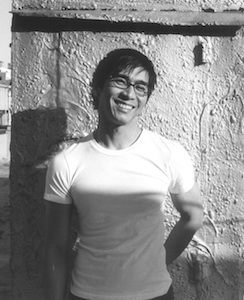
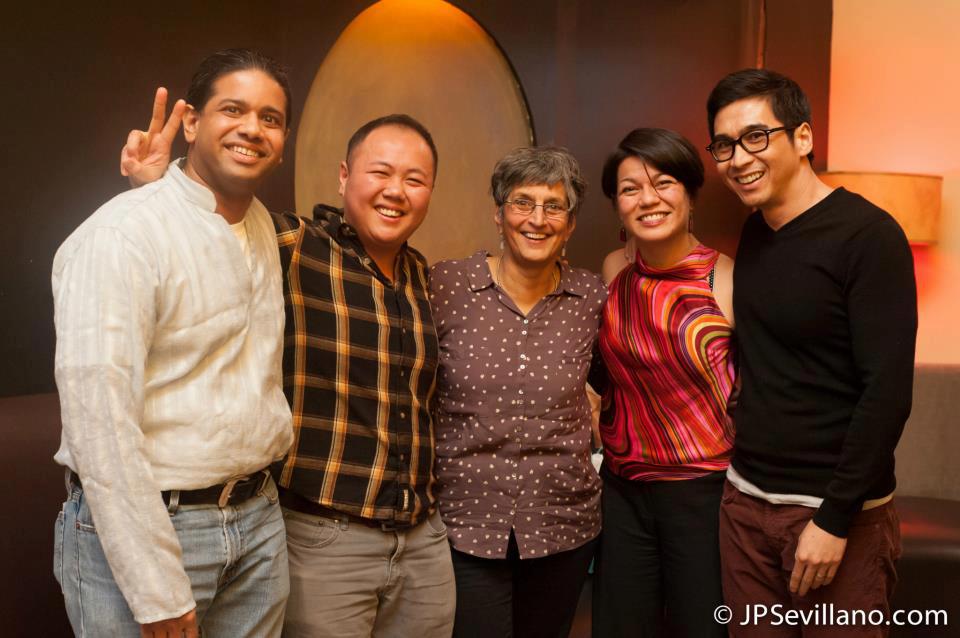
Photos: (Top, from left to right:) Regie Cabico, Sarah Gambito. Credit: Oliver de la Paz. (Bottom, from left to right:) Soham Patel, Regie Cabico, and Regie's patron poet Carlos Bulosan.

Support for Readings/Workshops events in Washington, D.C., is provided by an endowment established with generous contributions from the Poets & Writers Board of Directors and others. Additional support comes from the Friends of Poets & Writers.

New $60,000 Folio Prize Launched

Last week, during a ceremony at the British Library in London, the Folio Society announced the launch of a new literature prize worth forty thousand pounds, or roughly sixty thousand dollars. 

The Folio Prize will be given annually for books of literary fiction, regardless of form or genre, written in English by an author from any country and published in the United Kingdom during the previous calendar year. The inaugural prize will be awarded in 2014. 

Led by prize cofounder Andrew Kidd, a literary agent and former publisher of Picador/Macmillan, the advisory committee gathered over a hundred authors, editors, and critics from around the world to form the Folio Academy, from which a panel of five judges will be selected each year. The Folio Society—a London–based publisher that reissues classic works of literature in illustrated special editions—was announced as the prize’s sponsor earlier this year. 

Academy members include Nobel laureate J.M. Coetzee; Booker Prize recipients Margaret Atwood, Peter Carey, Ian McEwan, Michael Ondaatje, and Salman Rushdie; critics Geoff Dyer and Elif Batuman; Granta editor John Freeman, n+1 editor Keith Gessen, and New Yorker fiction editor Deborah Treisman; American authors Michael Chabon, Michael Cunningham, Bret Easton Ellis, Junot Díaz, Ben Lerner, Richard Powers, Alice Sebold, and Maria Semple; and international writers Nam Le, China Mieville, David Mitchell, Philip Pullman, Zadie Smith, Miguel Syjuco, Colm Toibin, and Jeanette Winterson.

The panel of judges will consider eighty books each year for the prize. The Academy will nominate sixty titles (each member is encouraged to nominate up to three titles per year); publishers will also be invited to nominate titles, from which twenty additional finalists will be chosen. The panel will select a shortlist of eight books, and the final winner will be announced in the spring. The judges for the first Folio Prize will be announced this summer, and the inaugural winner will be announced in March 2014. 

To watch a video from the launch and for more information, visit the Folio Prize website. 

Footnote It

3.21.13

Write a micro essay of 1,000 words in which you incorporate a series of footnotes. Strive to create the footnotes so that they both propel the essay forward and layer it with meaning.

Marie Ponsot Wins Ruth Lilly Poetry Prize

The Poetry Foundation has announced that poet and translator Marie Ponsot will receive the 2013 Ruth Lilly Poetry Prize, one of the most prestigious prizes given to American poets. Given for lifetime achievement, the award carries with it a $100,000 purse. 

Born in New York City, where she still resides, Ponsot, ninety-one, joins poets John Ashbery, Lucille Clifton, Yusef Komunyakaa, Philip Levine, and Adrienne Rich on the roster of Ruth Lilly winners. W. S. di Piero took the 2012 prize. Ponsot’s work—which often tackles and challenges traditional forms such as the vilanelle and sestina—includes the collections Springing, The Green Dark, True Minds, The Bird Catcher (which won the 1998 National Book Critics Circle Award), and, most recently, Easy (Knopf, 2009). She has also translated more than thirty books into English from the French.

Given annually since 1986, the Ruth Lilly Prize is one of the largest monetary prizes given for poetry in the world. As part of the award, Poetry magazine will publish eleven of Ponsot’s poems in its May issue. Christian Wiman, the magazine’s editor, described Ponsot’s poems as “marvels of intellectual curiosity and acuity” that “will also break your heart.” She will participate in a celebratory reading on April 8 at the 92nd Street Y in New York City.

Last fall, the Poetry Foundation also named the recipients of the 2012 Ruth Lilly Poetry Fellowships, the $15,000 awards given annually to five emerging U.S. poets between the ages of twenty-one and thirty-one. 

Create a Monster

3.20.13

From Mary Shelley's Frankenstein; or, The Modern Prometheus to Anne Carson's Autobiography of Red, there is a long tradition of fiction about monsters. Write a story of your own in which a monster is the main character. The monster could be based on another monster from literature or popular culture or it could be one from your imagination.

What Every Writer Should Know: Laura Joyce Davis on the California Writers Exchange

Recently, Poets & Writers awarded one poet and one fiction writer with a trip to New York to meet with editors, agents, and other literary professionals as part of the California Writers Exchange contest. The winning fiction writer, Laura Joyce Davis of Oakland, blogs about her experience.

Laura Joyce Davis, Xochitl-Julisa Bermejo, Jeffrey YangI am so grateful to Poets & Writers for the once-in-a-lifetime experience of the California Writers Exchange! I heard people say this week that there’s no mystery in publishing, but for those of us not in New York, it can feel mystifying. In an attempt to pull back the curtain and share what I’ve learned, I give you my Top Ten Things Every Writer Should Know:

1. Revise like it’s your full-time job.
Agents and editors alike emphasized revising, putting your book away for a couple of months, revising again, getting feedback—and then repeating until you reach perfection (or something like it).

2. Read, read, read!
The only way writers will survive is if people buy their books. But reading also helps you discern where to send your work. This is true of literary journals (where you’re looking for a natural home for your writing) as well as books (if you find a book like yours, the agent and editor for that book might also like your book).

3. Get connected.
Pick up one of the “best of” collections, look at which magazines nominated the authors there, and then submit to those magazines (referencing the story you enjoyed in the collection). This helps on two levels: It shows that you did your research, but also that you have a sense of the kinds of stories they publish and love.

If you have a connection to an editor (even a small one, like a personalized rejection), mention it. Writers who get a personalized rejection are sometimes flagged so that future submissions will be read by more senior editors rather than by interns or whoever looks at the slush pile.

4. Be a man (or be like one).
VIDA showed us that men are published in greater numbers than women. I learned this week that men also submit in greater numbers, are more likely to submit again after being rejected, or write letters to the editor pitching story ideas. Women, let’s put ourselves out there more.

5. Develop a thick skin.
I met an author who submitted to 150 agents over the course of four years, finally found an agent, and then sold his book in two weeks. Another writer sold her book to a major publisher, but was tormented by a few negative reviews on GoodReads (even though most people love her book). No matter how successful you are, you will still face rejection, and there will always be someone who doesn’t like your book.

6. Persevere.
It has never been so easy to be a writer, but so difficult to be a professional one. The good news is that for the persistent, things seem to work out eventually. Maybe (okay, probably) you won’t get a six-figure advance or be in Oprah’s book club, but with a lot of diligence, your book will be edited and published by someone who loves it just as much as you do.

7. Get involved in your local literary community.
Volunteer with your local literary magazine. Go to readings. Help out other writers. The people you help may end up buying your book, and the journals you assist may take a closer look at your story. Plugging into our literary communities means we are part of the conversation of what is happening in publishing and in life.

8. Look for creative opportunities to publish and build a platform.
Blog. Write interviews and essays. Speak at events. Tweet. These things are good promotion, but will also connect you with the people who are going to care about your book once it comes out.

9. Remember that we’re all just people.
Many of the agents and editors I met said that they wished authors understood that they are human. They have a full client list, dozens of manuscripts to read, and hundreds of new queries every week. Remember that people in the publishing industry have lives (and kids and hard days and relationships) just like you do.

10. Keep writing!
Remember that agents and editors are not disdainful of new writers or eager to reject; they are waiting for the next story that makes them miss their subway stop. There will always be room in the world for great writing. May that challenge us all to produce it!

Photo: From left: Laura Joyce Davis, Xochitl-Julisa Bermejo, and Jeffrey Yang of New Directions. Credit: Jamie FitzGerald.

The California Writers Exchange contest is made possible by a generous grant from the James Irvine Foundation. For more information on the contest, visit here.

Record the Dailies

3.19.13

Collect phrases and words that you see throughout the day today. Arrange them on the page, using line breaks where they seem to naturally fall. Next, above the lines you’ve recorded, write words and phrases that are somehow related to those on the page, such as synomyms, antonyms, or words that sound or look similar. Rewrite what you’ve recorded replacing the new words with the old. Use this as the first draft of a poem and continue revising it into a finished draft.

Don’t Be Afraid to Be Rejected: Xochitl-Julisa Bermejo on the California Writers Exchange

Recently, Poets & Writers awarded one poet and one fiction writer with a trip to New York to meet with editors, agents, and other literary professionals as part of the California Writers Exchange contest. The winning poet, Xochitl-Julisa Bermejo of Los Angeles, blogs about her experience from NYC. (Stay tuned for another post from winning fiction writer Laura Joyce Davis as well!)

Contest winners and Deborah Treisman.The invaluable gift this trip has given me is confidence to know that I am moving in the right direction, and that as long as I keep working on my writing, I will reach my goals. Being able to walk into the offices of The New Yorker has been a crazy experience, but it has also shown me that everyone is in this “business” because they love books, and everyone works extremely hard to put out their best work because of that love. Often this work will be thankless, but as New Yorker fiction editor Deborah Treisman told me, “Don’t be afraid to be rejected.”

Opportunities like this trip will be far and few between, but hopefully, I can remember the glow of this moment when I am back at my desk agonizing over a poem that refuses to go my way. In that moment I can remember how Alice Quinn, the Poetry Society of America’s executive director, recited poetry to me, sounds dancing on her tongue, with a giant smile, and know that there are people out there hungry and excited for poetry. The next time I cry over my computer, I can think of New Directions editor Jeffrey Yang, who told me when he wrote the last poem of his collection Aquarium, he wept as he wrote the lines, and know that I am not alone. Or when I’m struggling to have my book published, I can remember that there are Johnny Temples in the world who started Akashic Books because he liked cool books, and is always looking for something exciting.

The New Yorker is looking, Akashic is looking, A Public Space is looking, Poetry Society of America is looking. All I have to do is be fearless in putting my work out there because eventually it will link up with someone who is looking for just what I am sending. When I look at it that way, it doesn’t feel so ominous. There is a publisher, there is a magazine that is looking for me, I just have to find them. And that goes for all of us.

You may remember that in my previous blog post, I asked each guest two questions. Here are some more fun answers:

Q: As a reader, what is the first book you remember getting swept up in?

Jeffery Yang (editor, New Directions): A Tree Within by Octavio Paz.

Brigid Hughes (founding editor, A Public Space): Little House on the Prairie by Laura Ingalls Wilder; The Bell Jar by Sylvia Plath; The Old Man and the Sea by Ernest Hemingway.

Brett Fletcher Lauer (poetry editor, A Public Space): Are You There God? It’s Me, Margaret by Judy Blume.

Alice Quinn (executive director, Poetry Society of America): The Children’s Hour #9 edited by Marjorie Barrows. It was devoted to poetry. I remember reading “The Barefoot Boy” and Robert Browning.

Aurora Anaya-Cerda (independent bookseller, La Casa Azul Bookstore): It has to be Where the Red Fern Grows by Wilson Rawls. That was THE book.

Deborah Treisman (fiction editor, The New Yorker): When I was young, Oxford Book of Poetry for Children. I called it “the purple book.” In high school, it was Lolita by Vladimir Nabokov.

Johnny Temple (independent publisher, Akashic Books): Honestly, it was probably something like a Nancy Drew book. My mom would know.

Q: Besides reading and writing, what is an activity that is important to your writing/creative work?

Jeffery Yang: My mental health [is important]. I run a lot.

Brigid Hughes: Walking.

Brett Fletcher Lauer: Watching the Kardashians.

Alice Quinn: I try to memorize a poem almost everyday while I walk the dog in the morning.

Aurora Anaya-Cerda: Performing arts, going to museums, going to the theatre. It feeds my soul.

Deborah Treisman: Staying up on current events. Knowing what’s going on.

Johnny Temple: Can I say my music? The Caribbean. Traveling to book festivals in the Caribbean. The Calabash in Jamaica (and other festivals) is my favorite thing in the world of books that isn’t writing.

Photo: From left: Xochitl-Julisa Bermejo, Deborah Treisman, Laura Joyce Davis. Credit: Jamie FitzGerald.
The California Writers Exchange contest is made possible by a generous grant from the James Irvine Foundation. For more information on the contest, visit here.

Pages

Subscribe to RSS - blogs