Emotional Robot

Designed by the French robotics company, Aldebaran, Pepper the robot is able to read emotions and respond accordingly, and has the ability to learn over time. Write a short story imagining that your protagonist has somehow acquired one of these highly sought-after robots. What plans or hopes does he have for Pepper? Will having the robot turn out to be a nightmare or a dream come true?

On the Big Screen

Choose a memorable character from a movie—someone from an old Western or a James Bond film, for example—and write a poem inspired by this on-screen persona. What are the most striking aspects of her style or demeanor? Focus on connecting specific details, like a certain way of walking or talking or dressing, to her emotional state to create a lyrical portrayal of this larger-than-life character.

Reshaping the Past

In Mary Karr's new book, The Art of Memoir (Harper, 2015), she writes that "from the second you choose one event over another, you're shaping the past's meaning." Think of a significant event from your past that you've written about before. Make a list of three other events or changes that were occurring in your life around that same time. Write an essay about one of these "secondary" events, focusing on deriving personal or emotional meaning out of this seemingly less impactful event.

Personified Emotions

In the recent animated film, Inside Out, the main character’s mind is steered by five personified emotions—anger, disgust, fear, joy, and sadness. Imagine a scene in which your main character suddenly feels one of these emotions intensely. Jot down a list of colors, sensations, and personality traits you associate with this emotion. For example, if you choose anger, you might find yourself thinking of the color red, heat, erratic gestures and movements, and loud noises. Write a short story in which this emotion completely overtakes your character’s personality, using vivid sensory details to match the atmosphere and tone.

Rona Jaffe Award Winners Announced

The Rona Jaffe Foundation has announced the six recipients of the 2015 Rona Jaffe Writers’ Awards, which are given annually to emerging women poets, fiction writers, and nonfiction writers. The awards “identify and support women writers of exceptional talent in the early stages of their careers.” Each winner receives $30,000.

The 2015 recipients are poets Ashley M. Jones of Birmingham, Alabama, and Britteney Black Rose Kapri of Chicago; fiction writers Vanessa Hua of Orinda, California, Amanda Rea of Denver, and Natalie Haney Tilghman of Glenville, Illinois; and nonfiction writer Meehan Crist of New York City. Visit the website for the winners’ complete bios.

The six recipients will be honored at a private reception in New York City on September 17. The Rona Jaffe Foundation solicits nominations for the awards each year from writers, editors, publishers, academics, and other literary professionals; a committee of judges selected by the foundation chooses the recipients.

Since writer Rona Jaffe established the awards program in 1995, the foundation has awarded more than $2 million to over one hundred twenty women writers. Past recipients include poets Erin Belieu, Tracy K. Smith, and Mary Szybist; fiction writers Rebecca Lee, ZZ Packer, and Tiphanie Yanique; and nonfiction writers Rachel Aviv, Eula Biss, and Sharifa Rhodes-Pitts.

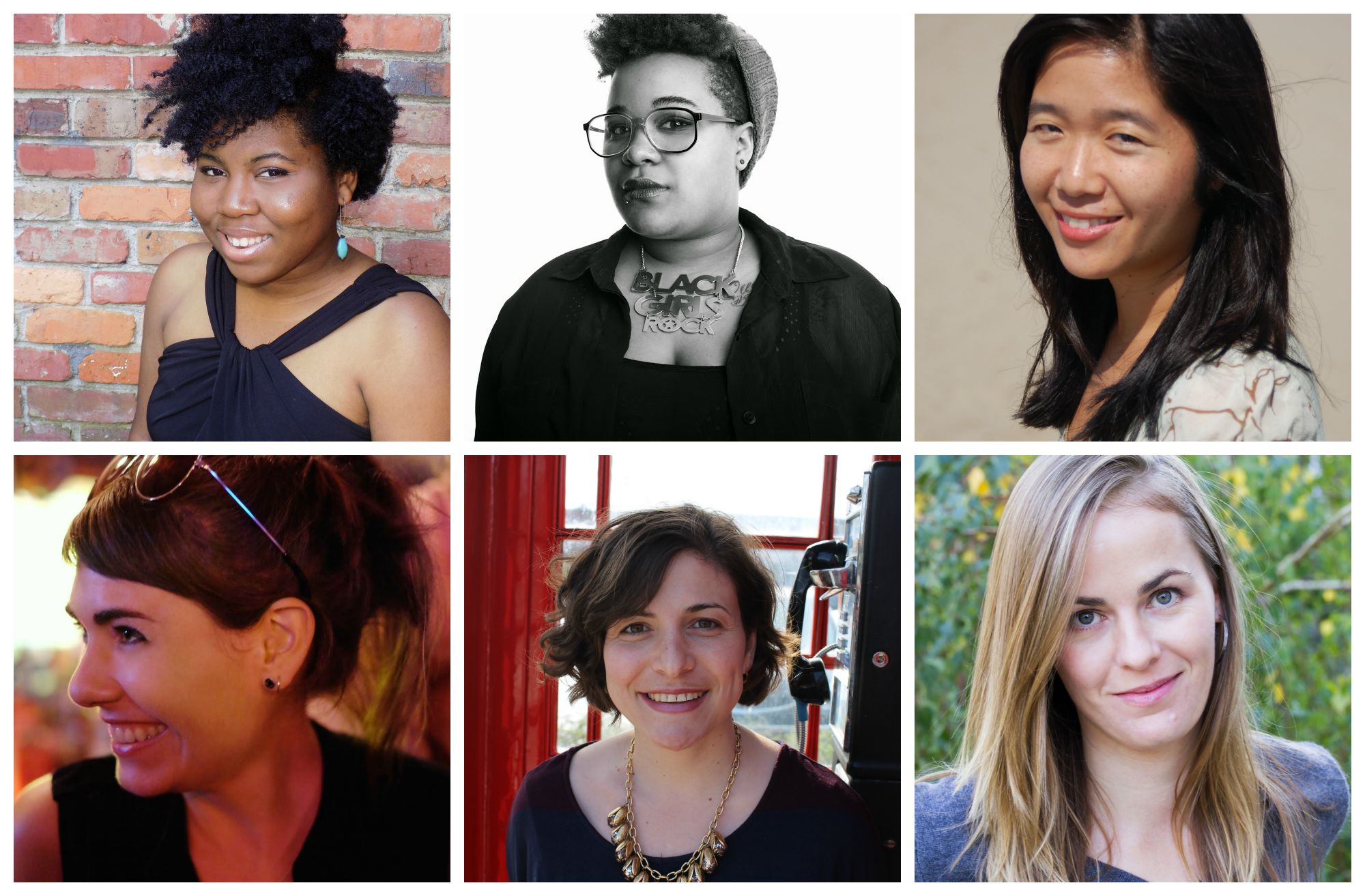
Clockwise from top left: Ashley M. Jones, Britteny Black Rose Kapri, Vanessa Hua, Amanda Rea, Natalie Haney Tilghman, Meehan Crist

Loud or Quiet

Do your poems tend to be loud or quiet? Try your hand at switching up your writing’s volume. Write a poem that’s noisy and full of hard consonants and cacophonous sounds, or write a calmer poem that whispers with a softer rhythm and smoother pacing. Perhaps you can transform your piece by altering capitalization or punctuation, or by italicizing. When you increase or decrease the levels in your poem, are the types of images or emotions that come to mind drastically different?

From the Big City to the Boys Ranch: Coe Booth Visits the Bay

Joe Young is the librarian for the Frandsen Library at the Contra Costa County Juvenile Hall and the Lesher Library at the Orin Allen Youth Rehabilitation Facility, both in California's East Bay region. The Frandsen and Lesher libraries opened their doors in November of 2006, with the mission to promote a love of literature and reading, support educational curriculum, and encourage the development of a lifelong habit of self-directed learning. Young furthers this mission by working to bring a wide variety of authors, artists, and speakers to visit the young men and women his libraries serve. This post is a report on one such P&W-supported event—a visit to the Lesher Library at the Orin Allen Youth Rehabilitation Facility from Coe Booth. Booth is the author of Tyrell (Push, 2007), which won the Los Angeles Times Book Prize for Best Young Adult Novel and was named an ALA Best Book for Young Adults and a New York Public Library Book for the Teen Age.
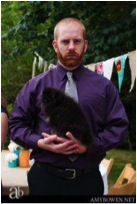
Joe YouungIt was an unseasonably hot May morning in the San Francisco Bay when I pulled up to the Berkeley address where author Coe Booth was staying. Sweat dripped down my forehead and into my eyes as I anxiously knocked on the door. I was nervous!

In my world, Coe Booth is a big deal. Her books Tyrell (Push, 2007), Bronxwood (Push, 2013), Kendra (Push, 2010), and Kinda Like Brothers (Scholastic Press, 2014) fall into the sweet spot of urban fiction for young adults that is exciting, authentic, and has a positive message. Her books also happen to be some of the most consistently popular titles in my libraries.

Coe greeted me with a warm smile. After a quick introduction we loaded into my car and embarked on the hour-long commute to the Byron Boys Ranch.

Established in 1960 on the site of a converted cattle ranch in Byron, California, the Orin Allen Youth Rehabilitation Facility (colloquially known as the Byron Boys Ranch) is a minimum security treatment center for adolescent delinquent youngsters, and the home of the Lesher Library. After a brief introduction and orientation from the probation staff, the sixty-three young men residing at the Boys Ranch were gathered and assembled in the dusty gym. Then, Coe took the stage and addressed the young men. 

She read and spoke eloquently, honestly, earnestly, with passion and poise. She spoke about being an author and a woman and an African-American. She spoke about where her stories come from, how her characters are born, what parts of herself she puts into her stories, and what she hopes to communicate to the reader. The young men sat and listened, some seemingly indifferent, some in eager, rapt attention.

After talking for the better part of an hour, Coe asked if anybody in the audience had questions. At first the young men were hesitant, but after a bit of coaxing the questions gleefully poured forth: "Are you famous?" "Where do you live?" "How do you come up with characters’ names?" "Are you rich?" "Why did you want to be a writer?" "Do you feel proud of the books you wrote?" "How can I get a book published?" "Could we write a book together?" Coe made sure to answer every question, connecting with each young man who reached out to her.
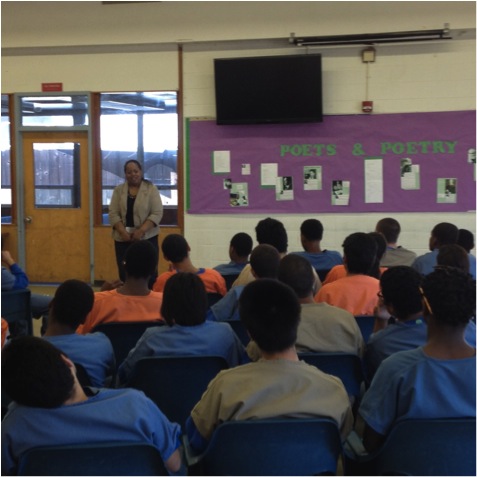
Coe BoothCoe spent just over two hours with the young men. As we drove back to Berkeley through the shimmering, midday heat, my car’s air conditioning sadly failing us once again, I was struck by how she was both down-to-earth and larger-than-life.

This woman—who I had talked with so comfortably during our car ride, sharing our small, personal thoughts and concerns—was transformed in front of my eyes during those two hours. She stood in front of that group of young men, who were a unique combination of worldly sophistication and childish naivety, and gave freely of herself. She gave them honesty and compassion. She held herself up as a role model—imperfections and all—and told them: "What I have done, you can do." She believed in them and believed in their ability to change and improve, and become the people they want to become. And, even if just for those two hours, the boys believed, too.

Photos: (top) Joe Young. (bottom) Author Coe Booth addressing boys at the Orin Allen Youth Rehabilitation Facility. Credit: Amy Bowen, Joe Young.

Major support for Readings & Workshops in California is provided by the James Irvine Foundation and the Hearst Foundations. Additional support comes from the Friends of Poets & Writers. 

Shoes

8.27.15

This week, choose a pair of shoes that you own or have owned that has significance to you. Perhaps it’s the first pair of dress shoes that you purchased, the well-worn sneakers that you wear over and over again, or a pair of shoes that you’ve never worn but can’t bear to toss out. Write an essay about your connection to these shoes, describing them in detail and thinking about the specific qualities that drew you to them in the first place. What do they say about your personality? Where have they accompanied you already, and where might they take you in the future?

Telephone

8.26.15

In the ​game of telephone, a sentence is whispered down a line from person to person until the last person says the sentence out loud, which oftentimes turns out to be humorously different, and distorted by misunderstandings, from the original. Write a short story that opens with a dialogue between two characters talking on the phone. After the conversation is finished, imagine that one character has completely misheard or misinterpreted something the other character has said. What are the consequences? Is the chain of events that the error sets off tragic or funny, relatively insignificant or life-changing?

Blue Cow

8.25.15

In the September/October issue of Poets & Writers Magazine, Dean Young talks about his earliest recollection of writing a poem as a child and the realization that, "you could make up reality with language.... You could write the words blue cow, for example, and there'd be a blue cow." Make a list of five vivid but nonsensical phrases describing things that don't exist in reality. Then, choosing one of the phrases to use as a first line, write a poem that is unrestrained by fact or conventional logic. Rather than focusing on consistency or reason, allow your imagination to quickly zigzag from one surprising image, sound, or emotion to the next.

Pages

Subscribe to RSS - blogs