Dormant Danger

12.11.19

In the December 2019 issue of National Geographic magazine, photographer Corey Arnold writes about an expedition last winter to change the batteries in the radio collar of a black bear in Utah’s Bryce Canyon National Park that he assumed would be hibernating. The bear turned out to be awake, which made the adventure more adventurous than expected. Write a short story in which your main character is operating under the assumption that an upcoming activity will be safe, but at a crucial moment discovers that danger is lurking. How do you ramp up the sense of anxiety and tension? Does your protagonist respond calmly or with panic when confronted with a sudden terror?

Poison Pen Reading Series

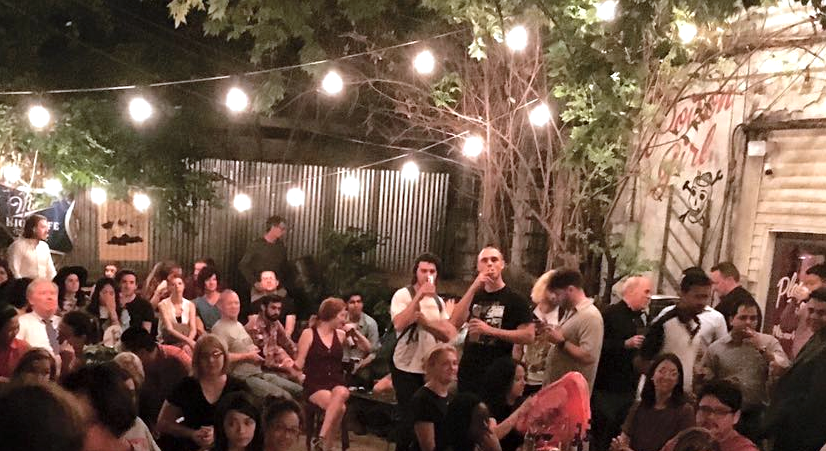
The Poison Pen Reading Series holds events in a bar called the Poison Girl Cocktail Lounge. The series has been going for twelve years, just a little longer than Houston VIP Slam (which I featured last week), but functions in a very different way. The series brings three writers together who read on the outside patio of the lounge. Audience members get to relax in a space under the stars and listen to literary works from writers from Houston and beyond.

The readings are usually hosted by Scott Repass, one of the owners of the lounge, and start at 8:00 PM on every third Thursday of the month. The featured readers vary for each event, but most times, audience members will get the opportunity to hear from at least one writer from the University of Houston Creative Writing Program, a writer from the Houston literary community, and a visiting writer from outside of Houston. Writers share work from all genres including poetry, fiction, and nonfiction.

I have been to many Poison Pen readings and have had the pleasure of being a featured reader, the last time was this past July when I was honored to share the stage with poet Natasha Carrizosa and fiction writer Robert Liddell. The readings are always jam-packed, standing room only in most cases, so if you plan to attend, get there early for a drink and to find a good seat for the reading. It’s worth it.

The Poison Pen Reading Series at Poison Girl in Houston.
 
Lupe Mendez is the literary outreach coordinator for Poets & Writers in Houston. Contact him at Houston@pw.org or on Twitter, @houstonpworg.

Speaking Into a Shell

12.10.19

“Often discussions of persona poetry focus on its potential for cultivating empathy, inhabiting another’s perspective, but I have always felt that, inevitably, one circles back upon oneself,” writes Jennifer S. Cheng in Literary Hub about her second collection, Moon: Letters, Maps, Poems (Tarpaulin Sky Press, 2018). “Persona poetry is often compared to wearing a mask, but to me it is like speaking into a shell.” In her book, Cheng writes a series of persona poems in the voice of Chang’E, the woman who floats up to the moon in Chinese folktales. Think of a mythical figure or other fictionalized character who resonates with you, and write a short series of poems that explores this person’s inner self. Allow your own voice to intermingle and draw you toward imagining where your identities might overlap.

From Miami to Detroit

There are so many writers in Detroit that I am discovering. This week I want to share a conversation I recently had with local poet and editor Jeni De La O.

Jeni founded Relato:Detroit, a bilingual community storytelling series, and Poems in the Park, an acoustic poetry reading series in historic Lafayette Park. A first-generation Cuban American who grew up in Miami, Jeni came to writing from humble beginnings. “My mom grabbed some scraps of fabric from a dress she’d made me, cut up a cereal box and went at it with her hot glue gun to make me a journal,” she says about what drove her to write as a youngster.

Jeni moved from Miami to Detroit about ten years ago. “When I got to Detroit, the people felt like home, and that feeling of home lets you breathe,” says Jeni. “This city puts life and movement and connection into your writing in a way I haven’t felt or seen elsewhere.” Some of her favorite venues and events in Detroit include the Secret Society of Twisted Storytellers, the Brain Candy series held at Green Brain Comics, and the East Side Reading Series

I asked Jeni if she could put out a call to action to Detroit writers, what would it be? In chorus with many of the local writers I have spoken with, Jeni suggested a large gathering of literary artists or a citywide poetry festival. I truly think that there are already writers beginning to lay the groundwork for something of that magnitude in years to come. I am glad to have a voice and to highlight voices in this growing conversation.

Jeni De La O.
 
Justin Rogers is the literary outreach coordinator for Poets & Writers in Detroit. Contact him at Detroit@pw.org or on Twitter, @Detroitpworg.

Upcoming Contest Deadlines

As we enter the last month of 2019, the time is right to submit to contests with a deadline of December 15. These poetry, fiction, and nonfiction awards include opportunities to attend a residency in upstate New York and to have your work reviewed by a literary agency. Most offer a prize of $1,000 or more. 

Center for Book Arts Letterpress Poetry Chapbook Competition: A prize of $500 and letterpress publication by the Center for Book Arts is given annually for a poetry chapbook. The winner will also receive an additional $500 to give a reading with the contest judge at the Center for Book Arts in New York City in fall 2020, and a weeklong residency at the Winter Shakers program at the Millay Colony for the Arts in Austerlitz, New York. Entry fee: $30.

Commonwealth Club of California Book Awards: Five prizes are given annually for a poetry collection, a book of fiction, a first book of fiction, a book of creative nonfiction, and a book of fiction or nonfiction that relates to California published during the previous year. Books written by authors residing in California are eligible. Entry fee: none.

F(r)iction Short Story Contest: A prize of $1,000 is given three times a year for a short story. Entry fee: $15.

LitMag Virginia Woolf Award for Short Fiction: A prize of $3,500 and publication in LitMag is given annually for a short story. A second-place prize of $1,000 will also be given. The winners will have their work reviewed by Sobel Weber Associates literary agency. The editors will judge. Entry fee: $20. 

Mid-American Review Poetry and Fiction Contests: Two prizes of $1,000 each and publication in Mid-American Review are given annually for a poem (the James Wright Poetry Award) and a short story (the Sherwood Anderson Fiction Award). Entry fee: $10. 

Silverfish Review Press Gerald Cable Book Award: A prize of $1,000, publication by Silverfish Review Press, and 25 author copies is given annually for a first poetry collection. Entry fee: $25, which includes a copy of the winning book.

Willow Books Literature Awards: Two prizes of $1,000 each and publication by Willow Books are given annually for a book of fiction and a book of creative nonfiction by writers of color. Entry fee: $25.

Visit the contest websites for complete guidelines, and check out the Grants & Awards database and Submission Calendar for more contests in poetry, fiction, and creative nonfiction.

The ABCs

12.5.19

“We need to grab the words that have possibility in them and begin using them anew,” writes John Freeman in the prologue to Dictionary of the Undoing (MCD x FSG Originals, 2019). Freeman selects terms from A to Z, from “Agitate,” “Body,” “Citizen,” and “Decency” all the way to “You” and “Zygote,” and writes entries that reclaim, redefine, and expand the definitions of the words to “build a lexicon of engagement and meaning.” Write a lyric essay that borrows this idea, selecting words related to current events of particular importance to you and providing personalized definitions in the form of brief exploratory passages. Reflect on your own experiences, the community around you, and what the future may hold. 

Deadline Approaches for Columbia Journal’s Winter Contest

Submissions are currently open for Columbia Journal’s 2019 Winter Contest, which features awards for poetry, fiction, and nonfiction. One winner in each genre will receive a $1,000 cash prize and publication in Columbia Journal in spring 2020. At least two runners-up will also be selected and announced for each category.  

Using only the online submission system, submit a cover letter and up to five poems totaling no more than five pages or a piece of prose of up to 5,000 words with a $15 entry fee by December 15. Ruth Madievsky, Ottessa Moshfegh, and Ada Calhoun will judge for poetry, fiction, and nonfiction, respectively. Visit the website for complete guidelines.

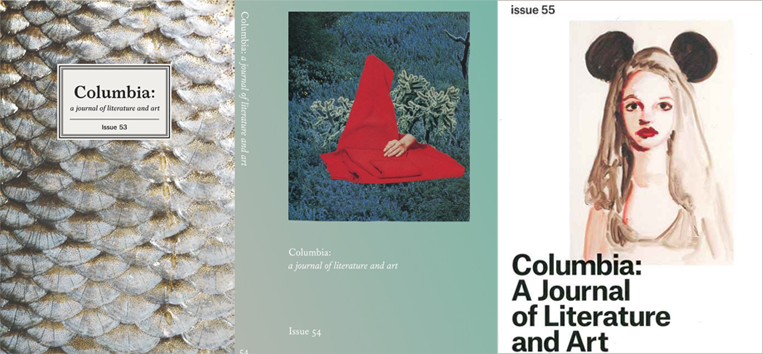
Founded in 1977, Columbia Journal is edited by students in the Columbia University School of the Arts MFA program. The journal, which publishes a print edition every spring and online content throughout the year, seeks to “showcase the best poetry, nonfiction, fiction, translation, and visual art.” Previous issues have featured Raymond Carver, Joyce Carol Oates, and Sharon Olds, among others. 

Poets Respond to Gentrification

On November 22, I attended “Poets Respond to Gentrification,” a reading cosponsored by the Readings & Workshops program that was part of the 2019 Words & Music Festival.

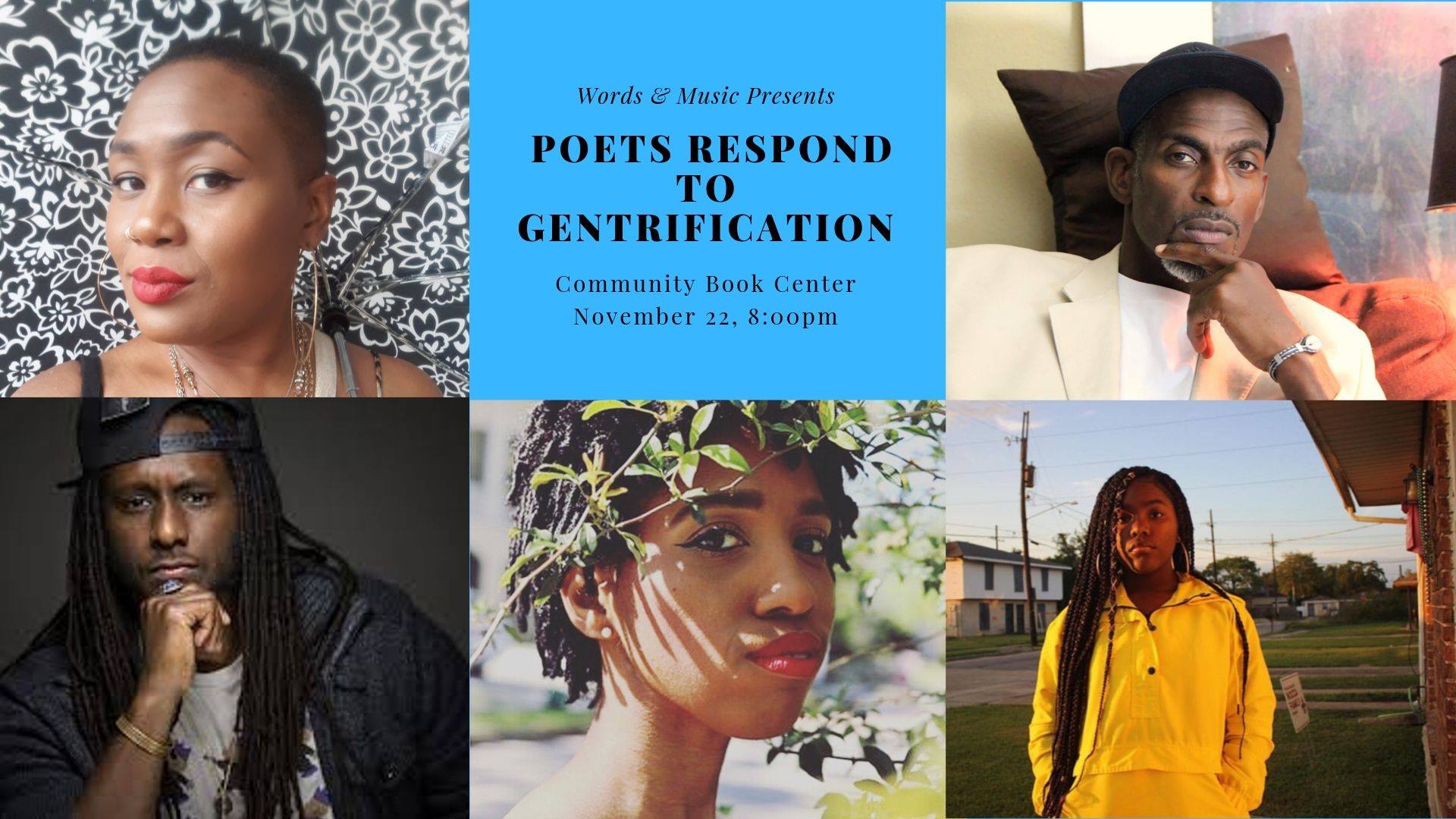
The sold-out reading was held at the Community Book Center, the only remaining Black-owned bookstore in New Orleans. There was a large, diverse crowd of attendees which included local poets. The evening began with youth jazz musicians playing classic songs including “Do You Know What it Means to Miss New Orleans.” Veteran poet Peteh Muhammad Haroon emceed the reading which featured Skye Jackson, Michael Quess Moore, Sha’Condria iCon Sibley, and Akilah Toney.

Seventeen-year-old Akilah Toney started the evening with a poem containing the refrain: “You not from here, you don’t know how it feel. You love the culture, not the people—the love not real.” Skye Jackson wore a long, black velvet, off-the-shoulder dress and delivered a poem about being born and raised in New Orleans and the tension she feels from watching the neighborhoods change. Michael Quess Moore, a former teacher and now a full-time artist, addressed colonization and the global impact of white supremacy in his poems. Moore has been on the front line of the removal of Confederate monuments in New Orleans. Sha’Condria iCon Sibley opened with a poem exploring the current political climate and questioned what her poem should be called suggesting, “We’re Living Between Barack and a Hard Place.”

It was great to know that these four engaging readers were able to receive mini-grants from the R&W program. The reading was followed by an open mic and drinks at nearby Whiskey & Sticks, a wonderful way to wrap up a night about community.

The flyer for the “Poets Respond to Gentrification” reading.
 
Kelly Harris is the literary outreach coordinator for Poets & Writers in New Orleans. Contact her at NOLA@pw.org or on Twitter, @NOLApworg.

Tiny Tales

12.4.19

If you’re looking for a change in perspective, why not try from the mind of a tiny animal? In a New York Times By the Book interview, when asked what subjects she wants more authors to write about, actor and writer Phoebe Waller-Bridge says, “I wish more people would write from the point of view of tiny, witty animals.” Write a story from a diminutive, bright critter’s point of view. Consider whether this animal observes a larger story enacted by human beings, or if the story’s universe is comprised solely of tiny animals. Try incorporating humor in the voice of this quick-witted creature while still retaining its animal-like nature in unexpected ways.

Houston VIP Slam

I would like to take time to focus some attention on a few of the literary organizations helping Houston shine bright. Houston VIP Slam, currently led by Houston’s poet laureate Deborah D.E.E.P. Mouton, is a slam team that provides community for writers who want to take their stories to the stage. Houston VIP has just celebrated ten years of their program and they show no signs of stopping.

I have been a big fan of their work and dedication for quite a while and the format for their monthly slam is so inclusive and so necessary for community building. Each slam is scheduled for the last Saturday of the month and begins with a writing workshop, a unique structure that provides time and inspiration for new work to be created. Local poets and anyone in attendance for the slam are invited to participate in a series of writing exercises led by the night’s emcee. The workshop usually takes place between 7:00 PM and 8:00 PM.  The slam begins at 8:00 PM and concludes with a featured poet taking the stage to wow the crowd. 

Houston VIP holds twelve slam events for the year, with one poet winning each slam. The winning twelve poets then move on to compete in the Grand Slam at the end of the season for a spot on the Houston VIP National Poetry Slam Team. The top five poets from the Grand Slam represent Houston at the annual National Poetry Slam.

The next workshop and slam will be on December 14 featuring Rudy Francisco. If you’re in the Houston area and looking for something to do on a Saturday night, go by. It is truly a beautiful experience. 

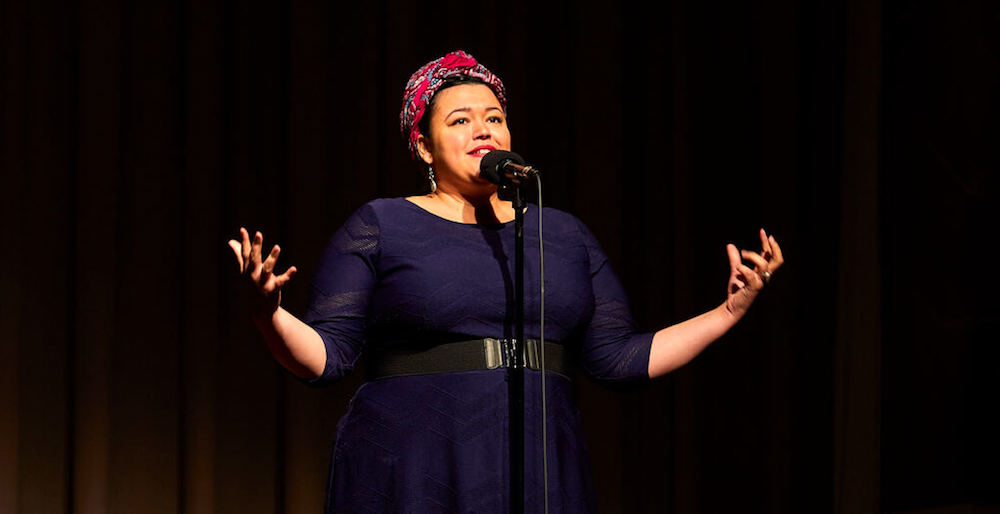
The 2018 Houston VIP National Poetry Slam Team. (Credit: Christy Lee)
 
Lupe Mendez is the literary outreach coordinator for Poets & Writers in Houston. Contact him at Houston@pw.org or on Twitter, @houstonpworg.

Pages

Subscribe to RSS - blogs