

Genre: Poetry

Krista Wissing on Making the Hero’s Journey After a Brain Injury

Krista Wissing is a licensed therapist who has facilitated expressive arts therapy experiences for people impacted by brain injury, Alzheimer’s disease, medical illness, addiction, co-occurring disorders, and trauma. She founded The Rediscovery Project in 2012 and is currently the Day Program Coordinator for Brain Injury Network of the Bay Area. Expressive writing has been critical to Krista’s own healing process, and her work has appeared in The Molotov Cocktail, Bitchbuzz.com, and Know Journal (upcoming). She recently taught a workshop for people with brain injuries at the Institute for Poetic Medicine in Larkspur, California. We asked her to blog about the experience.
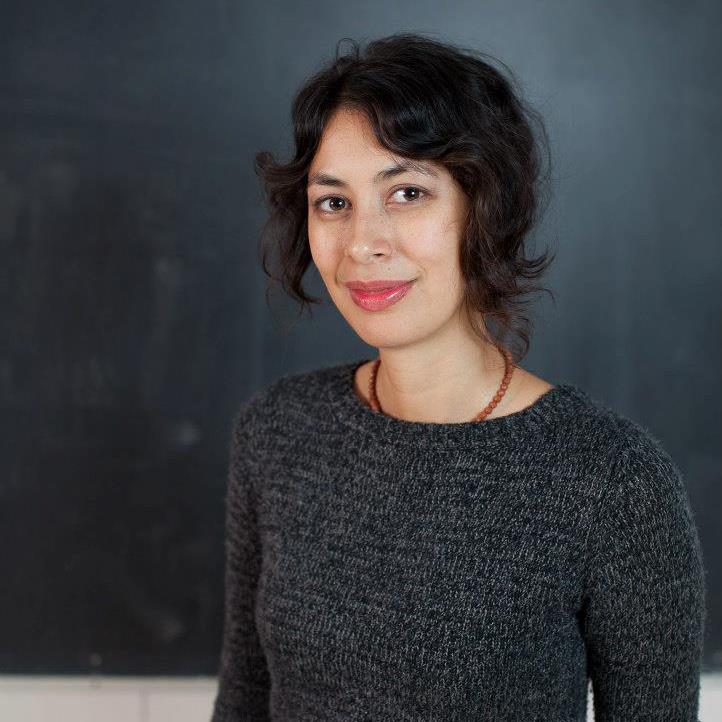
Krista WissingIn my years of working with people who’ve experienced an acquired brain injury (ABI), I often hear how destabilizing and isolating the cognitive, emotional, social, and physical aftermath of ABI can be.

The thing about ABI is that nine times out of ten there is no warning. Be it a head trauma, stroke or a virus attacking the brain, ABI barrels in like an unexpected wind and divides one’s life narrative into two—life before and life after brain injury.

It’s the kind of phenomena that rocks one’s foundation to the core.

It’s the kind of phenomena that leaves the bearer asking tough questions. Why did this happen to me? What kind of life lies ahead? Where and with whom do I belong? And what of my dreams? My purpose? My identity? My faith?

My Right Arm
Blake Herod

My right arm was my buddy. Grade school
rock and ball throwing. Nose
and scab picking. Young breast holding
nipple rolling. Holder of all the
body making, body destroying
drugs, liquor, food, for a good time
call, wait a minute, hold this.
Can you climb all the way to the
top, gesture drawing, paintbrush holding
steering wheel with three on the
tree, 5-speed, with granny gear,
floor shifting, board paddling wave
riding. Pool lap swimming. Nail pounding,
board lifting, torch holding, bike riding,
throttle whacking, old buddy.
My future by building the foundation.

Now it’s not.

It’s the kind of life-altering experience that holds the transformative potential of the Hero’s Journey and merits the healing elixirs of poetry, art, and community.

This is the heart and soul of the Rediscovery Project, a ten-week group that supports ABI survivors in uncovering their own Hero’s Journey through poetry and expressive art. The project culminates by bridging project participants with the community at large through a public poetry reading and print anthology.
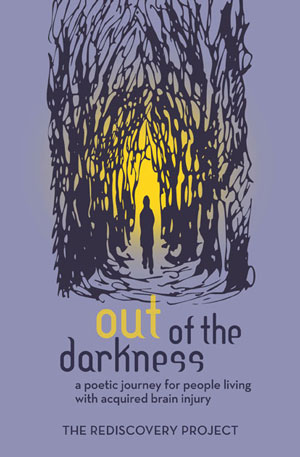
Out of the Darkness anthology The project was conceived of in 2011 during a discussion I had with poetry therapist John Fox, CPT. Years earlier, during grad school, I attended John’s poetry therapy class and felt an affinity for his work with poetry as healer. By 2012, John’s organization, Institute of Poetic Medicine, was on board to graciously fund the program. Rediscovery Project was launched later that year at Brain Injury Network of the Bay Area and continued in 2013, thanks to funding from Institute of Poetic Medicine, P&W’s Readings/Workshops program, and Bread for the Journey-Marin Chapter.

When people who suffer come together to heal, magic happens. To bear witness to this is sacred. If we listen closely and with care, what might we hear? If we lean in, what might we feel? Might we hear the Hero’s call to adventure—its cadence, pulse, and urgency? Might we feel its gravitational pull, even at its most tentative, to life experiences that shake, shift, and shape us?

And when we finally wake up to our own Hero’s Journey, how do we explore the truth of what brings us here today?

Mosaic
Philippa Courtney

The white wolf wails inside my soul,
cries in the darkness—Make me whole.

Summon the shaman.
Fan the flame.
Scatter the ashes—chant my name.

Gather the pieces, shard and sliver
silent brain cells in a quiver

Fly like an arrow through the night.
Sparks ignited;
second sight.

Broken open,
given form.
Lose it all; be reborn.

Photos: Top: Krista Wissing. Credit: Kari Ovik. Lower: the anthology of work by participants in Wissing's classes.

Major support for Readings/Workshops in California is provided by The James Irvine Foundation. Additional support comes from the Friends of Poets & Writers.
Gerald Stern Receives Frost Medal

The Poetry Society of America (PSA) has announced that poet Gerald Stern will receive the 2014 Frost Medal, the organization’s most prestigious award, given annually for distinguished lifetime achievement in poetry.

The son of immigrants from Poland and Ukraine, Gerald Stern was born in 1925 in Pittsburgh. He is the author of eighteen books of poetry, including most recently In Beauty Bright (Norton, 2012), as well as two chapbooks and four essay collections. His collection This Time: New and Selected Poems, received the National Book Award in 1998, and in 2000 he was appointed the first poet laureate of New Jersey. Among numerous other accolades, he has also received the Wallace Stevens Award from the Academy of American Poets, and was inducted into the American Academy of Arts and Sciences. He studied at the University of Pittsburgh and Columbia University, and has taught literature and creative writing at Temple University, Indiana University of Pennsylvania, Drew University, and the Iowa Writers' Workshop. He lives in Lambertville, New Jersey.

Stern will be honored, along with the recipients of PSA’s annual Shelley Award, Chapbook Fellowships, and a number of other annual poetry awards, at a ceremony on April 9 in New York City. Admission is free and open to the public.

Previous Frost Medal winners have included Robert Bly, Gwendolyn Brooks, Lucille Clifton, Robert Frost, Allen Ginsberg, Marianne Moore, Marilyn Nelson, Charles Simic, and Wallace Stevens.

In the video below, Gerald Stern reads his poem “The Dancing” for Public Television’s Poetry Everywhere series.

New Book Prize Aims to Right the Wrongs of Past Awards

In an effort to celebrate great books of long ago that were overlooked by major American literary prizes such as the National Book Awards and the Pulitzer Prizes, online literary magazine Bookslut has launched its own new award.

The Daphnes will posthumously honor books published decades ago, starting with the year 1963, in order to “right the wrongs of the 1964 National Book Awards," editor Jessa Crispin writes on the Bookslut blog. “If you look back at the books that won the Pulitzer or the National Book Award, it is always the wrong book. It takes decades for the reader to catch up to a genius book, it takes years away from hype, publicity teams, and favoritism to see that some books just aren’t that good.”

The Bookslut team has begun compiling nominations of some of the best books published in 1963—very few of which even made the NBA shortlist—which in fiction included The Bell Jar by Sylvia Plath, V by Thomas Pynchon, and Cat's Cradle by Kurt Vonnegut, among others (John Updike's The Centaur took the fiction prize that year). Notable nonfiction works of the year included Fire Next Time by James Baldwin and Eichmann in Jerusalem by Hannah Arendt (the award went to a biography of John Keats); and while a John Crowe Ransome anthology took the prize in poetry, other 1963 collections included 73 Poems by E. E. Cummings, Reality Sandwiches by Allen Ginsburg, Snapshots of a Daughter-in-Law by Adrienne Rich, and All My Pretty Ones by Anne Sexton.

The editors are currently seeking more nominees for the best books of 1963, in the categories of fiction, nonfiction, poetry, and children’s books. Nominations can be sent via e-mail to Jessa Crispin.

A panel of judges in each category, comprised of writers chosen by the editors, will read each nominated book and vote on the winner.

Stay tuned to the Bookslut blog for more updates about the award, and in the meantime check out an interview with Crispin by Dustin Kurtz of independent publisher Melville House.

What the Eye Can’t See

1.28.14

“The poet is the priest of the invisible,” wrote Wallace Stevens. This week, try to write about an invisible force that affects you deeply. For example, it could be your DNA, music, or the smell of your childhood home. Try to imagine the complexity of the invisible (at least to the naked eye) structure that you are describing. Integrate all of your senses to navigate its visual formlessness.

Rita Dove

Caption: 

“I always tell my students that the first version of anything that you write is purely personal and probably incomprehensible to anybody else.” In this clip, renowned poet Rita Dove discusses the act of creating a poem and the writer’s relationship to the reader.

Genre: 

Summer Literary Seminars Accepting Submissions

Submissions are currently open for the annual Summer Literary Seminars (SLS) contests in poetry, fiction, and creative nonfiction. Held this year in affiliation with Fence Magazine, the prizes in each category include an all-expenses-paid trip to attend one of SLS’s writing programs in Kenya, Lithuania, or Montreal. The deadline is February 28.

The winners in poetry and fiction will have the choice of attending a two-week program in Vilnius, Lithuania, from July 13–26, or in Nairobi-Lamu, Kenya, in December, and will have their work published in Fence Magazine. The winner in nonfiction will have the choice of attending either of the two-week programs or the annual SLS workshop in Montreal from March 27–30. The programs include writing workshops, seminars, readings, walking tours, and other cultural events. Each prize includes airfare, tuition, and housing.

Second-place winners in poetry and fiction will receive a full tuition waiver for the two-week program of their choice; third-place winners will receive a 50 percent tuition discount. All qualifying entries will automatically be considered for a variety of additional prizes sponsored by SLS. All entrants will also receive a yearlong subscription to Fence Magazine.

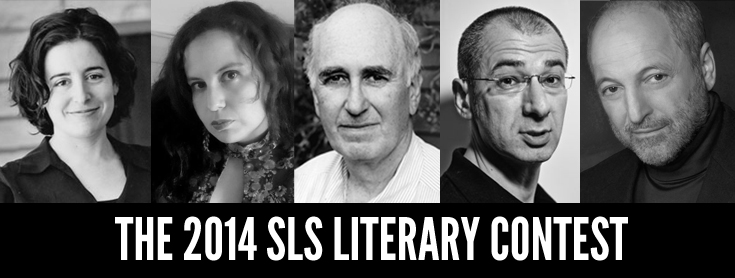
Dorothea Lasky will judge in poetry, Aimee Bender will judge in fiction, and Phillip Lopate will judge in nonfiction.

Submit up to three poems, a short story or novel excerpt of up to twenty pages, or a work of creative nonfiction of up to twenty pages, with an $18 entry fee, by February 28. Submissions can be sent via e-mail or by postal mail to Summer Literary Seminars, Unified Literary Contest, English Department, Concordia University, 1455 de Maisonneuve Blvd. W., Montreal, Quebec H3G 1M8 Canada.

Visit the SLS website for more information about the programs and complete contest guidelines.

Protest Poem

1.21.14

"The only weapon that we have in our hands this evening is the weapon of protest," Martin Luther King Jr. said in a speech on December 5, 1955, in Montgomery, Alabama. Poetry can be a powerful vehicle for protest and social change. Write a poem in which you confront a subject that inspires personal objection. The topic does not have to be strictly political. For instance, Dylan Thomas’s villanelle “Do not go gentle into that good night” protests the death of the poet’s father: “Do not go gentle into that good night / Rage, rage against the dying of the light.” See how you can wield and transfer oppositional energy into language and form.

Applications Open for NEA Poetry Fellowships

The National Endowment for the Arts (NEA) is currently accepting applications for its annual creative writing fellowships. The $25,000 grants, which are given in alternating years to poets and prose writers, will be given in 2015 to poets. The deadline to apply is March 12, 2014.

Poets who have published at least one full-length poetry collection, or twenty or more poems or pages of poetry in five or more literary journals, anthologies, or publications, are eligible to apply. Detailed eligibility requirements are available here.

Complete application instructions, including all required materials, can be found on the NEA website. Applications must be submitted online through the Grants.gov website. Recipients will be announced in December 2014.

The annual fellowships are given in order to provide time for writing, research, travel, and general career advancement for poets and prose writers. Applications are reviewed through an anonymous process in which “the only criteria for review are artistic excellence and artistic merit.” The NEA assembles a different advisory panel each year to review applications.

This year, thirty-eight fellowships were awarded to fiction and creative nonfiction writers; forty poets received the 2013 grants. Fellowships in fiction and creative nonfiction will be offered again in 2016; guidelines will be available on the NEA website in the fall of 2014.

Questions about the fellowship program and application process can be directed to the National Endowment for the Arts by e-mail to litfellowships@arts.gov or by phone at (202) 682-5034.

Traveling Trajectories and Sequences with Poet Shin Yu Pai

Shin Yu Pai is the author of several poetry books, including AUX ARCS (La Alameda, 2013), Adamantine (White Pine, 2010), Sightings (1913 Press, 2007), and Equivalence (La Alameda, 2003). She has also published a number of limited edition artist’s books, including Hybrid Land (Filter Press, 2010), Works on Paper (Convivio Bookworks, 2007), and The Love Hotel Poems (Press Lorentz, 2006).

A visual artist, she has exhibited her work at the Paterson Museum, The McKinney Avenue Contemporary, and the Three Arts Club of Chicago. She is a former curator for The Wittliff Collections and has taught creative writing at Southern Methodist University and the University of Texas at Dallas. Pai received her MFA from the School of the Art Institute of Chicago and studied at Naropa University.

A recipient of awards from the Arkansas Arts Council, 4Culture, the City of Seattle’s Office of Arts & Cultural Affairs, and the Cambridge Arts Council, Pai has completed residencies at the Ragdale Foundation, Taipei Artist Village, Soul Mountain, and is a three-time fellow of The MacDowell Colony. Over the years, P&W has supported numerous events she has taken part in as a writer in the Seattle, Washington area.

Shin Yu PaiWhat are your reading dos and don’ts?
There are few things worse than not being able to hear the reader you’ve travelled distances to hear, so I almost always use the microphone if one is given, and I test it with the audience before proceeding with a reading. I also share information with an audience on the contexts of my poems to engage them in the process that informed the writing, so that my poems can be more accessible. I adhere to the time given to me and respect the time of my co-readers and audiences, and am conscious of listener fatigue. The don’ts are implicit in the dos.

How do you prepare for a reading?
When I started giving poetry readings fifteen years ago, I would practice reading my poems out loud and time the material, writing out comments in the margins of my work of information I thought might be helpful for an audience. Over time, as I’ve matured as a writer and grown more into who I am as a person (an unapologetic introvert with a penchant for occasional extroversion when it comes to poetry), this approach felt too polished or rehearsed, and less spontaneous.

While I never just wing an event with zero preparation, I do now often leave preparing for an event until the day of a reading to see what feels true to me in a given moment. I try to be who I am in front of an audience so that the poems can speak from my heart. I aspire to show up, instead of acting out a public persona.

I also give thought to the venue for which I will be reading. When I read recently at a P&W–supported event with The Wing Luke Museum in Seattle, I thought about the audience for the museum, which has a focus on Asian-American history and identity. I shared poems from my most recent book Aux Arcs on race and my experiences as an Asian-American woman living and working in the South. As a museum studies graduate student, I had spent time at The Wing cataloguing collections, including loaned items from the artist Roger Shimomura. So I also shared a poem that I had written inspired by contemplating Shimomura’s pop culture self-portrait of himself as “Washington Crossing the Delaware.”

Have the disciplines of photography and art curating crossed over into your writing, and the way you think about poetry and presentation?
Poetic presentation is not simply about an experience of activating randomly selected poems by reading them aloud to an audience. I think in terms of trajectories and sequences—images that talk to and across one another for specific audiences based on themes that can arc across different bodies of work from the present and past. I think in terms of editing/curating for presentation and making spaces for the listener to enter the stream of consciousness.

I have often been asked to give slide show presentations in which I talk about the influence of visual artists on my work in tandem with reading my poems. I do think that these sort of hybrid presentations can be a useful way to engage an audience in one’s creative and analytical process.

Presentations are really a kind of event or happening—for the book launch of Aux Arcs, I invited artist Whiting Tennis, who provided the cover art for my book, to perform his folk rock music at the event. Since the poems reflect on race and the experience of living in the South, I asked Whiting if he would perform some of his more lyrical folk songs, in particular a ballad about John Brown to create a bridge to the poems.

What do you consider to be the value of literary programs for your community?
You never know when something you read or say in a workshop will light a fire for someone and inspire them to explore their own story or creative expression. The value of literary programs is in providing a model for the community that individuals of all ages, experiences, and educational backgrounds might explore the richness, inherent worth, and complexity of their own vision—that audience members may see something of their own experience mirrored in my poems, and take that experience and run with it. Poetry is for the community and acts as tool to build community. When I say community, I don’t mean the literary audience of poets and writers, academics and peers. I mean everyday people engaged with the struggle and art of living fully from an authentic place that brings together mind, spirit, and heart.

Photo: Shin Yu Pai. Credit: Daniel Carrillo.
Support for Readings/Workshops events in Seattle is provided by an endowment established with generous contributions from the Poets & Writers Board of Directors and others. Additional support comes from the Friends of Poets & Writers.

Emotional Rescue

1.14.14

“Poetry is when an emotion has found its thought and the thought has found words.” This quote from Robert Frost reveals the raw origins of poetry, and emphasizes the complex cerebral and emotional forces that inspire poems. Think of how poetry accommodates both the expansiveness and simplicity of our emotions. Use this unique and paradoxical phenomenon to write about a profound and complicated experience in your life: perhaps the death of a long-suffering loved one, or the graduation of a child, or the private self-confession of having fallen out of love. Start with a single emotion, and begin your journey there.

Pages

Subscribe to Poetry