Water, Light, Music, Noise Make Eliot Prize Shortlist

The ten finalists for the T. S. Eliot Prize, a U.K. award worth fifteen thousand pounds, were recently named in what chair of judges Anne Stevenson called an "exceptional year for poetry." Among the titles selected from 123 entries are the second collection from an American Army veteran, three Forward Poetry Prize–nominated books and this year's winner (who is one of two Nobel laureates on the list), and a collection by the great-granddaughter of Sigmund Freud that includes a poetic sequence informed by family letters.

The shortlisted poets, each of whom will receive one thousand pounds, are below.

Simon Armitage for Seeing Stars (Faber)

Annie Freud for The Mirabelles (Picador)

John Haynes for You (Seren)

Nobel laureate Seamus Heaney for Human Chain (Faber; Farrar, Straus and Giroux), which won the Forward Prize this year

Pascale Petit for What the Water Gave Me (Seren)

Robin Robertson for The Wrecking Light (Picador; forthcoming from Mariner Books), which was a 2010 Forward finalist

Fiona Sampson for Rough Music (Carcanet Press), also a 2010 Forward finalist

Brian Turner for Phantom Noise (Bloodaxe, Alice James Books)

Nobel laureate Derek Walcott for White Egrets (Faber; Farrar, Straus and Giroux)

Sam Willetts for New Light for the Old Dark (Jonathan Cape)

The winner will be named on January 24 after a reading by the finalists at London's Royal Festival Hall on the previous day.

In the video below, Petit reads from What the Water Gave Me, inspired by the life of artist Frida Kahlo.
The Practice of the Wild

The Practice of the Wild, a documentary film about Pulitzer-Prize winning poet Gary Snyder, who has been called the poet laureate of deep ecology, premieres in New York City on November 12.

Figure L

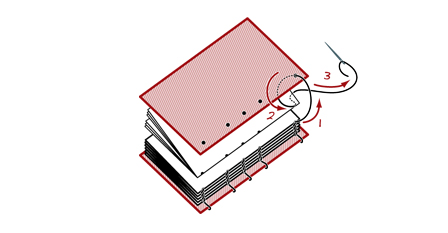
14. Stack your covers and signatures, making sure they’re in the proper orientation and page order. Take a piece of heavy thread (we used cooking twine) and wrap it around the stack lengthwise eight times (the number of signatures plus the covers) to determine the thread’s length. Cut it and thread a needle.

15. Take your cover and the first signature, and begin sewing from inside the fold of the first signature through the bottom hole, leaving a tail of about two inches. Wrap around the cover and sew through the bottom hole (fig. L).

Figures Q, R, and S

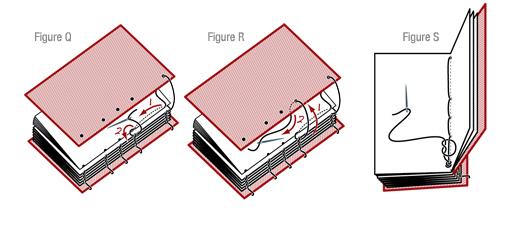
22. Sew outward through the next hole, kettle stitch between the previous two signatures (fig. Q), wrap around the cover and through the cover hole (fig. R), before sewing back into the hole in the signature. Repeat this step for the remaining holes. When you sew through the final hole, tie off as shown in figure S, twice. Trim the stray threads.

Figure P

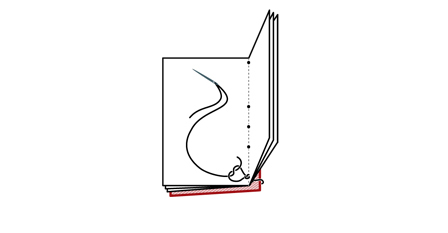
21. Next you’re going to sew the remaining signature and the cover at the same time. Wrap the thread around the signature and the cover and bring the needle through the first hole in the cover. Then push the needle through the hole in the signature (fig. P).

Figure O

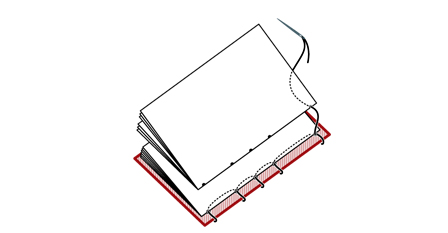
19. Sew down to the second hole and out. Stitch between the first signature and the cover, pushing your needle under the loop of thread, which makes a kettle stitch. Sew back into the hole in the second signature (fig. O). Repeat this step until you get to the last hole.

Figure N

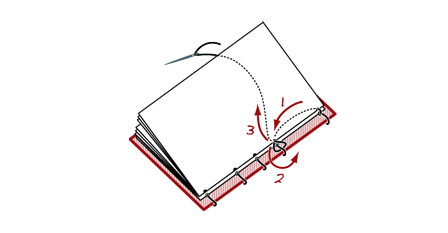
17. Sew through the second hole from inside the signature, as you did the first, and once again wrap around the cover. Sew through the second hole in the cover and then back through the second hole in the signature. Pull the thread through. Repeat this step until you get to the last hole.

18. At the last hole, sew through from the inside of the signature and wrap around the cover and through the hole as before, but instead of sewing back into the signature, connect the second signature, by sewing through its top hole (fig. N). 

Figure M

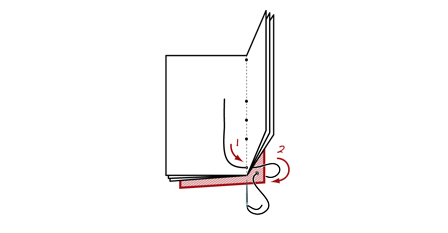
16. Hold the tail inside the signature while you pull the length of the thread through. Thread the needle back through the bottom signature hole. Tie a double knot (fig. M).

Figure K

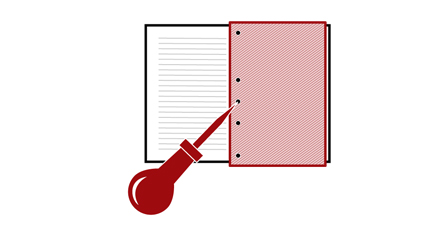
13. Line up the fold of one of the signatures with your cover and lightly mark where the holes should be. Punch with an awl (fig. K). Use a page from this signature as a guide to punch the holes in the other signatures. Fold and press again.

Pages

Subscribe to Poets & Writers RSS