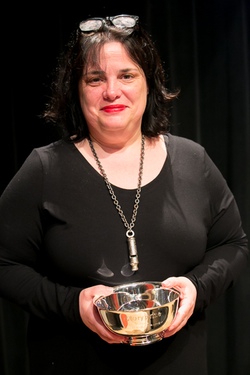
Deadline Approaches for Modern Love College Essay Contest

Submissions are currently open for the New York Times Modern Love College Essay Contest. The prize is awarded to a current U.S. college student for an essay that “illustrates the current state of love and relationships.” The winner will receive $1,000 and publication in the New York Times Sunday Styles section and on nytimes.com. Four runners-up will also receive publication in the Times Sunday Styles section and on nytimes.com.

To enter, writers should e-mail a previously unpublished essay of 1,500 to 1,700 words along with their name, e-mail, phone number, college, and year of graduation to [email protected] by Sunday, March 15. There is no entry fee. Daniel Jones, editor of the New York Times Modern Love column and author of Love Illuminated: Exploring Life’s Most Mystifying Subject (With the Help of 50,000 Strangers), will judge. The winner will be announced May 3.

The New York Times Modern Love column has sponsored its college essay contest two previous times—in 2008 and 2011—and received thousands of submissions each year from students representing hundreds of colleges and universities throughout the country. Caitlin Dewey won the 2011 prize for her essay “Even in Real Life, There Were Screens Between us,” and Marguerite Fields won the inaugural prize in 2008 for her essay “Want to Be My Boyfriend? Please Define.” The essays of previous finalists can also be read on the New York Times website.

For more information about the Modern Love column, read Jones’s article “How We Write About Love.”

Carolyn Joyner and Intrinsic Ardor

A Washington, D.C. poet, Carolyn Joyner has been featured in many publications and anthologies including Obsidian, Amistad, and Beltway Quarterly poetry magazines, Gathering Ground, Beyond the Frontier, Mass Ave Review, and the 2004-2005 Cave Canem annual collections. She is a former WritersCorps and River of Words Project instructor, and was a fellow at the Virginia Center for the Creative Arts and Cave Canem. In 2010, she cohosted Poet’s Corner, a program on local D.C. radio station, WPFW, and in 2003 and 2013, she received an Artist Fellowship grant from the D.C. Commission on the Arts and Humanities. Joyner has a Master of Arts degree in creative writing from Johns Hopkins University.

“They strutted like peacocks,” she said.
Upon completion of writing poems in a workshop for displaced women, a colleague likened the pride swelling from their chests to the swagger of the glorious peafowl. I was studying to be a poet at the time, and was immediately smitten by her comparison. It not only seemed to flesh out the emotion of the women’s newfound self-respect, but awoke in me the warmth and delight she felt about it. How great to limber up the imagination enough to stir lyrical life into those who didn’t know it was there. I vowed right then that I would do my best to achieve this impact when it was my turn to lead a workshop, and when I attended one, I would expect nothing less. This was a tall order for a newcomer, and the challenge persists to this day.

When I was first invited to conduct a Saturday workshop for the CentroNía community in Washington, D.C., which is funded through the Readings & Workshops program at Poets & Writers, I was asked to identify my implementation strategy. Would the focus be on the use of visual and sensory imagery? Would it be theme-based? Understanding that this would be the least of my concerns, I settled on a “generative” workshop—one designed to generate poems.

The poetry workshops at CentroNía have always been exciting and unique. I lived in the community and had attended many. The participants are very eclectic and representative of the intergenerational, varied ethnicities and cultures of the community, writers who range from the experienced to those just trying their hand. And this was the challenge—to tailor a workshop that would address the literary needs of such a diverse group and have them leave “strutting like peacocks.”

Workshop preparation took me well beyond the usual outline of discussion and accompanying exercises. I threw myself into my own thoughts, sensations, and feelings about poetry, and moved away from placing too much importance on the distinct characteristics of the target group. I thought of the workshops I had attended where my “imagination machine” was awakened, censors were turned off, I trusted my inner guide’s prompt, and wrote with ease and patience. This is what I wanted for the participants, and I set about constructing ways to ignite the “intrinsic ardor” that Phillis Wheatley referenced in her poem, “To the University of Cambridge, in New-England.” I’m always encouraged and amazed when reminded that she understood, at such a young age, that we carry the will to become poets despite the obstacles around us. 
My literary desires and expectations include many of the same things as the workshop participants: to stretch the mind, feel free to go off on a writing tangent, be irrational, and embrace the “intrinsic ardor” of our calling. I began to realize how essential the repeated exposure to poetry is through community workshops, for the participants, as well as for those who lead them. We read and discussed the works of a wide spectrum of poets—from Wallace Stevens to Langston Hughes, Maya Angelou to Emily Dickinson, Genny Lim to E. E. Cummings—and we let poetry “dance carefully in our minds.”

The work that Poets & Writers is doing for so many cities is nothing short of revolutionary. The philosophy embodies the belief that once a mind expands, it resists contraction, and therefore, narrow-mindedness.  As a writer, I have become more pliant, my writing is more imaginative, and my ability to blend abstract and concrete elements has greatly improved.

I had no idea whether those in attendance would accept the dare to recreate themselves and write poems that would make them “strut like peacocks,” but most gave it their all, and left happily with an awesome starter poem in hand. I didn’t wait to see their swagger, I had my own.

Photo (top): Carolyn Joyner.  Photo Credit: Mignonette Dooley. 

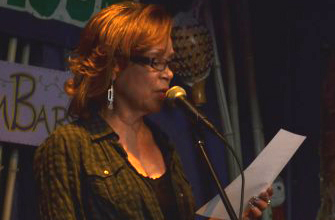
Photo (bottom): Carolyn Joyner reading. Photo Credit: Elizabeth Bruce

Support for Readings & Workshops events in Washington, D.C. is provided by an endowment  established with generous contributions from the Poets & Writers Board of Directors, and others. Additional support comes from the Friends of Poets & Writers.

.

Ben Lerner

"Modernism displaces its readers into the future.... I wanted to kind of purge myself of those tendencies." The award-winning poet and author, whose latest novel, 10:04, was published by Faber & Faber last September, speaks with Paul Holdengräber about modernist literature and what sincerity means.

The Perfect Pitch Panel: San Francisco 2015

Three writers from the Poets & Writers Live audience read their query letters and receive feedback from editors Jordan Bass of McSweeney's Publishing and Ethan Nosowsky of Graywolf Press, literary agent Danielle Svetcov, and publicist Megan...

The Savvy Self-Publisher: San Francisco 2015

Publishing veteran Debra Englander gives an overview of the self-publishing process, followed by a conversation with literary agent Ted Weinstein—who represents Keith Devlin, NPR's Math Guy and author of numerous traditionally published books as...

Whiting Award Winners Announced

The Whiting Foundation announced the winners of the Whiting Awards yesterday. Now in its thirtieth year, the annual awards are given to ten emerging writers in poetry, fiction, nonfiction, and drama. Each winner receives $50,000.

The 2015 winners in poetry are Anthony Carelli of New York City; Aracelis Girmay of New York City and Amherst, Massachusetts; Jenny Johnson of Pittsburgh; and Roger Reeves of Chicago. The winners in fiction are Leopoldine Core and Dan Josefson, both of New York City, and Azareen Van der Vliet Oloomi of South Bend, Indiana. The winner in nonfiction is Elena Passarello of Corvallis, Oregon. The winners in drama are Lucas Hnath and Anne Washburn, both of New York City. The winners will participate in a reading tonight at BookCourt in Brooklyn.

Established in 1985, the Whiting Awards support “exceptional new writers who have yet to make their mark in the literary culture.” Previous recipients include poets Linda Gregg, Jorie Graham, Terrance Hayes, Li-Young Lee, Nathaniel Mackey, and Tracy K. Smith; fiction writers Lydia Davis, Deborah Eisenberg, Jeffrey Eugenides, David Foster Wallace, Jonathan Franzen, ZZ Packer, and Tobias Woolf; and nonfiction writers Jo Ann Beard, Wayne Koestenbaum, Ian Frazier, and Sharifa Rhodes-Pitts.

Each year the New York City–based Whiting Foundation selects a small committee of writers, scholars, and editors to judge the prize. The judges, who remain anonymous, select the recipients from a pool of nominations the foundation solicits from writers, professors, editors, agents, critics, booksellers, and other publishing and theater professionals. There is no application process.

Photos, clockwise from top left: Anthony Carelli, Aracelis Girmay, Jenny Johnson, Roger Reeves, Elena Passarello, Azareen Van der Vliet Oloomi, Dan Josefson, and Leopoldine Core. (Whiting Foundation)

Get in Trouble

Kelly Link discusses the reasons and options for the title of her new story collection, published by Random House last month, with author and book critic Lev Grossman. Get in Trouble is featured in Page One in the March/April issue of Poets & Writers Magazine.

Elizabeth McCracken Wins Story Prize

Last night in New York City, Elizabeth McCracken was announced the winner of the tenth-annual Story Prize for her collection Thunderstruck (The Dial Press). The $20,000 prize is awarded for a short story collection published in the previous year.

The finalists, who each receive $5,000, were Francesca Marciano for her collection The Other Language (Pantheon) and Lorrie Moore for her collection Bark (Knopf). In addition, Kyle Minor received the Story Prize Spotlight Award—a prize of $1,000 given for a collection that merits additional attention—for his second collection, Praying Drunk (Sarabande Books). During last night’s event, the finalists read and discussed their work on stage with prize director Larry Dark.

A former public librarian who currently teaches at the University of Texas in Austin, McCracken has received literary grants and awards from numerous organizations including the Guggenheim Foundation, the American Academy of Arts and Letters, and the American Academy in Berlin. McCracken’s previous books include the story collection Here’s Your Hat What’s Your Hurry, the novels The Giants House and Niagara Falls All Over Again, and the memoir An Exact Replica of a Figure of My Imagination. Thunderstruck is her first short story collection in two decades.

“When you read this book it’s hard to believe it’s her first collection in twenty years—these stories are funny, nuanced, and self-assured,” said prize director Larry Dark. In her on-stage discussion with Dark, McCracken talked about her process, her return to the short story form, and the importance of humor in her writing. “The extent to which I believe that there is redemption in the world of sadness—it is by humor,” she said. McCracken also discussed her use of sensual detail and the importance of creating “evidence that the world in the story existed.”

Dark and Story Prize founder Julie Lindsey selected the three finalists from a record 129 submitted books, representing 85 different publishers. The winner was selected by three judges: Arsen Kashkashian, a book buyer and general manager of the Boulder Bookstore; Noreen Tomassi, director of the Center for Fiction in New York City; and author Laura van den Berg. “Each story in the collection reads like a masterwork, rich and confident and surprising, and together they form an electrifying whole,” the judges said of McCracken’s work. “She writes with such an open and compassionate heart that even the most damaged and lost of her characters thrum with life.”

Established in 2004 to honor the short story, the Story Prize is the largest award given for a book of fiction in the United States. Previous winners include Mary Gordon, George Saunders, Steven Millhauser, and Tobias Wolff.

Pages

Subscribe to Poets & Writers RSS