Figure E

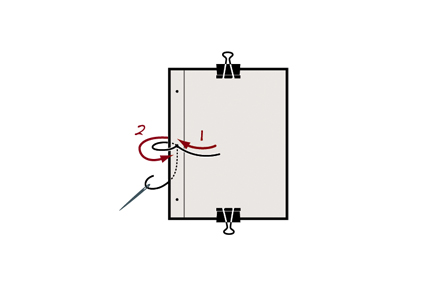
6. Stitch down to the bottom hole, around the spine, then around the bottom of the book and back through the same hole (fig. E).
Jump to navigation Skip to content
6. Stitch down to the bottom hole, around the spine, then around the bottom of the book and back through the same hole (fig. E).
5. Choose a sturdy thread such as bookbinding thread (available at specialty stores), waxed thread, or crochet thread—any kind that doesn't snap when you pull hard on its two ends. Thread a needle and push it through the middle hole from front to back. Then sew the thread around the spine, leaving a four-inch tail for a knot (fig. D).
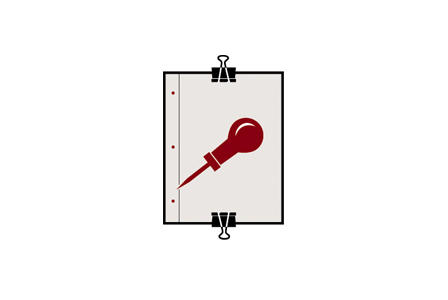
4. Using an awl—or, if you're just practicing, a hammer and nail—punch three holes, each a quarter inch from the spine edge: one in the middle, one a half inch from the top edge, and one a half inch from the bottom edge (fig. C).
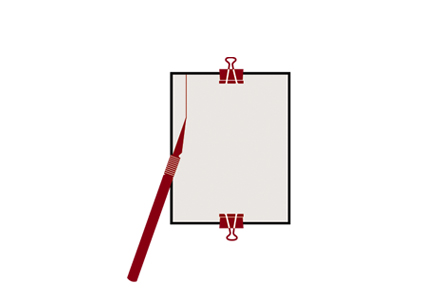
3. Order the pages chronologically, then clip the stack on the top and bottom with binder clips to keep it in place. (Protect delicate cover stock with an extra sheet of paper between the clip and the cover.) Score a line on the cover a half inch from the bind edge (fig. B).
1. Format and design the pages of your poetry or prose manuscript using steps 1 through 4 of the "How to Make a Saddle-Stitched Chapbook" instructions.
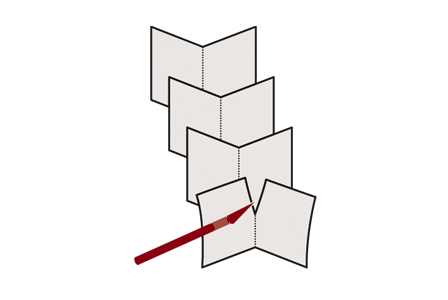
2. You should end up with all the pages folded vertically in the center. Cut the pages along the center fold so that they become individual pages (fig. A).

In 2010, the American Antiquarian Society in Worcester, Massachusetts, will give at least four fellowships to poets, fiction writers, and creative nonfiction writers who wish to explore American history before the twentieth century. The organization’s goal in providing the monthlong residencies, which include $1,100 and housing on the campus of the independent research library (or $1,600 without housing), is to "multiply and improve the ways in which an understanding of history is communicated to the American people."
Fellowship recipients may spend their time at the library researching any subject, with the objective of producing "imaginative, non-formulaic works dealing with pre-twentieth-century American history." The opportunity will also be offered to painters, sculptors, filmmakers, playwrights and other artists working on historical projects.
Writers should submit ten copies of a twenty-five-page manuscript, a resumé, and a five-page project proposal by October 5. Two references should also send letters of recommendation directly to the society. Complete guidelines are available on the organization's Web site.
Past fellows include poet Nicole Cooley (1999), who researched the Salem Witch Trials of 1692 for her collection The Afflicted Girls (Louisiana State University Press, 2004); fiction writer Amy Brill (2005), who worked on a novel set in the 1800s about a female astronomer in Nantucket; and creative nonfiction writer and novelist Ginger Strand (2006), who investigated the library’s collection of Niagara Falls–related writings, images, and miscellania for her book Inventing Niagara (Simon & Schuster, 2008).
A team representing Saint Paul has won the twentieth annual National Poetry Slam (NPS) in West Palm Beach, Florida. The Minnesotans beat out sixty-seven other teams from across North America to claim the two-thousand-dollar grand prize on August 8. Rounding out the final standings were, in order, teams from Albuquerque, San Francisco, and New York City.
Virginia Commonwealth University (VCU) has awarded Deb Olin Unferth the Cabell First Novelist Award for Vacation, published by McSweeney’s Books in 2008. She will receive five thousand dollars and an all-expenses-paid trip to Richmond to attend VCU’s First Novelist Festival in November.
Unferth has previously published a short story collection, Minor Robberies, one-third of the boxed set One Hundred and Forty Five Stories in a Small Box (McSweeney's Books, 2007), which also includes How the Water Feels to the Fishes by Dave Eggers and Hard to Admit and Harder to Escape by Sarah Manguso.
Unferth’s debut novel was selected for the honor by previous prizewinners Travis Holland and Peter Orner, and Andrew Blossom, the editor of Makeout Creek magazine and the anthology Richmond Noir, forthcoming from Akashic Books in March 2010. Holland won the 2008 award for The Archivist’s Story (Dial Press, 2007), and Orner won in 2007 for The Second Coming of Mavala Shikongo (Little, Brown, 2006).
This year's finalists were David Mura for Famous Suicides of the Japanese Empire (Coffee House Press) and Jesmyn Ward for Where the Line Bleeds (Agate Bolden), recently nominated for a Legacy Award from the Hurston/Wright Foundation.
The annual award is named for prolific Richmond author and poet James Branch Cabell, known for his contributions to fantasy fiction, though he also wrote literary works. His debut novel,
The Eagle’s Shadow—the first of fifty-two volumes of work—was published by Doubleday in 1904.
The next deadline for publishers to submit nominations is September 15, for books published in January through June of this year. The entry deadline for books released in July through December is January 15, 2010.
Google kicked off a new program yesterday that will allow authors who have released their books under the Creative Commons license to distribute them free through Google Books. Participants will be able to select from among seven versions of the Creative Commons agreement, which lets rightsholders make works openly available while still specifying how they may be used or altered.