Pacific Northwest Magazine Seeks Fiction With an Eye on Environment

A prize of one thousand dollars and publication in Bear Deluxe Magazine out of Portland, Oregon, is being offered for a short story that addresses the environment, sense of place, and the natural world. The magazine is published by Orlo, a nonprofit that supports creative arts that explore environmental issues.

The judge for this year’s prize will be Portland writer Jon Raymond, whose most recent book is the story collection Livability (Bloomsbury, 2009), two pieces from which have been adapted for film. The 2006 film Old Joy was based on the story of the same title, and "Train Choir" became the 2008 movie Wendy and Lucy. Raymond has also written and edited for locally-based literary magazine Tin House.

Writers may submit stories of up to 5,000 words by September 8. The contest charges a $15 entry fee, which includes a copy of the prize issue.

Last year’s winner, Justin Blessinger of Madison, South Dakota, had his story "Winter Count" published in the Summer 2009 issue of the magazine. The judge was Katherine Dunn, also a Portland resident and the author of Geek Love (Knopf, 1989).

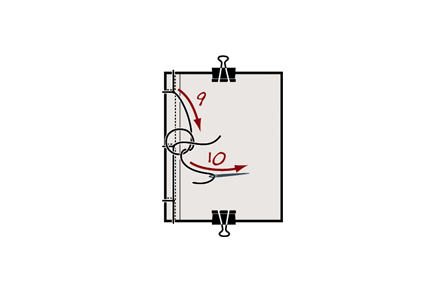
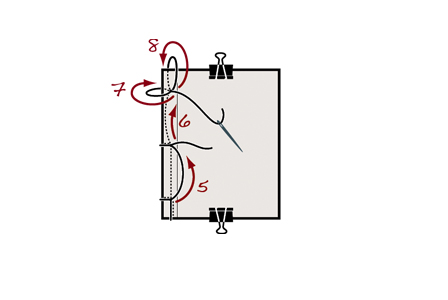
Figure G

8. Bring the thread back down to the middle hole and tie off your thread (fig. G). Now that you've made a basic stab-stitch binding, create your own variations: For instance, put the holes closer together, use more or less than three, or vary their placement for a zigzag look.

Figure F

7. Sew up to the middle hole again, then to the top hole, around the spine, and then around the top of the book (fig. F).

Figure E

6. Stitch down to the bottom hole, around the spine, then around the bottom of the book and back through the same hole (fig. E).

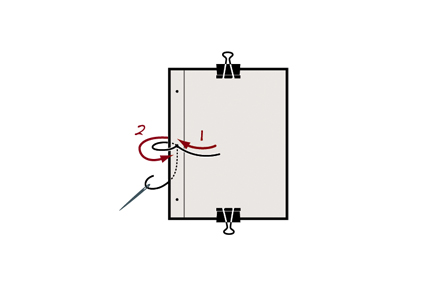
Figure D

5. Choose a sturdy thread such as bookbinding thread (available at specialty stores), waxed thread, or crochet thread—any kind that doesn't snap when you pull hard on its two ends. Thread a needle and push it through the middle hole from front to back. Then sew the thread around the spine, leaving a four-inch tail for a knot (fig. D).

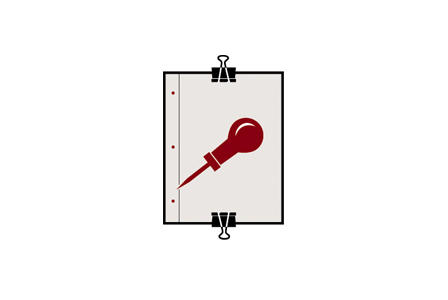
Figure C

4. Using an awl—or, if you're just practicing, a hammer and nail—punch three holes, each a quarter inch from the spine edge: one in the middle, one a half inch from the top edge, and one a half inch from the bottom edge (fig. C).

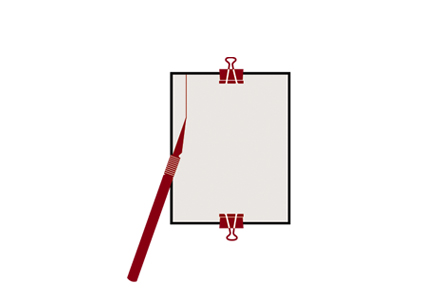
Figure B

3. Order the pages chronologically, then clip the stack on the top and bottom with binder clips to keep it in place. (Protect delicate cover stock with an extra sheet of paper between the clip and the cover.) Score a line on the cover a half inch from the bind edge (fig. B).

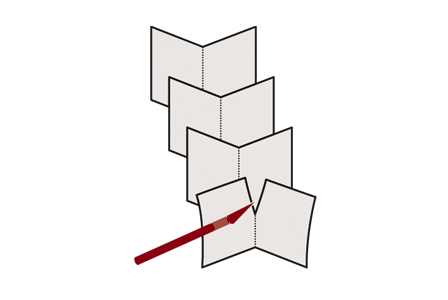
Figure A

1. Format and design the pages of your poetry or prose manuscript using steps 1 through 4 of the "How to Make a Saddle-Stitched Chapbook" instructions.

2. You should end up with all the pages folded vertically in the center. Cut the pages along the center fold so that they become individual pages (fig. A).

Pages

Subscribe to Poets & Writers RSS