When a young composer named Jake Runestad invited me out for coffee in 2011, neither of us could have foreseen that the relationship would lead to many years of collaborations, premieres at the Kennedy Center and Carnegie Hall, a regional Emmy, and Grammy nominations. An affable guy with an easy smile, Runestad paid for our coffees and soon got down to business: He was looking for a librettist. (Classical musicians use a lot of Italian terms. Libretto translates to “booklet” and refers to the words singers sing; librettos are lyrics.) “I write poems, not librettos, but you can set any of my poems to music,” I told him, offering to gift him a copy of my first collection. But setting one of my poems was not what he had in mind.
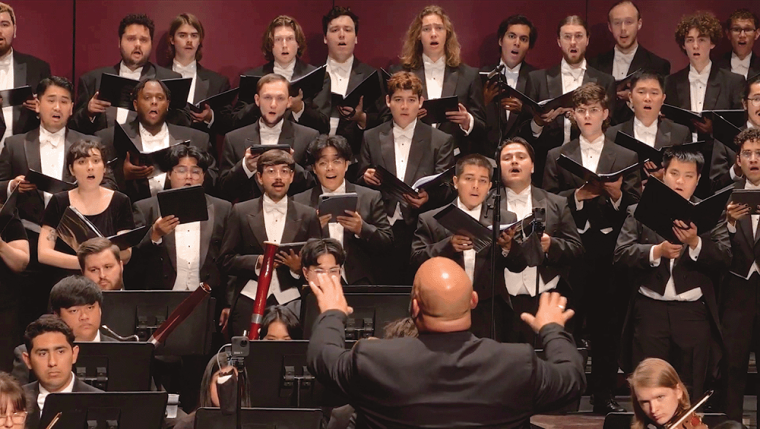
The Bob Cole Conservatory Symphony performance of Earth Symphony by Jake Runestad, libretto by Todd Boss, at the Carpenter Performing Arts Center in Long Beach, California, with Jonathan Talberg conducting, on May 6, 2023. (Credit: Bob Cole Conservatory of Music at California State University, Long Beach)
Runestad’s proposal was more ambitious: He wanted me to write new texts on which to base new compositions, and he was willing to pay me using money from his own commissions. One of his upcoming projects, for example, roughly seven minutes in length, was in need of a text in the style of Pablo Neruda, and not just a workable text from some anthology, either, but something original that spoke to the sorrow of a particular loss he wanted the work to explore. Could I write something for $500?
A good number of poets these days have enjoyed the thrill of having a composer set their already-written poems for classical performance, often as “art songs” (songs for solo voice and accompaniment). The earliest significant art-song collaborations, particularly within the German tradition of “Lieder,” emerged in the nineteenth century, notably with composers like Schubert, Schumann, and Brahms setting poetry by Goethe, Schiller, and Heine. The oldest known notated melody, “Hurrian Hymn No. 6,” is an ode to the goddess Nikkal composed around the fourteenth century BCE, with both musical notation and lyrics preserved on clay tablets later excavated from Ugarit in Syria. There’s no way to know how many artists contributed to the piece, but the fact remains: Earth’s oldest known human music had words. When writers and composers work together, they press themselves to this same sacred clay.
To write a custom lyric for a composer, however, offers a poet unique rewards in terms of inspiration. When I teach workshops and master classes, I urge poets to write into unfamiliar genres. A poet can learn a lot in the process of writing technical papers, or ad copy, or magazine articles. When I scramble my assumptions about audience, structure, or format, it exercises my brain and keeps my thinking nimble.
When I met with Runestad that day, the practice of writing for a composer was new to me. But collaborating with a living writer to commission an original text was new to him, too.
“Tell me what you look for in a text,” I asked.
Runestad explained that in choral music, emotion is conveyed by vowels. To demonstrate, he read aloud the first lines of Wendell Berry’s poem “The Peace of Wild Things,” a text he would later set—“When despair for the world grows in me”—but he read it like a choir conductor would read it to a choir: “Whendespaaair forthewooorld grooows inmeee,” emphasizing the speech rhythms of the line while exaggerating its dominant vowels. Forget scansion. Set the line to music according to the rhythms of speech, and the line practically self-organizes into those four emotional units. He continued to the next line, “AndIwaaake intheniiight infeeear”—three emotional units.
But what about the consonants? “Consonants don’t carry notes,” he explained. And since they don’t carry notes, they don’t carry emotion either. Well, not in the same way at least. So this was my first lesson in writing libretti: Minimize consonants and avoid clumsy consonant clusters. Unless of course clumsy consonant clusters are conclusively required. (A line like that, spring-loaded with velar plosive trapdoors for a choir to slapstick through, might interrupt a song about the perils of smooth love-letter writing, for example.)
By now I was taking notes. I admit I was an easy sell. I love prompts, rules, and constraints against which to push. Already the work appeared intuitive. I’d written about grief and loss before. And who doesn’t love Pablo Neruda? Plus, the text for a seven-minute piece might run only a hundred words or so, and that’s five bucks a word. Because he was his own publisher, Runestad could cut me a standard royalty contract, too, and I’d retain the rights to whatever I wrote.
I told him I could get to work right away.

Many modern-day composers avoid giving coffee-shop tutorials like the one Runestad gave me, electing to set the work of dead writers (or texts in the public domain) instead. Paying for the rights to a text outright is cheaper than sharing a commission, they figure, and less time-consuming. More than one composer has confessed to me a fear of poets resisting revision, or disregarding deadlines, or taking offense at how their work is ultimately set. But Runestad is fond of repeating, “The words are the most important thing.” We’ve collaborated on ten projects now, and that reverence for language is one of the many reasons I love working with him. He doesn’t write a note of music until every word is in place and he practically has the text memorized, each syllable taking on various tonal weights and colors in his mind. I wonder: How much more richly is he able to embody and invent into his craft, when he’s part of the very formation of the text it’s based on? How much better a writer of music is he, when he has labored (even if vicariously through me) over the writing of the lyrics, too?
Since that first coffee-shop tutorial, I’ve cocreated choral projects (with Runestad and other composers) dealing with wildfires, mortality, the howling of wolves, the pandemic, and Beethoven’s deafness. Most recently I wrote an epic monologue from a post-Anthropocene Mother Earth that puts environmental Armageddon on nothing less than an eternal timeline. Not exactly “This Little Light of Mine.” And there’s room for invention. A creative writer can bring a wide array of theatrical, sonic, structural, multimedia and interactive ideas to the table.
These days more and more composers are discovering the distinct thrills of cocreation, enjoying the artistic rewards that can come from being involved in the development of a project from its very first drafts. So Runestad and I have begun introducing composers to poets who have ever more complex stories to tell.
Sharing a commission from Ohio’s Capital University Chapel Choir, poet Samiya Bashir wrote a text for composer Joel Thompson so dark she called it “Dark Matters.”
… Some days are small miracles.
Some days insist on small miracles. Lately
I struggle. Some days my smallest miracle is
Me. Some days my smallest miracle is keep going. …
Thompson’s program note reads like the keen analysis of someone who has painstakingly set the poem line-by-line: “Samiya has masterfully given voice to emotions that sit within the deepest recesses of our souls, and in order to serve her artistry honestly in conversation with my music, I had to really follow her journey into that emotional abyss. I found myself composing this piece in small doses—unable to stay within the piece for too long without spiritual fatigue. Luckily, Bashir’s words also invited me to search the night by lamplight for myself. In doing so, I also found a way out of the oppressive fog of anxiety and doubt, especially when equipped with her words of encouragement: “Some days my smallest miracle is / Me.”
Nobody will ever read your work as closely as your composer collaborator. It’s possible no one will ever honor your work as intentionally either. For every hour you put into the text, your composer will put in three or four, or many more. Runestad first set “A Silence Haunts Me” (the piece about Beethoven’s deafness) for choir and piano. But as it gained in popularity, he reset it, so that it could be performed by full orchestra. And then he set it again for wind ensemble.
There is a natural hierarchy to this arrangement. Choirs and orchestras commission composers, not poets. A composer who extends their commission to include you as a collaborator will naturally keep the bulk of funds for themselves. But whereas you might be paid $500 or so out of the composer’s pocket for a short piece your first time out, later you might make $5,000 or more for a longer work negotiated from the commissioning institution over and above the composer’s share, plus additional allocations for travel and lodging to attend the premiere.
The music community reveres its composers, and this can have ramifications for living librettists that some writers might find challenging. For instance, no matter how seminal you were in the development of a piece, you may find your name omitted from programs or listings. Few will think to invite you to repeat performances. You should expect a standard publishing royalty, and you should register with the rights organizations ASCAP (American Society of Composers, Authors, and Publishers) or BMI (Broadcast Music, Inc.) to claim any royalties from performances of the work, but it may never pay much. Recognitions will officially be for the composer or the ensemble. The Grammy Awards don’t even have a category for classical librettists.
In addition you’ll need to employ some deference when it comes to revision of your work for a composer. Collaborations aren’t for divas. You’ll learn early to compromise poetic sensibilities when it comes to a text that isn’t exactly poetry. This is a libretto, after all. However passionate you might feel about the words you’ve chosen, in the end you’ll want the composer you’re collaborating with to feel just as passionate, or more so.
Opera librettos are more lucrative than shorter forms like art song or oratorio, but they’re also more time-consuming and will engage you through the course of developmental workshops and rehearsals for a year or more. But lest you think an opera sounds like a complicated undertaking, think again. Pulitzer Prize–winning librettist Mark Campbell, who put the finishing touches on his forty-ninth libretto earlier this year, says, “When you write text that’s meant to be sung, aim for brevity and simplicity.” Don’t try to compete with the depth and complexity of music. Work with it, he says. Use it.
Managing all this is a balancing act that demands a certain amount of pride-swallowing, but this will eventually cultivate in you a deep creative confidence, the kind that comes from entering into generative praxis with creative genius that’s very different from your own.
Plus, it’s fun.
None of the tactical or financial considerations above matter much the first time you step into some old church somewhere, to hear, for the first time, a choir rehearse your piece in advance of its world premiere. The choir has already been rehearsing for weeks, and the premiere is tomorrow. They’re giddy to know you’re in the room, as demonstrated by the warm applause that greets your introduction. One by one, choristers take the rare opportunity to ask you about your libretto, right down to individual word choices. Everything you tell them is carefully absorbed—useful to their craft of interpretation. These musicians don’t just want to sing your words at tomorrow’s audience. They’re intent on conveying the meaning behind them.
You’re shown to a seat and handed a copy of the finished score. It’s heavier than you’d imagined it would be. Your name is on the facing page, opposite the composer’s. Your words, in among the staves, have been chopped into irregular, hyphen-divided syllabics.
The conductor’s hands slice the air, a pianist unspools a series of chords you’ve never heard before, the choir takes a collective breath…and suddenly sixty mouths are carving your words into the strange and marvelous space the music has made.
The phrasing isn’t what you’d expected. Nor is it a direct line-by-line delivery—some phrases repeat, or overlap. There’s discord. Pauses disrupt the flow while the piano elaborates. The conductor stops the rehearsal to give notes. Someone grumbles, someone laughs. It’s unlike any poetry reading you’ve ever attended. You’re somehow both instrumental to the work being done and incidental to it. The work is yours and not yours at the same time, a blend of languages—tonal, nontonal, and pitch-accent, all three. Your words aren’t distinct from the whole but integrated. Your vowels and consonants aren’t merely literary symbols but musical notations. You’ve worked hard to bring your voice to the page—but what is your voice, when so many other voices have united in bringing it off the page?
Beyond words and music, there is a third thing taking shape in this room—bigger than either, by a multiplicative factor. And the full shape of it won’t be apparent till tomorrow evening, when the pianist is joined by the other instrumentalists in the accompanying ensemble. Ticket holders will take their seats in the concert hall, your words in the programs in their laps. The instruments will finish tuning, and the house lights will go down. An anticipatory hush will come over everyone….
So where can you begin? Maybe you can still major in “libretto” somewhere (Italy? Austria?), but you can’t do it in the United States. You might look to foundational courses in dramatic theory, scriptwriting, or music theory, but outside of a conservatory, you’ll be hard-pressed to find even a single substantive class on writing libretti. Few classical music associations welcome writers, and their conferences don’t cater to them. I’ll be first in the water to coach any summer camp that gets poets and composers swimming together. Rather than hold my breath, I’m leading a collective for poets and composers at PoCo Labs (pocolabs.org) that has already held mixers to help us connect. (Watch for just such an opportunity at the AWP Annual Conference & Book Fair in Chicago next year.)
Do you have a project you want to write? Opportunities like New Music USA’s music creator fund doesn’t discriminate writers from other music creators in awarding up to $5,000 for collaborative projects, although you’ll need to apply with three examples of performed work.
But don’t forget to look for opportunity in the same place your work will one day be performed: the concert hall. Seek out ensembles that commission and premiere new works in your area, keeping in mind they may be the smaller, more nimble arts organizations, or universities. Go to a show, read the program notes, and stick around afterward, asking to meet the composer of that strange and wondrous new piece you just heard. Tell them you’d like to find the words that’ll make them want to break into a new song.
Soon they’ll be asking you out for coffee.
Todd Boss is an Emmy-winning, Grammy-nominated poet and lyricist who has written four poetry collections, all published by W. W. Norton. He has been published in the New Yorker and elsewhere and pioneers the concept of Poetic Intelligence on his podcast, There’s a Poem in That, where he writes healing poems for total strangers. A father of two, he lives with his partner, Grammy-winning soprano Hila Plitmann, in Austin. His first children’s book, The Boy Who Said Wow, which celebrates music’s power to reach the private mind, was published by Beach Lane Books in 2024.
Thumbnail credit: René Treece Roberts