I have a sign hanging on my office wall that reads Demented Whimsy. I take this as a daily challenge, a reminder, a mission statement—a way to calibrate my imagination before I’ve begun the day’s writing. Demented whimsy is the fuel authors use to tell stories in nuanced and evocative ways, a celebration of the magic thrumming in our hearts.

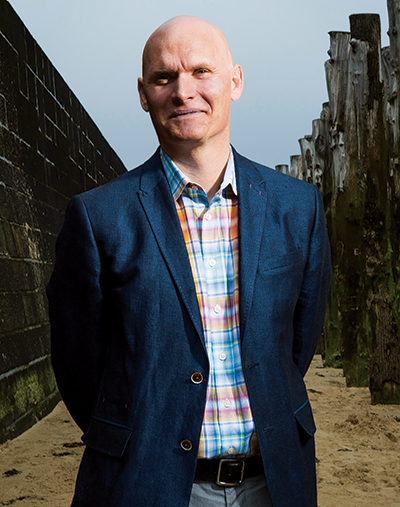
Anthony Doerr, author of Cloud Cuckoo Land. (Credit: Philippe Matsas)
Anthony Doerr has that magic in droves. He possesses a singular gift for the alchemy of the cerebral and the emotional on the page. Plenty of writers can nimbly toggle between these two human hemispheres—the head and the heart—and yet very few of us possess the talent to approach these thrilling commodities simultaneously. In two previous novels, including All the Light We Cannot See (Scribner, 2014), which was awarded the Pulitzer Prize for Fiction and the Andrew Carnegie Medal for Excellence in Fiction; two story collections, Memory Wall (Scribner, 2010) and The Shell Collector (Scribner, 2002); as well as the memoir Four Seasons in Rome (Scribner, 2007), Doerr has alerted us to his unique capacity to excel at such arcane practices. But that’s not even what impresses me most: The attribute of his work I admire more than anything is that while accomplishing this high-wire act, his books remain so much damn fun to read.
After all, we can gussy up narrative construction and talk about it in the most highfalutin and pretentious ways. At the end of the day, however, it’s deceptively, sometimes even depressingly, simple: The second page has to make our audiences want to read the third page, page 108 must create an appetite for page 109, and so on. Doerr does this to great effect because of the intimacy he establishes with his audience.
In his latest feat the work feels so embodied, told from an ensemble of diverse players who all have vibrant and complicated inner lives. He gives every single one of his characters the “dignity of complexity,” a phrase I’m poaching from my memoir Model Citizen. It is an ethos, a literary responsibility. There can’t be a caricature in sight in our work. We must burrow deep into our players’ hearts, and if we need glimmering examples of exactly how to pull off such exquisite tricks, we have Doerr’s new novel: Cloud Cuckoo Land, published in late September by Scribner. Everyone is authentically inhabited and brought to real-deal life.
We often ask ourselves as creative writers: What’s at stake for our characters? And the very best of us also ask: What’s at stake for me as the storyteller? If we aren’t willing to risk marvelously falling on our faces, the answer is nothing. Doerr, however, seizes that challenge with wanton spirit, taking readers of Cloud Cuckoo Land from ancient Constantinople to a recognizable contemporary Idaho and finally into the future on a spaceship called the Argos, controlled by an artificial intelligence named Sybil.
The main connective tissue between these threads is a book, is storytelling itself: how books are magic, how they are time machines, how they connect us all to the story that has been happening since the first scribbles appeared on cave walls. Only an artist who doesn’t flinch and is willing to risk a public face-plant would attempt such vast experimentation across time and space, yet Doerr doesn’t stray from the anxieties of our era—climate change, contagion, disinformation.
In lesser hands those concerns would read like a polemic, a sermon tuned to saccharine buzzwords. But Doerr hits these zeitgeist targets through his visceral characters, not authorial intention. It is his players—Anna, Omeir, Seymour, Zeno, and Konstance—who offer us hope. Not cloying, Lifetime channel hope. The good stuff, the kind of hope that makes you think, despite all evidence to the contrary, that we might just find a way through this wounded world after all.
I’ve long told my graduate students that their imaginations are the ultimate commodity on the page and how nobody else on earth has an imagination quite like theirs. I can really pour it on when I get going, especially when it’s true: Our imaginations really are as unique as our fingerprints—and because of this, it’s the critical currency, the epicenter of our idiosyncratic aesthetics. We need to be authentic. Be you.
And while my grad students have been known to roll their eyes at my unabashed and obscene belief that literature remains an important ecosystem to teach empathy, these stilted pursuits should never come at the expense of spinning a readable yarn. Yes, novels can be readable and smart and emotional, or at least they have the potential to be, in the right hands. Cloud Cuckoo Land is a masterpiece. Told in mesmerizing prose, moving dexterously through millennia, this work is orchestrated by a novelist at the height of his powers. You and me? We’re just lucky enough to be alive to indulge in the lavishness of his imagination.
Before we get to the new book, I want to ask you a question about writing after winning the Pulitzer. Unfortunately this isn’t something I’m directly familiar with. [Laughter.] But I have good friends who have been lauded like that and felt a paralyzing anxiety while composing the follow-up to the artifact that had won them mainstream prestige. What was your experience like—not from a craft perspective yet, but just as a human who was suddenly thrust into the hallowed Pulitzer social club?
The Pulitzer just gave me and my family a huge burst of joy, so it didn’t mess with my head much. In the months afterward, daily life was still the same—you still have to collect the kids’ dirty socks and cook dinner and pick up the dog poos. My work remained as challenging and as involving as ever. Maybe surprisingly it was the fact that All the Light We Cannot See was reaching so many more readers than my previous books that was much more overwhelming.
What exactly does overwhelming mean in that context? Can you give an example?
Before, if I screwed up some little detail and only realized it after a book went to print—if, say, I had a snail appear in The Shell Collector in the wrong region of the ocean—I might hear about that mistake twice in a year. But with All the Light I was hearing hourly about some little research mix-up I’d made.
I love that. I mean, I’m sure it comes with its own irritations—but the fact that the work resonated with your audience so mightily, so poignantly that they felt the need to reach out, to be helpful to the book’s accuracy—that speaks to the clout of storytelling, of literature. That’s why we do what we do.
I screwed up the date for the formation of Pakistan, for example, and didn’t get that fixed until a third printing, so I heard about that ten times a day for about a year.
I can see how the charm on that might lose its luster with time. I still super dig that they care so much about the book.
Imagining all those readers out there who know far more than you do can become a bit paralyzing when you’re writing your next work. So, as I put together a novel set in multiple spaces and times, I had to keep reminding myself that I’m just one—particularly fallible—human and try to accept that I was never going to be able to ensure a six-hundred-page novel was free of mistakes.
Yes, let’s dive into that 640-page wonder factory you call a novel. I love this new one, Tony. I mean, I always dig your work, but I love the ambition here. And its heart. How you manage to be so cerebral on the page and heartfelt is a feat unto itself. Let’s start with the primary source from which you found the book’s title. Had you been previously familiar with the text, and had it resonated thematically?
I had not read a page of Aristophanes before starting this project. “Cloud Cuckoo Land [Νεϕελοκοκκυγία]” was a phrase invented by the comic playwright Aristophanes 2,400 years ago in The Birds, one of his few plays that survives to this day.
I wasn’t familiar with the phrase before reading your novel, though my knowledge of the ancient Greek texts is limited to one drunken semester in a state college.
[Laughter.] We read Oedipus Rex in high school, and I’d crashed through some Euripides in graduate school, but I was mostly ignorant when it came to the Greek playwrights. So when I was ranging around searching for a classical text to weave into the core of my novel, I had lots of catching up to do.
My favorite part of talking shop with other writers is hearing about nuanced processes so different from mine. We’re all trying to tell a compelling story and yet go about it in such divergent ways. So once you made the decision about weaving that narrative into yours, did that become the thematic connection you’d been hunting for?
I knew pretty early on that I was looking for a motif that might lighten the often-heavy burdens my characters were carrying. And I needed a text that could appeal to kids, since so many of my characters are young, including the five kids working with Zeno on a translation. I thought for several months, after reading The Birds, that this could be my book-inside-the-book, but there were too many copies of The Birds coming out of the ancient world, and I wanted a text that had been whittled down to a single copy so that it was in extreme danger of extinction.
Extinction. Yes, that’s an important word for this book. For the planet, too.
And I needed a text that had survived because of a Byzantine copy protected inside Constantinople. So I decided to invent a text.
No pressure there. [Laughter.] So how did you go about constructing this “primary source”? Were you trying to replicate a cadence you’d heard in your research or just cooking up the voice from scratch?
Once I found Antonius Diogenes, a novelist writing in Greek about 1,800 years ago—all of his books have been lost—I began to think I’d found my path forward. We don’t know much about Diogenes, but we do know that he wrote a very long book called The Wonders Beyond Thule. A ninth-century plot summary of the book says that The Wonders was a big globe-trotting tale, full of interlocking stories and divided into twenty-four sections. It apparently borrowed from both scholarly and folksy sources, mashed up existing genres, and may have included the first literary voyage to outer space.
Now that sounds like my kind of deranged book. What a tragedy that it, too, has gone extinct.
I thought it would be fun not only to invent pieces of a lost novel like The Wonders Beyond Thule, but also to try to design the larger, enveloping novel in the spirit of it. As for thematic connections to Aristophanes’s original notions about Cloud Cuckoo Land, I hope there are many. Aethon—the foolish shepherd at the center of my invented tale, who is loosely based on the hero at the center of Apuleius’s The Golden Ass—is always searching, always restless, always thinking the barley is more plentiful in another man’s field, always determined to get to his Cloud Cuckoo Land in the sky.
That gives you a terrific thematic canvas to paint on, especially as the novel moves from this story line in the past and jets into the future. The various eras covered in the novel sound like three notes struck together, forming a chord. I loved watching that particular story line inform the future.
All of us can be prey to similar desires, urged by capitalist culture to keep searching for something better than what we already have. Maybe that’s my story, too, so maybe this novel is my middle-aged book: a story of trying to rein in my own restlessness, accept the beauty of what I already have, and welcome my own insignificance in the face of the vastness of the cosmos.
I want to ask a question about structure. It’s one of the paradoxes of the novel form, how the more seemingly freewheeling a book’s architecture appears on the page—spontaneous, organic, kinetic in its unpredictability—often projects like that require even more of a code or schematic or system of scaffolding. Can you tell me about the challenge of bringing intention to the book’s aesthetic design?
The structural challenges of this novel were enormous, and there were many nights when I feared I’d never be able to piece the whole puzzle together. I built hundreds of outlines and maps and laid lots of strips of paper out on the kitchen counter. Ultimately relying on the number 24—the number of books in the Iliad and Odyssey, and the number of letters in the ancient Greek alphabet—helped me to commit to a certain shape.
When I draft I only want to know the book’s opening image, and from there I just want to make it all up. So hearing your organizing principles is fascinating to me. Were these outlines and maps all intuitively constructed, or were you using any external organizers to help curate your content?
I wrote the letters from alpha to omega horizontally across a sheet of paper and began to hang the characters’ stories off that, arranging them in different formations for months, trying out different things—sort of like hanging different pieces of fabric from a curtain rod.
The structure of this new book is worth the price of admission. I described it to a friend the other day as David Mitchell’s Cloud Atlas meets Michael Cunningham’s The Hours. I don’t know if that makes sense to anyone but me—but I mean it as a total compliment. Now that we’ve covered structure, can you talk about the difficulties in building tension, allowing the drama and danger of each epoch to blossom thoroughly and thoughtfully? Since they “interrupt” one another every time we hop into our time machine, how does each tine of the narrative continue to accrue meaning, subtext, and readability?
I like thinking about suspense as interruption. A couple of studies published in 2008 and 2009 found that disruptions sometimes enhance our enjoyment of pleasurable activities: An experiment at New York University found that students got more pleasure out of watching a sitcom with commercial interruptions than those who watched the same show without commercials, and another found that people who had massages interrupted and then resumed reported a higher degree of pleasure than folks who had uninterrupted massages. Isn’t that interesting?
It’s thrilling to be tantalized in life, so why wouldn’t we as artists attempt to imbue our work with such pleasure? That’s something I do remember from my one semester of Greek mythology, the story of Tantalus, forever punished by being close to what he needed, but these necessities were always just out of reach.
Maybe interruptions—like sipping some wine in between bites of fatty food—help us re-appreciate the deliciousness of certain moments.
When I work, I think about it in terms of postponements and payoffs—always asking: How long can I put off revealing a certain morsel of information to extract every single drop of dramatic tension—but never pushing it so far that the audience gets frustrated or feels manipulated.
In Memory Wall and All the Light, I wondered how interrupting various characters’ trajectories—leaving them suspended in your subconscious while the narrator’s attention swivels to another character’s story—might increase a reader’s pleasure. So I played around with shifting back and forth between a few characters. And in Cloud Cuckoo Land I just tried to push the idea twice as far, to see how many different resonances I could build.
A cacophony. A beautiful choir of very flawed human voices. The way you’ve organized and arranged this novel is so impressive. And of course form is only compelling if it’s balanced with content, with compelling characters. You’re working in an ensemble here, and getting to know new characters is often like meeting people in real life at a party. Some just walk up to you and spill their guts, whether you want them to or not. Others make us work harder to figure out what makes them idiosyncratically alive. Me, I prefer the prodigals. Was there a certain character’s voice that you heard first?
I heard Anna’s voice first: She chafes against structure and monotony in ways that I can easily relate to, and she longs to live multiple lives through stories in ways that I needed to as a child—and still need to. So maybe she came first because, at least on some level, she’s the most like me—though I’m not nearly as brave as she is.
Anna will stick with me. She was the kind of character who, if you hold the book up to your ear, you hear her heartbeat. So what about the opposite end of the spectrum? Was there one player who remained elusive until later in the remix process?
I suppose every character you invent presents unique challenges, and their elusiveness depends on the challenges of that particular working day. Everyday details of Omeir’s life in the 1440s in the mountains of what we now call Bulgaria, for example, were extremely hard to find, so sometimes I’d put off working on his sections for weeks or even months.
Seymour’s sensitivities were sometimes hard to render: To write his sections I dug into my own sensitivities to crowds and loud noises and my own anxieties about the health of the planet.
Health of the planet. Circling that word extinction again. The climate crisis—though that noun feels too timid. This book has a conscience, has a sort of livid kindness in it at times, and yet it never feels didactic or authorial. I’ve always adored Grace Paley’s idea that a writer knows she’s written a story when she’s written two stories—meaning as authors we need to dote evenly on the literal plane of the story as well as the subtextual action, its soul. From a craft perspective, can you talk about how you make sure you’ve equally and evocatively explored the external action as well as the spiritual, the existential, the emotional?
As writers we have this amazing gift of revision, and for me, sleep and time are the key ingredients here. At first you make some clumsy paragraphs, you sleep, you research, you work on your crappy paragraphs, and—hopefully—they get slightly better, richer, deeper. Then you sleep, and then you work on them again, and repeat: for months. You don’t always make progress, but each time you revisit a passage with a rested mind you—if you’re lucky—should be able to pull more out of it: You try to understand the levels it’s operating on. Maybe you notice a moment where you can improve rhythm, or you start playing with a motif you played with elsewhere in the project, or you want to draw a thread back through an earlier section in the novel by repeating a phrase or an image. These things come only with time and sleep.
An excerpt from Cloud Cuckoo Land
Anna
On the Fourth Hill of the city we call Constantinople, but which the inhabitants at the time simply called the City, across the street from the convent of Saint Theophano the Empress, in the once-great embroidery house of Nicholas Kalaphates, lives an orphan named Anna. She does not speak until she’s three. Then it’s all questions all the time.
“Why do we breathe, Maria?”
“Why don’t horses have fingers?”
“If I eat a raven’s egg will my hair turn black?”
“Does the moon fit inside the sun, Maria, or is it the other way around?”
The nuns at Saint Theophano call her Monkey because she’s always climbing their fruit trees, and the Fourth Hill boys call her Mosquito because she won’t leave them alone, and the Head Embroideress, Widow Theodora, says she ought to be called Hopeless because she’s the only child she has ever known who can learn a stitch one hour and completely forget it the next.
Anna and her older sister, Maria, sleep in a one-window cell barely large enough for a horsehair pallet. Between them they own four copper coins, three ivory buttons, a patched wool blanket, and an icon of Saint Koralia that may or may not have belonged to their mother. Anna has never tasted sweet cream, never eaten an orange, and never set foot outside the city walls. Before she turns fourteen, every person she knows will be either enslaved or dead.
From Cloud Cuckoo Land by Anthony Doerr. Copyright © 2021 by Anthony Doerr. Reprinted by permission of Scribner, an imprint of Simon & Schuster, Inc.
Joshua Mohr is the author of five novels, including All This Life (Soft Skull Press, 2015), winner of the Northern California Book Award; Damascus (Two Dollar Radio, 2011), which the New York Times called “Beat-poet cool”; and Some Things That Meant the World to Me (Two Dollar Radio, 2009), one of O, the Oprah Magazine’s “10 Terrific reads of 2009.” His latest book is a memoir, Model Citizen (Farrar, Straus and Giroux, 2021).