Poetry: Emoji Poetics
Stine An’s debut collection, B-Dragon Suite, published by Nightboat Books in September, is a multidisciplinary, hybrid work that revolves around Korean pop music’s sounds and culture. The verses spring from an invented universe inhabited by a fictional boy band and girl group while also meditating on themes of colonial history and diaspora. Pieces range from prose poems and concrete poetry to song lyrics and dramatic scripts. The poem “B-Dragon Solo” begins: “B is for benighted. / Use banger in a sentence. The Korean War was is such a club banger. / B is for bang. / B is for banger.” The lines continue, incorporating emojis and Korean characters and romanizations. Create a poem that grows out of an imagined universe of your own, perhaps one that exists at the confluence of pop-music aesthetics and digital forms of communication, such as emojis and graphics. Try your own experiments with language and translations.
Fiction: House Haunting
Haunted houses are often depicted as decrepit manses with crumbling Victorian architecture, sitting on top of hills, surrounded by creepy dark woods, isolated from civilization. The house in Brenda Iijima’s second novel, Shelter Is Necessary for Existence, published by Two Dollar Radio in October, is set instead in a densely populated, affluent brownstone neighborhood in Brooklyn, New York, and is haunted by the ghosts of previous tenants and psychogeographical history, as well as its new owners’ preoccupations and paranoias. Write a story set in a haunted home located in a neighborhood that doesn’t lend itself to conventional spooky tropes. Start with a scene of exploration or discovery of something that formerly went unnoticed, in or around the home. How might gentrification, exploitation, or constant construction contribute to a sense of dread as elements of psychological horror seep into your story?
Nonfiction: Tribute to a Colleague
Jérôme Lindon by Jean Echenoz, translated from the French by Mark Polizzotti and published by Archipelago Books in September, is the story of the author’s decades-long friendship with his publisher, Jérôme Lindon, who directed the renowned French publishing house Les Éditions de Minuit for over a half century. “It begins on a snowy day, on Rue de Fleurus in Paris, January 9, 1979,” writes Echenoz. “I’ve written a novel, my first. I don’t know if it’s only my first; I don’t know if I’ll write another. All I know is that I’ve written one, and if I could find a publisher for it, that would be good.” The book’s final page concludes twenty-two years later, after Echenoz receives news that Lindon has died. Write a memoiristic account that chronicles an important friendship with someone you have worked with professionally, beginning with your first meeting. Reflect on their admirable qualities along with their less-than-perfect traits to provide a tribute that encompasses their humanness.
Suggested Reading
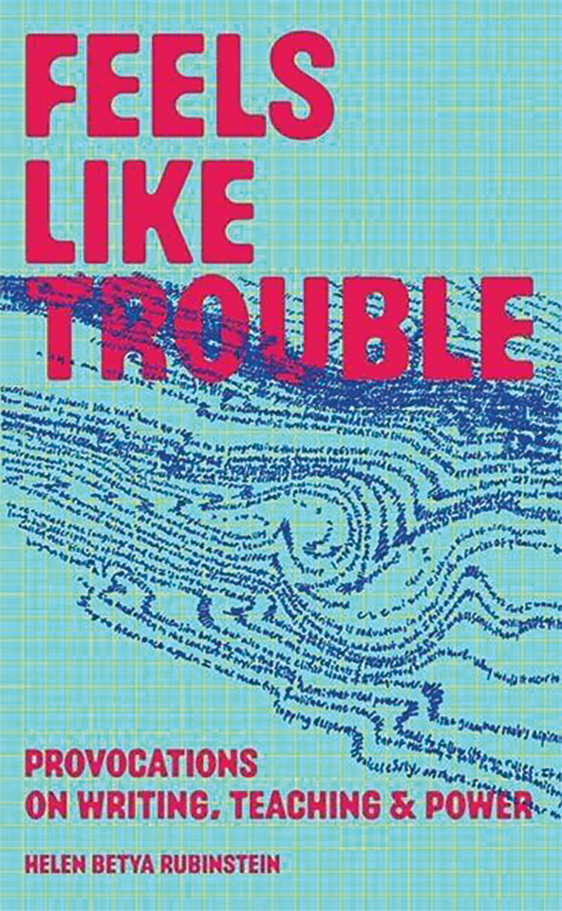
Feels Like Trouble: Provocations on Writing, Teaching & Power (University of New Orleans Press, October 2026) by Helen Betya Rubinstein
Building on her article published in these pages in 2018, “Practice Imagining Change: A Workshop Manifesto,” Rubinstein interrogates the notion of “good writing” in this collection of essays that mixes personal narrative with practical advice. By drawing on experiences in classrooms and coaching sessions as well as with publishers, Feels Like Trouble offers a vision of literary culture in which aesthetics and ethics are more thoughtfully intertwined. “‘Is it good?’ is a fixation that distracts us from what literature does and what it could do,” she writes in a note shared by the publisher. “I wrote Feels Like Trouble for anyone who has had this question...lodged in their mind, such that it resurfaces every time they pick up a book or a pen. In these essays, I hope to show how else we might read, write, teach writing, and talk about writing—how much becomes possible when we identify our own values and begin to approach writing as a gift for someone else.”
Thumbnail credit: Lan Gao via Unsplash