
Nearly a year after Hurricane Helene devastated the mountains of western North Carolina with unprecedented wind and rainfall in late September 2024, a group of conservationists donned wet suits and entered the South Toe River in search of the eastern hellbender, an aquatic salamander that grows up to thirty inches in length and spends most of its life under the shelter of large, flat rocks. The hellbender breathes through its skin and thus requires clear, oxygen-rich water. Because it’s an indicator species, the hellbender’s presence signifies a healthy ecosystem. Its environment is compromised by dirt, minerals, and sediment that enter the water from development, tree cutting, gravel mining, and the catastrophic effects of events like Helene. Though there were once 626 populations of hellbenders across fifteen states, from Mississippi to New York, there are now only 371, with 59 percent of those declining. So when these conservationists found two hellbenders in the South Toe’s cool waters, the response was pure joy. “Seeing them is a sign of hope—that things might return to what they were,” says Nickole Brown, executive director and president of the Hellbender Gathering of Poets, which takes its name from the salamander.
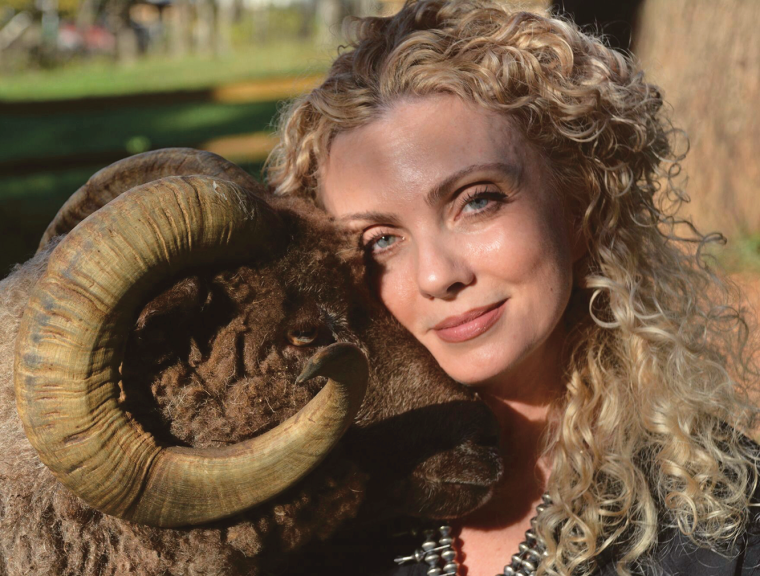
Nickole Brown, Hellbender executive director and president.
(Credit: Donald Schuster)The mission of the Hellbender Gathering of Poets is “to nurture a community hell-bent on finding the words that protect and repair our climate-changed world.” The gathering has metamorphosed from the Palm Beach Poetry Festival, which was founded by Miles Coon and held in Delray Beach, Florida, from 2005 until 2021. Coon appointed Brown, a longtime participant of the festival, as his successor before he died in 2022. “I want to hold fast to the feeling that the Palm Beach Poetry Festival created, which was always one of rigor and loving-kindness,” Brown says. “And it was all in service to poetry—the appreciation of poetry, the power of poetry. That is the core of Hellbender, because that is the good soil from which we sprung.”
Having since relocated to North Carolina, where Brown resides, the Hellbender Gathering of Poets will host its inaugural gathering this year from October 5 to October 11, at the YMCA Blue Ridge Assembly in Black Mountain. “None of us are far from the effects of environmental catastrophe, and the meeting site for the first Hellbender Gathering of Poets will remind us of this truth,” says poetry faculty member Camille T. Dungy. Poetry workshops, led by David Baker, Dungy, Jane Hirshfield, and Tim Seibles, will be complemented by guided “awe walks” led by ecologists Laura Boggess and Luke Cannon. Featured guest David George Haskell, author of How Flowers Made Our World (Viking, 2026), will offer a reading and book signing. Participants will attend craft talks, readings, and book signings by faculty; be invited to a ceremonial planting of an American chestnut tree, provided by the American Chestnut Foundation; and have opportunities to write and share their work. S’mores around a bonfire and a midweek dance party will foster community and celebration.
While the focus of the gathering is environmental poetry, Brown notes that there are no restrictions on subject matter. Those who do not consider themselves nature writers are welcome to treat the gathering as an entry point to writing about our shared environmental concerns. “What’s happening is happening to all of us. It doesn’t matter where you live—no matter how urban or rural you may be. It doesn’t matter how well informed you may or may not be in terms of being able to identify species or to understand the science,” Brown says. The gathering will give participants “the tools—and the permission—they might need to begin to articulate and bear witness.” The inaugural gathering will take place after a yearlong delay due to Hurricane Helene’s impact on the region. “That the gathering’s original first year was delayed by a hurricane is a grievous proof of how indispensably needed it is to unite scientific facts, natural history’s close observation and affection, and our human feelings,” says Hirshfield.
Applications for the inaugural gathering will be accepted until May 11 or until all seats are filled. Some financial assistance will be available, including a limited number of need-based scholarships of up to $500. The gathering will also offer the Miles Coon Fellowship for a poet of sixty years or older who has not yet published a full-length book, in honor of Coon’s dedication to the world of poetry—through the completion of his MFA and founding of the Palm Beach Poetry Festival—in his sixties.
Mud devil, lasagna lizard, snot otter, the last dragon—if there’s anything the eastern hellbender’s colorful nicknames tell us, it’s that language is a playful and powerful tool for articulating our relationships to the nonhuman world. “Poetry asks us to think more carefully, to feel our lives—and our relationship to life—more deeply, more accurately,” says Seibles. “If we are committed to saving ourselves and our besieged planet, I believe that the emotive force and intellectual precision found in poetry are desperately needed right now.”
Jenna Gersie is an environmental humanities scholar and writer living in Boulder, Colorado.