April 25 will mark the thirteenth annual Independent Bookstore Day (or Indie Bookstore Day), a celebration of independent bookstores, booksellers, and their communities that was launched in 2013 as California Bookstore Day by writer and editor Samantha Schoech, and went national in 2014. Events have included regional bookstore crawls, indie bookstore passports—where participants get stamps and prizes from multiple participating stores in an area—author signings and readings, live music, scavenger hunts, arts and crafts, barbecues, exclusive merchandise, face painting, contests, raffles, and readathons.
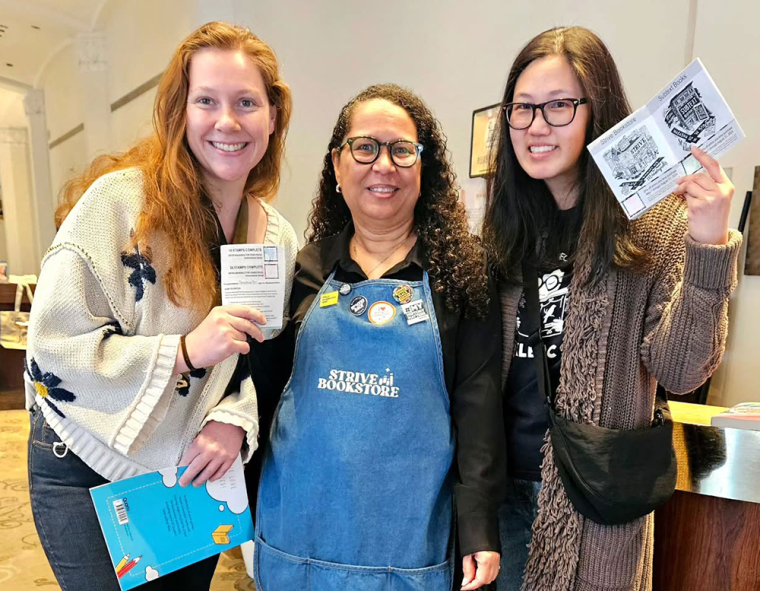
Mary Taris (center), owner of Strive Bookstore in Minneapolis, celebrates Independent Bookstore Day 2024 with two customers. (Credit: Dusty Dembley Design)
Last year Indie Bookstore Day (IBD) brought something unexpected—a clash with Amazon, which held a last-minute major book sale that “unintentionally overlapped” with the annual event on the last Saturday of April (Amazon’s inaugural book sale in 2024 was held in May). Outrage from independent booksellers and their advocates about the overlapping events led to consumer backlash and the best sales day in history for many of the more than sixteen hundred stores that participated in the event. “Many shoppers who hadn’t planned to visit a bookstore said they came out specifically to support their local bookshop and protest what they saw as Amazon’s stepping on the indies. We’re seeing this broader trend of people aligning purchases with personal values,” says Allison Hill, CEO of the American Booksellers Association (ABA), a national trade organization supporting independent bookstores.
As of 2020, Amazon controlled over 50 percent of the print book market and more than 80 percent of the e-book market. Amazon also owns Audible, the dominant audiobook retailer. Several companies, including Bookshop.org and Libro.fm, have emerged to support local indie bookstores in the fight against the behemoth online retailer.
“When we found out Amazon was pushing a deep-discount book sale on Indie Bookstore Day [last year], we sprung into action, reaching out to media and mobilizing our community to spark a backlash. It worked,” says Andy Hunter, CEO of Bookshop.org. “Our sales spiked 340 percent that day, major media outlets covered the story, and some bookstores’ reported sales were 50 percent above last year’s Independent Bookstore Day.” The online print and e-book retailer, of which ABA is a shareholder, currently has twenty-five hundred member bookstores. About five hundred stores use the site for all their online sales. “Our market research says 78 percent of Bookshop.org customers used to shop at Amazon,” Hunter says. “We’ve helped grow online sales for indies by over 600 percent since 2019.” Hunter clarifies that this spike in online retail hasn’t come at the cost of brick-and-mortar stores: “Over five hundred new bookstores have opened since we launched.” Though industry-wide book sales have not consistently trended up, the number of independent bookstores continues to increase, with a focus on genre bookstores and stores championing diversity.
Hunter and Hill are hopeful that last year’s enthusiasm for conscious consumption will make IBD 2026 the biggest yet—Bookshop.org’s plans include guerrilla marketing strategies, and the ABA’s 2026 Indie Bookstore Ambassador is LeVar Burton.
For booksellers themselves, 2025’s buzzy anti-Amazon sentiment didn’t motivate them to drastically change course for 2026. Amazon’s size and market share have many focusing on what indies offer that the tech giant does not: community. “We focus on our strengths—immediate gratification, a superior browsing experience, fun and enlightening events, community ties, personal service from a book-loving human,” says San Francisco–based Green Apple Books co-owner Pete Mulvihill.
Independent bookstores invest in their community and in creating community spaces—efforts that cost money. “It’s not always enough just to tell people to shop small. If you’re spending money, where is that money going? Is it going back to your community, or is it going into a billionaire’s pocket? We’re able to host events because of the support from our community,” says Katherine Morgan, owner of Grand Gesture Books, a romance bookstore in Portland, Oregon. Her shop has hosted (and financed) everything from author events to movie nights to a free all-day wedding ceremony with the Marion County court for eight couples. She reinvests money in her local community for many of these events and has partnered with a nearby cupcake store, brewery, and library branch.
But on the matter of price, Morgan acknowledges that indies cannot compete. To those who say it’s easier to shop on Amazon, especially in the midst of an affordability crisis, she says she understands. “But when the landscape of your city or your neighborhood changes, when the coffee shop you want to go to is no longer there, the question is: Did you go to it? [Or] did you go to Starbucks?” According to Morgan, “You have to weigh everything.”
Rain Taxi Review of Books, a literary organization and publication based in Minneapolis, organizes the Twin Cities Book Festival. Rain Taxi has been the logical place from which to run an Independent Bookstore Day initiative for the area, says editor and executive director Eric Lorberer. The organization leveraged its existing relationships with bookstores to create the Twin Cities Independent Bookstore Passport, which included thirty-seven participating bookstores in the area in 2025. Participants could get their passports stamped for unique coupons and prizes over several days around IBD. Rain Taxi also hosts a Twin Cities Literary Calendar, which lists book events in the area. Lorberer sees these efforts as mutually beneficial for Rain Taxi and local indie shops. “We want to see bookstores thrive because that’s our readership,” he says.
Amazon has declined to make promises to avoid overlap with IBD in the future, but indie bookstores and their supporters remind readers that supporting small businesses can be most impactful at the local level. “Every community is going to organize differently,” Lorberer says. “Small and specific can be of greater use and of greater pleasure than large and monolithic, a contrast to big tech.”
Priscilla Wu is a writer, editor, and communications and marketing professional based in Portland, Oregon.