In May the Commonwealth Foundation announced the selection of five regional winners for its Short Story Prize and shortly thereafter faced major backlash when one of the awardees, “The Serpent in the Grove” by Jamir Nazir, was believed by many online readers to be created in large part using generative AI (GAI). Readers pointed out that the story featured several of the elaborate anaphora and “not X but Y” synthetic tells that AI-generated text tends to demonstrate, as well as detached, vague descriptions that often made little sense logically. In late June the Commonwealth Foundation announced that its review concluded the story had not been created with AI. Nevertheless, a far more pressing issue than the stylistic criticism remained: the erosion of trust in authors. How can readers know for certain who has written any given story and whether that person used GAI to do so?
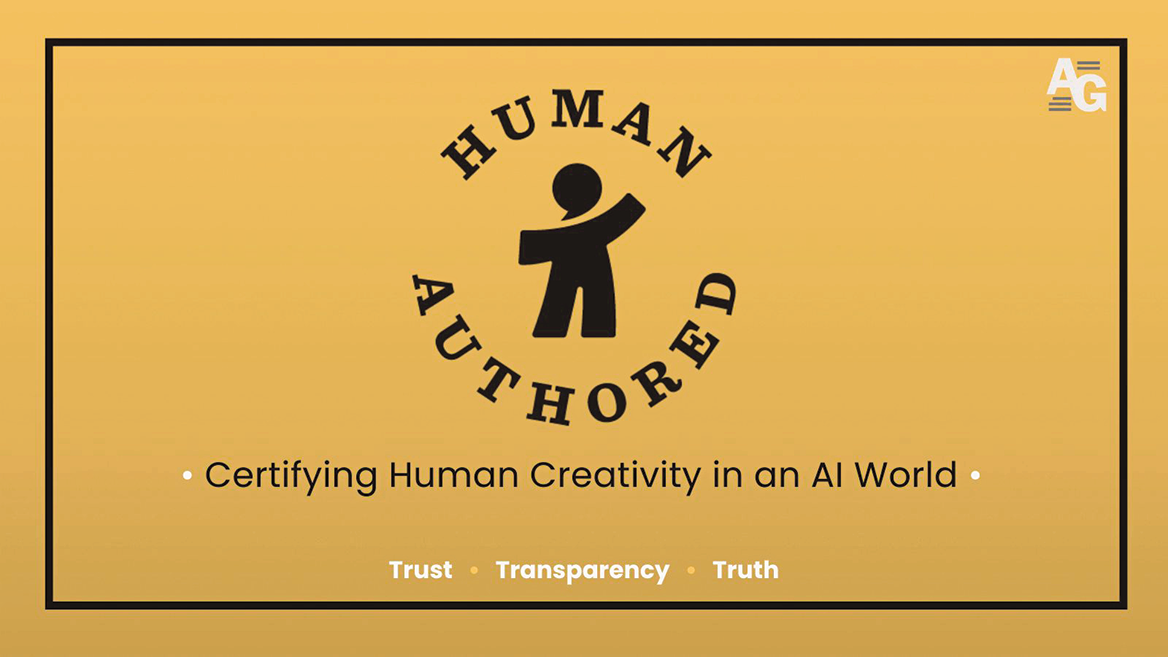
The Authors Guild designed the Human Authored Certification Mark, which consists of a label with the words “Human Authored” around a silhouette of a person as well as a registration number, to combat this erosion of trust emerging between the author named on the page and readers.
According to the Guild’s definition, “‘Human Authored’ means that the text of the work was fully authored by one or more human beings and not generated by GAI, except that a de minimis ([i.e.,] very small or trifling) amount of text may be generated or modified by or with the use of GAI, e.g., through the use of GAI-powered spelling and grammar check applications or to create indices.”
To obtain a certification, authors must have their own identity verified through a third-party verification system (the Authors Guild uses Veriff). Then they can register their work on a title-by-title basis. Non-Guild members must pay $10 per title to obtain a certification mark; Guild members can register their books for free.
Since the Human Authored Certification Mark’s beta launch in January 2025, it has been adopted by over six thousand writers. The Authors Guild is working with traditional publishers to print the mark on the covers of certified titles, and the mark is popular among self-published writers, particularly amid the rise of Kindle Unlimited self-publishing. “The number of books posted on Amazon has tripled since the introduction of ChatGPT,” says Mary Rasenberger, the CEO of the Authors Guild. “There are millions of books. So it’s really easy to buy an AI-generated book on Amazon by mistake that might sound good but not have an original thought in there.”
Nina Beguš, a researcher in artificial humanities at the University of California in Berkeley and the editor of First Encounters With AI: Writers on Writing (University of Michigan Press, 2026), sees this certification mark as “a long-expected and necessary step in establishing authorial trust and transparency.” This development, she says, “marks a generational change in how authors and readers engage with text.”
Still, the Authors Guild certification relies on an honor code. Perhaps this is a necessity, at least for the time being, since AI detection technology that can be considered foolproof has proved to be elusive. (Pangram, GPTZero, Originality.ai, and others have been demonstrated to be unreliable and to disagree with one another.) And, of course, books without a certification aren’t necessarily non–human authored, since no author is required to opt in.
In the meantime the language around AI best practices continues to evolve. The Authors Guild’s original recommendations, released in February 2024, stipulated that authors need not “disclose use of generative AI tools like grammar check or when it is employed merely as a tool for brainstorming, idea generation, researching, or for copyediting.” However, Umair Kazi, the Authors Guild’s director of policy and advocacy, says that the council soon realized “brainstorming” could be construed very differently from writer to writer, and in May the Guild revised the language in both the certification requirements and the best practices guidelines. Now the certification mark does not apply to books in which the authors have used AI for brainstorming and research beyond simple background information.
Of course, authors have always had assistance. “No one writes alone,” Beguš says. “Translators, editors, ghostwriters, writing groups, [and] workshops have always done the writing work in the background. This idea of a writer chained to a desk, observing and digesting the world onto a written page, obscures the fact that we are a collective and relational species.” But never before have people attempted to pass off machine-generated text as the product of a human brain.
Jamie Metzl, a technology futurist, names GPT-5 as his coauthor on the cover of The AI Ten Commandments: A New Moral Code for Humanity, which he self-published in April. “I’m a huge believer in radical honesty,” Metzl says. “The only choice was to have GPT-5 as a named author.” When the traditional publishers Metzl had previously worked with rejected the idea of putting ChatGPT on the cover, he founded Transcend Books to publish The AI Ten Commandments himself.
Metzl and Beguš both believe that much of the public’s reaction to AI comes from a place of fear, paranoia, and distrust. For Beguš, the issues run much deeper than labeling a title as human- or AI-created. “An overwhelming majority of people are affected by AI but are not a part of the conversations about it,” she says. “We need a richer vocabulary—we can start with AI-assisted, AI-generated, AI-edited, AI-translated—and a more nuanced approach.”
Helen Betya Rubinstein, professor, writing coach, and author of the forthcoming essay collection Feels Like Trouble: Provocations on Writing, Teaching & Power (University of New Orleans Press, 2026), is more skeptical of the Human Authored Certification Mark: “I don’t imagine that a mark could be created that AI couldn’t replicate on its own,” she says. Jane Friedman, author of The Business of Being a Writer (University of Chicago Press, 2018), has similar worries about the certification mark, noting in a blog post: “As AI tools become more sophisticated, I’m not sure how much any certification will hold up under scrutiny.”
Rasenberger, on the other hand, emphasizes that the certification is an enforceable trademark and that authors receive a registration number with each title. Even as AI continues to evolve, Rasenberger has observed readers are just as averse to generative AI authorship as many writers are. “Readers vastly prefer to read what humans have written,” she says. “They want to connect to the human being behind the story.”
Adrienne Raphel is the author of Our Dark Academia (Rescue Press, 2022), Thinking Inside the Box: Adventures With Crosswords and the Puzzling People Who Can’t Live Without Them (Penguin Press, 2020), and What Was It For (Rescue Press, 2017). She teaches at Baruch College and lives in Brooklyn, New York.