On September 24, 2021, Rachel Eliza Griffiths and Salman Rushdie were married, though the absence of poet Kamilah Aisha Moon, the bride’s closest friend who was to read an original poem for the occasion, cast a pall over what should have been a glorious moment. Some of the guests already knew that Moon had died unexpectedly that morning, alone at her home in Atlanta, but kept silent. After the ceremony, Griffiths found out via incoming text messages. Not quite eleven months later, Rushdie was nearly killed in a brutal stabbing at the Chautauqua Institute in New York state. The convergence of those two life-changing traumas is the subject of Griffiths’s memoir, The Flower Bearers, out from Random House, a story of searing grief and hard-fought survival that the author quietly summarized during a recent conversation. “My life is altered; it is not what it once was,” she says.
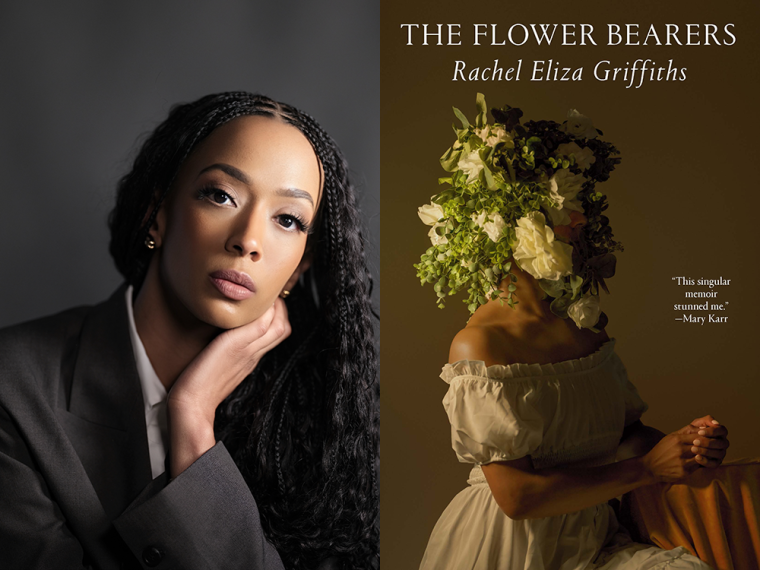
Rachel Eliza Griffiths, author of the memoir The Flower Bearers. (Credit: Rachel Eliza Griffiths)
Griffiths is recognized as a gifted multi-media artist, poet, and novelist. Her most recent and fifth collection of poetry and photography is Seeing the Body (Norton, 2020), which won the Hurston/Wright Foundation Legacy Award in Poetry as well as the Paterson Poetry Prize and was nominated for a NAACP Image Award. Her debut novel, Promise (Random House, 2023) was described by Kirkus Reviews as “a stunning and evocative portrait of love, pride, and survival.” She has been featured in a wide range of publications including the New Yorker, the New York Times, Callaloo, the Paris Review, and Best American Poetry (in 2020 and 2021) and has received prestigious fellowships from Cave Canem, the Robert Rauschenberg Foundation, and Yaddo, among others. This past November she was awarded a residency at the Merwin Conservancy in Maui.
Griffiths draws and builds strength from community, enjoying the company of her artistic peers and eagerly celebrating them. In 2012 she began a video series called P.O.P (Poets on Poetry) which was then released on the Academy of American Poets website. Featuring more than eighty writers, the series highlights contemporary American poets who read both an original poem and a work by another poet, reflect on their choice, and then respond to a question offered by a previous participant. In her essay on the project, “Poets on Poetry: A Virtual Village of Discovery and Poetics,” Griffiths calls the collective a “complex and dynamic conversation” that explores her view of technology as “an instrument that serves the endowment of [her] imagination.”
Another community that inspires Griffiths as she continues to rebuild herself after the double trauma are her literary ancestors. In The Flower Bearers she writes about, among others, Toni Morrison, Toni Cade Bambara, and, perhaps most reverently, Lucille Clifton. Clifton’s poem, “won’t you celebrate with me” resonates throughout the memoir: “what did i see to be except myself?” Griffiths writes about a time of despair when she was “half dead, waiting to be called back to life.” While researching at Emory University, she encounters a folder of Clifton’s automatic, or spirit, writings and in a moment alive with breath, she realizes, “I’m not dead because I can feel Clifton’s handwriting with my fingertips. Each sheet of paper carries the urgency of a Black woman investigating her life.” Former U.S. Poet Laureate Tracy K. Smith appreciates Griffiths’s understanding of the presence of the past in the life of artists: “Like Eliza, I believe that our departed beloveds and ancestors accompany us, willing to reach and teach us even from across the mortal divide. Art is creation, formulation, craft, and revision. It is also—when we allow it to be—a form of collaboration with the large intelligence of the universe.”
Nicholas Boggs, author of Baldwin: A Love Story (Farrar, Straus and Giroux, 2025), praises the memoir for its “incandescent language” and places it in the vein of Patti Smith’s Just Kids (Ecco, 2010) in its description of “the wonder and awe of the making of a young artist in New York City.” Even more specifically, he sees it as a “portrait of the artist as a young Black woman that we’ve never really seen before—the closest may be Audre Lorde’s Zami: A New Spelling of My Name” and predicts it will become “a Black feminist classic.”
In the meantime, as The Flower Bearers makes its way into the world, this personal story gains a public face. In fact, Griffiths commented that she never intended to write a memoir but felt she had no choice. When asked if writers do not always have choices, Jacqueline Woodson, author of the acclaimed adolescent memoir-in-verse Brown Girl Dreaming (Nancy Paulsen Books, 2014), points out that the inciting incident for memoir “is something that happens to you, that you’ve already sat with for a long time and haven’t been able to shake or figure out.” A memoir, Woodson says, “is blood and bones without a layer of skin.” The Flower Bearers has that raw vulnerability, a howl of grief, but with a strength and resolve that affirms the bonds of friendship and love that can carry us through—and beyond. The following conversation took place last November and December over Zoom and e-mail.
You have previously commented on public versus private mourning. In The Flower Bearers, you recall Kamilah Aisha Moon warning you that involvement with Salman Rushdie likely means “that thing called privacy you love so much is about to fly out the window.” But that didn’t stop you from marrying him. Now you will be publicly reading about intensely personal experiences. What made you willing to be so vulnerable?
This is a question that finds me every day. I don’t think I could have done anything else but write this book. I tried to continue on a creative path, but this was the elephant in the room. I needed to have this time in my life on record for myself. I’m writing for Aisha, I’m writing for Salman, but I’m also writing for that inner child I speak about in the memoir—this young child that I’m taking care of very well now.
I do love my privacy, and in some ways I still have it, but the definition has expanded. I think being vulnerable can be a way to offer something to others because I know I’m not the only one who has endured trauma; it’s powerful to hold space with them as readers but then to ask them to share space with me. Even as I am sitting here speaking to you, the person who I was in the memoir is healing and is no longer the same. As an artist I have to take risks in order to protect the woman who endured and survived these things. One way is to write the story and accept different parts of the story that are complicated and tragic but also really beautiful and filled with love. Love is the foundation of how I decided to go forward and write the memoir—love for my husband, love for my closest friend—and let that illuminate what felt so dark and incomprehensible.
I’d like to ask you about the three opening quotes. From Moon: “No matter / how it may appear, / I’m not rootless.” From Toni Morrison’s Sula: “I don’t want to make somebody else. I want to make myself.” And from Tina Turner: “I deserve more.” Do you intend them as separate thoughts, or is there a synergy among these women who’ve been so important to you?
It’s both. One is someone I knew and whose poetry, life, kindness, and generosity directly impacted me. I write in the memoir about how Aisha and I are rooted like trees and we share a kind of ecosystem that supports us and allows us to grow. Tina Turner is [part of] one of my earliest memories growing up. My father was a huge fan so we had her on vinyl—the voice of a woman who endured a lot of hard things but found a kind of peace and inner strength and grace within herself. In that one sentence there’s so much dimension. I knew Morrison as an author but earlier on as a reader when I found her books on my mother’s bookshelf. I could go to Morrison’s novels to find out the things my mother could never tell me, wouldn’t dare tell me. I wanted to do what Morrison was doing, but I wanted to do it as Rachel Eliza. What I didn’t include in the memoir, and this is kind of a privacy thing, is that when I first met her and gave her one of my books, Morrison asked me to write down where she could reach me. It didn’t register in that moment that she would ever respond. When I received a beautiful letter from her, the entire borough of Brooklyn probably heard me screaming at the top of my lungs. That she did respond helped me at that moment to keep going. Each of these women stands in my circle in a kind of village that I draw on for strength but also beauty and wonder and fun. They’re all very personal to me, even that triangulation interests me.
Moon passed away in 2021, your husband was attacked in 2022, the memoir is coming out in early 2026, so this was about three years in the making. You write, “Gathered here as I attempt to write a chronological narrative, these pieces are incoherent fragments, which I still can’t fully access within my mind on my own.” You also describe “repetitive blackouts.” How did you remember and reconstruct all that happened?
When Salman was in the trauma ward, there was a bench window that was my bed, but I could not fully extend or turn over, so I couldn’t sleep. Most of those nights from midnight until the sun came up, I kept a journal. I was writing down everything, including notes about medication and what the doctors were saying. If you’ve read Knife [by Rushdie], you know I had my camera, so I could go back and look. I can still close my eyes and hear how the air sounds in my head in the way that trauma can both sharpen and blur memory. So there were ways to access description and information.
When it came to remembering and recalling what happened with Aisha, I had to depend upon dear friends who could sit with me [and tell me] what happened. Some wrote letters and said this is what I remember. As I wrote, after the wedding portraits ended, the bottom fell out of the entire day. Because of the traumatic response I had—the shock that exploded like shrapnel—I had to ask friends. It was interesting to have friends and family, including Salman, share their experience of the day from multiple perspectives. So I had this kaleidoscope of different details. For over a year I worked hard with EMDR [Eye Movement Desensitization and Reprocessing], which has allowed me to get back into certain parts of my head, not to remember everything, just more of the immediate moment.
What is EMDR?
It’s a technique that’s used with bilateral stimulation for people who’ve undergone trauma, like first responders and veterans. It was recommended to me by several people, and I decided to try it. I basically either hold two buzzers in my hands or there is a bar of light. It doesn’t fool your brain, but it allows you to go under the supervision of a professional to try to get memories back so that you can understand what happened and not feel so fractured. Google will probably tell you more clearly. I have really been focused [on this technique] for the past year or so, and it’s been elemental. Still, one of the things I admit in the memoir is that I don’t know all of the details.
So with these slivers and shards I have to show up as an artist and construct a pace, a narrative arc. That was actually a gorgeous space for me to be in because after going through these two events, I didn’t know if I would ever write again. I certainly couldn’t write poetry. For a while, I couldn’t even read. But then I thought, how could I keep that energy and my ambivalence about writing [about the traumas] in the actual text itself? At times it felt as though I was pulling organs out of my body and trying to name them and put them back in to build a body—to rebuild myself, which is what I was trying to do.
These two events within months of each other destroyed me. You have to let your body come back, take time for yourself, get a lot of help, find resources to think about an altered life. There was grief not only for the loss of Aisha and the way that Salman was attacked, but also, I had not even recovered from losing her by the time the attack happened, so whoever I was by then, there wasn’t much left. After the attack there was nothing. Or at least it felt that way.
At the same time, I could feel Aisha and my mother. My mother had been sick [with kidney disease] for most of my life, and it helped me after the attack knowing how to be in a hospital, how to be an advocate, how to compartmentalize a lot of trauma so I could breathe and take care of my husband. The grief for Aisha had to be delayed and postponed because I could not bear to think about that while I was in a trauma ward with Salman trying to survive.
I just finished the audiobook this week, and I have to say that reading every single sentence in this book I thought, What a woman, how did she get through this? I have to show up for her, and that’s why I have to speak, it’s why I have to say who I love and also be grateful that there’s something in me that could come out of this and still want to have compassion for others. It makes me think of the James Baldwin quote, “You think your pain and your heartbreak are unprecedented in the history of the world, but then you read.”
You’ve described your extraordinary bond with Moon as “our seventeen years of sisterhood, love, and growth” that began during such a formative time: two young women—“broke, Black, and brilliant”—striving to find their identities as poets, as artists. Yet you write, “I’d never had a friendship where I allowed myself a future,” because you did not expect to live very long. How did she change or dismantle that shadow you carried?
She offered this space to expand that was nonjudgmental, uncritical—unconditional trust, and love and care for each other. I remember saying, almost involuntarily, “When we’re eighty…” and I later thought, I’ve never said that before; I never talked about when I would be eighty. I was frightened that I would inherit my mother’s illness—that’s a child who sees her mother suffer and thinks she’s going to get sick too. Then, [given] my depression, anxiety, and suicidal energy, I thought one of those will take me out of this world early. This is what I once believed. I do not believe that now.
Aisha was the kind of friend I always wanted to be around and hear what she was going to say next, see what our next adventure would be, and that diverted me from some of the other stories I’d made up about how and when I was going to die because, I thought, We’re having a good time—I can’t go anywhere. We wanted to become the elders. From very early on we would say, “This is for the archive,” because we thought maybe one day someone might be curious about what it takes, what our experience was to become what we dreamed of becoming. She gave me hope that there was actually a new story, and I wouldn’t be lonely because she was going to be there. I have to say that even though she isn’t here in the way I want her to be, she is here, she is in the archive. When I went to Emory and Spellman [to do research] she was there, an ancestor now. I feel grateful that she helps me to construct and reinvent and reimagine possibilities for myself, to give myself permission to do, be, or think something different from the expectations or assumptions I’ve made about what I deserve, who I was, what would happen to me.
Rachel Eliza Griffiths and Kamilah Aisha Moon at Cave Canem’s tenth-anniversary celebration in New York City, 2006. (Courtesy of Rachel Eliza Griffiths.)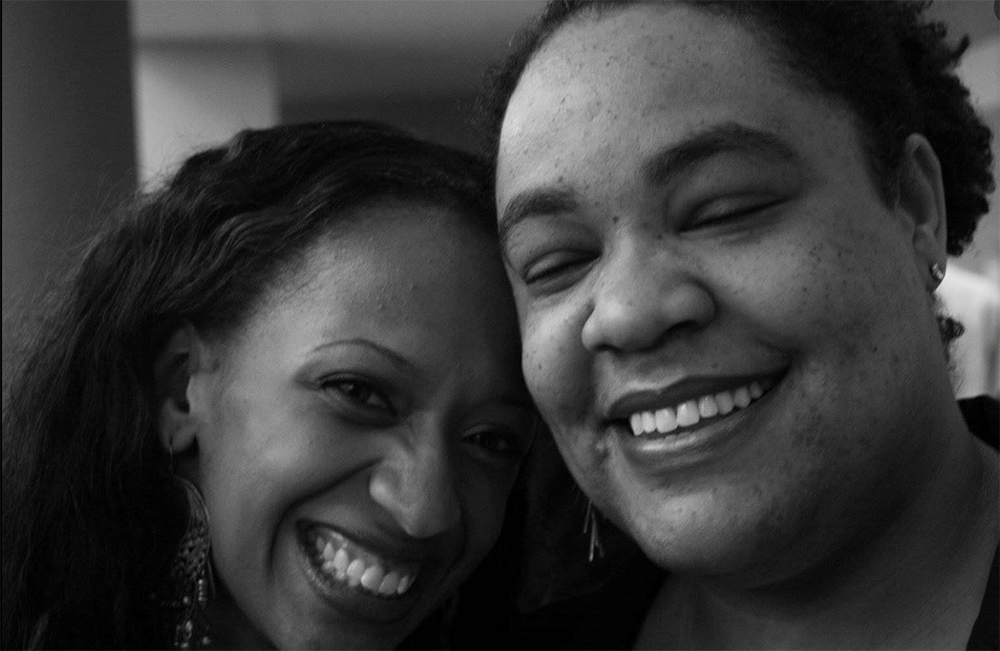
In the context of the beginning of the Black Lives Matter movement, you wrote, “Aisha and I tried to arm our lives with the kinds of love that could not be sold, drowned, shot, hung, drunk, burned, broken, fucked, injected, erased, kidnapped, massacred, commodified, castrated, smoked, sterilized, or stolen.” What was there about your friendship that could be a bulwark against such violence and dehumanization?
The things that raised us—the histories and memories that we both carried—poured into the relationship. We’d both been raised as young girls, eldest daughters, big sisters, confidants to our mothers. But we were also witnesses to American history, knowing that we could align ourselves in a way to resist, defend, and protect a space of love and care and culture. Our heroes like Lucille Clifton, Sonia Sanchez, June Jordan, Toni Morrison, Audre Lorde, Adrienne Rich, Sharon Olds gave us a map. There’s a point where you’re on the scaffolding of your elders and ancestors, but you also have to build the structure that is inside that scaffolding—that is who you are, your identity. Parts of the scaffolding get taken away, removed. We gave each other the scaffolding to build this kind of homeplace, a shelter together. It mattered to us to witness, not to look away. All of those things in that passage you just read are still happening. We were committed to trying to understand freedom in a personal way but also in a way that is particular to the lives of Black people, Black families. For all of these reasons, I could not leave out of the memoir that we were quite committed to thinking beyond ourselves and beyond our literary selves.
Do you mind my asking what Moon was supposed to read at your wedding?
She was supposed to read a new poem that she had written with another dear sister. It was [inspired by] multiple love poems and poems that I love. I have it. The other friend showed it to me in the Google doc where I could see the collaboration. It’s not in the memoir; it’s for me to have. I’ve looked at it a few times, but then I had to put it away. It’s unbearable to think this was maybe one of the last things she did.
The cover image of The Flower Bearers is stunning—and I understand that it is a self-portrait of you. How did you decide on this image and the title?
For a long time I didn’t have a title. I remember at some point I had a table filled with photographs, letters, cards, Aisha’s books, and things. But one thing that was also on the table was the funeral program. I looked back to find the name of the photographer who did the portrait of Aisha [that is] most widely used—her in a gray turtleneck and black-framed glasses. Just holding the funeral program, looking at it, and remembering that day, I got very quiet. I turned it over and I saw pallbearers and then I saw flower bearers. When I saw the phrase, I thought, What is that? In the Catholic tradition that I was raised in, I had never seen that phrase for funerals; the phrase “flower girls” is usually for weddings. I could remember there were several women who carried the flowers out of the church at Aisha’s funeral to meet the cars that were lined up. They were beautiful. When I began to do research, I stumbled across Zora Neale Hurston’s funeral program, which has been digitized, and saw that nine of her former students were flower bearers. The word “bearers”—to bear witness, to bear grief, to bear children—was kind of amazing. Flowers have been a kind of theme, motif, or emblem in my work for many years, particularly in my visual work. I wouldn’t have even thought of that until I arrived at this title.
The title felt expansive to me: It could hold all the kind of dissonant and disparate parts of this memoir and my identity. I have many memories of taking flowers to visit Baldwin’s grave. I’ve taken other poets and writers to visit Jimmy, and that’s another kind of definition of a flower bearer. So when my friend Ryan and I visited Aisha’s grave, we came to find acceptance, to really understand something that had been missing in both of us. We were the flowers.
The first flower bearer I made as a photographer was during the pandemic, but I didn’t call it a flower bearer; it was just me with flowers wrapped around my head. Some of these images were elegiac, some made from anger that I couldn’t get to attend funerals of those who had died. It’s weird that I was already making those images before I found the language for them. Now I’ve made a whole series of about thirty flower bearers, self-portraits where I praise, elegize, and express care for the ways in which various Black women’s lives, writings, practices, and imaginations have expanded and challenged my own self-awareness and identity. So the flower bearer has moved around this internal map for me literally, spiritually, historically, and culturally. In a way, the phrase itself is a gift from Aisha, though I wish I hadn’t had to write such a book.
In this memoir you reveal your mental health struggles: depression, a suicide attempt in your early twenties, diagnosis of dissociative identity disorder. Would you talk about how you made peace with your “Ferris wheel of selves,” or they with you, befriending your personalities, as you say, until your “luminous selves coexisted”? And how did you come to realize that “the village of women” within you is “not rooted only in pain,” that “the selves who have accompanied [you] all these years need [you] to love and to listen to them” as well?
I am strengthened these days by a mostly harmonious coexistence of my selves. When you’re fighting them or they’re fighting each other, it’s a constant tension that leaves you knotted and entangled within yourself. Sometimes it’s surrendering. When Salman was attacked, I realized there were the things that I could control and the things that were beyond my control. That allowed me to figure out what I am able to do versus what I cannot do. Growing up I had to compartmentalize different identities to survive a lot of situations, so this tribe of girls aged and grew and changed. Judging and criticizing certain aspects of that wasn’t really serving me—everything became heavier and darker. I started to do the deep dive, working with therapists and specialists to understand what I needed to do to have peace. Barring this world being as insane as it is, I have a profound calm most of the time these days. That’s new, and I’m so excited that hopefully I will live long enough to enjoy years and years of what I have. For a long time I was bewildered by these different personalities—embarrassed, ashamed—and it made me anxious around people because if I felt threatened or triggered, I didn’t know what might happen, which girl might present herself. It’s a work in progress. It’s not even a destination; it’s the kind of thing you have to carry and tend to.
I also realized that after these two traumatic events, I could have turned into a ghost or a shell or been hospitalized or medicated out of my mind to deal with what happened. But those girls [within me] said, “Not so fast, that’s not our story; our story is going to be amazing.” I can say, now that I’ve kind of outed myself, I embrace it—I put it out there—and I’m aware that for some people that might be hard to grasp, but that’s not my business.
Throughout the memoir you speak of the desire for a home, which you and Salman found with and for each other, though his attack threatened to shatter that. Did writing the book help to rebuild that refuge—or does home mean something different to you now?
Sitting here having this wonderful conversation with you, I think there’s a way that I have come home internally, after being on the battlefield. I feel as though I’ve rebuilt the roof, put in new windows, put my seashells out. I tend to reframe things so that I’m hopeful but also realistic. One of the words that I never had to think about in a certain kind of way prior to Salman’s attack is security. It means something very different [now] than how I once defined in. But there are things that are constant. As a child, once my mother got sick, I never really took things for granted. I was very serious. I never knew if something was the last thing, which is hard on a child. Right now I’m grateful for the time I do have with him, and we don’t take anything for granted. We both acknowledge that given the age difference we want to focus on the quality of the time we have together, and that is a profound thing to accept. We have a lot of fun.
There’s a complicated thing in the past for me, of being at home but not necessarily feeling I could be my full self even in the space of home. That has been turned on its head. I can be at home with my friendships, with my work, and feel safe enough to take the risks I need to as an artist, but also have the support of a loving and caring marriage. Coming to terms with my mental health is a way that has helped me feel at home. Leaving the trauma ward and returning to this bigger world was really terrifying and different and demanded different ways of and perspectives on existing. I’m still managing that. I think of my beautiful friends as my home, feeling safe with someone you choose. To be able to be at home with another person is a state of being. But you must have it within yourself, too.
One of the most compelling moments in this memoir is the confrontation with your mother when she accuses you of hiding and denying your feelings. She ends with: “But baby, you keep hiding and you’ll see what kind of shitty life that is.” I’m going to use your own words from the book here to ask: Is it fair to describe your journey in The Flower Bearers as that of moving from obedience and playing it safe to becoming “marvelous and dangerous”?
Absolutely, I think that is one of the ways I’m able to accept this book being in the world. I’ve put down shame, put down guilt. Marvelous and dangerous is a wonderful pairing. At this moment that is finally arriving, I’m almost fifty [and I’m] accepting that many things can be true at once, a phrase I’m borrowing from Elizabeth Alexander, who I love and admire, [which] means that you can be both marvelous and dangerous. That’s also true of nature, but for me it’s the kind of dangerous that reminds me of John Lewis’s “good trouble.” It’s good danger, not being comfortable and not being complacent or complicit but being dangerous to those trying to oppress other people and demanding more for yourself and others. So it is really beautiful to come out and take risks and speak. I think of Audre Lorde who wrote about the importance of this speaking up, saying who you are, and not hiding. Aisha and I used to think of ourselves as outlaw women in this way.
Your mother discouraged you from becoming an artist and a writer, yet she was the one who saw the “marvelous and dangerous” artist you could become. That to me is so revelatory.
She was so amazing in that way, the smarts she had, the kind of emotional intelligence she had. As an adult now, I think, Oh my goodness, she had this eldest daughter who wanted to be a writer, an artist. Being born in the 1950s, she wanted to protect her daughter—how is she going to eat, where is she going to live, is she going to find someone who loves her? Putting this [into] context now, I can understand why she was so ambivalent.
I have to tell you that after my mother died I was cleaning out her office; she had this tall bookcase that had doors on it. The last two shelves were filled with my books, newspaper clippings, ephemera. She didn’t tell me that she was proud of me, that she was holding space. She was collecting and gathering these things, so she knew even if she couldn’t have the conversation with me, the evidence was right in front of me. Now I can see, I understand.
The lyrical passage about the flower bearers near the end of the memoir closes with this question: “Do you always give your flowers away, or do you save some flowers for yourself?” Do you give yourself flowers?
I do now. There’s always been this intimacy, this way of coming toward myself by having flowers near me. I learn so much from them. I photograph them all the time. There’s something timeless and bigger than me. When I was younger, I didn’t think I really deserved flowers; sometimes women give and do everything for others before they do nice things for themselves. I’ve since resolved that. I get up early in the morning these days and sit alone with coffee or tea, do some breathing and meditation, and prepare for the day. With flowers nearby, there’s beauty immediately.
Writer and educator Renée H. Shea has contributed extensively to Poets & Writers Magazine, including profiles of Kiran Desai (September/October 2025), Edwidge Danticat (September/October 2024), and Julia Phillips (July/August 2024). A number of her interviews appear in World Literature Today, most recently a conversation with Dinaw Mengestu. She is currently doing a series for the American Book Review on “The Laureates.” She also coauthors English language arts textbooks for Bedford, Freeman & Worth.
EXCERPT
Mentally, I ask Aisha to join me in the library. I want to have the energy of her delicate hands moving across the papers and photographs I touch. I want her wonder to merge with mine. I am searching for a memory of her, of us, and of myself that exists as past, present, and future, somewhere inside the complex language of Black womanhood.
As I eye two carts loaded with simple gray boxes, I sense I’m standing in the center of a map that might guide me away from the cliffs of my grief. My heart quickens as the first box is placed on the broad table before me.
I don’t know what I’m listening for, but the room tilts slightly as I remove a folder with a large selection of Lucille Clifton’s automatic, or spirit, writings.
My hands shake uncontrollably as I run my fingers across the looping waves and frequencies of words, many illegible. Lunar, tidal energy vibrates through me. There is the oceanic cresting of the writing itself, the rising and falling of inner transmissions, brought urgently and confidently to the surface.
The voice of Lucille Clifton circles me like fresh flowers circling the casket I’ve been sitting in for two years. These blossoms, thick with sweetness, rise with their ripe music, pushing at the pine box where I have been, half dead, waiting to be called back to life. I want to come back to life.
Here are flowers on every page, singing.
From The Flower Bearers by Rachel Eliza Griffiths. Copyright © 2026 by Rachel Eliza Griffiths. Reprinted by arrangement with Random House, an imprint of Random House, a division of Penguin Random House LLC. All rights reserved.