In the more than ten years that Aamina Ahmad worked on her first collection, July Sun (Riverhead Books, June 2026), she says that it grew story by story into a “project that was interested in the way contemporary Pakistani society functions, the pressures it exerts on ordinary people, and how people bear those struggles as best they can.” In one piece a woman faces an unwanted pregnancy and a lack of affordable health care, in another a man in a small, conservative village struggles with a romantic indiscretion he witnessed, and in another a man takes his mother-in-law on a pilgrimage after his wife has died. With crisp images and a keen sense of dramatic tension, Ahmad’s stories reveal the quiet heartbreak, fear, and yearning of “ordinary” people, attesting to the moral turmoil that often goes unspoken and unseen.
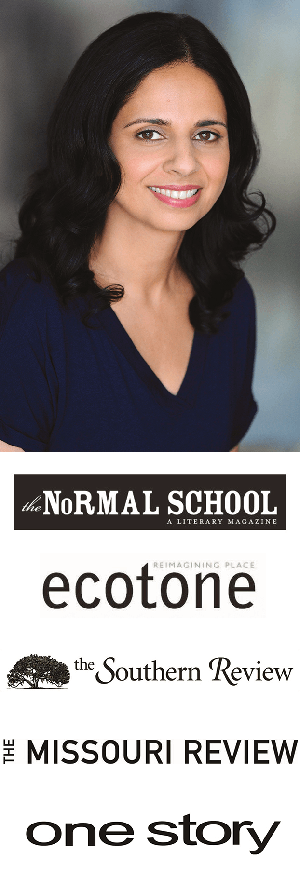
Aamina Ahmad is the author of July Sun (Riverhead Books, June 2026), a debut story collection.
Ahmad placed her story “Punjab,” which follows a lonely bureaucrat dwelling on a romantic encounter with another man, in the online triannual the Normal School. “I was really drawn to the verve and a kind of humor the journal exudes,” says Ahmad, “but I was especially interested in submitting there because at the time Randa Jarrar, whose writing is so potent, so alive, was the fiction editor.” The Normal School, which features poetry, fiction, nonfiction, multimedia texts, interviews, and art, is edited by graduate students at California State University in Fresno. “We dig quirky, boundary-challenging, energetic prose and poetry with innovations in content, form, and focus,” write the editors. Submissions in all genres will open in September.
When Ahmad looked for places to submit, she says, “I wasn’t sure if my work, which is very much located in Pakistan, would fit in any kind of American publication.” She found a few magazines, however, where “the questions [they] seemed to be interrogating felt worldly and expansive.” One such journal was Ecotone, which published her story “The Discarded,” later retitled “Remnants,” about a longtime domestic worker in a wealthy house in Lahore dealing with the arrival of a new worker. The print biannual showcases poetry, fiction, and nonfiction that reimagines place, drawing inspiration from the word ecotone, which refers to the transitional zone between ecological communities. Faculty and students at the MFA program at the University of North Carolina in Wilmington edit Ecotone, which alternates between themed and unthemed issues. One recent issue focused on the moon and included, as editor Anna Lena Phillips Bell wrote, “a minimum of lunar colonization and a maximum of lunar appreciation.” The editors intend to open submissions in August or September, if possible.
As with Ecotone, Ahmad was drawn to the Southern Review in part for its “careful and thoughtful editing process,” which she had heard about from other writers, and in part for the “astonishing variety and diversity of fiction they publish.” In 2019 the print quarterly ran Ahmad’s story “Zarina,” later retitled “Ghee,” alongside stories by Mesha Maren, S. Tremaine Nelson, and Alicia Upano, among others. The review publishes poetry, fiction, and nonfiction in print as well as an online blog highlighting recent contributors. The journal, which was founded in 1935 at Louisiana State University, in its early years featured writers such as Randall Jarrell, Katherine Anne Porter, Wallace Stevens, and cofounder Robert Penn Warren. Submissions in all genres open in September.
“Journals tend to be run by writers and editors who are passionate about writing craft, very widely read, and deeply curious,” says Ahmad. She found such editors at the Missouri Review, a print quarterly of poetry, fiction, nonfiction, and art. In addition to sharing her book’s title story in the review in 2015, Ahmad visited the review’s office at the University of Missouri in Columbia, where she “got a lovely glimpse of the warm literary community [editor Speer Morgan] and his team had created locally and a brief insight into the immense labor and painstaking process that goes into making a beautiful journal.” The review’s team is made up of several staff editors as well as about sixty editorial interns each year, all of them students at the university, who are mentored by the editors. Submissions in all genres are open year-round.
Ahmad cites the “meticulous care” of editors in helping refine her stories, in particular “The Red One Who Rocks,” which was published by One Story. Each monthly issue spotlights a single story by a writer not yet published by One Story in a simple, no-frills chapbook. The editors’ focus on one story at a time aligns with the attention contributors receive—Ahmad describes multiple editors treating every sentence of her story with “incredible attention” and praises editor Patrick Ryan for giving her the “space, time, and support to experiment with [my story’s] ending, to think about the story at a macro level.” One Story has been publishing stories since 2002—including entries from Lauren Groff, Tom Hanks, Min Jin Lee, and Ann Patchett—and also hosts online workshops and lectures. Submissions opened on June 8 and will close after the journal receives two thousand submissions.
Dana Isokawa is the editor in chief of the Margins and a contributing editor of Poets & Writers Magazine.