A few minutes into our conversation, the poet Roger Reeves reveals a surprising detail about Dark Days: Fugitive Essays, his third book and first essay collection, published by Graywolf in August. “I didn’t plan on writing a book,” he says before flashing a knowing smile. “But I’m a writer, and when someone says to you…” He trails off, leaving the rest of the sentence unspoken. As a fellow multi-genre author and member of the hip-hop generation, I know what this kind of silence means. The first rule of the game in any medium, from rap to nonfiction, is to know your skill set and to stay ready, which Reeves absolutely does. During our nearly two-hour talk, he is genial yet astute, tossing out quotes from DJ Khaled alongside references to Giorgio Agamben and Dante’s Inferno with an ease that gives our conversation a casual but invigorating timbre. Chatting with him makes it clear that if you’re in search of an essay collection whose author can traverse topics as disparate as the Outkast song “SpottieOttieDopaliscious” and the Chilean soprano Ayleen Jovita Romero’s defiant rendition of “El derecho de vivir en paz” (“The Right to Live in Peace”), you need look no further than Dark Days.

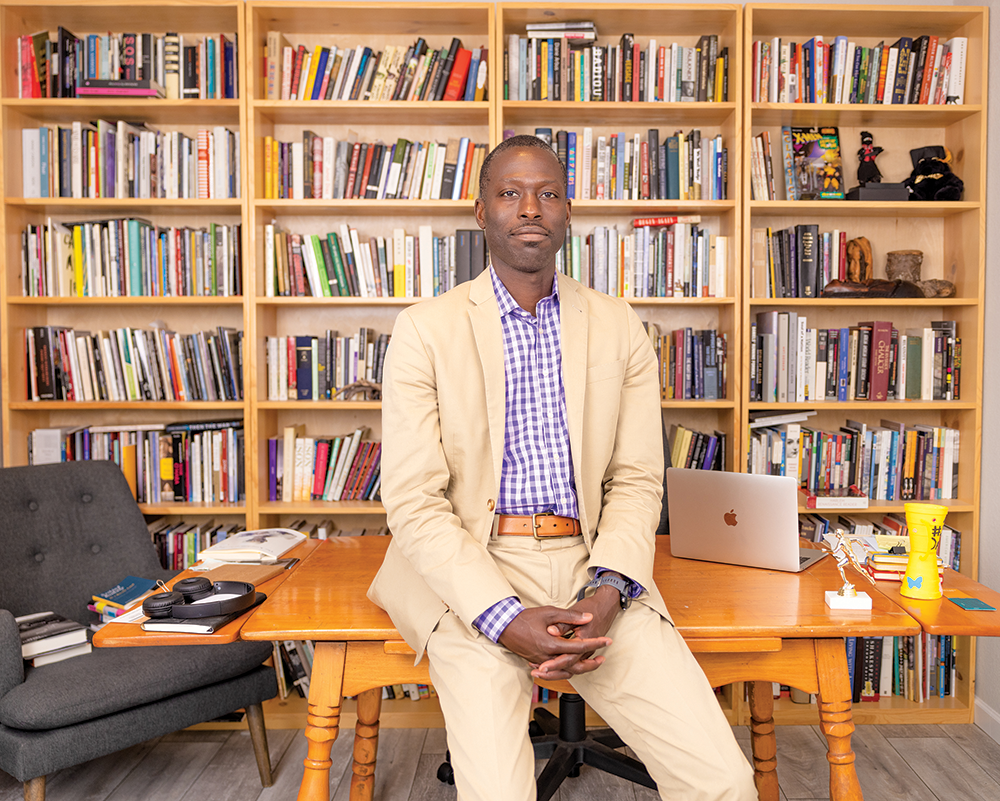
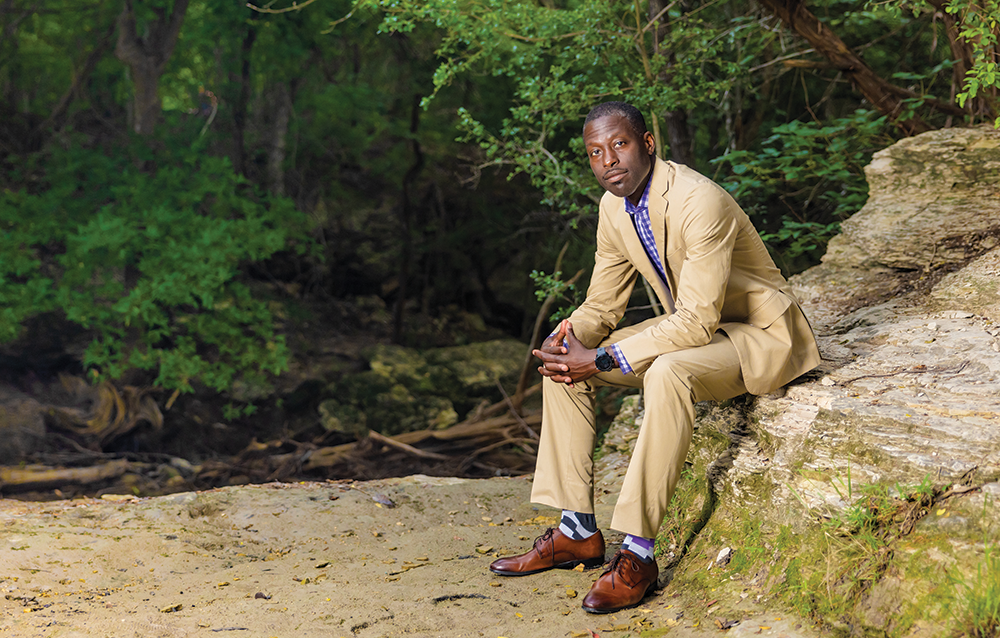
Roger Reeves, author of Dark Days: Fugitive Essays. (Credit: Dharmesh Bhakta)
In 2018 the person looking was Jeff Shotts, an executive editor at Graywolf Press who was in the audience at the Association of Writers & Writing Programs Conference in Tampa, Florida, where Reeves read an essay about the poetry of Solmaz Sharif, herself a Graywolf author. After Reeves’s reading, Shotts approached him, wanting to know if he had any other prose. “I have some ideas!” Reeves recalls telling him with a laugh. In that moment, Dark Days was born.
In 2012, when Reeves finished his PhD in poetry and poetics at the University of Texas at Austin—where he received his MFA at the Michener Center for Writers and where he still teaches, following a stint at the University of Illinois in Chicago—he saw few places in public discourse for the kind of work he was doing in his dissertation: analyzing Black poetry as both intellectual and aesthetic productions with political importance. But by the mid-2010s, nonfiction books like Ta-Nehisi Coates’s Between the World and Me (Spiegel & Grau, 2015) and Ibram X. Kendi’s Stamped From the Beginning: The Definitive History of Racist Ideas in America (Nation Books, 2016) were making waves both within and outside the academy. By then Reeves had made a name for himself as an award-winning poet. His first collection, King Me (Copper Canyon Press, 2013), was a Library Journal Best Poetry Book of the Year and winner of the Larry Levis Reading Prize. Reeves had also been awarded a Ruth Lilly and Dorothy Sargent Rosenberg Fellowship in 2008, a National Endowment for the Arts fellowship in 2013, the prestigious Hodder Fellowship from Princeton University the following year, and a Whiting Award in Poetry a year after that. And even while he continued to write poems, collected most recently in his second book, Best Barbarian (Norton, 2022), winner of the 2023 Griffin Poetry Prize and the 2023 Kingsley Tufts Poetry Award, Reeves took note of the change. “I began to see the essay as a place to enter into public intellectual discourse,” he says. “Even though I think the poem can do everything an essay can do, to some degree, and has as much truth, intellectual rigor, [and] political thought…the essayistic form was saturating America.” So when Shotts threw down the gauntlet, Reeves happily accepted.
Much of the original material in Dark Days included close readings and literary analysis: Discussions of Solmaz Sharif’s poetry and Toni Morrison’s character Sixo from Beloved figured prominently in early drafts. However, when the COVID-19 pandemic hit in early 2020, followed by social unrest in the wake of George Floyd’s murder at the hands of a Minneapolis police officer in May of that year, everything changed. “I decided to take a more personal turn in the essays, which is not something I was at first going to do,” says Reeves. Police violence, which he had both experienced and written about, was now an international conversation, and he found himself asking pertinent life questions, like how much time he and his partner, Mónica Jiménez, should be spending on the streets in protest, and whether they should take their five-year-old daughter, Naima, along with them. There was also the sheer terror of watching Black people die at the hands of vigilante and state violence. In the new book’s lone epistolary essay, “Letters to Michael Brown,” Reeves recounts the psychological toll of living as a Black person in America. One midsummer evening, Reeves finds himself frozen in fear in the driver’s seat of his pickup truck in the heart of Austin, where he now lives. He is afraid to drive home because he knows that, as a Black person, he’s not safe, and the police cruisers that often lurk along his route have his mind racing. “Who is watching?” Reeves asks Brown—the eighteen-year-old who was shot and killed by a police officer in Ferguson, Missouri, in 2014—and in turn us, his readers. “Who is preparing to kill me in the name and under the auspices of the nation? I simply want to get home and be with my daughter—without incident.”
Those were dark days indeed, but Reeves also found himself turning to James Baldwin, whose work was a balm and convinced Reeves that his own lived experiences had a place in the book. “I was reading Baldwin over and over again and thinking, ‘Oh, no, no, no, no. We can do both. We can do the critical reading while we’re also doing the personal narrative,’” he recalls.
As a result, Dark Days has a rhizomatic yet mosaic feel. It begins and ends with analyses of Black folks on film: The first piece is about the photo of a child taken at a 2008 rally for then-presidential candidate Barack Obama, and the last muses about Something Good—Negro Kiss, the short 1898 silent film featuring the earliest known depiction of Black affection on-screen. In the intervening essays, Reeves moves backward and forward in time. Recollections of his grandmother cleaning the houses of Black women intellectuals in southern New Jersey, where he was born in 1980, while his mother studied for both college and Sunday School in the 1980s and 1990s are interspersed with discussions about enslaved children making bricks at the McLeod Plantation in Charleston, South Carolina, and watching his own child stage mock protests in their living room. There is also Reeves’s linking of the fictionalized Sixo, who shows deep respect for Native American communal spaces as he travels to visit his lover, Patsy, in Beloved to Reeves’s own call for greater Black and Native solidarity. Additionally, there is a set of instructions for Black folks who, like Fred Daniels, the main character in Richard Wright’s The Man Who Lived Underground, have tired of the panopticon of the police state. This comes only a few essays after an analysis of Sharif’s poems about surveillance and other forms of psychological terrorism, a genesis of the book that remains in the final draft.
Reeves’s breadth of knowledge, as well as his willingness to tackle so many of these subjects at once, makes for a rigorous read, and he carefully guides his readers through some of his potentially most polarizing claims, such as his critique of Nikole Hannah-Jones’s the 1619 Project—a long-form journalistic endeavor that was ultimately published as a book by One World in 2021—for what he writes is “its reluctance to think about and consider the relationship between Indigenous peoples and Africans brought to America as chattel.” Earlier in the book, he argues with equal aplomb that T. S. Eliot’s depictions of memory and ecstasy in Four Quartets make the text “ontologically Black and queer.” Such claims, however, are not meant for shock value alone. Instead, as Reeves writes about Eliot, they are “a means of disarticulating the smooth sequestering of ideas to culture, race, or historic moment only….” When I ask about these instances, Reeves admits that, while there is something for everyone in the book, “Every essay might not be for everybody.” Dark Days is a product of love, a book that was forged in communities that challenged Reeves’s thinking in the same ways he seeks to challenge ours. Throughout our conversation, he highlights the importance of learning from his colleagues and peers, like Terrance Hayes, who warned him about the importance of balancing writing and grassroots activism, and the gender studies scholar Ava Purkiss, who first alerted him to the existence of Something Good—Negro Kiss. “There are questions I don’t think I would have considered if I hadn’t been in conversation with Native poets…or queer poets in a certain way. Or Black poets in a certain way,” he says. Throughout our conversation Reeves often gestures to the massive bookshelves behind him as he discusses the past few decades of BIPOC scholarship. “The book is a conversation that really comes from being in community with many different types of folks,” he says. “And them offering challenges to me.”
In Dark Days, Reeves grapples with many of those challenges in compelling ways, but he ultimately concedes that even the most fervent of claims made in contemporary scholarship might not provide perfect, long-standing answers. For instance, he ends the preface of the book by declaring that the peace we are all looking for might be found only in “being still,” a claim further explored in “Peace Be Still,” a section-long essay that composes the middle of the book. Here, Reeves discusses the lingering political power of hush harbors, secret outdoor spaces where enslaved Black people gathered to worship, combining their Christian belief systems with African religious practices. Reeves argues that, in those spaces, silence was a means to preserve something precious, while today silence—particularly about one’s own suffering—is seen as acquiescence and apathy. He writes that an often-shared quote that has been attributed to both Alice Walker and Zora Neale Hurston, “If you are silent about your pain, they’ll kill you and say you enjoyed it,” has, at least in some instances, caused more harm than good. Near the essay’s conclusion, Reeves wonders whether our culture’s “constant announcement of pain, putting one’s subjection to work isn’t a sort of gimmick, a trafficking in a type of disaster capitalism.”
During our interview I ask about the congruity of this statement with the balance of the book, which, among many things, is about Reeves’s own experiences with violence, disgruntled faith, emotional fatigue, and, yes, pain. Reeves explains that he is not advocating for silence that is absolute but rather strategic, pointing out how COINTELPRO, the counterintelligence program started in 1956 under then–FBI Director J. Edgar Hoover, had to infiltrate the civil rights movement simply because the most valuable information was often carefully hidden among the movement’s tightest ranks. It’s a lesson Reeves thinks we could stand to relearn in the present age. “One of the things I kept thinking about was, for four hundred years, the way Black folks were able to achieve modicums of autonomy and freedom was by not telling everyone about their desires for autonomy and freedom,” he says to me. “Sometimes we have to do certain types of work, and that will require us to be quiet. And I think poetry teaches us this. I think writers teach us this. Because often we have to spend years by ourselves, in the shed, in the office, in the closet—wherever we write—and it looks quiet to the outside world…. But we needed to nurture that new possibility.”
In a later piece titled “Notes on the Underground,” Reeves offers an all-capitalized instructional guide for this kind of sequestering from the powers that be. In this imagined space, one can sleep, laugh, play spades, and forgive, but he also warns that “There is no safety here,” and although one can leave at will, they might be unable to return. After a series of both commands and suggestions, the list ends with the admonition to “Do none of this. / Do none of this.” When I ask about this seeming discrepancy, Reeves points to the importance of intuitive self-determination in the path to sociopolitical freedom. “In some ways the list is very theoretical and contingent,” he explains. “You might want to do this; you can do this, do this, do this, do this—but at the end of it, none of it may actually be the thing we might need to do.” His explanation brings to mind something once said to me by Aljosie Aldrich Harding, a civil rights activist who was married to theologian, activist, and historian Vincent Harding: “We make the path by walking.” Reeves heartily agrees, explaining how jazz music illustrates this perfectly. Jazz is “the articulation of the desire for freedom and liberation, and it begins to enact it aesthetically,” he says. “That to me is what it is to be Black in America. Here’s the chord structure. Now watch me deviate and do all of these things, and watch me not obey the time signature [or] the chord structure at all.”
Reeves also cites the Pentecostal church as a space of innovation and self-articulation in his early years, even though he left the church in his twenties. Still, its importance looms large in the book. “A Little Brown Liquor” is an essay written in praise of good drinks, good music, and the joys of physical touch that are made possible when Black people gather on the dance floor to have a good time—essentially all the things his mother, grandmother, and the church elders warned him against. Nevertheless, in “Reading Fire, Reading the Stars,” Reeves cites the same church—Full Gospel Church of God, near where he was born in New Jersey—as a transformative space where literacy for him and his sister was encouraged, and where his mother was respected as a scholar of biblical texts alongside the pastor and other church leaders. Because of America’s long history of the criminalization and underfunding of Black education, Reeves tells me, Black people “had to study at the church. So the church had to be interdisciplinary. There’s a way in which the Pentecostal church was the beginning of my Black radical imagination.” Now in his forties, he has reforged a still-evolving relationship with it, one wherein he can now trace its influence over his vocation while acknowledging the shortcomings of its doctrines. “For so long I felt like I had to reject everything about it, particularly in my early twenties. [But] I don’t have to reject anything…if it’s productive and healthy. And it’s not all healthy. But when it’s good, it’s good, and you let it be good to you. And you let it be good to others.” Reeves is articulating a powerful moment of reckoning between past and present, self and community, truth and belief, the very themes that make Dark Days such a dynamic read. “I had to figure out what was useful and what wasn’t,” he says, which is a statement that rings true about his spiritual practices as well as his editing style. While working on Dark Days, he wrote one piece at a time, focusing on the strength of single essays before turning to the book’s order, much in the way poets organize collections. His one rule: “If it’s not doing something, it has to go.”
As such, Dark Days is a meticulous text, one that is ambitious in its scope, prismatic in its critiques, and honest about the darkness of the days we are living in, as well as of the days that lie ahead. At the same time, Reeves was determined to end the book with joy, but it wasn’t until late 2022 that he discovered how he would do it, with Shotts offering encouragement along the way. In a final mini-essay titled “Something Good,” named for the film that serves as its subject, Reeves offers us hope via the historic kiss that gives the film its fame. In 1898, Saint Suttle and Gertie Brown, two Black vaudeville performers and occasional dance partners, embraced on-screen at the height of one of the most violent periods in Black history, when state legislatures were rolling back the progress made during Reconstruction, debt peonage was dragging many freed Black people back to the brink of slavery, and lynchings were a common occurrence, as were larger mass killings like the Wilmington massacre in North Carolina, which took place during the year the movie was filmed. In both the essay and our conversation, Reeves argues that these crises of the era make the kiss even more powerful. “This is the kind of joy we have to have in the middle of ongoing catastrophe,” he says, smiling. “That’s why I wanted it. It’s a moment for which you have to use the term ‘beautiful.’” Like the balance of the book, it is also emblematic of what Reeves wants readers to walk away with: not a clear blueprint for Black self-determination or even a rubric for evaluating the power and potency of Black art, but rather a deeper understanding of the magnitude of the Black experience. As he tells me during our interview, his hands raised, a veritable library behind him, “I hope people see that what I’m trying to do is think about the wideness of us and the wideness of all of what I think we’re trying to do, which is to liberate ourselves and each other.”
An excerpt from Dark Days: Fugitive Essays
Singing Into the Silence of the State
What is the song that can be sung to soothe a fretting child in a bomb shelter? What is the song sung to disrupt a State-imposed curfew? What is the necessity of singing during catastrophe, whether State-created or virus-induced? Bleary-eyed, my head pandemic-heavy, I watch protests erupt all over Austin, Texas, after the murder of George Floyd, a Black man, by Derek Chauvin, a white Minneapolis police officer. My daughter sits beside me, and I’m fumbling to find a poem to read to her, as I do every morning, a poem that will allow us both to enter the day. But, the day appears much like the day before in this early part of the pandemic: she is huddled over a tablet, watching an Australian cartoon about a family of red and blue heelers, and I am furiously trying to write on a small pad of paper. However, I’m distracted by the growing number of deaths in my neighbors’ houses and in hospitals. How did we get here? And, how long will we be here—the purple-blooming crepe myrtle tree tossed by the wind, its branches touching its trunk as if making sure it is still whole, still there in the ground, and in the city, the people burning and the city burning too?
What is the poem, the singing that can console and be with us while a city burns, and the people die in the burning, die on gurneys in the hallways of the hospital, die and disappear because our politicians are too in love with their mouths, which they mistake for beauty? But, their mouths are not beautiful things. They are the mouths of dogs in love, addicted to trash, pulling down the cans in the alley at night, running into the shadows after they’ve dined and swelled their bellies, leaving trash strewn everywhere. They leave, they hide. And, we must be with this absence, be with this silence.
How might we sing into this silence?
From “Singing Into the Silence of the State” from Dark Days: Fugitive Essays. Copyright © 2023 by Roger Reeves. Reproduced with the permission of Graywolf Press, Minneapolis, Minnesota, graywolfpress.org.
Destiny O. Birdsong is the author of the poetry collection Negotiations (Tin House, 2020) and the triptych novel Nobody’s Magic (Grand Central, 2022). She is an artist-in-residence at the University of Tennessee in Knoxville.