Turn over that book you’re reading. On the back you will see a barcode, and just above the barcode you’ll spot a number. It’s probably thirteen digits, starting with 978 or maybe 979. That number is the International Standard Book Number—more familiarly, the ISBN. If you’ve never paid attention to this number, and if you’re publishing a book, you’d be wise to learn what it is and what it does, because you can’t send your book out into the world without an ISBN. “As a reader, you don’t necessarily know about the ISBN,” says writer Susan Barr-Toman, who has dealt with ISBNs as both a small press author and, more recently, a self-published one. “It’s only as an author that you need to pay attention to it. It’s the universal ID number for your book. It’s how your book is listed and viewed, whether you’re selling it or it’s going to a library. It is how your book is known.”
The idea of a standardized book number first came into being in 1965 when W. H. Smith, then the largest bookseller in the U.K., began to computerize its operations and hired consultants to create a numbering system to help the company keep track of inventory in its new digital records. The SBN, or standardized book number, was created and soon adapted for national use, and in 1967 it was implemented throughout Britain. A drive to make it an international system followed, with involvement from several other countries and organizations, and the end result was the ten-digit ISBN, which was established in 1970. By 2007 the ten-digit ISBN became too limited because of the volume of books in circulation, and an additional three digits were added. The current and favored format is the “ISBN 13.” In cases where a book was published before 2007 and reprinted after that date, you may see both a ten- and a thirteen-digit ISBN on the back of a book as well as on the copyright page, where the ISBN is also always printed. Up until 2020 a thirteen-digit ISBN always began with 978; six years ago the 979 prefix was introduced due to a shrinking inventory of 978 numbers. These days a 979 ISBN often indicates a self-published book, as many traditional publishers still have a stock of 978 numbers to assign.
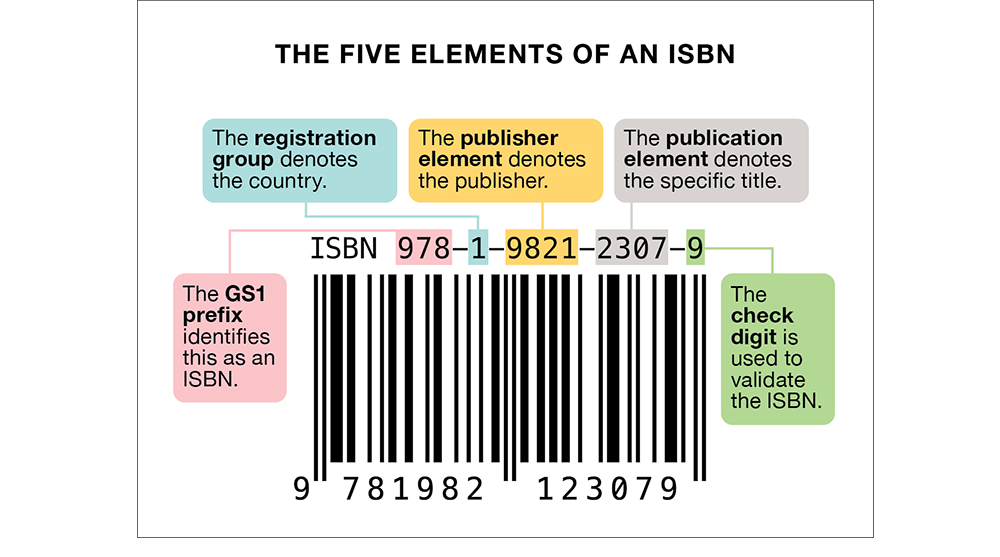
The digits that compose each ISBN are not random; instead, the number is built from five parts, each of which reflects certain metadata about the book. “The ISBN is thirteen digits long, and that string identifies not only the specific publication, but also the publisher and where that publisher obtained that ISBN,” says Stella Griffiths, executive director of the International ISBN Agency. “The ISBN acts as the key information point to which all the other data elements—title, author, date of publication, subject, price, jacket image, and so on—can be associated and linked.” Griffiths provides a quick primer on how to break down this important thirteen-digit number: “Each ISBN consists of five parts: the GS1 prefix element (always three digits and currently either 978 or 979), the registration group element (variable length, denoting the country or region of the ISBN agency assigning the number), the registrant or publisher element (variable length, denoting the publisher), the publication element (variable length, denoting the specific title), and the check digit (fixed length of one digit).” The resulting ISBN will travel with a book, giving retailers, readers, and other industry professionals a shared, reliable way to identify a given title. “You can think of it as being like a passport for books,” says Griffiths.
In the United States, the assignment of ISBNs is administered by the official ISBN agency, Bowker, which is to say that every ISBN must be applied for through Bowker via its system and online tools. If your book is published by a traditional publisher, it will assign the book an ISBN, but if you are self-publishing, you may be responsible for this task yourself. It is also possible to pay some self-publishing platforms to get an ISBN from Bowker for you, but some advise against it, including Lee Wind, the chief content officer of the Independent Book Publishers Association (IBPA), an organization whose members include small and independent publishers as well as self-published authors. Wind, who is an author himself, believes that authors should be the ones to apply for ISBNs: “Our bottom-line advice for ISBNs is that folks in the United States should make sure to get their thirteen-digit ISBNs directly from Bowker themselves, and never use the ‘free’ ISBNs that a lot of self-publishing platforms offer. The issue there is that those platforms will list themselves as the publisher of those works, when you should make sure you’re the publisher of record.” (Of note, IBPA members receive a 15 percent discount on buying ISBNs from Bowker.)
Barr-Toman agrees with Wind. After finishing the manuscript for her second book, Breath by Breath: A Mindful Approach to Memoir Writing (2025), she decided to self-publish. Self-publishing enabled her to be true to her vision and to work on a timetable of her own making. Because she’d had a novel published several years earlier by a small press, she was already familiar with ISBNs. Even though she chose to publish with IngramSpark, she eschewed its ISBN service. “You want to buy it yourself and have it in your name. That way you have access to that book so you can go in and make revisions and little changes.” Barr-Toman has learned these nuances from experience: When the press that published her novel, When Love Was Clean Underwear (New Rivers Press, 2009), closed, the rights reverted to her. Barr-Toman decided she’d like to republish it with a new cover—but to do that she needed a new ISBN. “If you change a cover or add a foreword, you need a new ISBN,” says Barr-Toman. “The ISBN is attached to the interior and the exterior of the book.” Wind of IBPA adds: “ISBNs designate the format of a particular book, so a single title would have a different ISBN number for each format—you would have a different ISBN for the same title for paperback, hardcover, e-book, audiobook, large print, etcetera.” Barr-Toman went directly to Bowker to apply for the new ISBN for her book’s new edition. “It’s not a complicated process,” she says. “I had it within the day.”
IngramSpark, the self-publishing platform of global book distributor Ingram, allows author-publishers to choose how they approach getting an ISBN. Marty Schoenleber III, senior manager of IngramSpark Distribution and Promotion Services, says this flexibility is offered to fit the varying needs of authors. “Most first-time indie authors aren’t familiar with ISBNs. Because there’s so much to learn about the bookmaking process, we try not to drown people in education too early,” says Schoenleber. “During the title setup process, we require ISBNs for any book that’s intended to be sold into the wholesale and retail channels. For creators who just want to print it for themselves, there’s a separate path without ISBNs.” In its step-by-step online instructions to authors, IngramSpark recommends what it calls the “purchase-to-own” approach from Bowker. IngramSpark is transparent about the limitations of its no-cost ISBN option: “If you accept a free ISBN from IngramSpark, you will need to provide a new ISBN in order to publish this work elsewhere. The free ISBN provided by IngramSpark will be associated with this title only if it continues to be available through IngramSpark.”
Some larger publishers purchase blocks of ISBNs and assign them to forthcoming titles. Griffiths says: “Publishers who are expecting to publish a number of different books may be assigned a block of ISBNs that is unique and exclusive to them. In that case the first three elements of the ISBN will be the same for the whole of the block—only the publication element and check digit will change.” Indie authors can purchase ISBNs in bulk, too. Bowker offers a special price for a group of ten ISBN numbers. Considering that each individual format of a book (hardcover, paperback, e-book, audio, etc.) requires its own number, a bulk purchase is potentially useful, depending on your plans. One ISBN is currently $125—the barcode, which you’ll also need, is an additional $25. A package of ten ISBNs is $295. Feeling ambitious? Thinking you might turn your idea into a series? You can get one hundred ISBNs for $575.
An ISBN is also a marketing tool. Circana is the market research company that runs BookScan, the industry standard source for data on book sales. As Brenna Connor, a director and industry analyst for the company, explains, only the sales of books with ISBNs can appear in BookScan tabulations of what is selling. “Without an ISBN, [a title] is not considered a book and will not be included in BookScan data,” says Connor, but when a book does have an ISBN, retail partners will share weekly sales numbers with Circana. Having an ISBN is also key to how and where books are stocked. Kristen McLean, vice president for the Circana Entertainment Knowledge Group, adds: “Many authors have a basic question about why they would pay for ‘extended distribution’ services from self-publishing platforms, which includes an ISBN, not just an ASIN within the Amazon universe. These services are what creates the metadata footprint of the book for distribution beyond the platform. So on [Amazon’s self-publishing platform] CreateSpace, for instance, Extended Distribution services pushes the whole metadata package—including an ISBN—to distributor services like Ingram, regardless of format. That in turn populates metadata for the book throughout the entire publishing ecosystem. It’s what makes the book available for POD [print-on-demand] or e-book ordering on other platforms, and it makes it possible for chains and independent stores to carry the book, even if it is self-published.”
Obtaining an ISBN may be a relatively easy process, but that doesn’t mean there isn’t room for error. “Today there are many different service providers who offer to assist with various aspects—everything from jacket design and editing to ghostwriting,” Griffiths says. “Many of these services also offer ISBNs either free or as part of a package. Authors should take care when selecting between these providers as scams are quite common. For example, some use names and e-mail addresses that are similar to, but not quite the same as, big-name publishers. A good source that flags services that are misleading in their claims or general setup is Writer Beware, writerbeware.blog.”
Obtaining an ISBN is a simple but crucial process, one authors deserve to be empowered to navigate successfully. In my work as a bookseller, I find that when customers call the store and ask if we have a particular book, they are providing us with ISBNs more often than ever. As we all try to do better at managing the increasingly complex and bewildering sea of information online, even readers are realizing the importance of an ISBN. Once your book has an ISBN, it can forever be found through that singular identifier. Stella Griffiths called it a passport; Kristen McLean thinks of it as a book’s Social Security number. Bowker poetically says that the ISBN provides “bibliographic immortality.” Now who wouldn’t want that?
Lynn Rosen has been in the book publishing industry for a long time now, as an editor, an author, a literary agent, and an educator. She is currently a store manager for Barnes & Noble in Philadelphia. Her ISBN is 978-0-307-33933-1.