Ama Codjoe Is Alone in the Woods

Social justice activist and Cave Canem fellow Ama Codjoe blogs about writing in form and five days in the woods.

In September of 2011, equipped with lessons from the P&W–supported Cave Canem workshop with Marilyn Nelson and with Annie Finch's A Formal Feeling Comes: Poems in Form by Contemporary Women, I drove to a friend's country home in Pine Plains, New York. I spent five days alone in the woods (with deer, wild turkey, trees, and books as worthy companions).

Most writers acknowledge the benefit of retreat. Getting away enabled me to turn off technology and turn any distractions into sustenance: cooking, watching the lake shift and move, or watching a deer watching me. In this way some retreats are a coming towards: towards nature, towards community, towards solitude, towards discipline. I am grateful to have benefited from different kinds of retreats where I have learned about the craft of poetry, the power of community, and the sacredness of solitude.

Writing is a creative act that one performs alone, but when I began writing sonnets after Julia Alvarez, I was communing with the poems I had read and the poets I had heard. I am not sure that I would have decided to write thirty-three sonnets without my time in the woods. I know that I wouldn't have begun writing a series of sonnets without the P&W–supported regional Cave Canem workshop with Marilyn Nelson in 2009.  We explored the virtues of formal poetry, and it was then that I first dipped my toes into the waters of the sonnet.           

Since September, I have crafted sonnets about mermaids, desire, fishermen, and seascapes. They are the most personal poems I have written. They are poems that benefit from the syllabic, rhythmic, and aural constraints of formal verse. The word sonnet comes from the Italian word sonetto meaning "little song." Through composing and revising sonnets, I am singing to myself, to Alvarez, to Nelson, and to the deer and turkey in Pine Plains too.

Photo: Ama Codjoe. Credit: Matthew Goldberg.

Support for Readings/Workshops in New York City is provided, in part, by public funds from the New York State Council on the Arts, and the Department of Cultural Affairs, with additional support from the Louis & Anne Abrons Foundation, the Axe-Houghton Foundation, the A.K. Starr Charitable Trust, and Friends of Poets & Writers.

Sacramento Conference Puts the Life in Life Stories

The fifth annual Our Life Stories Writers’ Conference took place April 28 at Cosumnes River College in Sacramento. This one-day conference, co-sponsored by the Ethel Hart Senior Center and Cosumnes River College, and supported by P&W, is designed for seniors and others interested in documenting their life stories. Project directors Alicia Black and Bubbles Miguel describe the event.

The celebration began the evening of Friday, April 27, when more than eighty people gathered at the Hart Senior Center in downtown Sacramento for a pre-conference reception. Attendees sipped port wine and dunked fresh fruit into a multi-tiered chocolate fountain while mingling with conference faculty and fellow participants. Faculty greeted participants, signed books, and read their own work for the crowd.

Early the following morning, more than 150 attendees and volunteers streamed past manicured lawns and flowering trees on the Cosumnes River College (CRC) campus to enter the conference room. Allegra Silberstein, poet laureate of the nearby town of Davis, kicked the day off with a reading. Jennifer Bayse Sander, a New York Times bestselling author, publisher, and former Random House senior editor, delivered the keynote address.

Participants dispersed to a nearby building to attend their selected morning workshops. The seven workshop offerings gave the writers an opportunity to learn about autobiographical narrative, poetry, memoir, and publishing. The workshops were led by a culturally diverse group of nationally and locally recognized writers. Offerings included “Painting with words: creating atmosphere in settings” by Kerstin Feindert, “Your life as a list of ten” by Susan Kelly-DeWitt, and “Who said that? Voice and point of view in fiction” by Kakwasi Somadhi.

After a catered Italian lunch accompanied by an enticing slice of strawberry cheesecake, Ginny McReynolds, CRC Dean of Humanities and Social Science, gave a keynote talk about the importance of writing on a regular basis. Once the afternoon workshops concluded, participants returned to submit their evaluations for prizes donated by local restaurants, private individuals, and a local winery. As attendees departed, many reported that they had met new people and enjoyed the chance to network and eat great food. Many promised to return next year, as their life stories continue to unfold.

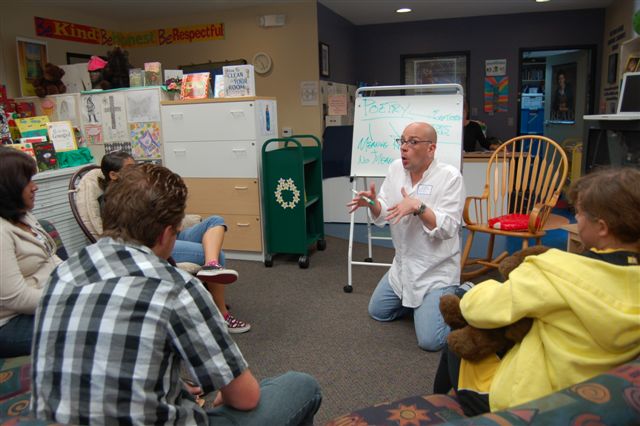
Above: Emmanuel Sigauke signs a book. Left: Susan Kelly-DeWitt (standing) leads a workshop. Credit: Martin McIllroy.

Major support for Readings/Workshops in California is provided by The James Irvine Foundation. Additional support comes from the Friends of Poets & Writers.

Literary Agents Become Owners of ICM

After more than a year of negotiations, a group of agents at International Creative Management (ICM) successfully reached an agreement to purchase a majority ownership of the company from the private-equity firm Rizvi Traverse Management LLC, and longtime ICM chief executive officer Jeffrey Berg. The Hollywood talent agency will now be known as ICM Partners and is controlled by a partnership of twenty-nine agents and executives from its film, television, publishing, and touring departments. The financial details of the agreement weren't revealed.

ICM was formed in 1975 through the merger of International Famous Agency and Creative Management Associates (which were themselves formed by earlier mergers). Rizvi Traverse Management paid ICM's founding owners seventy million dollars for a majority interest in the agency in 2005, which allowed ICM to purchase the Broder Webb Chervin Silbermann literary agency in 2006. According to the Wall Street Journal, in recent years, there were grumblings among the agents that Rizvi, a Connecticut-based financial company, did not show significant interest in the agency.

In the publishing world, one of ICM's best-known agents is Amanda "Binky" Urban, who represents Charles Frazier, Mary Karr, Cormac McCarthy, Toni Morrison, Haruki Murakami, and Donna Tartt.

What's to Become of the Orange Prize?

Earlier this week, just days out from the announcement of the 2012 Orange Prize for Fiction winner, news broke that the prize's namesake, telecommunications company Orange, will be ceasing its sponsorship after this year. The award, which honors women novelists and comes with a thirty-thousand-pound purse (approximately forty-seven thousand dollars), has been given annually since 1996.

Despite the dissolution of what by prize director Kate Mosse's estimate was a successful partnershipaccording to a quote from Mosse in the Huffington Post, over the years, the prize has afforded Orange "the equivalent of 17 million pounds in advertising revenue"prize administrators are keeping an optimistic tone about the impact of the move. "This is the end of an era, but no major arts project should stand still," Mosse wrote in a letter on the prize website. "We are very much looking forward to developing the prize for the future and working with a new sponsor to ensure the prize grows and plays an even more significant part in the years to come."

According to Mosse, a number of potential "brand partners" are already in talks with the Prize for Fiction administrators.

Past winners of the prize, which, while based in the United Kingdom, has never been limited to U.K. authors, include American novelists Barbara Kingsolver, Ann Patchett, and Marilynne Robinson, Nigerian author Chimamanda Ngozi Adichie, and Canadian authors Anne Michaels and Carol Shields. This year's shortlist is comprised of titles by Americans Madeline Miller, Cynthia Ozick, and Patchett, Canadian author Esi Edugyan, Irish author Anne Enright, and British author Georgina Harding. The final recipient of the Orange Prize will be announced at a ceremony in London on May 30.

In the video below, the shortlist of this year's award is announced at the London Book Fair.

Amazon's Breakthrough Contest Introduces Literary Novelist

Amazon announced yesterday the three finalists for its fifth annual Breakthrough Novel Award in fiction. Along with two genre titles, Portland, Oregon, writer Brian Reeves's novel, A Chant of Love and Lamentation, was selected by editors at Penguin for the shortlist.

Reeves's story blends Hawaiian history—the author lived on the islands for a number of years—with fictional events that see the state moving toward regaining sovereignty. "This novel comes from my sincere hope that the people of Hawaii may someday soon reclaim what was once theirs," says the author in his bio note.

Also shortlisted were Alan Averill's The Beautiful Land, a "literary-flavored time-travel tale," in the words of literary agent and contest reviewer Donald Maass, and Charles Kelly's historical mystery, Grace Humiston and the Vanishing.

Registered customers of Amazon are now invited to vote on the winner of the novel competition, who will receive a publishing contract from Penguin and a fifteen-thousand-dollar advance against royalties. Voters can read a snippet from each book on the Amazon website or, if they have access to the Kindle, download an extended excerpt for free. The winner will be announced on June 16.

Amazon's Breakthrough Contest Introduces Literary Novelist

Amazon announced yesterday the three finalists for its Breakthrough Novel Award in fiction. Along with two genre titles, Portland, Oregon, writer Brian Reeves's novel, A Chant of Love and Lamentation, was selected by editors at Penguin for the shortlist.

Reeves's story blends Hawaiian history—the author lived on the islands for a number of years—with fictional events that see the state moving toward regaining sovereignty. "This novel comes from my sincere hope that the people of Hawaii may someday soon reclaim what was once theirs," says the author in his bio note.

Registered customers of Amazon are now invited to vote on the winner of the novel competition, who will receive a publishing contract from Penguin and a fifteen-thousand-dollar advance against royalties. Voters can read a snippet from each book on the Amazon website or, if they have access to the Kindle, download an extended excerpt for free. The winner will be announced on June 16.

The Moment

5.23.12

Write about the moment that everything changed. For inspiration, check out Smith Magazine's The Moment (Harper Perennial, 2012), a collection of personal essays about the key experience—"a moment of opportunity, serendipity, calamity, or chaos"—in each of the author's lives, whose effect was revelatory, profound, and life-changing.

Between These Walls

5.23.12

Write a story where nothing takes place outside of one small room. You can describe the interior of the room, but refrain from describing anything outside of it. Take note of how this restriction forces you to rely on certain techniques of storytelling.

Keep It Short

5.22.12

Revisit a poem of yours that is longer than one page. Try rewriting the poem by condensing it to ten lines or fewer. Cut and rearrange lines from the original poem, or write a completely new one that gives fresh attention to an evocative image or line from the original. 

Ama Codjoe's Introduction to Formalism

Social justice activist and Cave Canem fellow Ama Codjoe blogs about participating in a P&W–supported Cave Canem regional workshop with formalist poet Marilyn Nelson in 2009. 

In fall 2009, Poets & Writers supported a Cave Canem regional workshop with Marilyn Nelson. Nelson is a goddess of formal poetics. Before taking a workshop with Marilyn I had little experience with sonnets, sestinas, or ballads. Through a series of lessons on meter, rhyme, and phrasing, I learned the arithmetic of formalism.

Nelson asked us to pay particular attention to the construction of the poetic line. Through a sequence of assignments we experienced how careful and intentional construction could lead to a meaningful, surprising, and exciting composition. Formal verse provides the writer with added parameters. Nelson’s poetry exhibits how such constraints used skillfully can produce poems that are wild, challenging, liberating, and free. Gwendolyn Brooks and Robert Hayden offer examples of how constraint or restraint can be used to describe terror, horror, beauty, and oppression. In these ways formal poetry holds paradox with nimble hands.

To conclude our time together Marilyn asked us to write one sonnet. About two years later, a childhood friend reminded me of a series of poems that we read when we were teenagers. “Don’t you remember?” she asked. “Who touches this poem touches a woman.” I did remember. The last line of Julia Alvarez’s last sonnet was a line that moved my teenage-becoming-a-woman self. Rereading those sonnets from Alvarez’s first book, Homecoming, was a kind of homecoming. I admired the way her sonnets sounded both casual and intimate. The themes she was obsessed with: relationships, God, marriage, and womanhood resonated with the preoccupations of my thirty-something mind and heart.

By experiencing the resonance of a poetic line as a teenager and returning to that line as an adult, I began a process of constructing, revising, and building a sonnet cycle of my own. I am grateful for Nelson’s instruction and for an introduction to formalism that continues to shape and propel my work.

Photo: Ama Codjoe. Credit: Amanda Morgan.


Support for
Readings/Workshops in New York City is provided, in part, by public funds from the New York State Council on the Arts, and the Department of Cultural Affairs, with additional support from the Louis & Anne Abrons Foundation, the Axe-Houghton Foundation, the A.K. Starr Charitable Trust, and Friends of Poets & Writers.

Pages

Subscribe to RSS - blogs