Jerusalem Prize Honors Literature of the Individual

The International Jerusalem Book Fair has announced the twenty-fifth winner of the ten-thousand-dollar Jerusalem Prize, given biennially since 1963. Novelist and short story writer Ian McEwan will be given the award honoring "freedom of the individual in society" at the festival this February.

"McEwan’s protagonists struggle for their right to give personal expression to their ideas and to live according to those ideas in an environment of political and social turmoil," the prize jury said in a statement. "His obvious affection for them, and the compelling manner in which he describes their struggle, make him one of the most important writers of our time. His books have been translated into many languages and have enjoyed world-wide success—particularly in Israel, where he is one of the most widely-read of foreign authors."

McEwan, who lives in London, joins previous honorees—all male with the exception of Simone de Beauvoir and Susan Sontag—including Jorge Luis Borges, Mario Vargas Llosa, and Haruki Murakami. Author of the Booker Prize–winning novels On Chesil Beach (Nan A. Talese, 2007) and Amsterdam (Nan A. Talese, 1999), his most recent novel is Solar (Nan A. Talese, 2010).

In the video below, McEwan discusses his latest work.
Edifice

I am
empy,
hollow,
no,
hollowed out,
scooped,
not ice cream scoop,
but derrick—
a shovel
with teeth
coming down hard
to make a hole:

I am to be a hole,
an important hole,
to base a footing
for an edifice,
a Grand Edifice,
a Grand Plan
for a construction.

I am to be
crushed with cement,
pierced through
with re-bars.

I am to be an anchor
for the cornerstone,
an anchor in dirt.

Terrance Hayes Edits Ploughshares

In this clip, produced by Emerson College, National Book Award-winning poet Terrance Hayes talks about his experience as guest editor of the Winter 2010 issue of the literary journal Ploughshares.

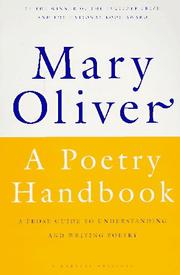
A Poetry Handbook: A Prose Guide to Understanding and Writing Poetry

by
Author: 
Mary Oliver
Published in 1994
by Mariner Books

Poet Mary Oliver tells of the basic ways a poem is built, including meter and rhyme, form and diction, sound and sense. Drawing on poems from Robert Frost, Elizabeth Bishop, and others, Oliver gives clear instruction on how to approach poetry.


January 17

1.17.11

What is something you are afraid to write about in your own poems, either because it is too personal, or because you feel it is cliché? Create a character—a swarthy bum, a baker, a dog—and write a narrative poem in which your character addresses this topic. Let the fact that the poem isn’t really about you be freeing.

Poetry Contest Turns Verse to Verses

Memorious, the six-year-old online literary journal, is open for poetry entries to its annual art song contest. One poet will have her work set to music by composer Luke Gullickson and performed at an event in Chicago, cosponsored by local group Singers on New Ground (SONG). The winning poem, along with a recording of the musical adaptation, will also be published in Memorious.

"The last quarter-century has seen an explosion of American composers writing art songs for our own time and nation," writes SONG director Eric Malmquist in an introduction to the genre of the art song—technically a poem set to music for voice and piano. "Composers are still setting poetry to music, but many are also setting non-poetic works, including newspaper columns, recipes, listings from 'missed connections' on Craigslist, and crazed writings found on a Chicago bus."

Inspired? Poets can submit via e-mail three to six poems, each of no more than thirty lines, or one long poem of no more than one hundred lines along with a brief bio (there is no entry fee). The deadline is February 12.

For more about the project, entry guidelines, and an audio-visual experience of the winning poem from last year—"Blackwater" by Jill McDonough with musical composition by Randall West—visit the Memorious blog.

Pages

Subscribe to Poets & Writers RSS