For the month of June, poet Kelly Norman Ellis, author of Tougaloo Blues and longtime P&W-supported writer and presenter of literary events, will spotlight Chicago's literary landscape.
I love what I do. I get to talk to smart, talented people about words. I am the director of creative writing at Chicago State University (CSU). But the nature of directing a creative writing program at an underfunded state university tests my creative endurance and that of my colleagues each year. Our MFA program’s sister institution, the Gwendolyn Brooks Center for Black Literature and Creative Writing (GBC), has been the saving grace of our program. The GBC, named in honor of the esteemed Pulitzer Prize winner and Illinois poet laureate, serves as the home of the MFA program, a meeting place for creative writing students, both graduate and undergraduate, and provides literary readings and workshops, mostly famously the Gwendolyn Brooks Conference.
 Because of financial constraints, our writing program does not have a formal writers series, but the GBC's programming and physical space have kept our creative writing program thriving. The center and its directors both past and present (Professor Haki R Madhubuti, Dr. Joyce E Joyce, the late Dr. B.J. Bolden and Professor Quraysh Ali Lansana) have provided an important literary environment for the university and Chicago’s south side communities. The center is a world within a world.
This world includes a video archive of literary readings by Sonia Sanchez, Toni Cade Bambara, John Edgar Wideman, bell hooks, Edward P. Jones, Amiri Baraka, Saul Williams, and Lucille Clifton and scholars Houston Baker, Maryemma Graham, Joanne Gabbin, and Cheryl Clarke, among others. The center’s dedication to social justice through the HYPE program, which works to educate young people about AIDS/HIV, has produced two anthologies (Fingernails Across the Chalkboard and Spaces Between Us), co-edited by graduates of our writing program (ML Hunter and Randall Horton).
Centers like the GBC are a cultural and artistic lifeline for a community of black and brown people struggling against oppressive forces. In this small space, contemporary writers have shared their words and expertise with the students of CSU and the surrounding communities with workshops and readings; Martin Espada, Thomas Sayers Ellis, Honoree Fannon Jeffers, Crystal Wilkerson, Frank X Walker, Roger Bonair-Agard, Jessica Care Moore, and Achy Obejas have done this work for little or no financial reward. They serve the community because of their commitment to writing and the right of every person to own her own stories and to craft those stories with the attention they deserve.
It is possible to make a world with what you have. Even though we do not have vast financial resources, we have the commitment of writers around the country who believe in the necessity of art in the lives of every person. Every day I enter our small space and am greeted by the portraits of Lorraine Hansberry, Langston Hughes, Richard Wright, and, of course, Gwendolyn Brooks. I walk into the space where Ms. Brooks taught poetry and where she made a world fashioned from poems... And what a world it is.
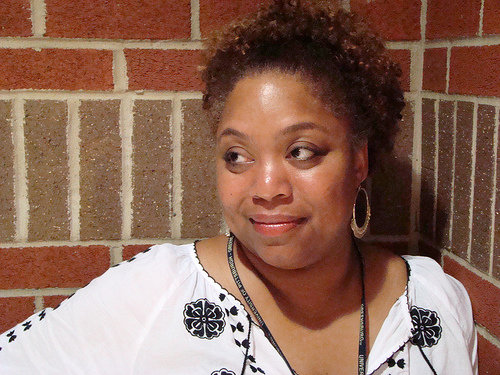
Photo: Kelly Norman Ellis. Credit: Natasha Marin.
Support for Readings/Workshops events in Chicago is provided by an endowment established with generous contributions from Poets & Writers Board of Directors and others. Additional support comes from the Friends of Poets & Writers.



