Literary luck, for a time, seemed to shine upon me. In 2016, I won the Maureen Egen Writers Exchange (WEX) Award, sponsored by Poets & Writers, which included an all-expenses-paid trip to New York City during which I met literary agents and Big Five and indie editors. Two years later I won the James Jones First Novel Fellowship and, soon thereafter, received a hefty check as a vote of confidence in my literary promise.
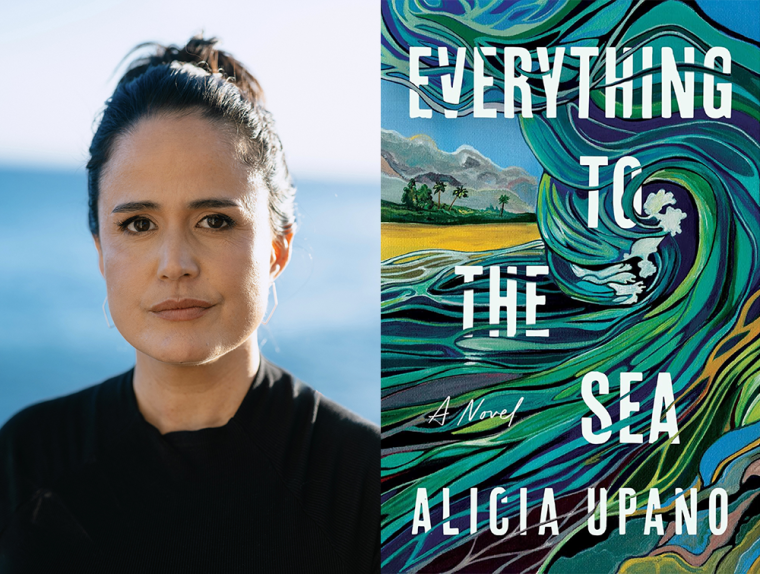
Alicia Upano, author of Everything to the Sea. (Credit: Mar Mizunaka)
An excerpt from a novel-in-progress had garnered those two awards and the attention of several agents. When I first got an agent call, a friend suggested I play the lottery. You’re fertile with something, he said.
It didn’t last.
Those initial New York introductions did not bear fruit. Agents sent warm and encouraging rejections, blandly formal ones (often via their assistants), or ghosted. Eventually, I signed with an agent, who approached me after reading a prize announcement. I was relieved and ecstatic, but also unprepared. I had a young child at home and, newly overwhelmed, could not find balance amid my responsibilities—including full-time work, and now, revising a book for submission.
Despite my agent’s valiant efforts, that first book failed to sell.
The feedback was clear: compelling premise, characters, and writing—the promise that attracted those prize judges and agents. But over the course of a novel, editors couldn’t ignore the lack of narrative drive. I felt not just unlucky, but bereft.
While I could have revised the manuscript, the more I tinkered, the more I realized I had written myself into a dead end. Not only did I not possess the skills, but I no longer had the heart for the book.
So that first novel was fated for the trash heap. But what is “first,” really, for a novelist? There was an abandoned one before that. Decades of writing, and yet I didn’t know how to get the reader to turn the page.
This summer I’ll publish my debut, Everything to the Sea. It’s the book I started in the wake of that failed novel, and its success thus far can be attributed to the lessons of the book that will never publish. That failure flattened me, then motivated me. In hindsight, here’s what I learned.
1. You always need a bit of luck. As I mentioned, I had a run of good fortune, then bad. It’s also true that plenty of great books don’t sell. In all cases, a bit of luck helps because so many factors lie outside of our control: the market, the weather, the president. Case in point: For one prize I submitted a writing sample. I got an early, formal rejection. The following year, I submitted the same sample, and I nabbed first place. So there you go.
2. Sometimes the work just isn’t ready. The counterpoint to the last lesson, this one is very useful when facing rejection. My work had promise, and I did my best given my skills and knowledge at the time. The advice to just keep trying is incomplete—I also needed to use those rejections as data. My writing was called “quiet,” the “plot didn’t carry the reader,” and editors wanted “much more to be happening, more quickly.” Reframed, this became invaluable feedback, defining exactly what skills I needed to build as a storyteller.
3. My disappointment isn’t mine alone, and neither are my successes. There’s grief in one’s first failure, and for me, grief tends to trigger a sense of narcissistic loneliness. It took months to recall my friends who also had “failed” books—who could not nab an agent, editor, commercial success, or literary acclaim—and realize that I was in very good company. I also realized how much rejection is part of the literary game—every day agents and editors get rejections too. When I returned to my agent with the second book after we both had grieved the first, we were equally motivated and committed to doing everything we could to help this one succeed.
4. Fundamentals matter (more than an MFA might let you believe). Despite my conventional writing education—dozens of workshops and countless editorial letters—there remained a gaping hole in my knowledge about plot. I was told my primary problem was narrative drive, but what was narrative drive? How does one create that? Many craft books helped, exposing the scaffolding I couldn’t see as a reader enraptured by story. I also benefitted from the advice of so-called “genre” writers—less precious than the literary camp, more practical, and thus, applicable. These books, teachers, and editors helped me build a narrative structure to propel my quiet characters along.
5. Every reader has something to teach you. For too long, I didn’t know how to revise. A workshop is an easy place to get overwhelmed (or sidetracked or rankled or defensive) with competing feedback. Often my revisions were surface level, but after the first novel failed, I promised myself that I would take all reader comments seriously. I would address them on my terms, but I had to address them. Underlying this choice is my belief that readers all have an instinct for story, having ingested them their whole lives. Conventions are genre- and culture-specific, yes, but story is universal. Every reader is a smart reader.
6. Get creative with comps. “Comps,” or comparison titles, position your book alongside existing (successful) books in the market. They are meant to help agents sell your book to editors, editors sell your book to their teams, and your publisher sell your book to readers. That’s beyond the scope of the writer’s job, but I like the term “creative comps” to refer to the books that aid, via inspiration and modeling, my work-in-progress. What novels did I love that featured a structure, emotional weight, accessible language, or sense of revelation similar to what I was going for? My creative comps comprised a short, shifting stack of six to twelve books I returned to again and again as I drafted.
7. Study writers, not just books. Increasingly I studied a novel’s acknowledgments—in addition to writer interviews, newsletters, and the like—to give me a sense of the paths writers took to creating books I adored. Which writing communities did they thrive in? What writing teachers and craft books inspired them? Which editors published them? With this knowledge, I found new craft books, applied for new workshops and residencies, and kept a list of editors who acquired books I admired.
8. Your process is your process. I had long thought I wasn’t really creative because I am not naturally freewheeling like my friends who could discover their characters, setting, and plot through the process of writing. Fiction contains endless possibilities, and I needed structure to begin. So I experimented with various ways to contain everything from my writing process to my story—elaborate drafting calendars, dictated brainstorms, and multiple spreadsheets. This organizational work gave me the confidence to sit down and fill each empty page.
9. Structure reveals itself through completion. In previous novel attempts it took me a long time to finish a draft, largely because I didn’t have a plan and would find myself in a storytelling jam I couldn’t write myself out of. Recently, I took several personality tests for fun, and discovered my primary Clifton Strength was Restorative, which means I like to fix things. So I realized that if I could draft the book, I could fix it. That bolstered me through the agony of shitty first drafts. Once a draft was complete, I could see the full arc and thus how I could add, fortify, or revise the structure to support the story.
10. Every draft does its own work. With each draft, I felt a sense of achievement (and collapse). Upon completing each iteration, I noted how long the draft took to complete (five days for tiny edits to one and a half years for overhauls), how long it was (80,000 words at first, then up to 113,000, then back down again), and, in hindsight, the purpose that draft served: figuring out what book I wanted to write, telling the story to myself, shaping the story for readers, introducing symmetry, compression, and so forth.
Thanks to these ten lessons, by the time I sent my agent the book (at that point on its fourth draft), I could also rely on the partnership we developed and had a list of comps and potential editors to share with her. She then helped develop the manuscript for submission—more drafts!—and added her expertise to refine the lists of comps and editors.
I often think about the ending of “The Writing Life,” by Alexander Chee, judge of the WEX Award. In an essay from his collection How to Write an Autobiographical Novel, Chee reflects on studying under Annie Dillard:
Go up to the place in the bookstore where your books will go, she said. Walk right up and find your place on the shelf. Put your finger there, and then go every time.
In class, the idea seemed ridiculous. But at some point after the class ended, I did it. I walked up to the shelf. Chabon, Cheever. I put my finger between them and made a space. Soon, I did it every time I went to a bookstore.
Years later, I tell my own students to do it. As Thoreau, someone Annie admired very much, once wrote, ‘In the long run, we only ever hit what we aim at.’ She was pointing us there.
For years, I was flailing. For this novel, I was aiming. With my agent’s magic and a bit of luck, the second book sold at auction in a significant deal to an editor on my list.
Then the work began again. Significant revisions ensued, but I’d developed a way to address the edits. The process wasn’t seamless—I ballooned the manuscript in one round, and we had to cut it down in the next. But in the end, the manuscript was stronger.
As I embark on my next project, I can only hope these lessons will follow me. If anything, they’ve provided me a way to navigate the uncertainty of the writing life and imbued me with a little faith.
Alicia Upano is the recipient of the Poets & Writers Maureen Egen Writers Exchange Award Hawai‘i, the James Jones First Novel Fellowship, and a Bread Loaf–Rona Jaffe Scholarship. After living in Asia and on both U.S. coasts, she now resides on O‘ahu with her family. Her debut novel, Everything to the Sea, is being published by William Morrow in July 2026. Learn more at aliciaupano.com.