In our Craft Capsules series, authors reveal the personal and particular ways they approach the art of writing. This is no. 285.
Let’s focus now on ways in which we can tell a poem slant, with the emphasis on how to make the unsayable present. By the unsayable, I mean something we are afraid to confront or unlock, something that is difficult to express, something that exists beyond language. It might be a painful experience like the loss of a child, for instance. One way is to use a fictive voice, as in the poem “Unknown Girl in the Maternity Ward” by Anne Sexton, to discover what emotions and insights might strike through and draw us closer toward discovering what cannot be said.
In this wrenching poem, Anne Sexton uses a fictive voice to write a dramatic monologue of an unknown girl in the maternity ward who has just delivered a child. Diane Wood Middlebrook, in her biography of Anne Sexton, says Sexton was at a certain period in her poetic development that “emboldened her to take a formally elaborate but emotionally direct approach to autobiographical material that was pressing urgently for expression—her separation through mental illness from Joy and Linda, her young children.” In this poem, the speaker is a new mother giving up her baby. What is more devastating a loss than having to give up a child? Though the voice of the poem is an unknown girl, this girl “trembling the selves we lose,” could be any of us facing the loss of a child, whether through pregnancy loss, separation, or adoption. Further, the poem speaks to anyone who is grieving or losing part of oneself in mourning. Might this poem also be read as a poem about the negotiation between motherhood and independence, and what might be lost or gained? How do we write the unsayable and write it slant so that the poem’s truth or meaning is more oblique and open-ended?
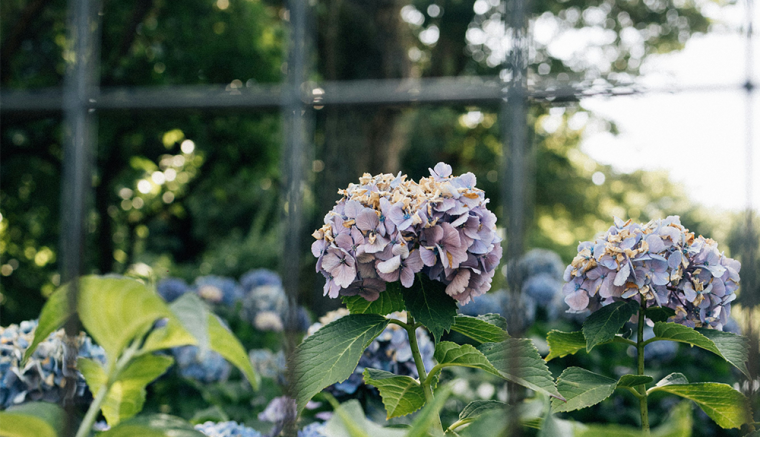
I tried to apply this technique in my prose poem “My Struggle.” I chose a situation, an attempt to protect hydrangeas from deer, and a place, my garden, inspired by a grated fence we built to protect our hydrangeas. But the understory, if you will, has a bigger / more insidious plot in mind. How could I use language to express my inexpressible bewilderment and rage at the racism and bigotry destroying our country? The garden became the platform to tell the poem slant and reveal a truth, even if indirectly. The poem became an homage to George Floyd.
“My Struggle”
My favorite tulip tree choked to death by a ravenous, unconscionable
vine strangling its neck. Riots unleash among bees & flowers. In winter
we resurrected a screened fence around our hydrangeas to keep deer
from destroying the eventual flower. Still, all summer, in mourning,
I could not revel in their luscious blooms, trapped behind the grate,
branches poking their fingers to be free of restraint, shrubs cramped,
suffocated by an unnatural malevolence exerting its power. Today I
spent the day taking down the gate. The hydrangeas are timid. They
held back, but hours later stretched their green branches, & shook their
shiny heads as if awakening from history’s long lament. More so than
ever, stakes are higher. Riots unleash among bees & flowers.
My intention was to convey, obliquely, the speaker’s mourning of an unforgivable and tragic crime through the image of the tulip tree being choked to death. I continue to draw on the garden and its imagery to describe the threat of danger and the fear of malevolence and discord.
As an exercise, try writing a dramatic monologue or creating a scene in which you indirectly approach what feels too hot—too unsayable—to touch or write explicitly.
Jill Bialosky is the author of six collections of poetry including Mock Heart: New & Selected Poems (Knopf, 2026). Her book Asylum (Knopf, 2020) was a finalist for the National Jewish Book Award and she is the author of the memoir Poetry Will Save Your Life (Atria Books, 2017). She is an executive editor and vice president at W. W. Norton.
“My Struggle” by Jill Bialosky was reprinted with permission from Alfred A. Knopf. image credit: Tsuyoshi Kozu