






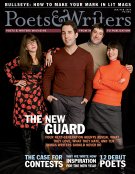
It must be obvious to anyone who has been following this series that I have an unabashed affection for the old guard of book publishing—and an endless appetite for their insights, their war stories, and their wisdom. But after a year in which "change" of one kind or another was never far from anybody's thoughts, it occurred to me that the series could use a shake-up. Why not give the graybeards a breather and talk with some younger agents and editors? And while I was at it, wouldn't it be more valuable to writers if I could get a few drinks in them first?

With that idea in mind, I asked the editors of this magazine to select four up-and-coming literary agents to take part in a roundtable conversation on the fine points of contemporary writing and publishing. One night after work we rode the subway to Brooklyn and congregated in the offices of the literary magazine A Public Space—located in a renovated horse stable with huge wooden doors that swing in from the street, vast ceilings, and an abundance of modern furniture and art—which were loaned to us for the evening by its gracious founder and editor, Brigid Hughes.
Within moments of making the necessary introductions, it became clear that I would need to confiscate everyone's BlackBerry if we were going to get anything done (a problem that had not arisen in my previous interviews). Then the panelists sat down to a spirited conversation that was fueled by Mexican takeout, multiple bottles of wine, and several highly off-the-record digressions—some of which appear as anonymous exchanges at the end—that are probably inevitable at gatherings of this sort. Here are brief biographies of the participants:
JULIE BARER spent six years at Sanford J. Greenburger Associates before starting her own agency, Barer Literary, in 2004. Her clients include Zoë Ferraris, Joshua Ferris, Kathleen Kent, and Gina Ochsner.
JEFF KLEINMAN was an agent at the Graybill & English Literary Agency for seven years before cofounding Folio Literary Management in 2006. His clients include Robert Hicks, Charles J. Shields, Garth Stein, and Neil White.
DANIEL LAZAR is an agent at Writers House, where he has worked for six years. His clients include Tiffany Baker, Ingrid Law, Jennifer McMahon, and Matt Rothschild.
RENEE ZUCKERBROT was an editor at Doubleday before founding her eponymous literary agency in 2002. Her clients include Harley Jane Kozak, Kelly Link, Keith Lee Morris, and Eric Sanderson.
Let's cut right to the chase. What are you people looking for in a piece of fiction?
BARER: I like what Dan has on his Publishers Marketplace profile: the book that makes me miss my subway stop. I think everybody's looking for a book that you can't put down, that you lose yourself in so completely that you forget everything else that's going on in your life and you just want to stay up and you don't care if you're going to be tired in the morning. You just want to keep reading.
ZUCKERBROT: Doesn't that have to do with voice? It's about the way that somebody tells a story. It's about a person's worldview. There are probably very few new stories. We're probably all ripping off the ancient Greeks—tragedy, comedy, yada yada—but it's the way someone sees the world and interprets events. It's their voice. It's how they use words. It's how they can slow things down when they need to. It's how they build up to a scene. It's how they describe ordinary things. Walking down Dean Street, for example. If I described that it would be the most prosaic description on the planet. But a really gifted writer will make me see things I've never seen even though I may have walked down the street a thousand times. At the end of the day, for me at least, it comes back to voice.
LAZAR: On my Publishers Marketplace page I say—because I'm so wise and pithy—that I want writers to show me new worlds or re-create the ones I already know. I generally find myself liking books that are not set in New York. Give me a weird little small town any day of the week.
BARER: That's why I love international fiction. I love reading a book where I don't know anything about the setting. I have this wonderful novel I sold this year that's set in Sri Lanka. I didn't know anything about Sri Lanka when I read it. Anything international, anything historical, anything set somewhere really unexpected. This is going to sound crazy, but I read a novel this summer that blew me away, and it's science fiction. I'm not usually drawn to science fiction, but it was so inventive and original and smart, and it took me somewhere I'd never been. Finishing that book and having it blow my mind was such a reminder of why I love my job: You can read something so unexpected, and fall in love with it, and think, "I never would have thought this would be my kind of thing, but now I can't stop talking about it."
KLEINMAN: That's my second criterion: can't-stop-talking-about-it. I have three criteria. The first is missing your subway stop. The second is gushing about it to any poor slob who will listen. The third is having editors in mind immediately.
BARER: That's so important. If you can't figure out who you're going to sell a book to from the get-go—if you finish it and think, "Who on earth would buy this?" and you can't come up with more than three names—it's a bad sign.
KLEINMAN: Not only that. I want to be thinking, "Oh my God, I've got to send this to so-and-so. So-and-so would love this."
BARER: I have found myself going on and on about books I don't even represent, books where I've lost a beauty contest. I remember one book I was going after. I was so obsessed with it that I couldn't stop talking about it. I'd have lunch with this editor, dinner with that editor, and then I lost the beauty contest and the book went out on submission and five editors e-mailed me and said, "This was the book you were raving about, right? It's awesome."
LAZAR: What was the book?
BARER: It's an incredible debut novel that's coming out with Ann Godoff called The Selected Works of T. S. Spivet. Denise Shannon sold it and she did a fantastic job. It's just one of those incredibly original books and I couldn't stop talking about it. It was the same thing with The Heretic's Daughter. I kept being like, "The Salem witch trials! Oh my God! Did you know that they didn't burn people, they hung people? I didn't know any of this!" You couldn't shut me up. I was probably really annoying.
Aside from referrals, where are you finding writers?
LAZAR: I get most of my fiction through slush.
BARER: I found The Heretic's Daughter in the slush pile. The author had never written a novel before. She had never been in a writing class or an MFA program. She came out of nowhere. She simply had this incredible story, which is that her grandmother, nine generations back, was hanged as a witch in Salem. Just because you have that great story doesn't mean that you can necessarily tell it well, but it was an incredible book.
ZUCKERBROT: I still read literary magazines, and I'll write to people whose work I like to see if they're working on a novel or a short story collection. I found one of my clients—he's a landscape ecologist who has a book coming out with Abrams—when he was profiled in the New York Times.
Where else?
BARER: Bread Loaf. The Squaw Valley writers conference. Grub Street, in Boston. I found the Sri Lankan novel at Bread Loaf last summer. I heard the author read for five minutes and was so blown away that I was basically like, "You. In the corner. Right now. Don't talk to anybody else!"
LAZAR: I got a query through Friendster once. It was a good query, so I asked to read the book, and I went on and sold it. This was two or three years ago, when Friendster was still cool.
BARER: I have a lot of love for certain MFA programs. Columbia. Michigan. I try to go to those schools at least once a year and maintain relationships with the professors so they might point out people to me.
ZUCKERBROT: I actually found a writer who had a short story in A Public Space. I'm going to be going out with her collection soon. She's been published in McSweeney's, Tin House, etcetera. But I also have a lot of clients who send me writers. I hear things from writers I used to work with back when I was an editor. People in my family will tell me about writers. You sort of hear about writers from everywhere.
BARER: That's exactly right. Clients come from everywhere and anywhere. And I think that's one of the biggest misconceptions about agents that some writers have. They think we're off in our ivory towers and our fancy offices in New York City. But the truth is that we're looking for them. We're waiting for them to come knock on our doors. I don't mean our literal doors. Please don't show up at our offices.
LAZAR: I once found a client through a mass e-mail forward. It was one of these funny e-mails. It had pictures of kids sitting on Santa's lap and crying. It took me almost a year to track down where it came from, and it ended up being an annual contest that's sponsored by the Chicago Tribune. So we put together a proposal and had a nice auction and Harper is publishing it this fall. It's all pictures of kids sitting on Santa's lap and crying. If any of my clients ever win a National Book Award or a Pulitzer Prize, nobody's ever going to know it because I will go down in history as the agent who sold Scared of Santa.
BARER: I think finding an agent is a little like applying to college. If you know anybody who knows anybody who knows somebody who's heard an agent speak somewhere, you want to try to use those connections. And there are so many resources now. There are so many books and Web sites. The more research you can do to target your query to the right agents, the better chance you have. The thing that frustrates me is when I get queries for the kinds of books that I just don't do. Ninety percent of my list is fiction, and my Web site says I don't represent military books or self-help books or prescriptive nonfiction. When I get that stuff I think, "Wow, you just wasted all this time. You should really be focusing on the agents who clearly have done a lot of books like that."
When you're looking at all these query letters, what are some things that make you sit up and pay attention?
LAZAR: When Evan Kuhlman wrote to me about Wolf Boy—this is a novel that Shaye Areheart published—he wrote a description of the book, and you could tell from the letter that he was a lovely writer, but I remember that he wrote about one character and the "museum of fucked-up things." That one line stuck with me. I thought it was very specific and evocative. I think that's what makes the best query letters. It's hard to distill your magnum opus that you've been working on for ten years into one letter, but it's great if you can get some of the specific details in the letter.
BARER: As a writer, you should be able to articulate what your book is about in a few lines. Obviously, great novels are about a lot of things. But if you can't articulate the essence of what the story is, then maybe you haven't figured that out, which signals to me that maybe the book isn't coming together.
ZUCKERBROT: We don't need to hear about all of the characters. You guys probably get the query letters that are like, "Suzy, the housewife..." and it goes on and on and you hear about everybody in the book. I mean, we don't really need that.
BARER: It should be like flap copy. It should give you just enough that you want to read the book, but not so much that you feel like you already know everything about it.
LAZAR: I disagree with that a little bit. I've taken on lots of clients who sometimes have written rambling and kind of disorganized query letters. But there will be lines that jump out at you and you think, "Oh, I need to read this." Even if the manuscript comes in and it's rambling and long, if it has that spark that I saw in the query letter, then I don't care if it's rambling, because I can fix that. But I can't fix a lack of spark.
BARER: The one thing that scares me is query letters that come in with accoutrements. Pictures. Little food samples. And the letter is all design-y.
ZUCKERBROT: Or they come on pink paper. All that stuff is a distraction from what's important. It just tells me that they're not real writers. I mean, could you ever imagine Marilynne Robinson sending out a query on pink paper? It's not about the pink paper, and it's not about the fancy font you choose. It's about what's on the page.
KLEINMAN: I just think that when somebody knows how to write, it's so freaking obvious. It's in the voice, it's in the rhythm, and you know it immediately. It has nothing to do with anything else. It can be a letter that's three pages long or a sentence.
LAZAR: Exactly. I would buy a shopping list if it was written by Stephen King.
Tell me ten things in the query process that can make you want to reject something immediately.
ZUCKERBROT: When I get an e-mail that says, "Dear Agent..." and I can see that I'm one of seventy agents who got it.
KLEINMAN: Bad punctuation, bad spelling, and passive voice.
BARER: Is it wrong of me to say that handwritten letters make me uncomfortable? Does that make me ageist?
LAZAR: Writers who will have a lawyer send you something "on their behalf." It's ridiculous, and you also can't get a sense of the author's voice, which is what the letter's all about.
ZUCKERBROT: When people talk about whom they would cast in the movie version of the book. I received three of those this week!
BARER: Anything that says something like, "This is going to be an enormous best-seller, and Oprah's going to love it, and it will make you millions of dollars."
KLEINMAN: Desperation is always good. "I've been living in a garage for the past sixty years. Nobody will publish my book. You have to help me."
BARER: I love it when they tell me why nobody else has taken it on—when they tell me why it's been so unsuccessful.
ZUCKERBROT: Or they've come close and they will include an explanation of who else has rejected it and why. "Julie Barer and Jeff Kleinman said..."
LAZAR: If they're writing a children's book, they'll often say, "My children love this book."
BARER: Right! I don't care if your children, your mother, or your spouse love it. All of that means nothing to me.
KLEINMAN: When it's totally the wrong genre. When they send me a mystery or a western or poetry or a screenplay.
BARER: Don't lie. Don't say, "I read Kevin Wilson's short story collection Tunneling to the Center of the Earth and I loved it so much that I thought you'd be great for my book." Because guess what? That book isn't coming out until next April. You just read that I sold that book, and you suck. You're a liar! That kind of thing happens because everybody subscribes to Publishers Marketplace, and nothing against Publishers Marketplace—I live for it, it's a very useful tool for me—but I think for writers it perpetuates this hugely obsessive cycle of compare and despair.
How else has technology changed things from your perspective?
BARER: The thing about technology that makes me sad is that we used to have a lot more conversations with people. And there are a lot of ways to misinterpret an e-mail. I sometimes have to stop and remind myself to pick up the phone. "It would be nice to catch up with this person and see what else is going on in their life. And we might get more out of it."
KLEINMAN: I have a question. One of the things that drives me crazy is when editors don't respond to me. What do you guys do?
[Expletives. Laughter.]
LAZAR: I have a trick that works every time. I use it a lot, so I should probably retire it at this point. But I write in the subject line, "People who owe me a phone call." Then they open the e-mail and number one is "The Pope." Number two is "Britney Spears." Number three is "You." Then I'll say, "If you can explain numbers one and two, that would be great, but I'll settle for number three. I'd love to hear from you." They always get back to me. [Laughter. Compliments.] It's good because it's a little passive-aggressive, but it's also polite.
BARER: I know an agent who once sent an editor who wouldn't call the client a fake phone and phone card and a whole little package of messages. Like, "Hello? Pick up the phone!" It's just astonishing and insulting.
LAZAR: I went over somebody's head once. I went to the publisher.
BARER: I hate doing that!
ZUCKERBROT: I think it's okay if you give them warning and say, "If you don't call the client, I have no choice."
BARER: But what about the editors who you leave a message with and say, "I have an offer on the table, are you even interested?" and they don't call you back. Oh my god! It takes five seconds to shoot me an e-mail or have your assistant call me if you're too busy.
LAZAR: I bide my time, and it never fails that a year later they're going to come crawling back when they need a book. "Why didn't you send me that?"
Why is that problem so common in our industry?
LAZAR: I think it's common in every industry.
BARER: There's no such thing as too busy. I have colleagues who are such huge agents, and they all find the time. I think it's an ego thing, to be honest. They feel like "You're not important enough. I don't have to call you back." Or sometimes it's because they don't want to give you bad news. That's the other thing.
I can attest to that.
BARER: The truth is, I would rather have the bad news.
In my head, I know you would.
BARER: But it's hard to give it.
ZUCKERBROT: I think it's just bad business sense. I had the good fortune of working for a publisher once who returned every phone call, no matter who it was from, because it's good business.
BARER: You never know where that submission is coming from. As an editor, obviously you're inundated with material and you have thousands of agents calling you every week trying to sell you stuff. It must be hard to figure out how quickly you need to pay attention to something from some person you've never heard of. But the truth is, great things come out of nowhere. I always say to my authors, "Be really nice to your editor's assistant. Because one day that editorial assistant is going to be an editor, and they might just be yours. This is a team sport, and if you don't play well with others and give everybody respect..."
ZUCKERBROT: I also tell them that it's nice to call your editor sometimes and just say, "Thanks. I'm really happy. I love what you're doing." That's really unusual, and as someone who used to be an editor, that goes a long way. Thank the publicist. Send a letter to the publisher. Tell them how beautiful the book looks.
KLEINMAN: I like that moment, you know, when life is going along and you have this grateful author, and all of the sudden there's like this switch. You can almost hear it—click—and all of a sudden they become entitled. It's so cool to watch that. They become demanding. It's like, "Hold on. You were really grateful last week. When did the switch go off?" I've started having conversations with authors about this.
BARER: I think that's good. There are about five minutes where they're so bowled over that they have a book deal, and then, five minutes later, not so much. What also happens is that they start to compare themselves to everybody else. "How come so-and-so got a Janet Maslin review? How come so-and-so got an ad in the New York Times Book Review? How come this person got that advance?" You know what? Stop looking around. Focus on your own book. Focus on your own career. It's not about what everybody else is getting.
Comments
youfunnytoo replied on Permalink
That opening scene
petetarslaw replied on Permalink
passion.
kristanhoffman replied on Permalink
I always enjoy these Q&As
quiquepolo replied on Permalink
I find a lot of matters in
little lord replied on Permalink
Prophetic?
RSMellette replied on Permalink
I just happen to be working
mullenjd42Perki... replied on Permalink
Agent-Talk from the Other Side
greatpoobah replied on Permalink
Agents & Editors
journalissimo replied on Permalink
Very disappointing piece.
downeyr replied on Permalink
@journalissimo I think that
YianniD replied on Permalink
Men DO Buy Fiction!
I thoroughly enjoyed reading this conversation with the four agents. I learned a lot, especially as one who is currently looking for an agent for my first novel. However, I must strongly disagree with Barer's statement that men do not buy fiction. As a man, I can tell you I both buy and read fiction, and I know of other men who do the same. I also liked the discussion about technology, which I think is a great tool to use for marketing a book. I do not think that the printing of books will go away because of Kindle or Nook. I just think those mediums are another way to attract people to books. Both will continue into the future. Anyway, thanks again P&W for making this dialogue possible. It's nice to get a glimpse into the thoughts of agents, and it has helped me find at least two more agents I'll be sending my query letter to. Best!
ejjjjder replied on Permalink
i have read
Thank you, i have read all of it takes 30 minutes completely and i liked this part very good. "I have a trick that works every time. I use it a lot, so I should probably retire it at this point. But I write in the subject line, "People who owe me a phone call." Then they open the jokes e-mail and number one is "The Pope." Number two is "Britney Spears." Number three is "You." Then I'll say, "If you can explain numbers one and two, that would be great, but I'll settle for number three. I'd love to hear from you." They always get back to me. [Laughter. Compliments.] It's good because it's a little passive-aggressive, but it's also polite.
BARER: I know an agent who once sent an editor who wouldn't call the client a fake phone and phone card and a whole little package of messages. Like, "Hello? Pick up the phone!" It's just astonishing and insulting.
JAFO replied on Permalink
Late to the Party
An incredible article. I'm certain the wine helped to open up these agents/owners/literary business people. I learned a great deal about literary agents from this article. They came across as open and honest in their responses. Some of those responses had me laughing out loud--not because I have any experience with being a literary agent, but rather because they were such human reactions; they reacted to questions the way my friends in business would react. It is a business after all. Cudos to the author of this article. His approach to this project was magnificent.